


Thought LeadershipMacroeconomicRecurring Reports
Inflection Points: The Spooked Earnings-Driven Market
S
Scott Helfstein
Oct 26, 20265 min read
Get the latest news and updates from our team.
Copyright © 2026 Global X. All rights reserved.
SEI Investments Distribution Co. (1 Freedom Valley Drive, Oaks, PA, 19456) is the distributor for the Global X Funds.
Check the background of SIDCO and Global X's Registered Representatives on FINRA's BrokerCheck.

Scott Helfstein
Scott Helfstein
Markets rarely move in a straight line. Last week offered a reminder, with the S&P 500 ending 12% below the October 6 high and many pockets of the market down considerably more.1 The key question is whether the selloff reflects a series of proximate events weighing on sentiment or a deterioration in economic and corporate expectations that warrants a rerating of asset prices.
Financial markets are as much a means of valuing assets as they are a marketplace of ideas. Differing views and debate are part of price discovery, and there is no shortage of hot takes on the selloff. For now, we believe sentiment is driving the weakness. That does not mean we are out of the woods. Prolonged corrections can become self-reinforcing, undermining consumer spending and corporate investment. But downturns can also create attractive entry points, and those opportunities usually come with some discomfort.
A series of proximate events has weighed on sentiment, but geopolitical and monetary policy risks likely outweigh broader concerns about AI and the investment cycle.
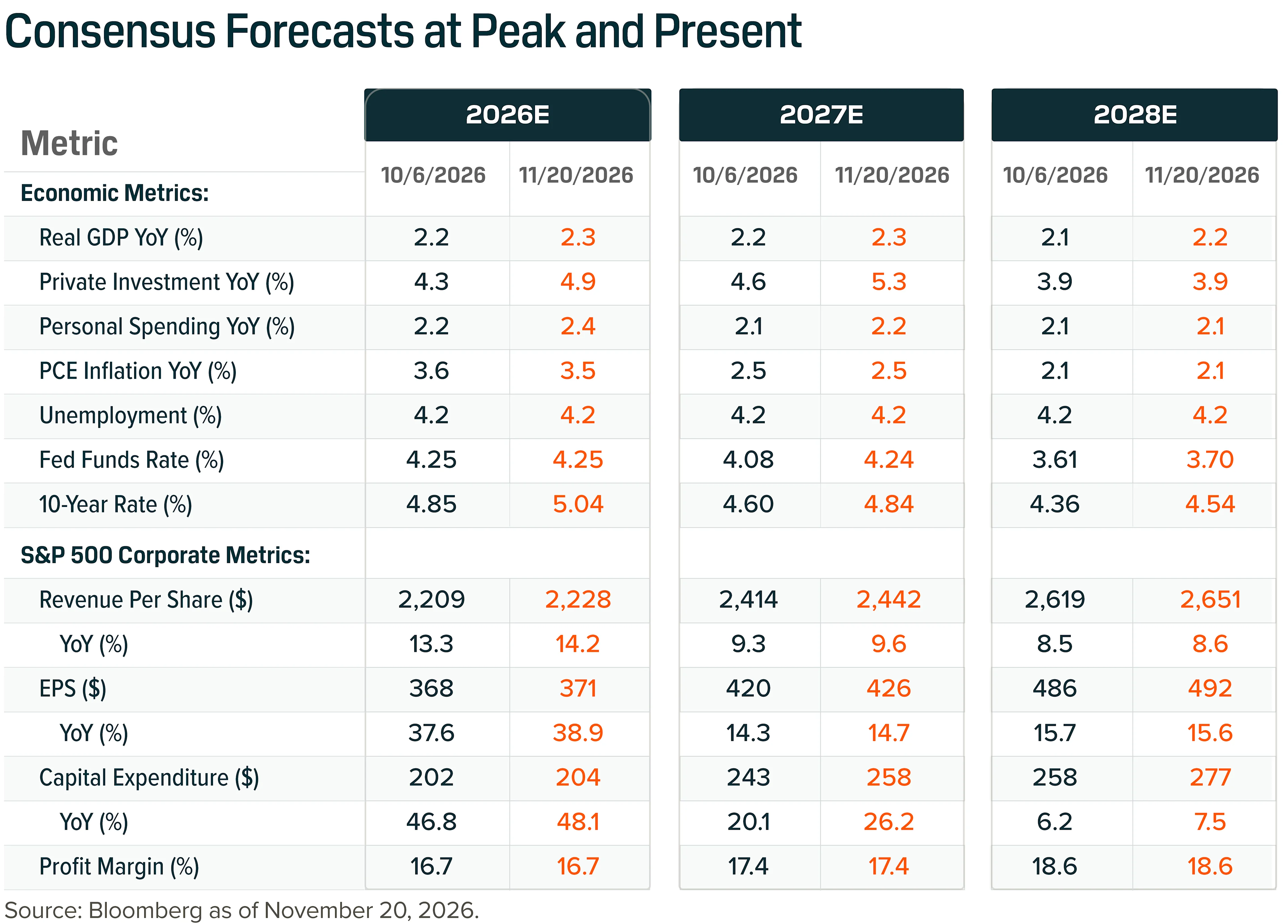
Economic and corporate forecasts have changed little since the October 6 market high, suggesting weaker sentiment and reduced risk appetite are driving the selloff.
Buying during a correction can feel like running into a burning building but can also offer opportunities to acquire quality assets at reasonable valuations.
The AI trade has dominated discussion over the past two weeks. Developments at Nvidia raised questions about the financing model underpinning the AI investment cycle. Yet the company reported stellar earnings and a substantial backlog that will take years to fulfill.2 Shares were already struggling to find their footing when Friday’s announcement of SEC scrutiny of accounting practices added pressure.3
Then came the Anthropic IPO. The successful offering demonstrated strong demand for AI assets, but the sale may have drained liquidity from other segments of the market as investors reallocated capital.4 In our view, these remain company-specific developments rather than evidence of a systemic risk.
Political and geopolitical developments may pose more consequential challenges. The midterm election’s blue wave raises the prospect of populist or progressive economic policies that could weigh on growth and AI investment. We think that concern is somewhat overstated. Democratic victories in traditionally Republican states do not necessarily signal a sweeping progressive mandate. Time will tell, but divided government is generally viewed as supportive of markets.5
Our greatest concern may be a monetary policy mistake after Fed Governor Waller hinted at a 50bp rate hike in December. The Fed’s margin for error may be narrower than policymakers believe. Inflation and financial conditions are unequal across the economy.6 Following July’s shift in inflation expectations, margins came under pressure even before September’s rate hike, with six S&P 1500 sectors reporting contractions in the third quarter.7 Additionally, the gap between nominal GDP growth and the 10-year Treasury yield is near a cycle low of 80 basis points.8 Historically, a negative gap has often signaled recession risk.9
Oil prices, a major driver of inflation, are down about 20% from their peak, which could ease some pressure.10 Another inflation spike is possible if the U.S. resumes military action against Iran, targets an oil tanker to enforce the blockade, or the Houthis cross from Yemen into Saudi Arabia. The Fed has been confronting supply pressures with tools designed to address demand. We continue to view inflation as more a structural feature of the economy than a policy choice. An overly aggressive response could trigger the next recession, much as monetary tightening contributed to the downturn of the early 1990s.11
Falling markets accompanied by weakening forecasts would be cause for concern. So far, that combination has not emerged. Since the S&P 500 peaked on October 6, economic and corporate forecasts for 2026 through 2028 have generally held steady or improved (see table below).12 Forecasts for real GDP growth, investment, and consumption have risen, while near-term PCE inflation expectations have edged lower.13
Interest rate forecasts have moved higher.14 The federal funds rate is now expected to end 2027 at 4.24%, up 16 basis points from the October 6 forecast.15 Expectations for the 10-year Treasury yield have risen 20 basis points in each of the next three years.16 Those changes are consistent with concerns about rates, but their magnitude remains modest.
Corporate forecasts tell a similar story. Revenue growth estimates have risen for each of the next three years, while earnings per share expectations have increased for 2026 and 2027.17 Profit margins are projected to expand from 16.7% in 2026 to 18.6% in 2028, unchanged from October 6.18 This remains one of the best signs of improving productivity.
Capital expenditure estimates have also risen, potentially reinforcing concerns about the sustainability of AI investment.19 Two caveats matter. First, spending forecasts increased by just 1% for 2026, 6% for 2027, and 1% for 2028.20 Second, capital expenditure forecasts have consistently overestimated actual spending by 6% since the start of 2025.21 The latest increases may not fully materialize, so concerns about cash burn and circular investing may be overhyped.
The selloff, then, has occurred without a corresponding deterioration in consensus expectations for the economy or corporate performance. Forecasts could still fall, but they have held up so far. Strategists may be growing more concerned about the market’s underlying health, yet consensus estimates do not reflect that concern.
Credit markets are also showing few signs of distress. Spreads barely budged during the selloff.22 The old saying that the bond market is smarter than the stock market may deserve scrutiny after 15 years of extraordinary monetary intervention, but this episode could offer an interesting test.
There is no way to call the bottom. That is only evident after the fact, but history offers some lessons for how the recovery might unfold. Since 1950, the S&P 500’s average annual drawdown has been 13.7%, with declines of at least 10% occurring in 41 years.23 Bear markets, declines of 20% or more, have been less common, occurring 13 times.24
For corrections of 10%-20%, the recovery from the trough to a new high has averaged 15 weeks.25 The full journey from the previous peak to a new high has averaged 34 weeks.26 Those averages suggest patience may still be warranted, but several areas could merit a closer look.
AI concerns have contributed to the selloff, and the sharp declines may create opportunities. AI likely remains a transformational technology, even if investment and monetization take longer to develop. Broad AI exposure, chips and hardware, and data centers have experienced valuation contractions that could rerate higher as the cycle matures.27
Real assets, including infrastructure and pipelines, have held up reasonably well.28 The pullback may also offer opportunities in industrial commodities such as copper and uranium, where structural supply shortages remain.
Finally, investors could consider exposures that diversify beyond AI such as defense technology, healthcare tied to an aging population, and hedged strategies that can reduce beta and generate income like equity covered-calls.29
Global X analysis with information derived from: Bloomberg L.P. (n.d.) [Data set]. Retrieved on November 20, 2026.
Navaellier, L. (2026, November 16). Nvidia’s Massive Backlog Puts Earnings Guidance Ahead of Leadership Concerns. Investing.com.
Michaels, D. et al. (2026, November 17). SEC Is Probing Nvidia Amid Departure of CEO Jensen Huang. The Wall Street Journal.
Green, N. (2026, November 19). Anthropic’s Record IPO Will Pull Cash Out of the Rest of the Market. Investing.com.
Global X analysis with information derived from: Bloomberg L.P. (n.d.) [Data set]. Retrieved on November 20, 2026.
Federal Reserve Board of Governors. (2026, October 28). Transcript of Chairman Warsh’s Press Conference.
Global X analysis with information derived from: Bloomberg L.P. (n.d.) [Data set]. Retrieved on November 20, 2026.
Ibid.
Ibid.
Ibid.
Ibid.
Ibid.
Ibid.
Ibid.
Ibid.
Ibid.
Ibid.
Ibid.
Ibid.
Ibid.
Ibid.
Ibid.
Ibid.
Ibid.
Ibid.
Ibid.
Ibid.
Ibid.
Ibid.
Despite several areas of concern, we believe the backdrop is supportive for a continued advance in equities, especially amid earnings season, which might offer key glimpses of 2027 forecasts.
Despite several areas of concern, we believe the backdrop is supportive for a continued advance in equities, especially amid earnings season, which might offer key glimpses of 2027 forecasts.
Markets’ uncertainty of tech’s winners and losers could make short-term pullbacks potential opportunities to access under-owned segments of the AI ecosystem.
Markets’ uncertainty of tech’s winners and losers could make short-term pullbacks potential opportunities to access under-owned segments of the AI ecosystem.
