In the first half of 2023, our investment team had six analysts make 25 trips to mainland China to meet with management teams, visit production centers, and interact with local policy makers. Overall, feedback centered on fits and starts across China’s broad economy, with specific opportunities in long-term secular trends such as energy transformation, manufacturing upgrades and automation, and enhancing self-reliance. The combination of a high savings rate, pent-up demand, and a loosening of regulatory measures has improved sentiment across most management teams we spoke with. From a demand perspective, it seems the market’s expectations for a post-reopening rebound were too lofty in the first half of the year. Forecasts have come down, but our on-the-ground research suggests that the reopening remains steady, and any signs of deeper fiscal or monetary stimulus could drive an unexpected re-rating. In this article, we examine the first half of 2023 and look at what the second half of the year may hold for various sectors in the large and diverse Chinese economy.
Key Takeaways
Although China’s recovery in the first half of 2023 undershot lofty expectations, our on-the-ground research suggests that the reopening is steady.
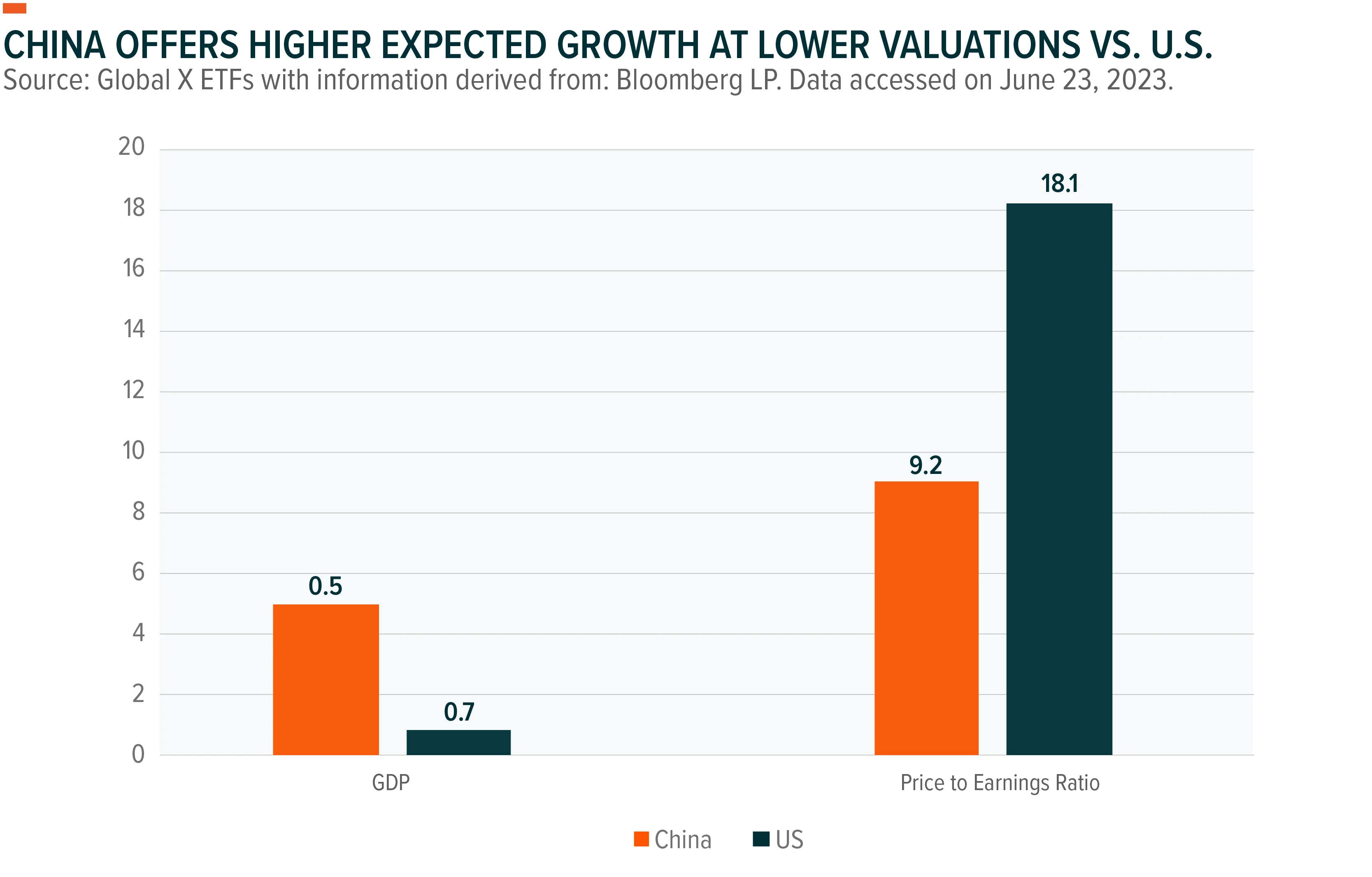
We remain optimistic about the long-term attractiveness of China’s shift toward higher quality, consumption-driven growth.
Any signs of deeper fiscal or monetary stimulus could drive an unexpected re-rating of Chinese equities.
Near-Term Outlook
China’s policy pendulum historically swings from tightening to loosening over a shorter time horizon versus typical U.S./European cycles. This reflects the Chinese Communist Party’s (CCP) desire to control the economic backdrop and deliver consistent economic growth. Given its far-reaching powers, the Chinese government has multiple levers beyond traditional monetary and fiscal policies, which means the market should not underestimate the CCP and its potential impact on China’s equity market.
China’s post-reopening recovery has been slower and bumpier than expected, but ongoing recovery will probably remain underway for the balance of 2023. Within consumption, the service sector has experienced the most significant recovery since reopening, as consumers flocked back to dining and tourism activities. Elevated activity levels are expected to flow into earnings over the next few quarters.
Though the weak job market data amongst younger age demographics have taken headlines, the overall unemployment rate has actually fallen since reopening, showing improvements are underway.1 As job creation continues to increase across the country, we could see more broad-based improvements in consumer confidence and consumption.
However, for consumer and business confidence to meaningfully rebound, the onus appears to be on policymakers to re-establish confidence by implementing measures such as incentives for investment or introducing stimulus initiatives. While lower borrowing rates and the recent tax exemption for electric vehicle purchases beyond 2023 are positive steps, other potential measures include relaxing home purchase restrictions, increasing infrastructure support, or offering targeted consumer incentives. Due to the growth slowdown in 2Q23 and concerns surrounding local government debt, we expect policymakers to maintain an accommodative stance in the upcoming quarters to reduce the negative output gap, with more significant moves potentially coming soon.
Parts of China’s economy may need a few more years to fully digest the excesses and rapid growth of the past decade. Still, we remain optimistic about the long-term attractiveness of China’s shift toward higher quality, consumption-driven growth. China’s household saving rate peaked in 2010 and has generally declined since then.2 Similarly, private consumption expenditure as a percentage of GDP bottomed in 2010 and has since gradually increased.3 While the pandemic temporarily disrupted this trend in recent years, the structural trend has not changed. As reopening continues, we expect to see private consumption driving economic growth again this year.
Big Picture: Evolving GDP Growth Drivers
GDP = Private Consumption + Government Spending + Private Investment + Net Exports
Government spending cannot last forever; exports (as a % of GDP) should diminish, as countries do not want to rely on outside forces; and private investment is dependent on business cycles. That leaves private consumption as the primary piece emerging market (EM) governments have left to control in order to drive GDP expansion. With roughly 68% of GDP growth coming from private consumption, the U.S. has set a model for a sustainable economy.4 China (where private consumption accounts for roughly 38% of GDP) has watched, learned, and begun to emulate this model.5
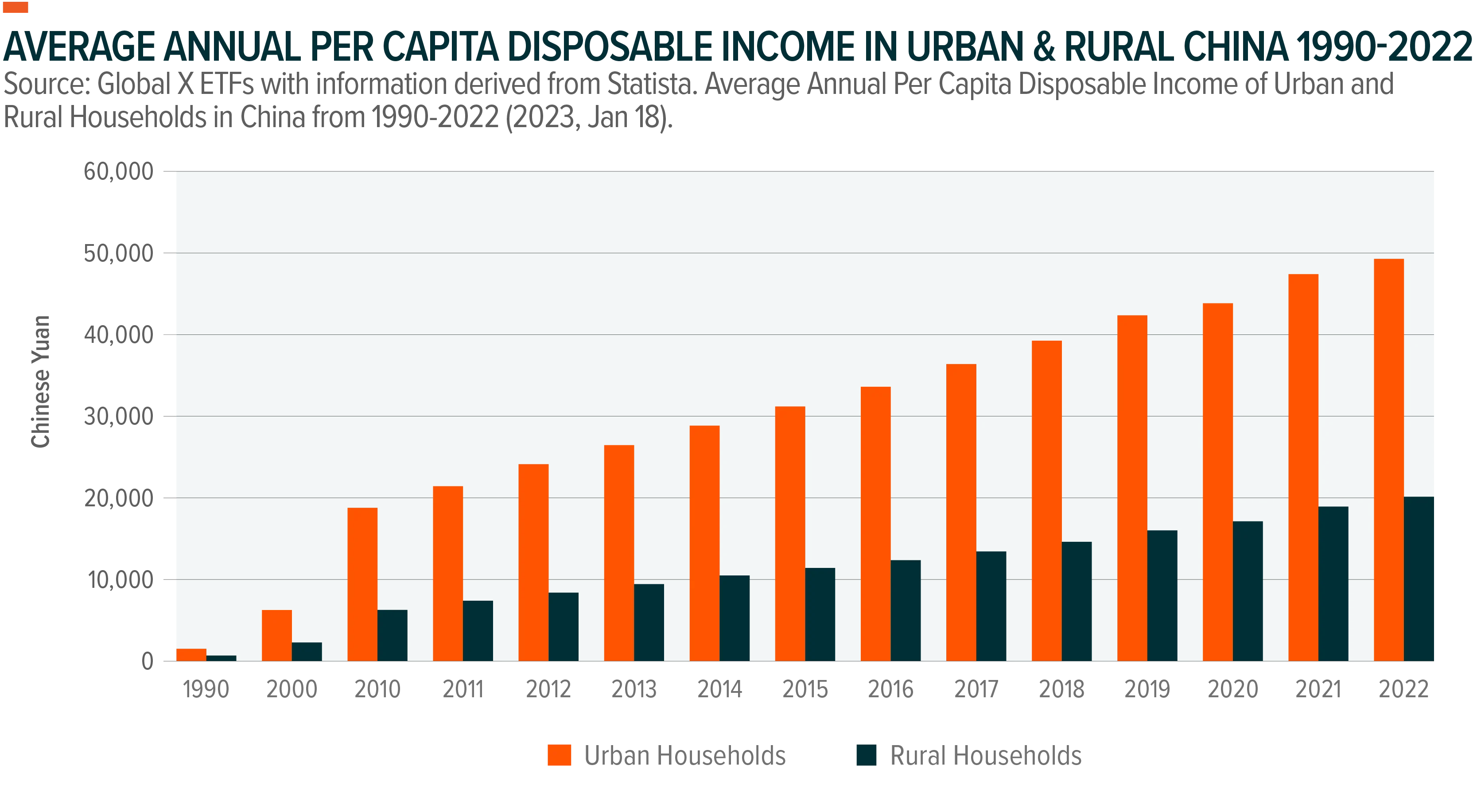
China’s common prosperity initiative (“Common Prosperity”) provides a clear example of this shift to private consumption as the key driver of sustainable growth. China has experienced tremendous economic growth, but it has come with a rise in social inequality and economic disparity. Common Prosperity is a development plan aimed at promoting domestic-oriented long-term growth.
The Chinese government understands that it must move its economy up the value chain, create higher-paying jobs, grow its middle class, and improve growth through consumption. This starts with moving capital allocations away from construction and low-level manufacturing to higher value-add production.
Virtuous Growth Cycle Could Be Emerging
With old economy sectors providing less forward-looking ammunition to drive GDP growth, China’s government has shifted its focus to technology and sustainability. Investments in these areas ought to help drive growth on their own, but they could also drive higher wages, leading to increased domestic consumption, which could create a virtuous cycle. This cycle would likely make up for the slowdown in exports, real estate investment, government spending, and low-end manufacturing. With falling birth rates, China sees fewer annual new workers enter the labor force. The government understands that a sustainable future requires a shift from quantity to quality. That means increasing value and productivity similar to what other countries did through the 20th century. Over the next five years, 50 million graduates are set to enter the workforce in China, more than the U.S., Germany, Japan, Korea, and Southeast Asian countries combined.6 The playbook is there, and China’s increasingly educated workforce appears well prepared for this transition.
That said, for the second half of this year, various sectors also have their own idiosyncratic drivers, which we discuss below.
Consumer Discretionary
Consumer Staples
Energy
Financials
Information Technology
Healthcare
Industrials
Materials
Real Estate
Utilities
Communication Services
Conclusion
Expectations for China’s post-COVID-19 reopening did not live up to investors’ lofty expectations in the first half of 2023. However, we have seen pockets of strength and believe that the myriad structural growth drivers we see in the country remain in place. The nation’s recovery following strict COVID-19-related lockdowns is unlikely to proceed in a linear fashion, but our time on the ground suggests that the reopening is ongoing, presenting potential opportunities for investors.