
This piece is one in a series that delves further into the leading themes emerging from this year’s iteration of our flagship research project, Charting Disruption.
The resurgence of U.S. manufacturing is gathering momentum, potentially setting the stage for a multiyear investment cycle across infrastructure and enabling technologies. Driven by supply chain realignment and industrial policy, companies announced $1.76 trillion in U.S. manufacturing investments between January 2025 and September 2026.1 Early signs are already emerging in the cyclical data: capital equipment orders have risen 15% since January 2025, and industrial production has reached its highest level since April 2019.2,3 Manufacturing sentiment has also improved, with the ISM Manufacturing PMI reaching 55.6 in July 2026, its highest level since June 2022.4 As companies advance their manufacturing investments, new opportunities could emerge across the infrastructure value chain.
Beyond new construction, the reindustrialization effort may create a second opportunity in automation. Robotics companies could benefit as accelerating adoption, driven by its labor and productivity benefits, becomes a key factor in many companies’ ability to bring capacity back to the United States. Heading into 2027, investment in U.S. manufacturing facilities and robotics could further boost industrial activity and deepen this new investment cycle.
Key Takeaways
The U.S. manufacturing landscape has reached a potential inflection point, with industrial output forecast to increase through 2027 as capital investments into manufacturing begin to translate to higher production.5
The buildout of U.S. manufacturing capacity remains in the early stages. Companies announced $1.76 trillion in planned spending to boost U.S. production capacity, and half of announced construction projects are now under construction.6
As companies advance their manufacturing investments and development plans, suppliers across the infrastructure development and automation value chains could benefit.
Industrial Resurgence Is Gaining Pace: Boosted by $1.76T in Commitments and Increasing Output7
The U.S. manufacturing landscape appears to have reached an inflection point as companies reassess where to locate production. Pandemic-era disruptions and geopolitical tensions exposed the risks of relying on concentrated supply chains, while rising demand for semiconductors and other strategic technologies is strengthening the business case for more domestic capacity. Advances in automation can also improve the economics of U.S. production, with policy support adding momentum. These forces are already showing up in corporate investment plans: companies announced $1.76 trillion in U.S. manufacturing commitments from January 2025 through September 2026.8 Early indicators suggest the shift is taking hold: industrial activity has reached its highest levels since April 2019, capital orders have risen 15% since January 2025, and the ISM Manufacturing PMI – a survey-based indicator of manufacturing sector health – reached 55.6 in July 2026, its highest level since June 2022 and a ninth consecutive months of expansion.9,10,11 Looking ahead, U.S. industrial output could remain on an upward trajectory, with a forecasted 5.2% increase between January 2025 and December 2027.12
Even so, the U.S. industrial resurgence likely remains in its early stages, and the same forces behind the rebound, plus rising demand for innovative technologies, could encourage continued investment in the country’s industrial base. The opportunity appears to be attracting a global range of companies, with both domestic and foreign firms increasingly investing in new U.S. production capacity.13
Manufacturing Investment Is Beginning to Broaden Beyond the Leading Sectors
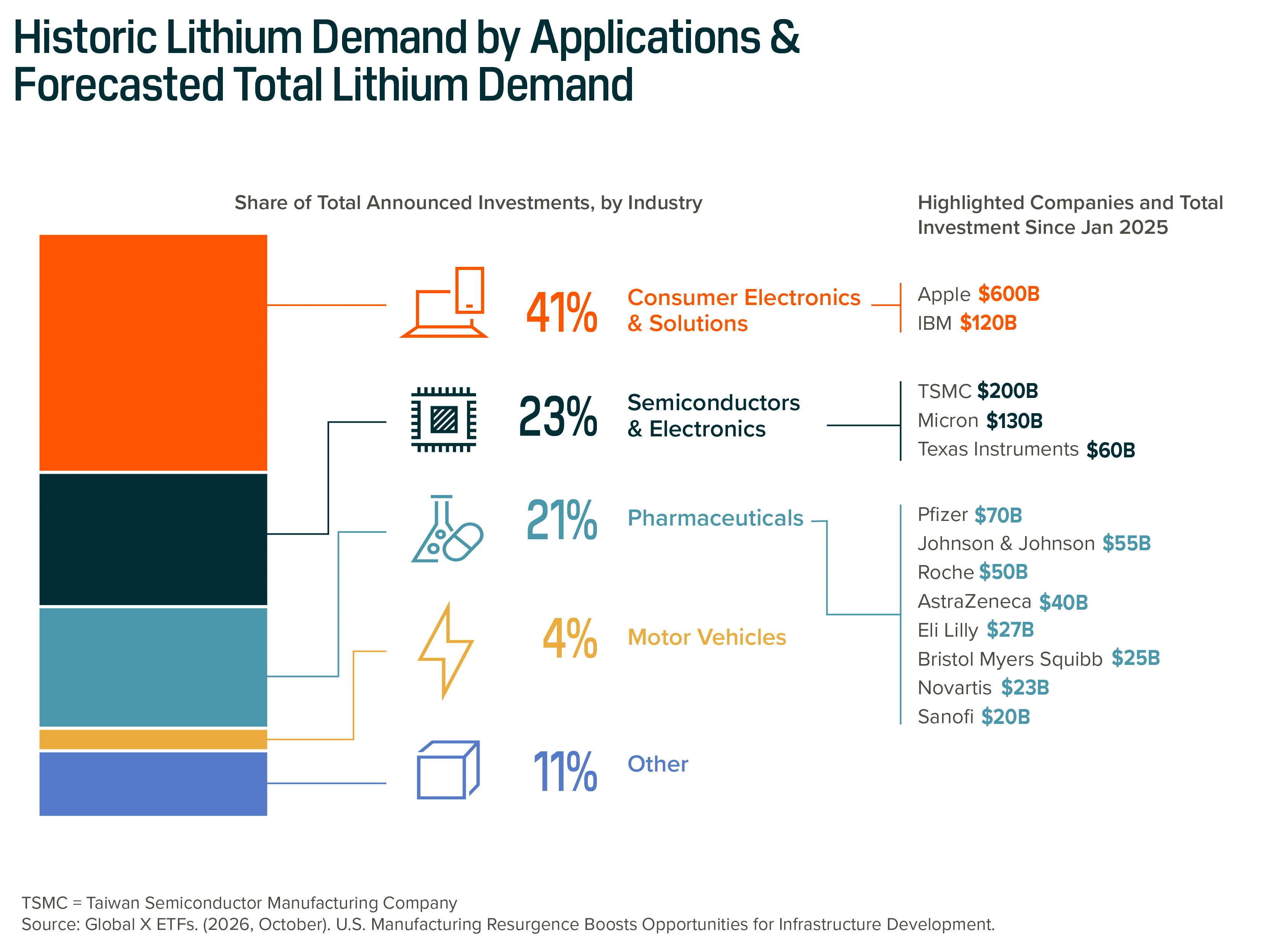
Of the $1.76 trillion in investments announced between January 2025 and September 2026, consumer electronics and solutions accounted for 41%, led by Apple and IBM, followed by semiconductors and electronics (23%) and pharmaceuticals (21%).14 Meanwhile, industries beyond the leading categories now make up 11% of the announced total, a broader mix than in last year’s analysis.15 This suggests a potential broadening of the U.S. manufacturing resurgence, pointing to further opportunities beyond the highest-profile, strategically important industries.
These significant spending plans also support additional, long-term growth in U.S. industrial production. Capital spending on the development of production sites remains in the early stages for most companies. In total, 181 projects have reached development stages, accounting for at least $433 billion in investment in the project pipeline: 62 are in pre-construction, 94 are under construction, and 25 have been completed.16 This leaves ample runway for additional funds to flow through the infrastructure value chain as projects progress and continue to deploy capital.17
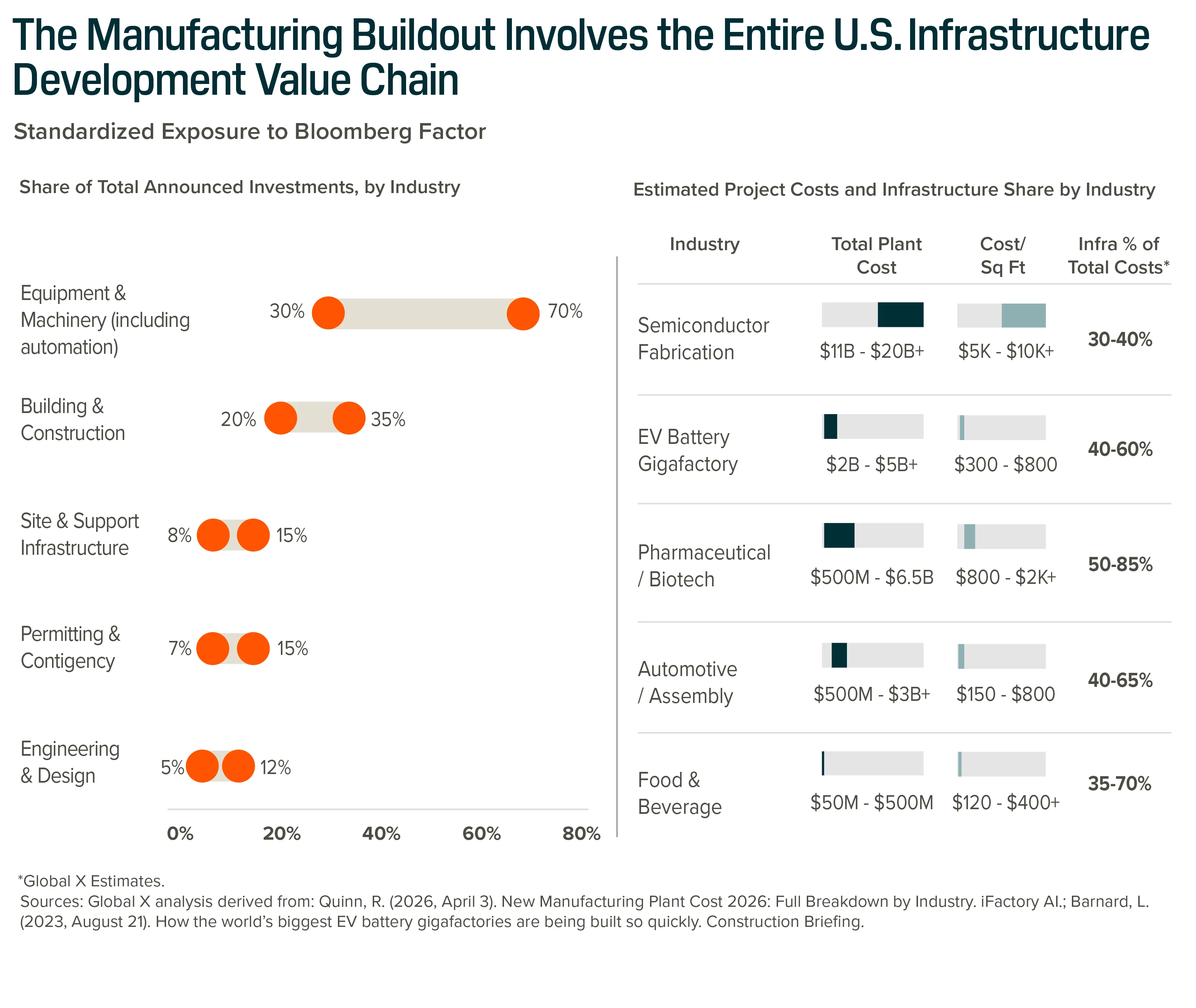
Companies supplying materials, construction equipment, and engineering and construction services could benefit as these planned investments and projects move forward over the coming years. Infrastructure development can account for up to 85% of the total cost of a new production site, with spending spanning the entire infrastructure value chain.18 For industries where infrastructure may account for a smaller share of cost than machinery, such as semiconductor fabs, the high overall investment can still translate to tens of billions in infrastructure spending.19 TSMC, for example, is planning to invest a total of $265 billion to build up to 10 semiconductor fabs alongside supporting transport, packaging, and power infrastructure at its first U.S. production site in Phoenix, Arizona.20
Automation Becomes Essential to American Manufacturing Competitiveness
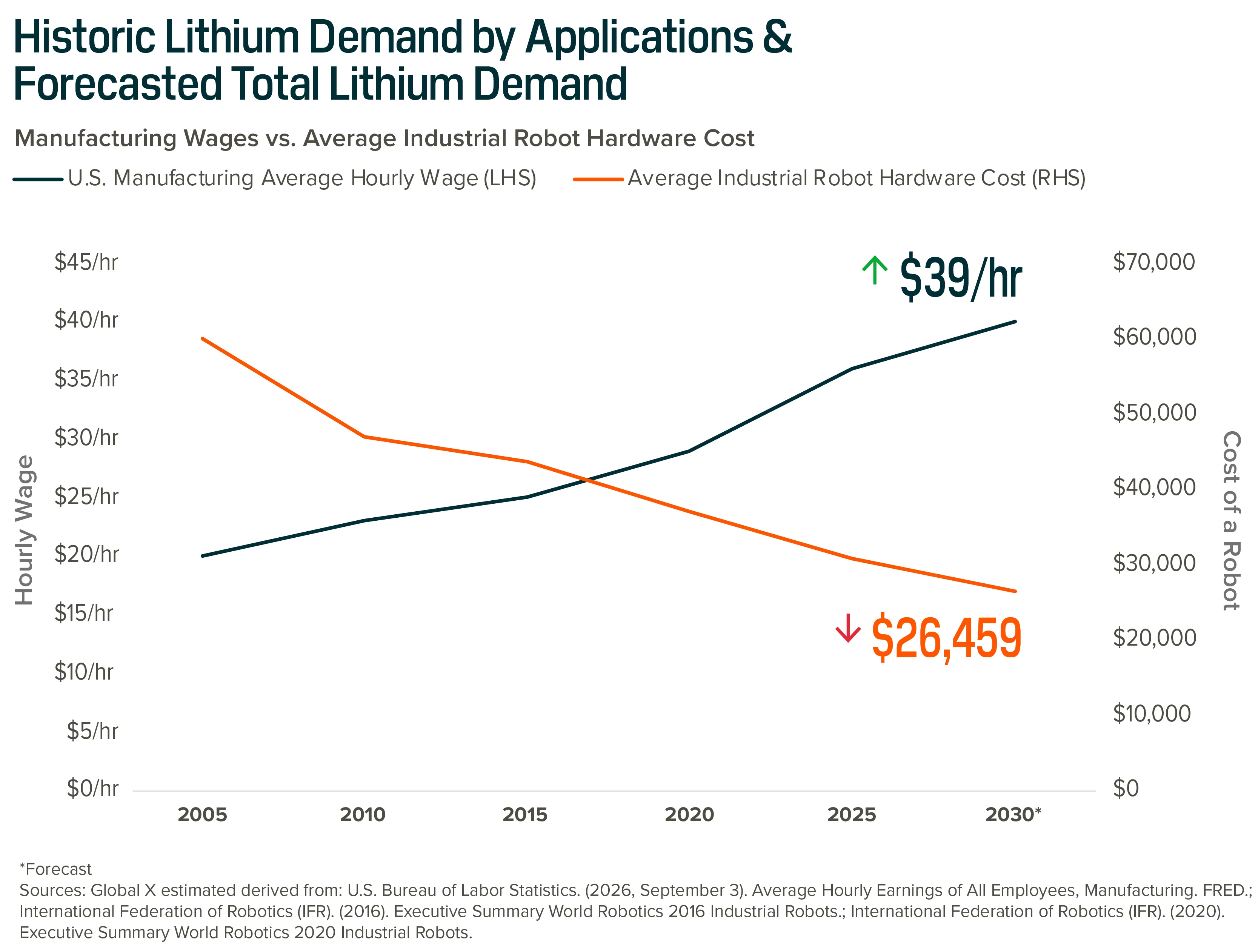
The U.S. manufacturing buildout is also likely to create new opportunities for supply chain automation, given automation’s potential to boost productivity and address labor constraints. It is currently projected that the sector will need 3.8 million additional workers by 2033 and that roughly half of those positions could go unfilled.21 Additionally, hourly compensation has increased 34% since 2017.22 These growing labor challenges, combined with expectations for falling hardware costs and rising demand for precision manufacturing are strengthening the case for U.S. manufacturers to adopt automation technologies and solutions.
Annual industrial robot installations in the United States grew 11% year over year in 2025 to 38,000 units, and installations could rise another 10% to 41,800 units in 2026.23 While the automotive industry remains the largest adopter, the non-automotive share grew to 64% in 2025, as robots become more capable and cost-effective across a wider range of manufacturing tasks.24 In our view, adoption can continue to broaden and expand the potential demand base for robotics suppliers as these new, diversified investments progress. Additionally, only 8.3% of U.S. manufacturing companies have incorporated robots into operations, leaving significant room for further adoption.25
Conclusion: The Next Phase of the Industrial Buildout Is Just Beginning
Reindustrialization creates a linked opportunity: expanding domestic production requires new infrastructure, while making that production increasingly depend on automation. This could support suppliers of materials, equipment, and engineering services for new facilities, as well as robotics providers helping manufacturers address labor constraints and improve productivity. Continued investment could create a multiyear demand cycle spanning both the physical buildout of U.S. manufacturing and the technologies that help factories operate more efficiently.
For additional insights, please view our full report, Charting Disruption: Outlook for 2027 and Beyond.