Thematic ETFs give investors a purposeful way to build portfolios around structural change. By targeting companies with meaningful economic exposure to a specific theme, they can provide access to long-term growth opportunities while diversifying exposure beyond increasingly concentrated broad market benchmarks.
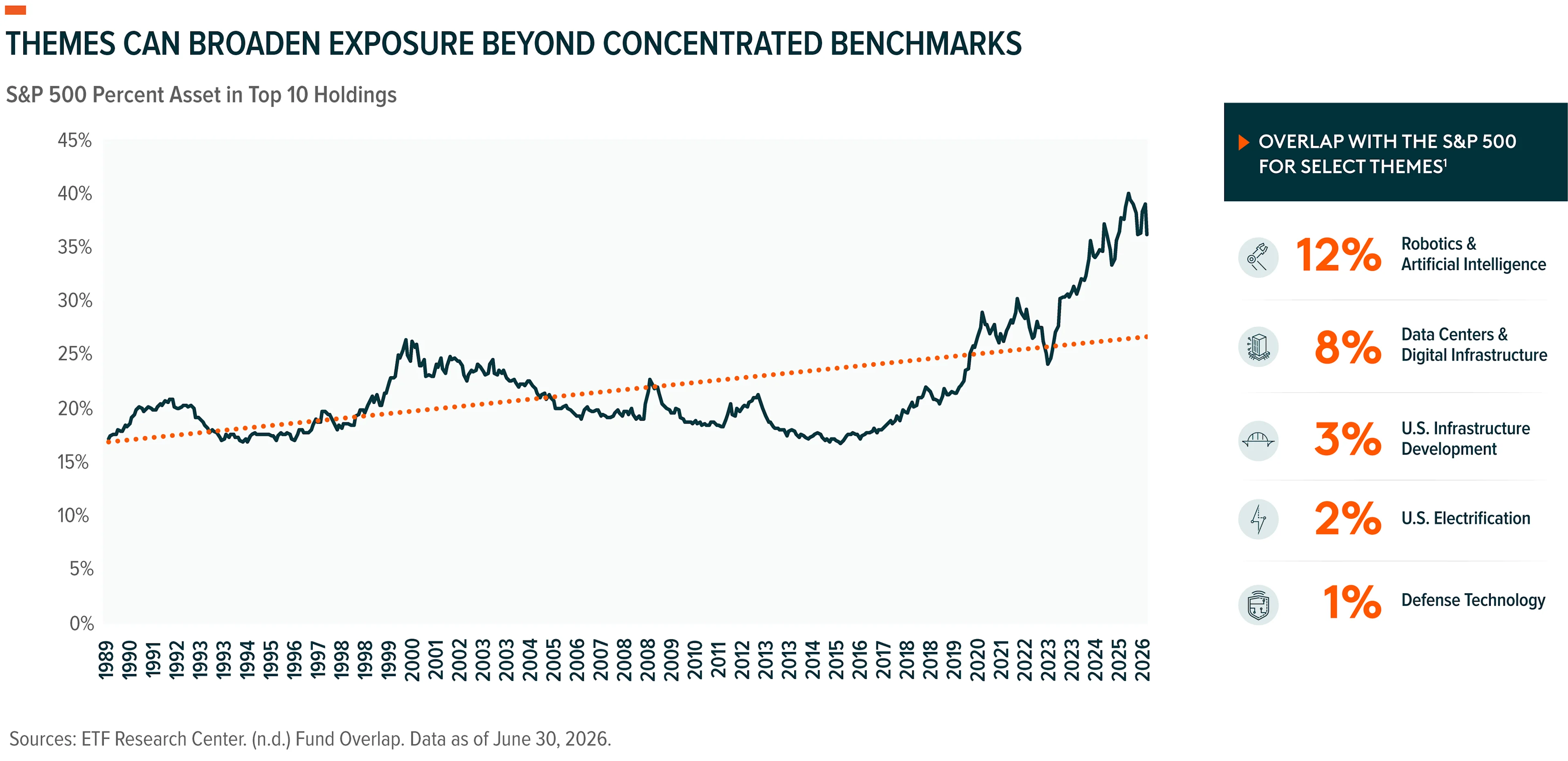
Both roles are becoming more relevant. The ten largest companies account for roughly 40% of the S&P 500, nearly double the range observed between 1990 and 2015.1 Meanwhile, structural opportunities are increasingly spanning across industries, regions, and stages of development. Thematic ETFs can help investors understand and deliberately select the exposures they are adding, rather than relying on incidental or diluted participation through broader allocations.
Delivering that exposure requires recognizing that the most effective representation of a theme will not always look the same. Expansive themes with broad value chains may warrant portfolios spanning dozens of companies, while emerging technologies, specialized industries, or established bottlenecks may be represented by a much smaller investable universe. The appropriate level of concentration should therefore reflect the scope, maturity, and underlying economics of the theme.
For more than 16 years, Global X has applied this principle to thematic research by defining themes carefully and maintaining a high bar for purity, including revenue and relevance screens designed to identify the companies most directly exposed to them. As the thematic opportunity set expands, that framework is evolving to reflect differences in the scope, maturity, and underlying structure of individual themes while maintaining a consistent research discipline.
Key Takeaways
Thematic ETFs allow investors to add deliberate exposure to structural change while diversifying beyond the increasingly concentrated return drivers embedded in broad market benchmarks.
Effective thematic exposure requires both purity and an appropriate portfolio aperture. Broad portfolios can capture expansive value chains, while focused strategies can represent themes with smaller or more specialized investable universes.
Global X applies a consistent, research-driven framework across both approaches – defining each theme, identifying companies with meaningful exposure, and allowing the industry structure of the opportunity to determine the breadth of the portfolio
Themes Enable Access to Structural Change
The modern economy is more dynamic than ever. The current cycle, shaped by forces such as automation, resource nationalism, energy security, and deglobalization, is driving meaningful changes in how capital is deployed, value is created, and market returns are produced.
Structural change of this scale rarely fits neatly within sector boundaries. Automation spans software, semiconductors, and industrial equipment; reshoring connects industrials, materials, and utilities; energy modernization brings together utilities, industrials, and materials; and healthcare innovation crosses pharmaceuticals, biotechnology, medical devices, and software.
Even within a well-positioned sector, underlying industries may be responding to structural forces that pull in opposite directions. For example, growth associated with AI, robotics, or cybersecurity can be diluted by industries within a sector facing slowing demand growth, disruption or competitive pressure.
Traditional sector frameworks remain useful for organizing the market, but they provide limited control over these underlying dynamics, and most importantly where the sector is headed. Thematic strategies offer a complementary lens, allowing investors to identify opportunities across sector lines and position more deliberately around the specific structural changes they want to capture.
For more than 16 years, Global X has helped investors look beyond traditional sector boundaries and gain targeted exposure to the structural changes reshaping the economy. Thematic ETFs have become one of the most practical vehicles for doing so. In the U.S. alone, the category has grown to more than 340 ETF listings with approximately $251 billion in assets under management.2
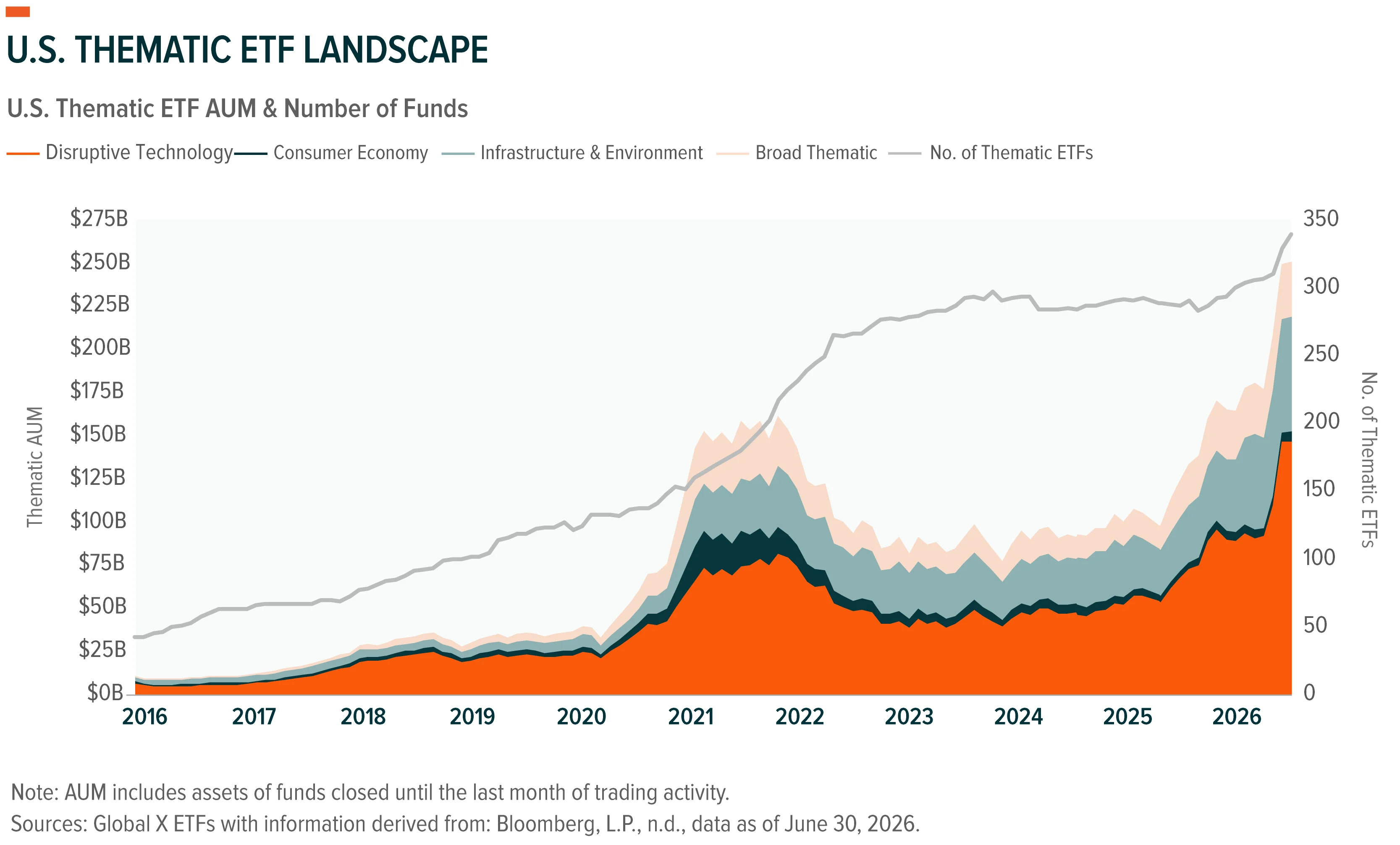
The category has also matured beyond its early association with emerging technology and higher-growth exposure. Today, some of the largest thematic opportunities are tied to multi-year capital spending – infrastructure investment, defense procurement, electrification, and energy security – capable of embedding durability and low-beta growth within portfolios.
One feature that connects well-constructed thematic ETFs across this broader opportunity set is a focus on purity. Purity can be measured differently from one theme to another, often through a 50% revenue threshold or a qualitative assessment of each company’s relevance. But its purpose is consistent: the exposure should match the idea the investor is trying to access. This allows a thematic strategy to complement an existing allocation with distinct exposure to the companies most directly enabling or benefiting from the structural change
Themes Diversify Sources of Return
For most of the past fifty years, broad-market index investing inherently also delivered substantial diversification for investors. That assumption is less reliable today. The ten largest companies in the S&P 500 formed over 40% of the index at the end of 2025, which is more than double their weight a decade ago and well above the long-run average of 24%.3 Those ten names also increasingly move on a single market narrative, concentrating a larger portion of index performance around a narrower set of structural and return drivers.
As a result, investors may already hold substantial exposure to the dominant theme of a given cycle, but largely as an incidental consequence of market-cap weighting. The narrative may change over time, while the size and composition of that exposure continue to reflect benchmark performance rather than a deliberate portfolio decision.
This concentration is also reshaping traditional core-satellite logic. Thematic ETFs have generally served as satellites, adding targeted sources of growth around a diversified core. With the core now more dependent on a small number of shared return drivers, well-constructed thematic baskets can also broaden the portfolio’s underlying sources of return. Each basket provides diversified exposure to a distinct structural opportunity, introducing catalysts that may behave differently if prevailing benchmark leadership weakens. The limited overlap between select themes and the S&P 500 reinforces their potential to add meaningful breadth alongside a broad-market allocation.
Themes Also Deliver Precision That Maps Underlying Industry Structure
The third and increasingly critical role of thematic ETFs is to provide precise exposure to the industries, technologies, and value pools driving structural change. And that does not always mean greater concentration; the objective is to calibrate portfolio breadth to the underlying opportunity.
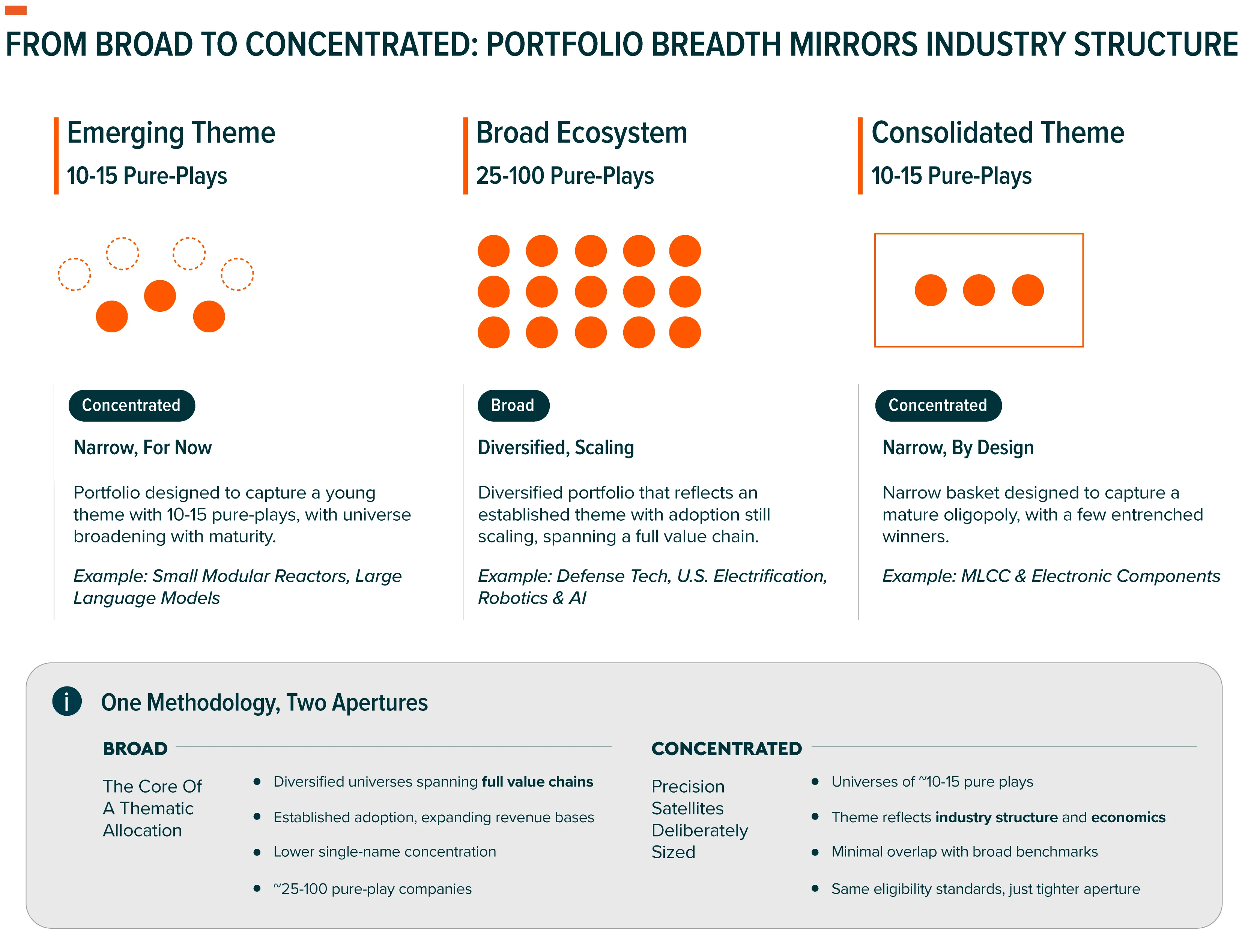
Historically, breadth has been a defining feature of thematic investing, and for many themes it remains the most faithful way to capture structural change. When a structural change spans a Broad Ecosystem, a diversified portfolio can capture the range of industries and companies participating in its growth. Global defense modernization, for example, encompasses military hardware, AI, cybersecurity, and drones; AI itself spans semiconductors, cloud computing, networking, and power. In these cases, breadth reflects the true scope of the theme, including the range of pure-play companies positioned across its value chain.
But increasingly the flexibility to tune aperture between breadth and concentration is becoming an equally important factor in delivering thematic precision. This is particularly relevant because the current investment cycle is also creating more opportunities where the relevant economics are concentrated among a much smaller number of companies.
That concentration can arise for two very different reasons:
Across both approaches, the construction philosophy remains consistent: define the segments driving the theme, screen for purity, accessibility, and size, and review the universe on a disciplined schedule. What changes is the aperture. The number of holdings is an output of the opportunity rather than an input into portfolio construction.
Within a broader portfolio, concentrated thematic ETFs can complement, rather than replace, diversified thematic allocations and core exposure. They can introduce greater volatility and single-name risk, making deliberate sizing important. Used appropriately, however, they can add precision where the economics of structural change are concentrated.
Conclusion: Themes for the Decade Ahead
Thematic ETFs have become a more versatile portfolio tool as structural change has grown more complex and traditional benchmarks more concentrated. Global X’s approach reflects that evolution, spanning broad strategies where opportunities extend across value chains and focused strategies where the underlying economics are more concentrated. After more than 16 years of thematic investing, the objective remains consistent: provide exposure that reflects how structural change is unfolding in the economy.