

Product ResearchHydrogenRenewable Energy
Why Hydrogen? Why HYDR?
M
Madeline Ruid
Sep 18, 20262 min read
SEI Investments Distribution Co. (1 Freedom Valley Drive, Oaks, PA, 19456) is the distributor for the Global X Funds.
Check the background of SIDCO and Global X's Registered Representatives on FINRA's BrokerCheck.
Get the latest news and updates from our team.

Ido Caspi
Madeline Ruid
Developers of large language models (LLMs) are emerging as the primary suppliers of intelligence to the AI economy. Data centers provide the infrastructure and semiconductors provide the computing power, but it is the models built by these specialized developers that turn that compute into reasoning, content, software, and economically valuable work.
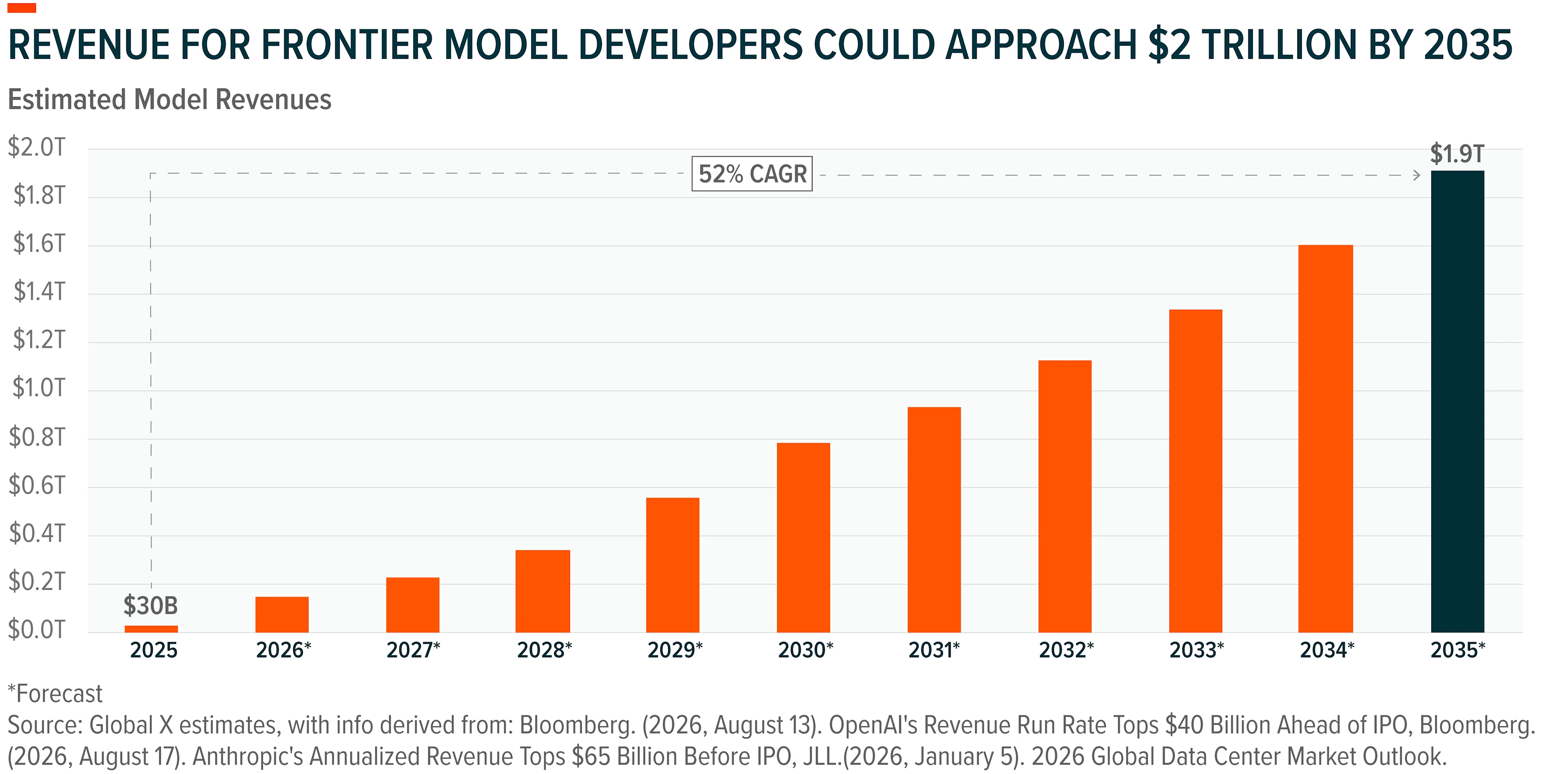
The commercial opportunity is beginning to scale quickly. We estimate that leading model developers are on track to generate roughly $150 billion in annualized recurring revenue (ARR) in 2026, more than five times the level of just one year ago.1 By 2035, we believe LLM developers could generate nearly $2 trillion in annual revenue, implying roughly 52% annualized growth.2 Monetization today is concentrated in subscriptions and model-as-a-service, but the opportunity is broadening rapidly into enterprise software, advertising, and agentic applications capable of performing increasingly complex tasks.
Even as monetization broadens, however, a disproportionate share of the economic value could continue to accrue to a relatively small group of frontier developers. Competing at the leading edge requires enormous computing infrastructure, scarce technical talent, proprietary data, and global distribution. Those advantages can reinforce one another: better models attract more users, greater adoption generates more revenue and data, and those resources fund the next generation of models, infrastructure, and products.
To help investors capture this opportunity, we are introducing the Global X LLM ETF (LLMA), which provides targeted exposure to up to approximately fifteen companies developing and commercializing frontier large language models across developed markets and China.
We believe frontier model developers could emerge the primary suppliers of intelligence to the economy of the future, putting them in a strong and increasingly lucrative position to monetize AI at a unique scale.
Competing at the frontier of AI requires extraordinary amounts of infrastructure, and these advantages can compound, creating a reinforcing cycle that may allow a relatively small group of global developers to capture a meaningful share of AI-driven value creation over time.
The Global X LLM ETF (LLMA) targets companies owning the intelligence layer, concentrating exposure toward global developers demonstrating model leadership and meaningful economic commitment to frontier AI.
Large language models have become the workhorses of the current AI cycle. Trained across vast quantities of text, code, images, audio, and video, these models are transforming AI from a tool that retrieves and manipulates information into a platform capable of reasoning, creating, and increasingly performing economically valuable work.
The companies developing and operating these models, often referred to as frontier AI labs, sit at the center of this shift. Much as search engines and social networks became defining platforms of the internet era, frontier model developers could emerge as defining platforms of the intelligence economy, supplying the raw underlying capabilities underpinning the automation age.
That opportunity is supported by unprecedented adoption. ChatGPT reached 100 million users less than two months after its November 2022 launch, one of the fastest expansions in consumer technology history.3 By 2025, an estimated 62% of U.S. adults and more than one billion people worldwide used AI each week, showing how quickly the technology has moved from experimentation into everyday use.4 U.S. employees spend nearly 87 minutes a day using AI tools, signaling strong engagement and stickiness.5
Yet the opportunity for developers extends well beyond user adoption. As agents take on increasingly complex tasks across embedded workflows, value creation decouples from individual users and can scale far faster than the user base itself.
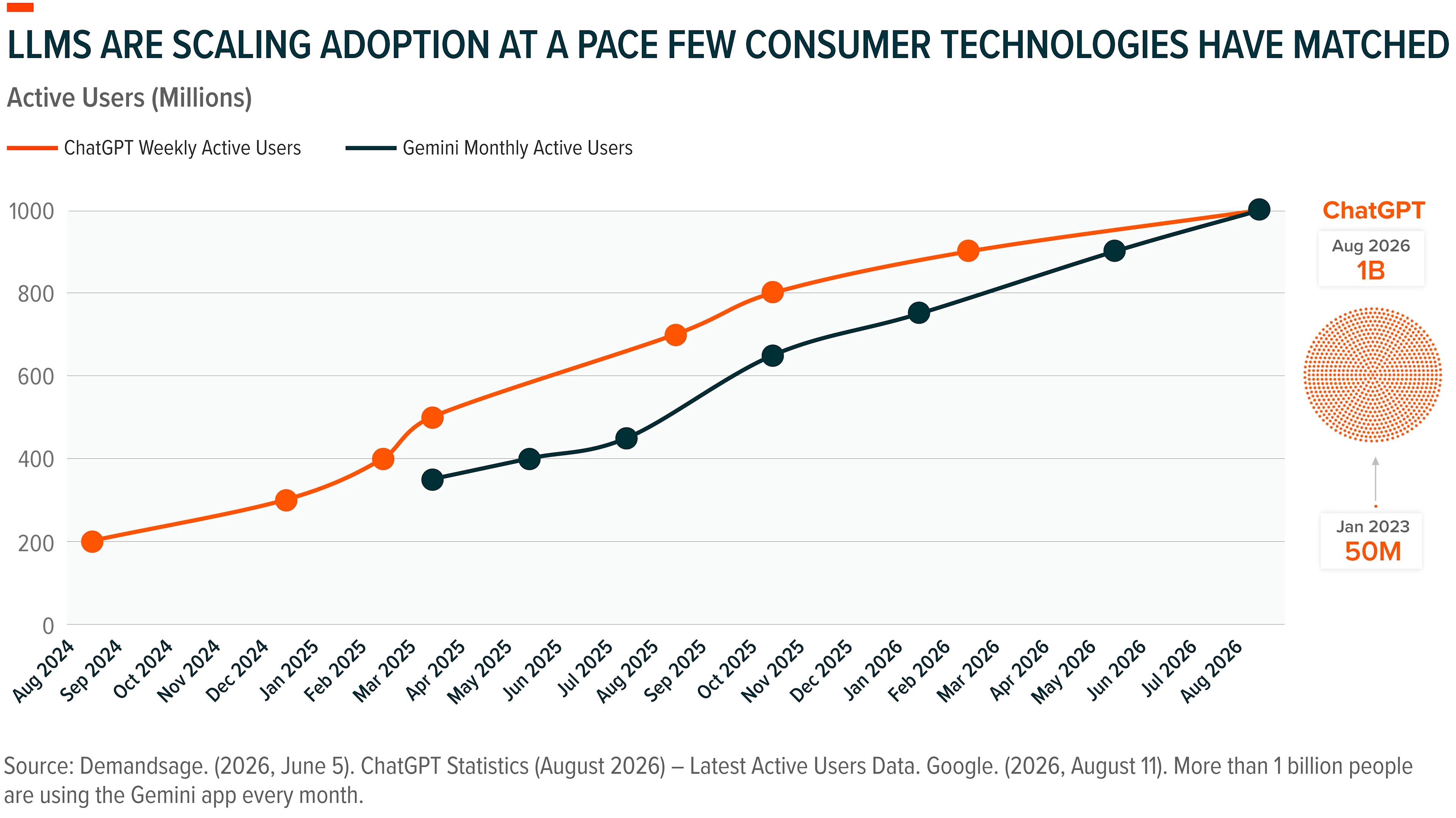
Converting that demand into durable commercial leadership requires resources that few companies can assemble. Frontier development depends on years of accumulated research, substantial capital, advanced computing infrastructure, proprietary data, specialized talent, and broad distribution. For example, the cost of individual frontier model training runs could surpass $1 billion by 2027, while the infrastructure supporting these models increasingly requires multi-gigawatt campuses worth hundreds of billions of dollars.6 These barriers could allow a relatively small group of developers to capture a disproportionate share of the emerging intelligence economy.
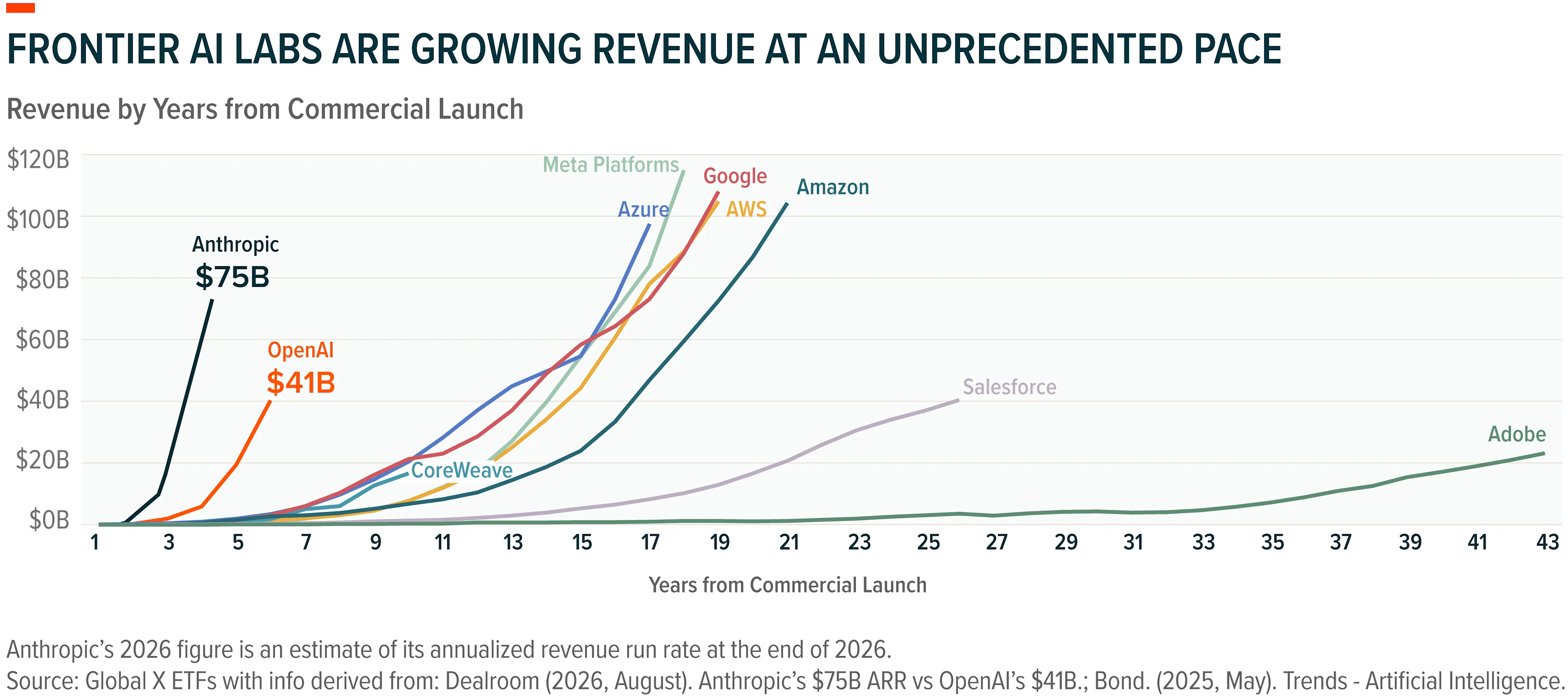
Frontier model developers are growing revenue at a pace rarely seen in technology. Subscriptions and usage-based APIs are already generating large, fast-growing revenue pools, offering clear evidence that demand for intelligence can be monetized at scale.
Anthropic’s annualized recurring revenues reached nearly $75 billion in July 2026, more than doubling in three months and increasing more than eightfold from $9 billion at the end of 2025.7 The company projects revenue of roughly $200 billion by 2028.8 OpenAI’s ARR also surpassed $40 billion, as of July 2026, doubling from the end of 2025.9 Together, the two companies have generated more than $115 billion in annualized revenue within only three and a half years of LLMs being made widely available.10 For perspective, it took Google approximately 19 years from its founding to reach a comparable level of annual revenue.11
Monetization is not limited to standalone private frontier labs. Our analysis suggests that Alphabet’s Gemini-branded products could already be generating approximately $25 billion in annualized revenue.12 Meta, another developer of frontier models, is using AI to improve engagement and advertising performance across its existing platforms while distributing open-weight models to expand its developer ecosystem. The company’s AI-powered Advantage+ advertising products surpassed a $75 billion annual revenue run rate in Q2 2026.13 The launch of its personal AI agent, Muse, introduces additional monetization opportunities through subscriptions and agentic commerce, demonstrating how model capabilities can create new products alongside strengthening established businesses.
Even these revenue streams are likely to represent only the first phase of AI monetization. Just as the internet and smartphone eras created business models that were difficult to anticipate at launch, increasingly capable models and agents could produce entirely new ways to price, distribute, and monetize intelligence.
While today's AI revenue opportunity is largely anchored to subscriptions and usage-based APIs, agents could substantially expand that model by allowing developers to monetize completed work rather than simply access to software. As agents execute larger portions of a workflow, revenue can scale with usage, complexity, and the value of the outcome delivered.
Coding provides an early example. Anthropic disclosed that Claude Code exceeded $2.5 billion in annualized revenue by February 2026, less than a year after its May 2025 launch.14 A coding agent can inspect a project, implement changes, run tests, and revise its output through repeated model calls, allowing revenue to grow with the work performed rather than the number of users.
Customer service offers a similar transition, as pricing can shift from the number of support seats deployed toward the volume of customer interactions or issues resolved. AI-based customer service is expected to be roughly a $16 billion market in 2026, and it is expected to grow at a 23.2% compounded annual growth rate (CAGR) to nearly $84 billion in 2033.15
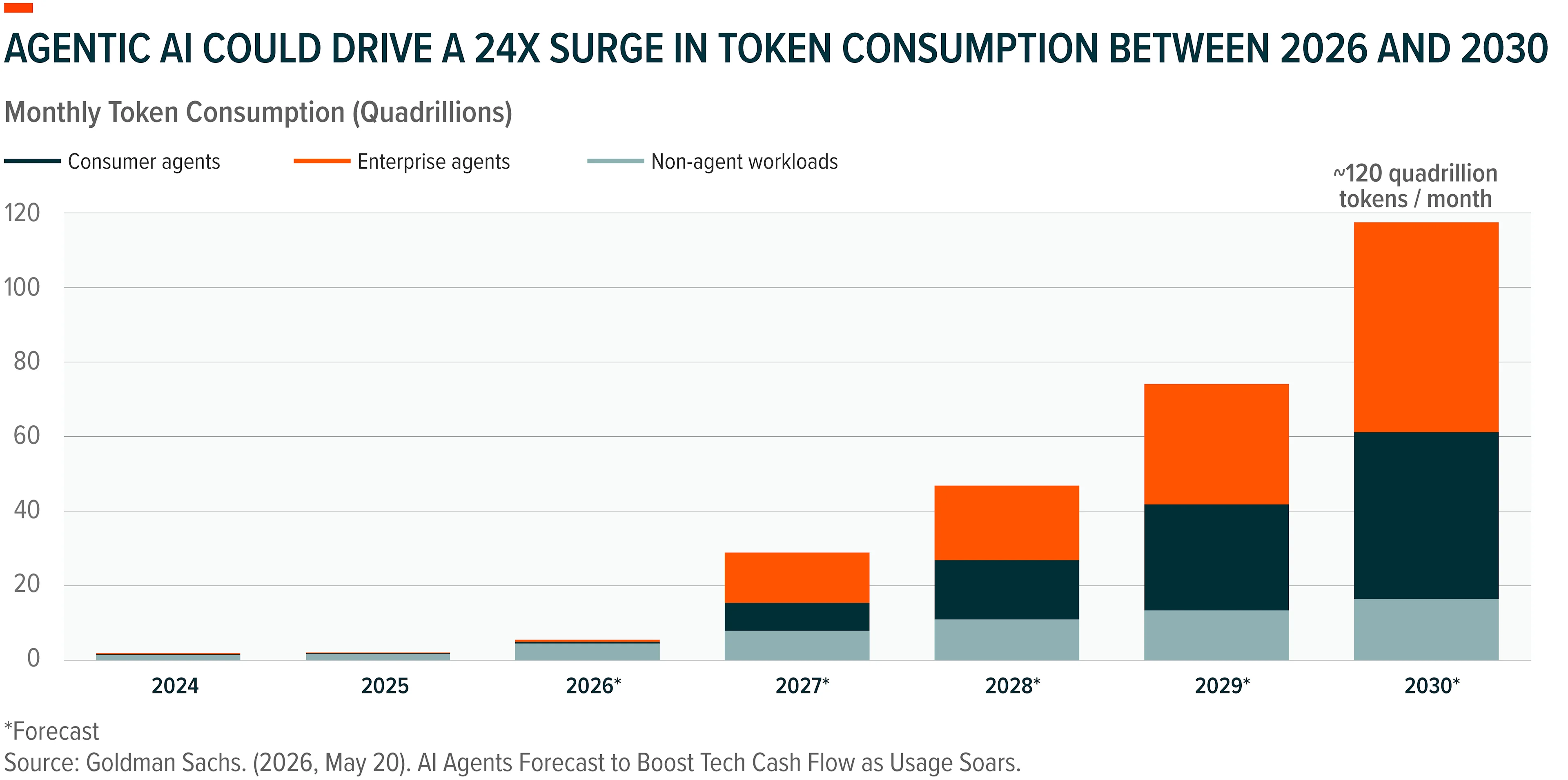
This model can extend across document analysis, research, drug discovery, materials science, and engineering, expanding the opportunity beyond traditional software budgets and into a much larger market for labor and productivity. As agentic capabilities advance, monthly AI token consumption is projected to rise 24-fold between 2026 and 2030, reaching 120 quadrillion and creating a substantial opportunity for model developers to supply the intelligence powering the broader AI ecosystem.16
Against this backdrop of expanding use cases and compounding demand intensity, we estimate that model developers could generate nearly $2 trillion in annual revenue by 2035 by supplying intelligence to businesses, governments, developers, and consumers, across a wide range of products and by selling agents capable of completing cognitive work.17 Even at that scale, their combined revenue would represent only a fraction of global services gross domestic product (GDP), highlighting the breadth of economic activity that AI could ultimately address.18
The market position of leading model developers is reinforced by three factors: infrastructure, product leadership, and distribution.
Infrastructure is the most capital-intensive advantage. Access to compute shapes nearly every dimension of competitive advantage: how extensively a developer can train and test models, how fast it can ship new capabilities, and how much customer demand it can serve — all of which determine whether it retains frontier leadership. The scale of current commitments illustrates the resources required to compete. OpenAI’s Stargate initiative plans to invest up to $500 billion in U.S. AI infrastructure over four years, while Anthropic has committed more than $100 billion to secure up to 5 gigawatts of capacity from Amazon Web Services.19,20 Both companies have signed similar deals with a wide range of other compute suppliers.21
SpaceX-AI, meanwhile, expanded its Colossus infrastructure to more than one million GPUs at the end of 2025.22 The company’s vertical AI infrastructure playbook also extends to chip fabrication, with SpaceX and Tesla potentially investing nearly $16.8 billion in the effort.23 Google is pursuing a similar full-stack strategy, scaling its own data center footprint while also investing heavily in custom chip fabrication.24 In summary, few companies can assemble this combination of capital, computing capacity, and technical expertise.
The second advantage is the product experience built around the model. While performance remains important, customers increasingly select AI platforms based on memory, personalization, and security. As enterprises connect proprietary data, establish permissions, customize agents, and embed AI into daily workflows, the relationship becomes more durable. Changing providers may require rebuilding both the underlying technology and the processes employees use around it, which converts into a moat for scaled leaders.
Distribution is the third advantage. For example, Alphabet can continue to deliver Gemini technology through established products like Google Workspace, while Meta can reach users across WhatsApp, Instagram, Facebook, and Messenger. In fact, this is already proving advantageous for the company’s Muse AI agent, which is scaling nearly as fast as ChatGPT in the early days since launch.25
Together, these advantages can create a reinforcing cycle: infrastructure supports better models and greater capacity, compelling products and broad distribution drive adoption, and incremental revenues can then fund further investment. Competitive leadership will evolve, but we believe the cost and complexity of frontier model development favor the few companies capable of sustaining this cycle.
Model development may be highly capital intensive, but the economics can improve quickly as usage scales, infrastructure utilization rises, and the cost of delivering a given level of intelligence falls.
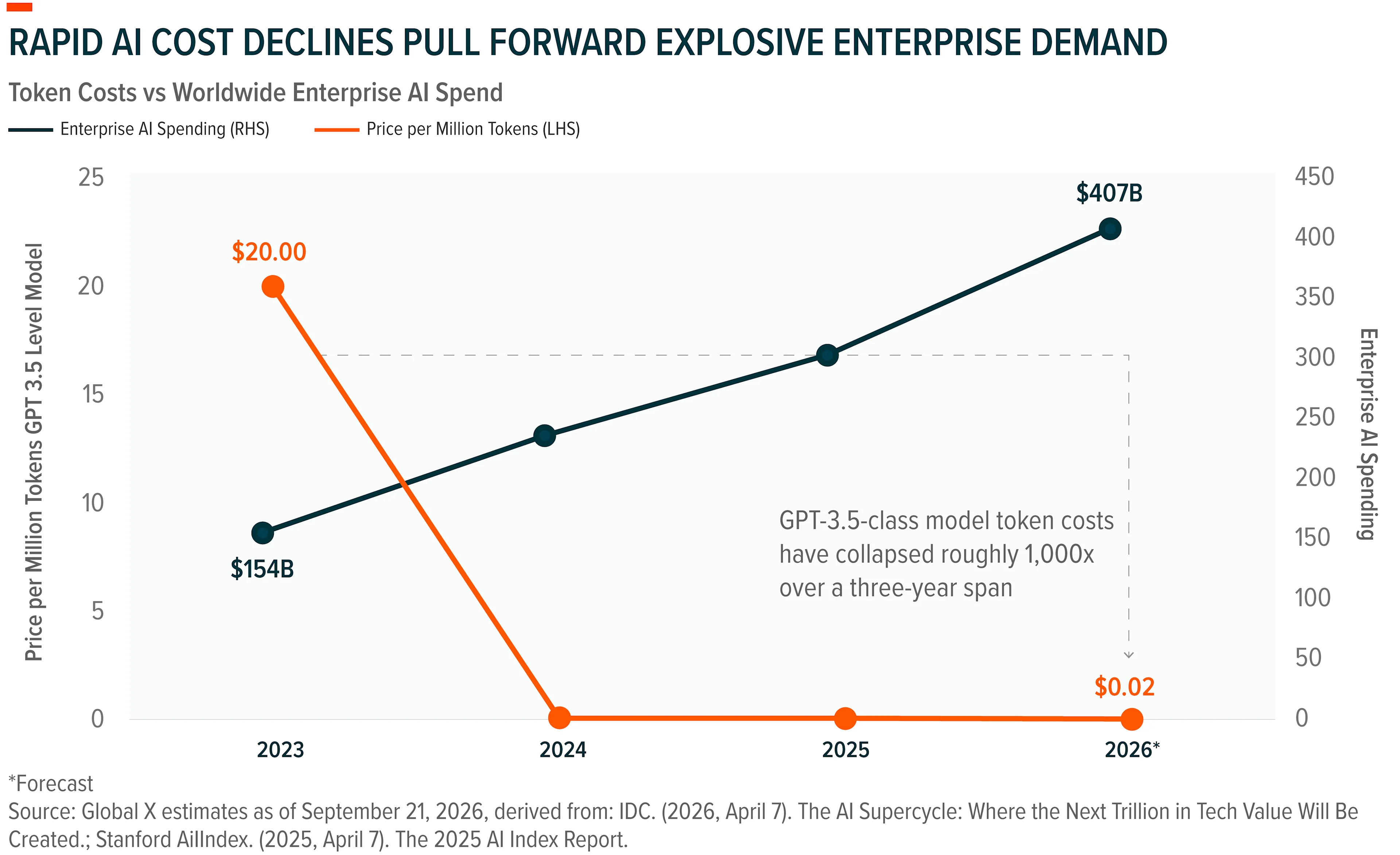
The price of querying a model with GPT-3.5-level performance has fallen nearly 1,000-fold in roughly three and a half years, while enterprise AI spending increased nearly threefold over the same period.26 While falling costs do not automatically translate into higher margins, they do make more workloads economically viable, supporting greater adoption and substantially higher usage.
Developers can also monetize the same model family across multiple products and price points. A frontier model can help train smaller, lower-cost variants, be adapted for specialized tasks, and support consumer subscriptions, enterprise products, APIs, and agents. Model routing can improve economics further by directing routine tasks toward smaller systems while reserving more expensive models for workloads that justify higher pricing.
Early evidence of operating leverage for developers is beginning to emerge. Anthropic expects Q3 2026 positive adjusted operating income for a second consecutive quarter, while gross margin exceeds 80% before model-training costs and revenue-sharing payments to distribution partners.27 That measure suggests that inference revenue can scale faster than the direct cost of serving demand.
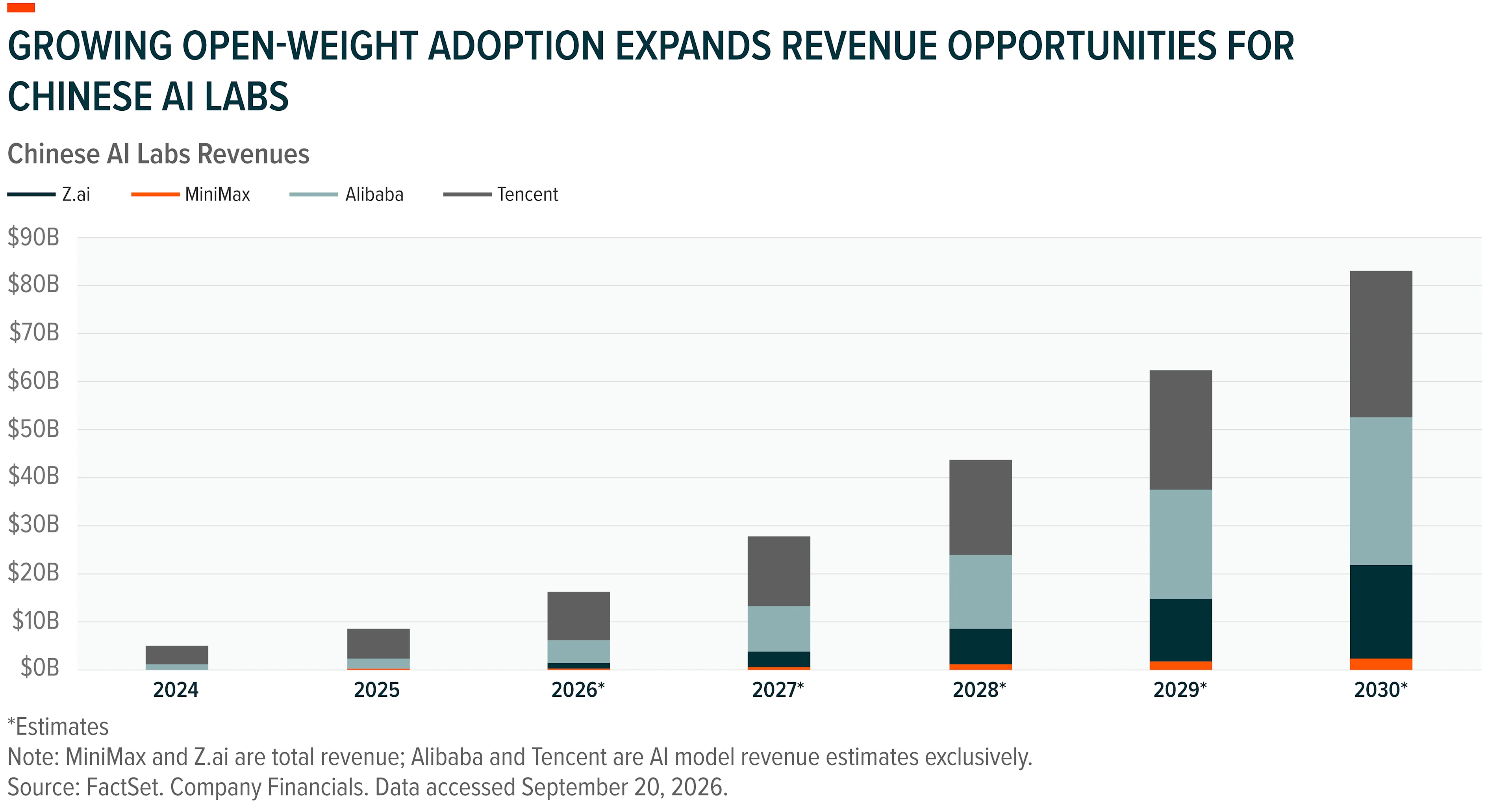
Frontier model development is no longer solely a U.S. story. Chinese developers, including Alibaba, Tencent, MiniMax, and Z.ai, are building increasingly competitive models while benefiting from domestic demand for localized AI infrastructure and applications. Their progress broadens the global opportunity set and introduces a distinct commercialization strategy centered on open-weight distribution.
Under this approach, which is central to China’s AI strategy, developers release a model's weights for others to download and fine-tune for specific tasks, easing adoption and customization. While those downloads may not immediately convert to revenues, they can preview the technology and create downstream demand for paid access, cloud infrastructure, and related platform services — a dynamic already visible among China's leading model developers.
The ecosystem is led by Alibaba's Qwen, MiniMax's M3, and Z.ai's GLM series, as well as private companies like ByteDance and Moonshot. As of August 2026, Alibaba’s Qwen family surpassed three billion global downloads and generated more than 300,000 derivative models. Commercial adoption is also accelerating, with Alibaba’s AI-related product revenue reaching $1.8 billion in its latest quarter, extending triple-digit YoY growth for a twelfth consecutive quarter.28 Alibaba is heavily investing into AI infrastructure to keep up with demand, expanding its chip program and cloud infrastructure commitments.29,30
Among standalone developers, Z.ai is emerging as a strong example of open-weight adoption translating into commercial usage. Formerly known as Zhipu AI, the company increasingly monetizes through a model-as-a-service platform used by enterprises and developers. The company generated nearly $142 million in first half revenue, up nearly 400%, including $123 million from its open platform and API business, which increased more than 27-fold. Its GLM model-service platform had attracted more than 7.4 million enterprise and developer users by the end of August.31
MiniMax is pursuing a broader model-to-application strategy, pairing its foundation models with consumer products and an enterprise developer platform. Its M3 model combines coding and agentic capabilities with a one-million-token context window and native multimodality. MiniMax now serves more than 300 million users globally, alongside a rapidly expanding enterprise and developer base. Commercialization is accelerating as well: first-half of 2026 revenue increased 283% YoY to $116.6 million, while revenue from its Open Platform and other enterprise AI services rose 703% to $73.9 million, representing 63% of total revenue.32
We’re launching the Global X LLM ETF (LLMA), an actively managed ETF that invests in companies involved in the development and commercialization of large language models and frontier AI technology.
Designed to stay focused on the suppliers of intelligence, the fund seeks to deliver access to a concentrated group of companies listed in developed markets and China whose models rank among the top 20 developers on designated independent benchmark leaderboards and that either derive at least 50% of revenue from their own AI models and related products or devote at least 50% of capital expenditure to developing or serving frontier AI.
This approach emphasizes demonstrated model capabilities and meaningful economic commitment to the success of LLMs. The fund could include up to three companies at 20% weights each, deliberately concentrating exposure in leading qualifying developers while maintaining sizable allocations to emerging participants. The fund also considers the inclusion of new IPOs as soon as seven U.S. trading days after listing, helping the portfolio stay aligned with a rapidly evolving AI market.
Together, this approach seeks to keep the fund focused on the companies driving frontier model innovation as the competitive landscape and investable universe for frontier labs continue to expand across major global AI markets.
If chips provide the compute and data centers provide the power, LLMs are the intelligence layer that turns both into economically valuable output. As AI adoption broadens across consumers, enterprises, and agents, demand for that intelligence could become one of the largest revenue opportunities created by the AI economy. And we believe the developers able to sustain frontier model leadership, commercialize at scale, and continually reinvest in their platforms could capture a growing share of that opportunity.
For investors seeking exposure to this emerging layer of AI value creation, the Global X LLM ETF (LLMA) offers targeted access to the companies building and commercializing the intelligence behind the AI economy.
Related ETFs
Click the fund name above to view current holdings. Holdings are subject to change.
Global X estimates, with info derived from: Bloomberg. (2026, August 13). OpenAI's Revenue Run Rate Tops $40 Billion Ahead of IPO, Bloomberg. (2026, August 17). Anthropic's Annualized Revenue Tops $65 Billion Before IPO, JLL.(2026, January 5). 2026 Global Data Center Market Outlook.
Ibid.
Digital Applied. (2026, June 12). AI Usage Statistics 2026: Who Used AI and How Much.
Pew Research Center. (2025, September 17). How Americans View AI and Its Impact On People and Society.
Yahoo Finance. (2026, September 14). Only 35% of AI usage time is productive, workers say.
Epoch AI. (2024, June 3). How Much Does It Cost to Train Frontier AI Models.
Dealroom (2026, August). Anthropic's $75B ARR vs OpenAI's $41B.
Reuters. (2026, August 14). EXCLUSIVE Anthropic IPO valuation hinges on $190-200 billion 2028 revenue forecast, sources say.
Dealroom (2026, August). Anthropic's $75B ARR vs OpenAI's $41B.
CNBC. (2026, August 17). Anthropic tells investors annualized revenue run rate climbed to $65 billion in July.
Macro Trends. (n.d). Alphabet Revenue. Accessed Sept 11, 2026.
Global X estimates with info derived from: Business of Apps. (2026, July 16). Google Gemini Revenue and Usage Statistics (2026).
Marketing Dive. (2026, July 30). Meta touts industry-leading ad revenue growth, but AI unease rises.
AI Business Weekly. (2026, July 2). Claude Code Statistics 2026: Revenue, Market Share & Growth.
Grandview Research. (2025, July). AI For Customer Service Market (2025 - 2033).
Goldman Sachs. (2026, May 5). AI Agents Forecast to Boost Tech Cash Flow as Usage Soars.
Global X ETFs estimates with info derived from: Vercel. (September 7, 2026). AI model leaderboards. FactSet Research Systems. Company Estimates. Data accessed September 21, 2026.; Financial Times. (2026, June 15). OpenAI spending hit $34bn last year ahead of planned IPO.; Barron's. (2026, September 18). The World Isn't Ready for an Anthropic IPO.
Global X ETFs estimates with info derived from: International Labour Organization. (2025, May 28). World Employment and Social Outlook. May 2025 Update.
OpenAI. (2025, January 21). Announcing the Stargate Project.
Anthropic. (2026, April 20). Anthropic and Amazon expand collaboration for up to 5 gigawatts of new compute.
OpenAI. (2026, January 14). OpenAI partners with Cerebras.
xAI. (2026, January 6). xAI Raises $20B Series E.
Reuters. (2026, August 6). SpaceX, Tesla to initially spend $16.8 billion on Terafab chip plant in Texas
Datacenters.com. (2026, August 19). Google Is Designing More Than AI Chips - It's Redesigning the Data Center Stack.
TechCrunch. (2026, September 25). Meta is putting its muscle behind Muse as the AI app takes off.
Global X estimates as of September 21, 2026, derived from: IDC. (2026, April 7). The AI Supercycle: Where the Next Trillion in Tech Value Will Be Created.; Stanford AiIIndex. (2025, April 7). The 2025 AI Index Report.
Financial Times. (2026, September 13). Anthropic tells investors it will be profitable for a second straight quarter.
Alibaba. (2026, August 20). Alibaba's Full-Stack AI Accelerates Monetization with 22-Quarter-High Cloud Growth.
Yahoo! Finance. (2026, August 27). Alibaba Raises $10 Billion for AI - Why BofA Is Looking Past the Dilution.
CNBC. (2026, September 22). Alibaba shares jump as new AI chip, data center buildout plans unveiled.
Z.ai. (2026, August 31). INTERIM RESULTS ANNOUNCEMENT FOR THE SIX MONTHS ENDED JUNE 30, 2026.
MiniMax. (2026, August 26). MiniMax Announces First Half 2026 Financial Results.
Rising demand for reliable onsite power and investment in low-carbon hydrogen are expanding opportunities for companies across the hydrogen value chain.
Rising demand for reliable onsite power and investment in low-carbon hydrogen are expanding opportunities for companies across the hydrogen value chain.
This month, we discuss disruptive trends in U.S. Infrastructure, AI, Defense Tech, Space Tech, Genomics and Robotics.
This month, we discuss disruptive trends in U.S. Infrastructure, AI, Defense Tech, Space Tech, Genomics and Robotics.
Delivering thematic exposure requires strict purity standards, identifying relevant companies, and calibrating portfolio breadth to industry structure.
Delivering thematic exposure requires strict purity standards, identifying relevant companies, and calibrating portfolio breadth to industry structure.
