
Portfolio Balance: Commodities, Banks, High Real Rates, and the Other Side of the AI Trade
Global equity leadership over the past three years has been concentrated in a small number of U.S. mega-cap names tied to the AI infrastructure buildout. Brazil offers potential barbell exposure: two key indices, the Ibovespa and MSCI Brazil Index, are weighted toward commodity producers (37% of MSCI Brazil and 30% of Ibovespa) and domestic banks (40% of MSCI Brazil and 28% of Ibovespa Brazil), sectors with limited direct correlation to AI CapEx cycles and none of the embedded multiple expansion.1 Paired with a high domestic real interest rate, we believe Brazil functions less as a satellite EM allocation and more as a genuine counterweight with a different set of return drivers, including commodity cycles, credit growth, and real income growth, which differs from the current AI trends that are dominating global index returns.
Flows: Is BRL13 Billion Out in Nine Days too Much?
@2x.png)
Foreign investors pulled roughly BRL3 billion from Brazilian equities in one week from August 11-18, compounding the BRL4.7 billion single-day outflow that started the slide. On our data, this ranks as the third-largest monthly outflow since 2008, trailing only the two Covid onset months of February and March 2020 (-BRL21 billion and -BRL24.2 billion, respectively).2 Nothing in Brazil's current fundamentals, growth, credit quality, or corporate earnings, resembles a 2020 style shock; this reads as a technical, election-driven overreaction rather than a fundamentally justified repricing, and market reactions of this size have historically been entry points rather than the start of a structural de-rating.
Valuations
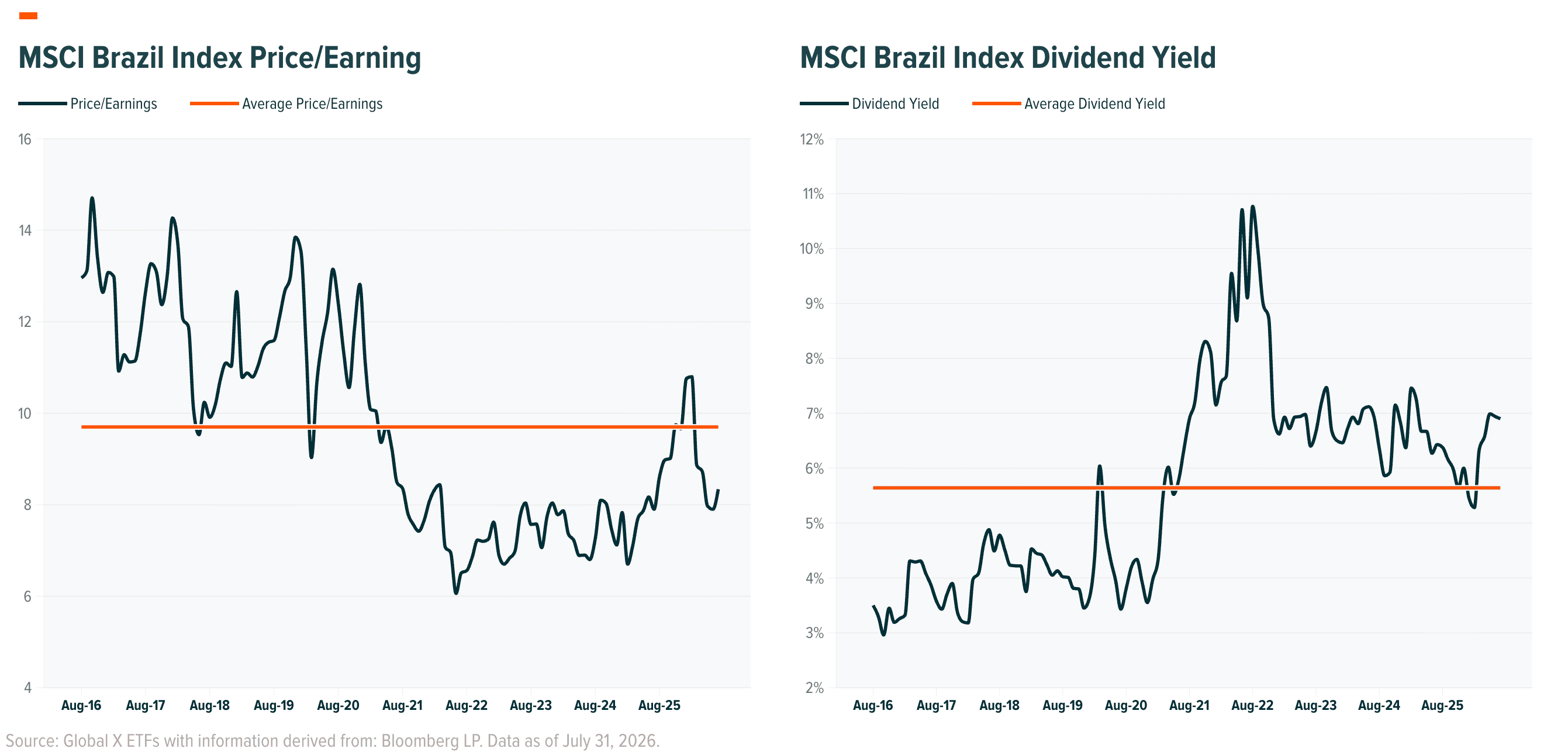
The MSCI Brazil Index trades at roughly 8.3x forward earnings, a 14% discount to its 10-year average of 9.7x, while paying a dividend yield near 7.0%, about 150 basis points above its 10-year average of 5.6%.3 That is a rare combination where investors are being paid more to wait at a discounted multiple that already assumes a left-wing presidential victory. After rallying in 2021, the de-rating in the multiple towards the end of the year has been largely structural, tied to higher-for-longer real interest rates and fiscal risk. However, the re-rating higher in yield means income has kept pace even as the price has not. Cheap on earnings and rich on yield at the same time is not a normal state for this market, and it likely won’t persist once political uncertainty clears after the October elections.
Carry Trade: Positive Real Rates Providing Currency Support
Brazil continues to offer one of the highest positive real interest rates among major economies at ~9.3%, with the Selic policy rate well above both trailing and expected inflation.4 That real rate differential can be a structural support for the currency even as equity flows turn negative, because rate-sensitive carry capital responds to a different signal than equity risk appetite does. A currency underpinned by carry economics may provide foreign equity investors a more favorable dollar-terms entry point than the equity outflow data alone would suggest. It also could reduce the odds that further equity selling turns into a disorderly currency move.
Monetary Policy: Rate-Cutting Cycle
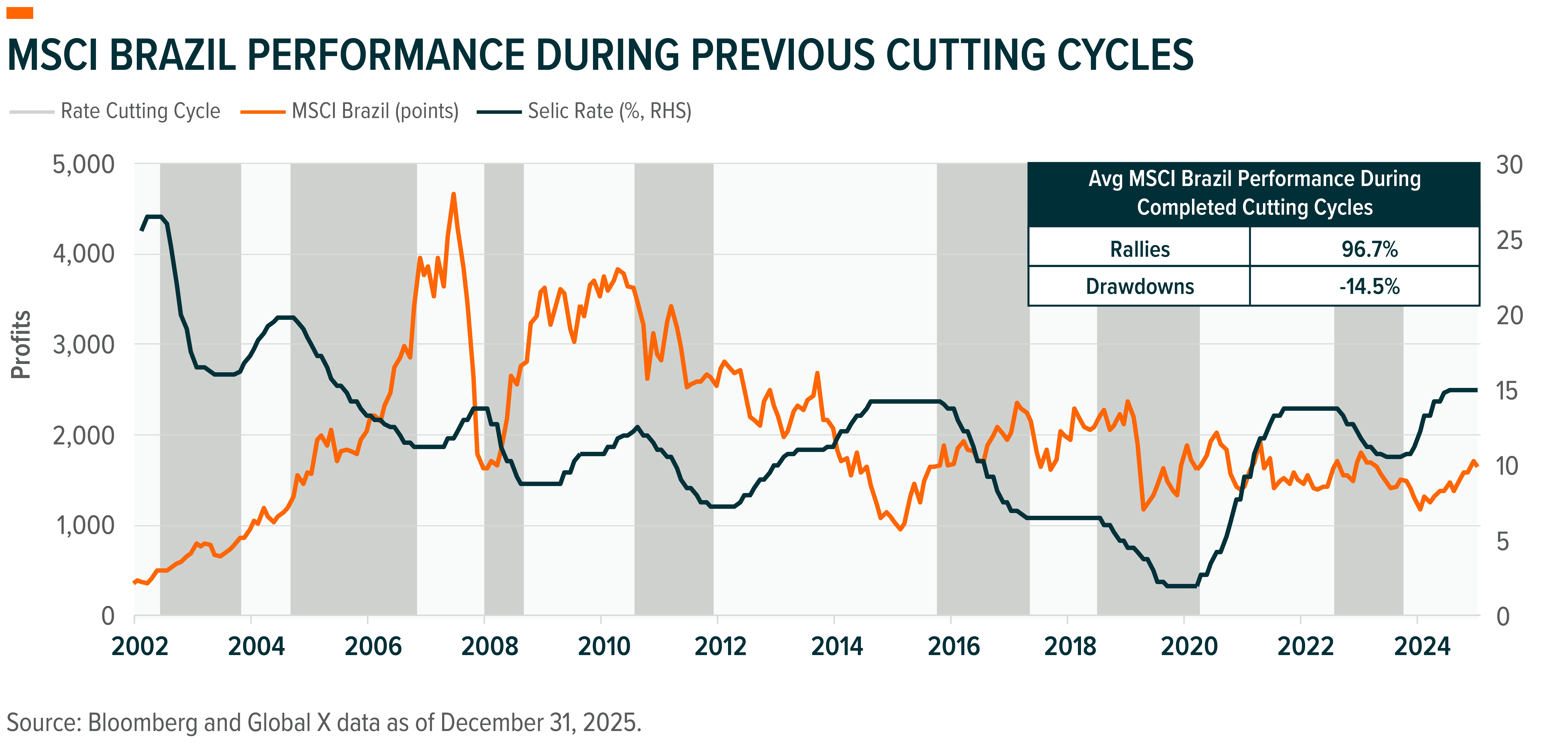
Brazil's central bank has moved from a defensive, inflation-fighting posture into an easing cycle, with the Selic past its peak and further cuts expected. Easing cycles typically lower the discount rate applied to equity cash flows and have historically supported multiple expansion in Brazilian equities. Furthermore, our analysis of the seven completed rate cutting cycles since 2000 showed that Brazilian equities rallied in four of them, climbing an average of ~96.7% compared to an average drawdown of only 14.5% in the three down cycles, suggesting potentially significant positive risk/reward.5
Politics: A Coin Toss, But Positive Momentum is Growing
The October 4th first round Presidential election and, if needed, October 25th runoff, currently sit close to a coin toss, with the most recent national polling showing incumbent President Lula and Senator Flávio Bolsonaro in a statistical tie in a simulated second round.6 Based off a recent visit to Brazil and discussions with other local investors, it appears that a Lula victory is largely priced into current positioning and may not be as damaging to markets as some fear. Importantly, since his coalition has never held a working majority in the Chamber of Deputies, a Centrão-controlled Congress has repeatedly constrained the fiscal and reform ambitions of Lula’s Workers’ Party (PT) in the past and would likely do so again.
On the other hand, we view an opposition victory as the larger source of asymmetric upside, though regional precedent shows the size of any rally likely depends on how decisive and how priced-in the result is. We have seen Bolsonaro gradually closing the polling gap versus Lula, and he is riding the recent momentum across Latin America that has seen center-right candidates win in Chile, Colombia, Peru, and Argentina. Brazil's own 2018 election is probably the closest analog, with the MSCI Brazil rallying 7.8% the day after Bolsonaro's first-round result on relief alone, well before any policy was enacted.7 For reference, we saw Argentina's Merval Index surge 26.6% after President Javier Milei's October 2025 midterm win cemented his reform mandate.8
Why Active Management
The MSCI Brazil Index concentrates over 64% of index weight in ten names, so a passive allocator is permanently long commodity and state-owned enterprise risk at whatever level the cycle happens to be in.9 Corporate governance quality varies widely across listing tiers, and passive vehicles cannot price that dispersion into position sizing the way an active manager can. Sell-side coverage thins sharply below the largest names, leaving a potential primary-research edge for active managers willing to do the work. Taken together with the asymmetry argued above, we see this as a market where the benchmark's own structure, not just the macro and political setup, argues for concentrated active exposure over passive beta.

Bottom Line: Positive Asymmetry and a Case for Active Management
Attractive valuations, a real-rate cushion under the currency, a monetary easing cycle, and a political outcome that potentially caps the downside of a Lula win while leaving upside optionality to a decisive opposition win, suggests a positive asymmetry in Brazilian equities at current levels. To us, this indicates a technically overdone, headline-driven outflow rather than a fundamental deterioration. Given the concentration and governance dispersion we have documented in the Brazil benchmark itself, we see this opportunity as best expressed through concentrated active strategies rather than passive beta, where security selection can seek to target the dispersion between quality domestic-demand names, misvalued state-linked exposure, and the strongest banks and exporters.