
Market Review
Fund Performance & Attribution
Get the latest news and updates from our team.
SEI Investments Distribution Co. (1 Freedom Valley Drive, Oaks, PA, 19456) is the distributor for the Global X Funds.
Check the background of SIDCO and Global X's Registered Representatives on FINRA's BrokerCheck.

Bloomberg LP. Data as of March 31, 2026.
Ibid.
Ibid.
Drovers. Denton, Angie. (2026, January 30). U.S. Cattle Inventory Hits 75-Year Low at 86.2 Million Head.
Global X ETFs. Data as of March 31, 2026.
Bloomberg LP. Data as of March 31, 2026.
Ibid.
Ibid.
Commodities, as measured by the Bloomberg Commodity Total Return Index, continued to show strong momentum in the first quarter of 2026, as energy prices rallied in the face of a major supply disruption while all five subsectors (Precious Metals, Energy, Agriculture, Livestock, and Industrial Metals) showed positive performance during the quarter.
Commodities delivered a volatile but strong start to 2026, with the Bloomberg Commodity Total Return Index rising +24.4% in the first quarter.1 Energy markets led performance, with the Bloomberg Energy Subindex rallying +58.6% due to the closure of the Strait of Hormuz, which raised immediate concerns about global supply disruption.2 Both crude oil and refined products, such as Gas Oil and Ultra-Low-Sulfur Diesel, moved sharply higher as the physical market tightened significantly, with natural gas lagging due to the limited impact from the crisis and seasonal factors.3
Both precious and industrial metals began the year on strong footing, supported by the dovish U.S. monetary policy outlook and the favorable macro environment. However, gains reversed later in the quarter, as higher energy prices pushed back Federal Reserve easing expectations and added to global economic growth concerns. Aluminum outperformed copper and other industrial metals on the back of gulf export disruptions, while gold and silver ended the quarter higher despite both correcting from their January peaks.
Agriculture commodities moved higher later in the quarter, supported in part by the closure of the Strait of Hormuz. Rising fertilizer supply concerns and transportation constraints provided tailwinds for the sector, while key crops including soybean oil, soybeans, and cotton rallied on speculation they could be included in U.S. trade deals. Cattle prices also continued to rise, supported by resilient demand amid the smallest U.S. cow herd since 1951.4
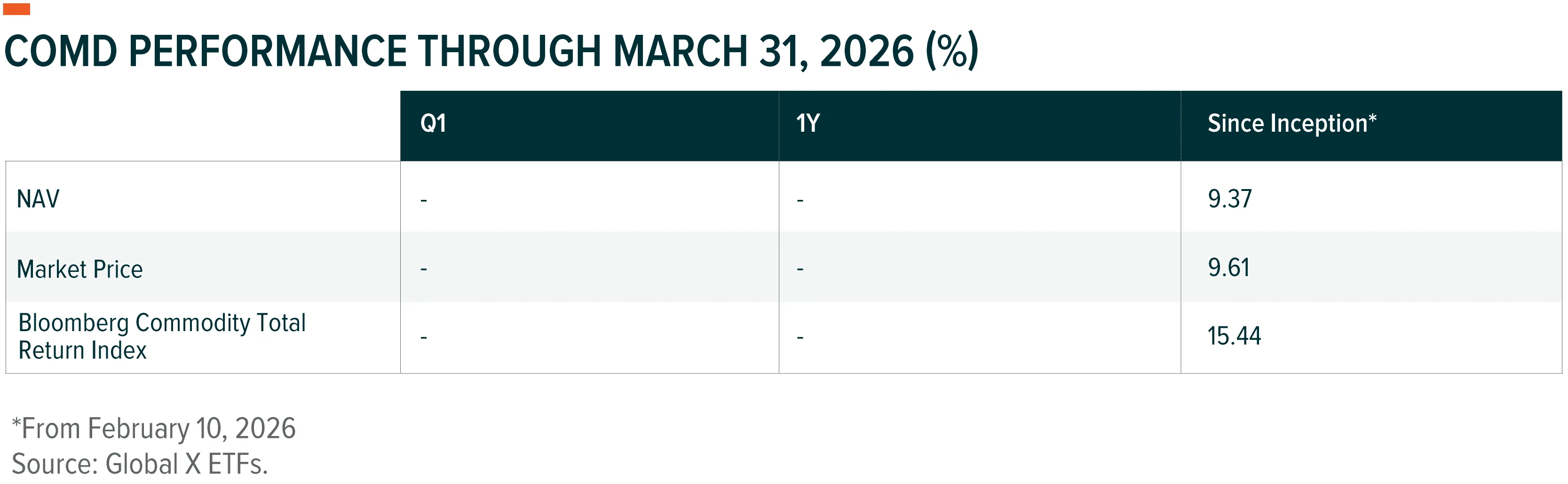
COMD returned +9.37% (NAV return) since inception on February 10, 2026, versus a +15.44% gain in the benchmark Bloomberg Commodity Total Return Index, resulting in -6.06% of relative underperformance.5,6 On a market price return basis, the fund returned +9.61%.
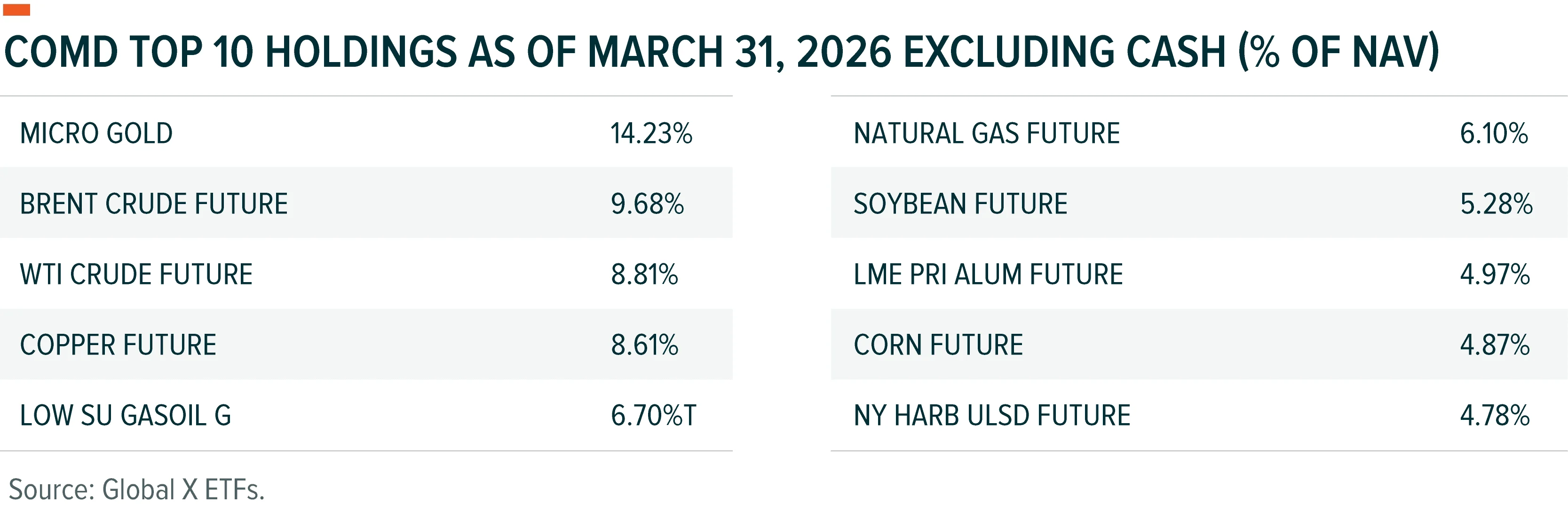
Despite positive absolute performance, COMD lagged the benchmark due to positioning in longer dated contracts. This strategic allocation resulted in performance drag during this extreme quarter due to the large disruption witnessed in energy markets, with the spot brent crude market trading at its tightest level on record in March.7 As a result, the fund’s positioning in the December 2026 Brent contract gained only +16% in March versus a +62% gain in the May 2026 contract.8 However, the fund’s overweight and more front-end-oriented positioning in downstream products helped partially offset the impact of the unprecedented steepness in the crude futures curves.
Beyond energy markets, the fund’s overweight positioning in aluminum, soybean oil, and cotton added to performance, while its overweight in both gold and copper, as well as being underweight sugar, detracted from performance.
Holdings are subject to change.
The performance data quoted represents past performance. Past performance does not guarantee future results. The investment return and principal value of an investment will fluctuate so that an investor's shares, when sold or redeemed, may be worth more or less than their original cost and current performance may be lower or higher than the performance quoted. Performance current to the most recent quarter- and month-end is available at https://www.globalxetfs.com/funds/comd/. Expense Ratio: 0.55%.
We remain constructive on commodities, with the asset class once again demonstrating its role as both a potential portfolio diversifier and an effective hedge against inflation in the first quarter. Broadly speaking, we see the recent underinvestment in supply approaching a period of increased demand, highlighting our conviction of a growing medium-supply demand disconnect. That said, the short-term outlook is becoming increasingly binary, particularly with respect to the status of the Strait of Hormuz. A full reopening could alleviate supply-side pressures and reverse some of the recent gains in energy and agriculture while also potentially benefitting metals, while a prolonged disruption may continue to support elevated energy prices and inflation expectations. We believe this environment underscores the importance of maintaining a balanced approach to commodity exposure, while the dispersion across subsectors can provide opportunities for active managers to navigate the current landscape. COMD provides active commodity allocations while maintaining its positioning further out on the futures curve in aims of reducing the impact of rolls over time. The fund provides active commodity security selection with the fee structure, and liquidity of its ETF wrapper.
Related ETFs
Click the fund name above to view current performance and holdings. Holdings are subject to change. Current and future holdings are subject to risk.
Silver is a potential store of value and key input for industrial purposes, making silver miners an intriguing and differentiated investment opportunity.
Trevor Yates
Global X Research