
Asia is home to many of the companies that design and manufacture the chips powering the global economy. Nearly 75% of global semiconductor manufacturing capacity is in the region, including over 90% of the world’s most advanced chip production.1 As AI and high-performance computing increase the need for sophisticated processors, memory, and associated components, the region’s specialized capabilities could become increasingly valuable.
Those capabilities are also highly specialized by market. Taiwan is a leader in contract chip manufacturing, South Korea is a global hub for memory, and Japan contributes established memory along with broader equipment and materials. China adds a growing domestic semiconductor industry. Together, these markets offer exposure to several sources of semiconductor demand, spanning AI and data centers, smartphones, autos, and industrial applications. Continued capital investment and government support are reinforcing these positions as demand grows for the chips and components.
We’re launching the Global X Asia Semiconductor ETF (ACHP) to offer investors targeted exposure to this regional opportunity. The fund seeks to track the Global X Asia Semiconductor Index, providing exposure to up to 25 Asian semiconductor companies, allowing investors to emphasize the region’s chip manufacturing and design capabilities within their portfolios.
Key Takeaways
Asia is central to the global semiconductor supply chain, accounting for nearly 75% of global chip manufacturing capacity and holding leading positions in memory, chip packaging, semiconductor equipment, and materials.
Asia’s semiconductor advantage is highly specialized and difficult to replicate with Taiwan, South Korea, Japan, and China each controlling distinct capabilities built over decades of process expertise, supplier density, and capital investment.
ACHP provides targeted access to Asia’s specialized semiconductor leaders, focusing on 25 companies across manufacturing, chip design, IP, and software enablement, offering differentiated geo-thematic exposure.
The Semiconductor Market Is Entering a New Growth Cycle
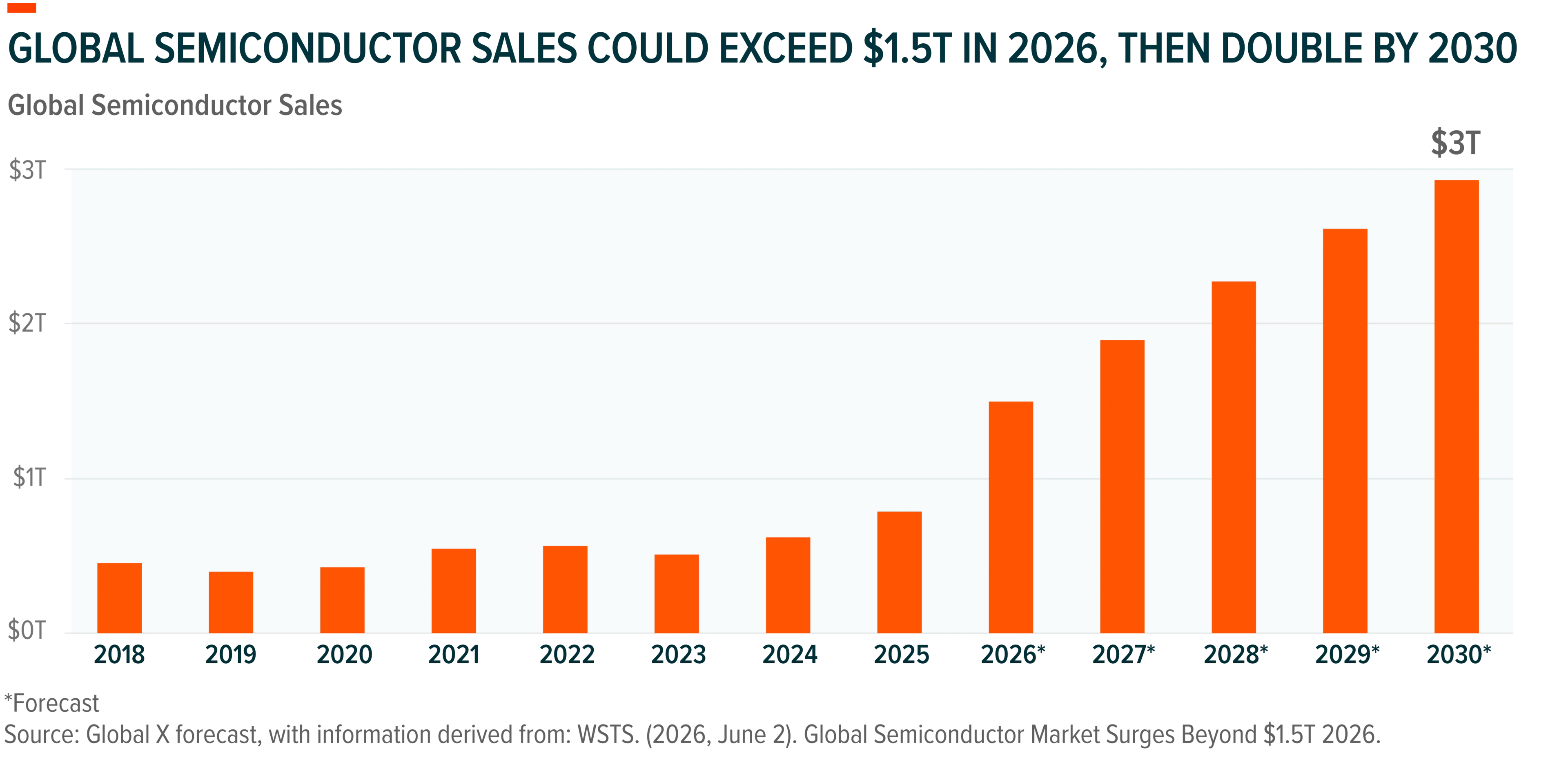
AI and high-performance computing are reshaping the semiconductor industry, adding structural growth drivers to a historically cyclical market. That shift is already visible in the numbers: the global semiconductor market could surpass $1.5 trillion in 2026, growing nearly 90% year-over-year (YoY), with expansion expected to continue through 2030 as trillions of dollars are invested in AI infrastructure.2
Two forces underpin that expected growth. First, semiconductor content is rising across the economy. AI data centers require dramatically more compute, memory, and networking chips, while emerging technologies – electric vehicles, robotics, connected devices, and defense systems – are embedding more chips into products and infrastructure. Semiconductor sales currently amount to just 0.79% of global GDP, a share that could rise substantially as the economy becomes increasingly dependent on computing.3
Second, increasingly demanding applications are driving a shift towards more advanced, higher-value chips. Data-intensive computing requires more sophisticated processors, high-bandwidth memory, advanced networking, and complex packaging. The industry is therefore expanding through both greater unit demand and the shift toward higher-value chips that deliver stronger performance.
At the same time, expanding manufacturing capacity and critical parts of the supply chain can take years. Building a new foundry – a process that can take up to two years to build – is only part of the process.4 Installing equipment, refining production processes, and qualifying chips with customers can add additional time.
Together, rising demand, increasing chip value, and lengthy capacity expansion timelines can support stronger pricing and margins for suppliers with scarce manufacturing capacity or differentiated technologies. This also gives established suppliers an advantage. Companies with capacity and capabilities already in place are positioned to capture rising demand sooner while new supply catches up.
Asia Sits at the Center of the Semiconductor Supply Chain
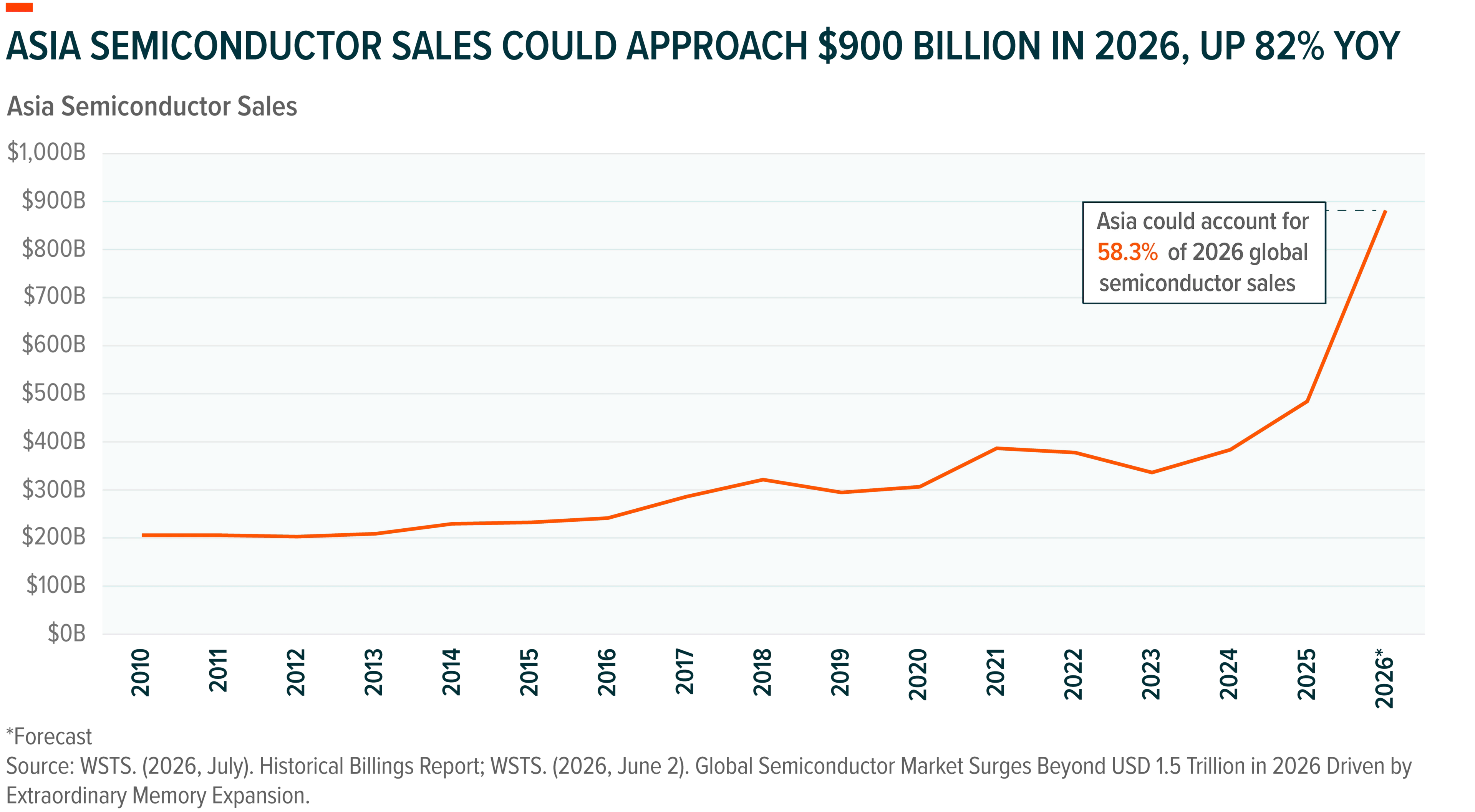
Asia sits at the center of the global semiconductor supply chain, with leading capabilities across advanced chip manufacturing, memory, packaging, equipment, and chip design. The region is projected to account for over 58% of global semiconductor sales in 2026, with sales growing 82% YoY, underscoring its central role in powering the next wave of AI and computing demand.5
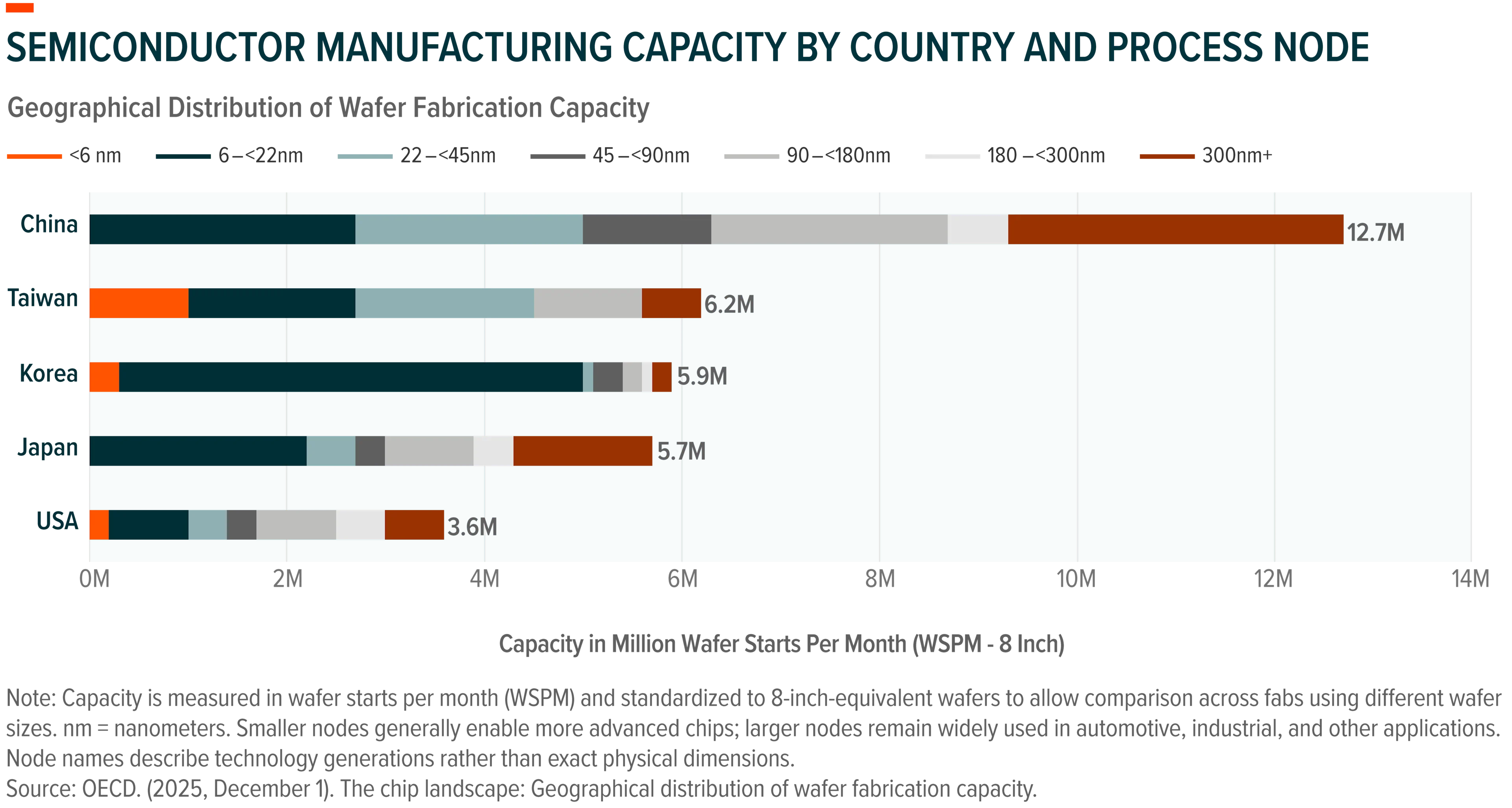
The advantage is primarily anchored in unrivaled regional chip fabrication scale. China, Taiwan, South Korea and Japan together process roughly 30.6 million wafers – the thin discs on which chips are made – each month, about nine times U.S. capacity.6
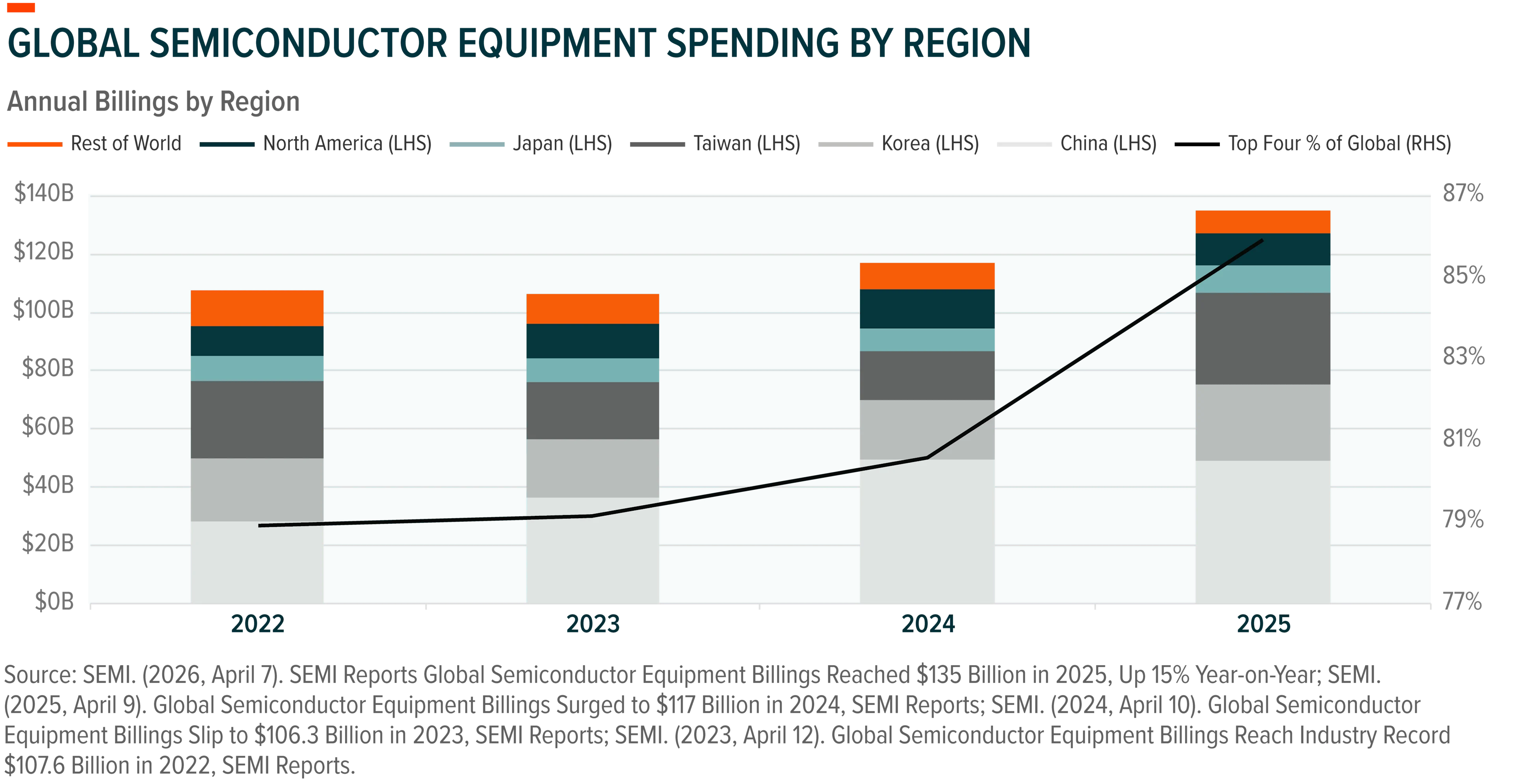
Despite U.S. and European efforts to expand domestic chip production, local investment in manufacturing equipment continues to reinforce Asia’s lead. China, Taiwan, South Korea, and Japan accounted for roughly $116 billion, or 86%, of global sales of chipmaking machinery (equipment billings) in 2025.7 China, Taiwan, and South Korea alone represented 79% of the global total, as AI, high-performance computing, and memory investments fueled further capacity expansion across the region.8
Within that manufacturing base, different markets serve distinct roles. The investment case depends on understanding those specializations built over decades, because chip designers, foundries, and memory manufacturers participate in semiconductor demand in different ways.
Taiwan
Taiwan leads in foundry manufacturing – producing chips designed by other companies – and advanced packaging, which connects multiple chips into powerful computing systems. TSMC held 72.5% of the global foundry market in Q2 2026, compared with 3.9% for Taiwan’s UMC and 3.2% for U.S.-based GlobalFoundries.9
AI is increasing demand for both capabilities. TSMC expects AI and high-performance computing to account for 55% of global semiconductor sales by 2030. 10 Taiwan’s expertise extends to chip design through companies such as MediaTek and Global Unichip, giving the market exposure across the development and production of increasingly sophisticated chips.
South Korea
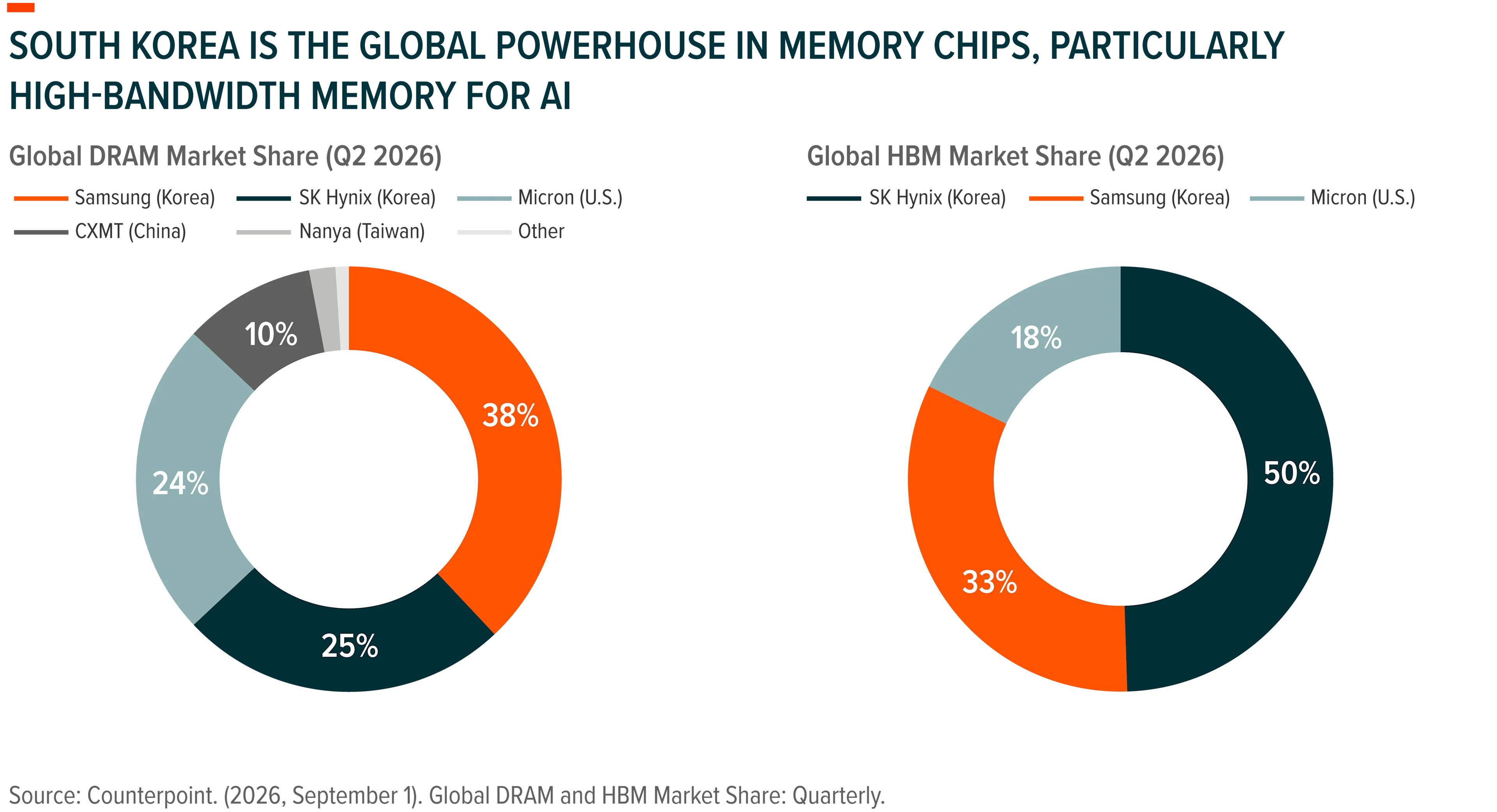
South Korea anchors global memory supply. Samsung and SK Hynix together accounted for approximately 63% of global DRAM revenue in Q2 2026, including 83% of high-bandwidth memory (HBM), a specialized type of DRAM increasingly used in AI processors.11 DRAM temporarily stores data for processors; HBM stacks DRAM chips to move more data at higher speeds.
That distinction matters as AI systems require faster access to larger volumes of data. HBM gives Korean suppliers direct exposure to this demand, alongside their broader memory businesses serving servers, smartphones, and PCs. Their manufacturing scale and expertise in increasingly complex memory technologies position them to capture both rising demand and the shift toward higher-value products.
Japan
Japan holds leading positions in semiconductor equipment and materials, with Japanese suppliers accounting for approximately 88% of the global coater/developer market, 53% of silicon wafers, and 50% of photoresists, making the region an important supplier of the technologies and materials essential to global chip production.12 Japan also has established semiconductor manufacturers serving AI infrastructure, automotive, and industrial applications.
In memory, Japan offers exposure to AI-driven storage demand through Kioxia, a major global NAND flash supplier with approximately 14% market share globally as of Q2 2026.13 Companies like Renesas add exposure to semiconductor demand across industrial, infrastructure, and automotive applications. Together, these companies demonstrate how Japan participates in both the AI infrastructure buildout and the broader adoption of semiconductors across the economy.
China
China is the world's largest single-country semiconductor market, reflecting its central role in global electronics manufacturing. Its production footprint is also expanding: SEMI projects China's share of global semiconductor manufacturing capacity will rise from 20% in 2020 to 32% by 2030.14
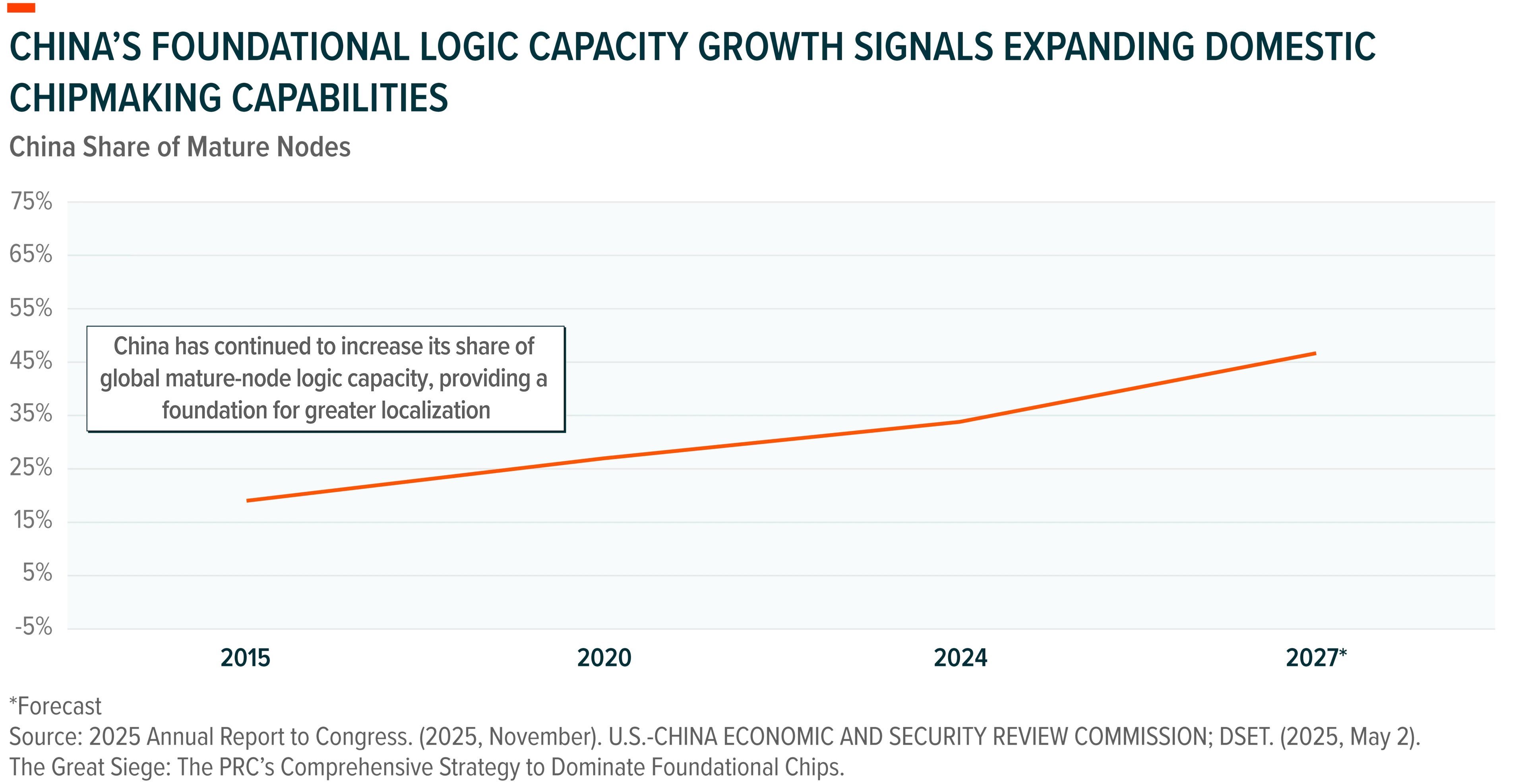
Much of this growth is concentrated in established manufacturing technologies. China's share of global capacity at 22–40 nanometers is projected to increase from 25% in 2024 to 42% by 2028.15 These technologies support a broad range of automotive, industrial, and consumer electronics applications, creating opportunities for Chinese chipmakers beyond the most advanced AI processors. For domestic suppliers, China's large customer base and expanding manufacturing capabilities offer significant opportunities to capture more local demand.
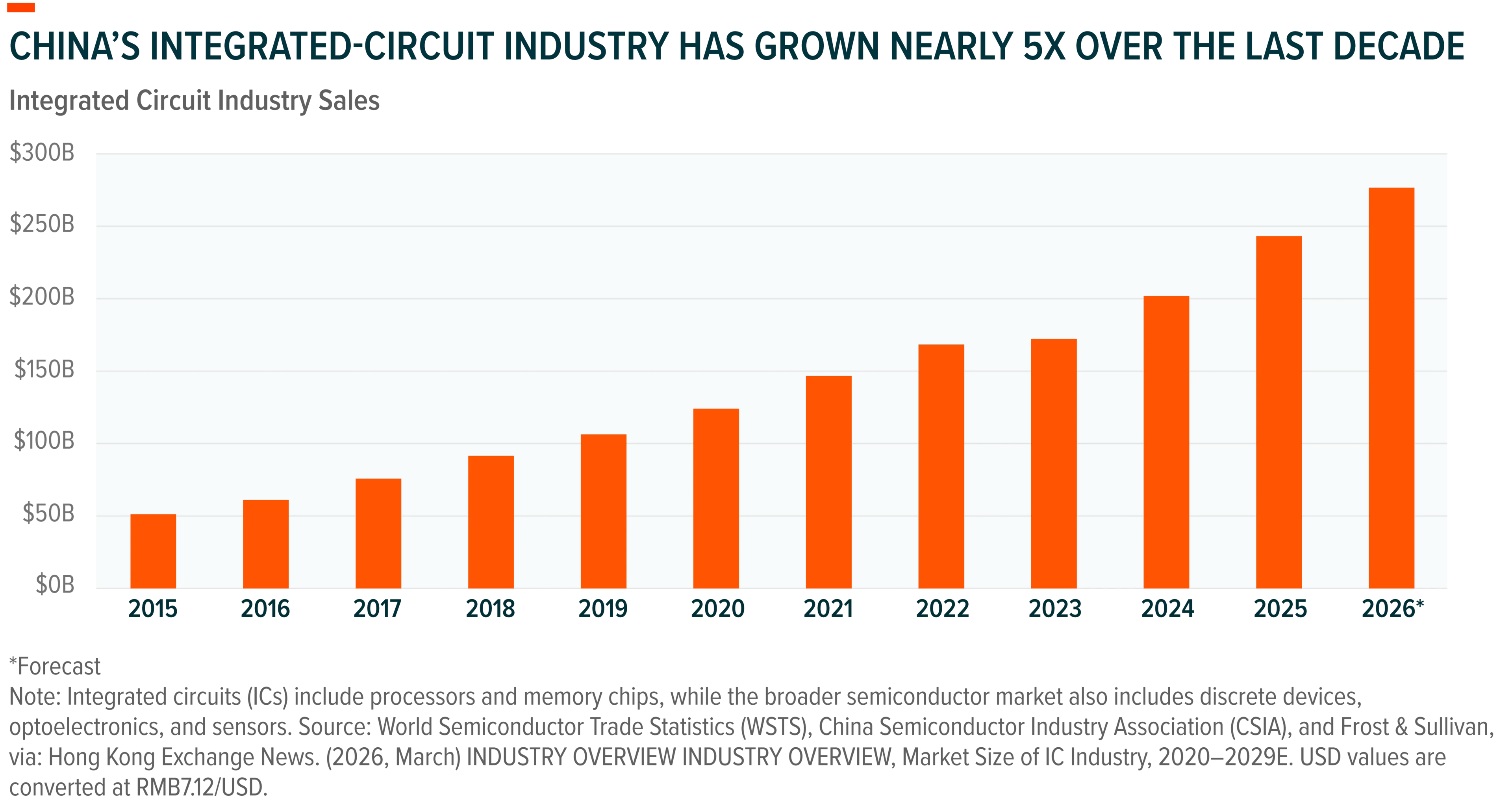
Government support remains a major driver. China's Made in China 2025 strategy targeted greater domestic self-sufficiency in critical components and materials, while its 15th Five-Year Plan (2026–2030) identifies integrated circuits as an emerging pillar industry and prioritizes technological breakthroughs across the semiconductor value chain.16 Financial backing reinforces these ambitions. The third phase of China's state-backed National Integrated Circuit Industry Investment Fund, known as the "Big Fund," was established with approximately $47 billion (RMB344 billion) in registered capital, exceeding the combined size of its first two phases.
ACHP: Targeting Asia’s Critical Semiconductor Ecosystem
The Global X Asia Semiconductor ETF (ACHP) is a passively managed fund offering targeted exposure to Asian companies across two key segments of the semiconductor value chain:
The underlying index evaluates companies across ten eligible Asian markets, including Taiwan, South Korea, Japan, and China. To qualify, companies must derive at least 50% of revenue from eligible semiconductor activities or be market leaders due to generating at least $50 billion in eligible semiconductor revenue.
From there, the index selects the 25 largest eligible companies and weights them by free-float market capitalization, subject to a 10% individual security cap. We believe this approach emphasizes established semiconductor leaders, where scale, capital intensity, and technological expertise can create lasting competitive advantages, while limiting concentration in any single company. The index rebalances quarterly.
We believe ACHP offers a differentiated complement to U.S.-centric technology portfolios, which often emphasize chip design, hyperscalers, software, and AI applications. By focusing on Asia's semiconductor leaders, ACHP provides exposure to the manufacturing scale and design capabilities underpinning the global AI investment cycle.
Conclusion: Capturing Asia’s Chip Dominance
Asia’s semiconductor leaders combine manufacturing scale with specialized expertise built over decades. As AI investment accelerates and semiconductor content rises across the economy, these capabilities position the region to capture growth across both advanced computing and everyday applications. We believe ACHP can complement broad AI, technology, and semiconductor allocations by increasing exposure to Asia’s chip designers and manufacturers. For investors, it provides targeted access to the companies translating rising semiconductor demand into the chips that power the global economy.
Related ETFs
ACHP – Global X Asia Semiconductor ETF
Click the fund name above to view current holdings. Holdings are subject to change. Current and future holdings are subject to risk.