
Commodities’ physicality distinguishes them from other asset classes. Investing in commodities requires a fundamental understanding of the factors that affect commodities’ prices and valuations. The essential roles that commodities play in disruptive, next-generation technologies, and the investment opportunities arising from this dynamic makes this understanding for investors critical. In this piece, we look to explore the commodity markets further, and the different aspects market participants should consider when investing in these markets.
Key Takeaways
A raw material's discovery to commercialization path is long. The value chain stages are as follows: upstream, midstream and downstream. Natural disasters, geopolitical conflicts, economic downturns or new technologies can interrupt or change commodities supply.
Demand indicators for commodities can vary by geography and industry. Keeping tabs on China's consumption is crucial because of the country's need to acquire more commodities than it produces. When economics allow, similar commodities might be swapped, altering demand.
Commodity prices historically hange inversely with the strength of the U.S. dollar. Commodities can be a hedge against inflation because of their inherent value, as their prices fluctuate with economic activity. Structural supply-demand imbalances can cause decades-long commodity supercycles.
Important Commodities Factors to Watch
Supply Factors
The path from initial discovery to commercialization of a raw material is lengthy and complex. The value chain consists of three stages. Upstream refers to the extraction of a product, such as crude oil or metal ore, to the surface from the earth’s crust. Midstream refers to the transportation and storage of raw materials prior to further processing. Downstream refers to when a raw material is transformed into finished goods for sale to consumers.
Events such as natural disasters, geopolitical conflicts, and economic downturns can disrupt a commodity’s supply. Governments keep strategic reserves as a hedge against unpredictable supply disruptions. Inventories and spare capacity allow companies to mitigate mismatch in supply and demand.1
New technology can alter the geopolitical equilibrium. For example, efficient and low-cost shale oil extraction propelled the United States to the ranks of the world's leading oil producers.2
Demand Factors
Commodities consumption often varies by industry and region, which means demand indicators vary. For example, scheduled flights help estimate jet fuel demand.3 A market like China imports more commodities than it produces, so monitoring the country’s consumption is essential. Commodity prices typically rise when imports to China rise in response to tighter markets.4
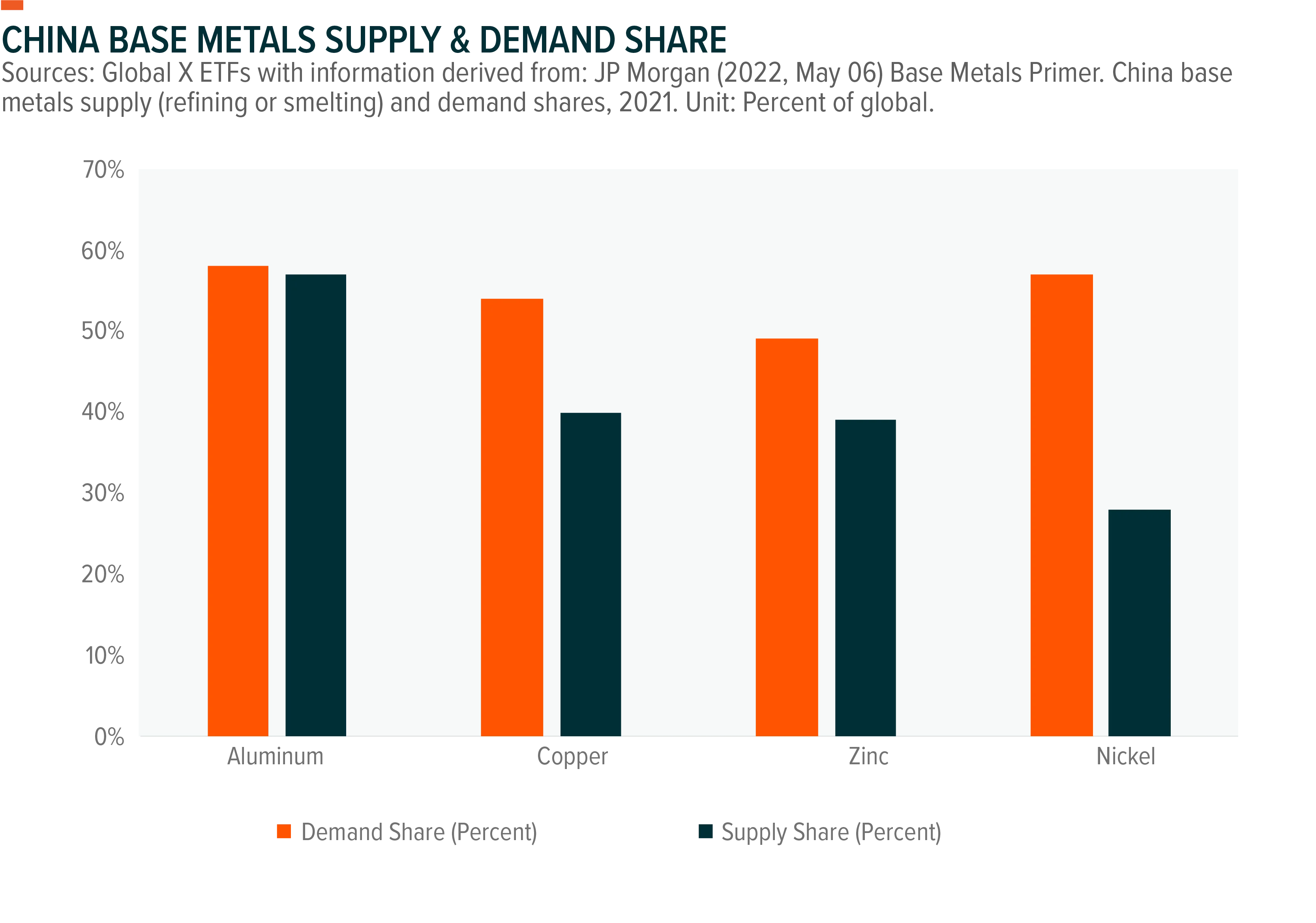
Also affecting demand is that commodities with similar attributes can be substituted when the economics make sense. For example, instead of copper, aluminum can be used for automobile wiring and tubing. Fuel switching is an option for electric generation and industrial users. Utilities often replace coal with natural gas when gas prices are low.5
Macro Indicators, Business Cycles and Supercycles
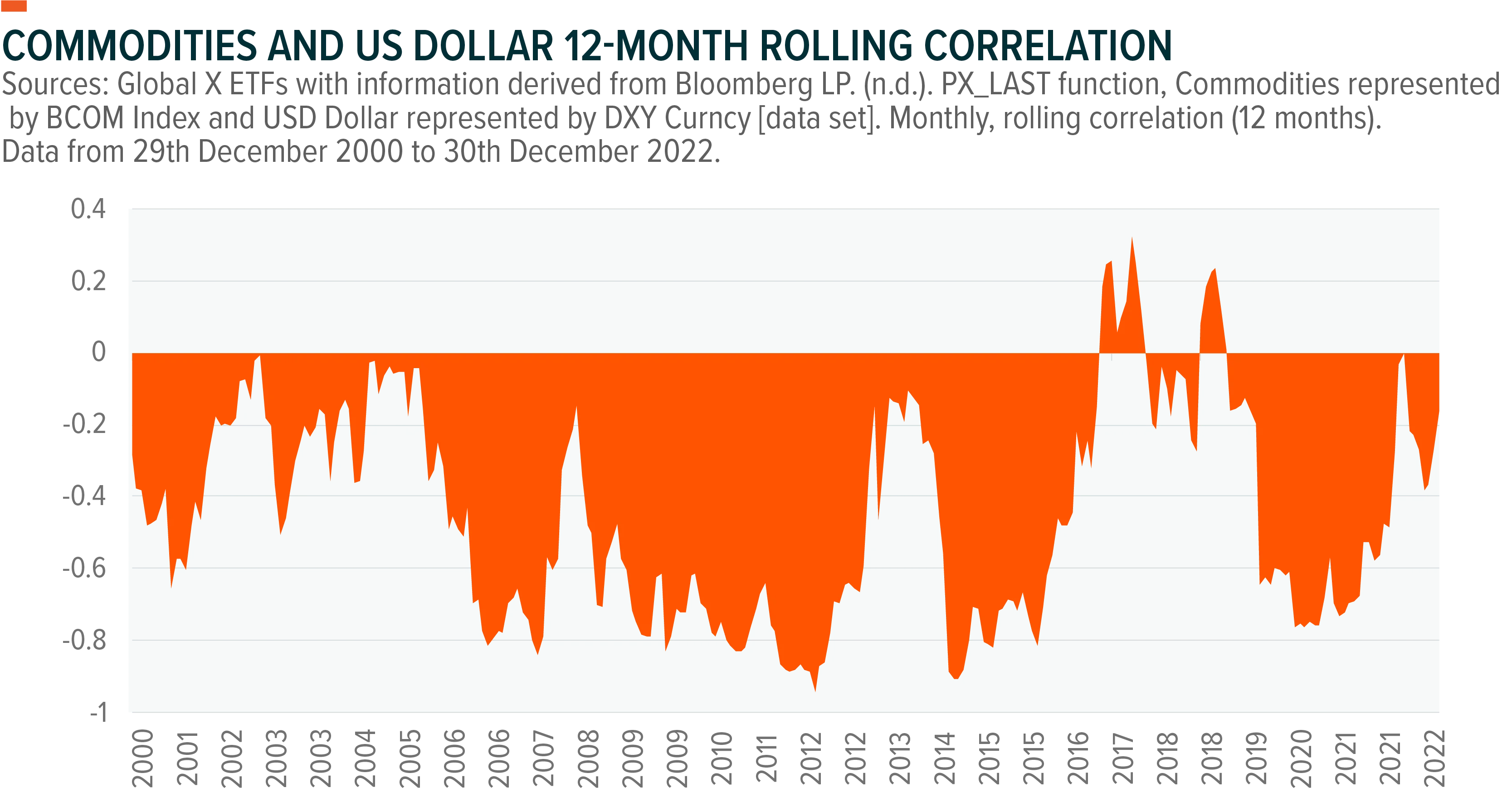
Commodities prices tend to fluctuate at a rate that is inversely proportional to the strength of the U.S. dollar, a universal standard for commodity pricing. Due to their inherent value, commodities can be viewed as a hedge against inflation and tend to gain value when consumer prices rise.
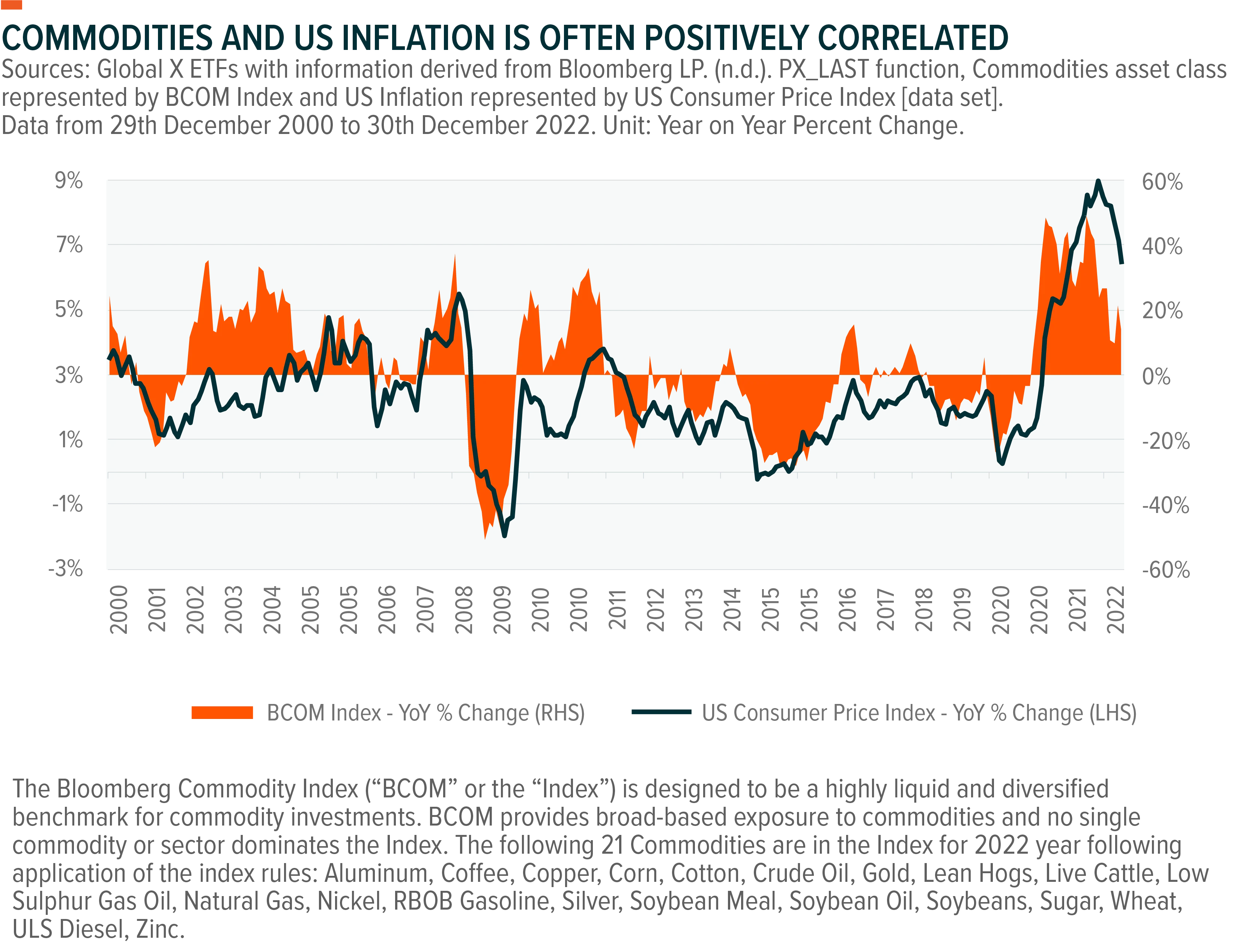
Commodities are cyclical. Their prices generally rise and fall based on economic activity. Commodities have shown consistent late-cycle appreciation over the business cycles. Late in a business cycle, inventory is low, and supply is lower than during expansion.6
Supercycles are decades-long commodities price booms and busts triggered by supply and demand imbalances. For example, when an unindustrialized country or region begins to industrialize, its demand for commodities increases along with its competition for global supplies. As demand increases faster than supply, prices rise. Structural deficiencies can be a factor in the higher prices.
The global economy’s transition to clean energy, including electric mobility, wind and solar, and grid upgrades, may spark a new commodities supercycle given the essential roles that they play in cleantech.7
How to Gain Exposure to Commodities
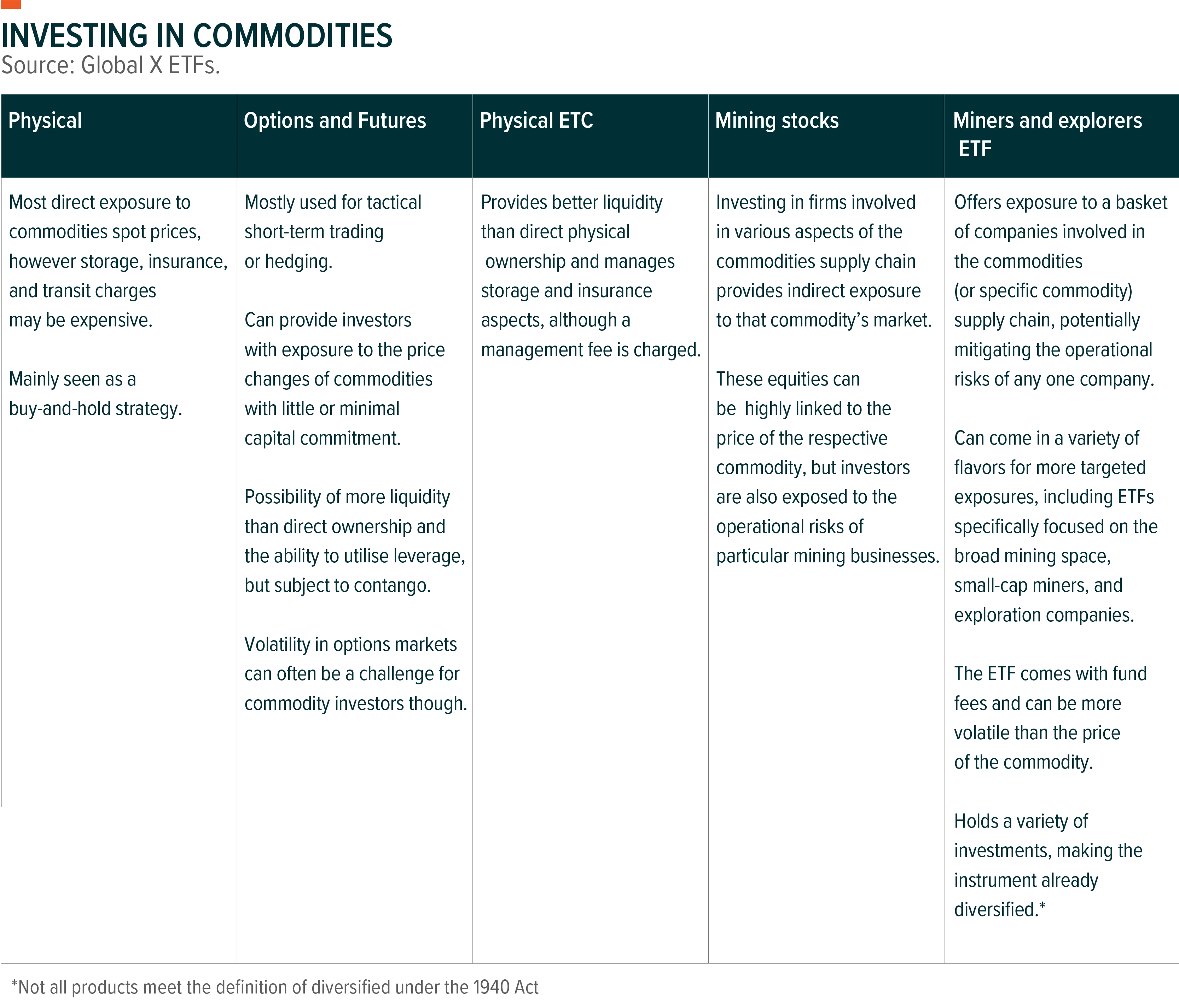
There are multiple ways to invest in commodities depending on the type of exposure an investor wants. Derivatives are the most common instruments used. Futures, forwards, options, and swaps are all available forms of commodity derivatives. One downside of futures is the potential for contango, when futures prices of a commodity are higher than the spot (current) price. This dynamic can erode gains over time, even if the spot price of the commodity rises.
Investors can buy and hold physical commodities if they can handle storage and the associated storage costs. Also, investors can gain exposure to commodities indirectly by purchasing mining companies’ stocks, which also means exposure to idiosyncratic company risks.
Given commodities’ complexity, ETFs are an efficient investment vehicle for investors to find direct and indirect exposure to a single commodity or a diversified group.
An ETF on mining stocks can indirectly track commodity prices. Due to fixed extraction costs, these stocks are leveraged plays on commodities. Miners can increase production as profits rise, employing operating leverage to improve earnings in bullish markets. For this reason, despite producing higher levels of volatility than their underlying commodities, mining stock ETFs are often an attractive solution for investors to express views of positive sentiment in the commodity markets.
Commodities continue to be an attractive potential hedge against inflation and store of value in times of economic downturns and geopolitical instability, which is why many investors are interested in purchasing them. Since they have had negative correlations with the US dollar, they are an asset that can help diversify a portfolio. Finally investing in different commodities, for example base metals, uranium, corn, etc., can provide a broad exposure to a wide range of industries, including mining, agriculture, energy, and more.
Related ETFs
URA – Global X Uranium ETF
COPX – Global X Copper Miners ETF
GOEX – Global X Gold Explorers ETF
SIL– Global X Silver Miners ETF
EART– Global X Disruptive Materials ETF
LIT– Global X Lithium & Battery Tech ETF
Click the fund name above to view current holdings. Holdings are subject to change. Current and future holdings are subject to risk.