

After several years of oversupply and depressed prices, the lithium market is showing signs of entering a new growth cycle. Rapidly accelerating demand from grid-scale battery energy storage, alongside continued electric vehicle (EV) adoption, is tightening supply balances and improving the outlook for established lithium producers.1 The outlook could strengthen further: global lithium demand could more than double by 2030, while projected supply deficits through 2027 and limited excess capacity could support a more favorable pricing environment.2,3
We believe these conditions could support a more durable recovery across the lithium and battery technology industry. Unlike previous cycles driven predominantly by EV adoption, today's demand is supported by a broader electrification investment cycle, while expanding mining capacity remains time-consuming and capital-intensive. For established producers, a sustained improvement in lithium prices could translate into higher margins, stronger cash flows, and meaningful earnings growth.
Key Takeaways
Lithium demand could more than double by 2030, driven by the rapid acceleration in energy storage applications as well as sustained adoption of EVs.4
Supply constraints could sustain a recovery in lithium prices, as projected near-term deficits and lengthy mine development timelines limit the industry's ability to respond quickly to rising demand.5
Higher lithium prices could drive substantial earnings upside for producers, particularly established ones with competitive operating costs and existing production capacity.
Energy Storage Is Reshaping Lithium Demand
Historically, investors have viewed lithium primarily as an EV story. That is changing as electrification expands well beyond automobiles. One catalyst is the surge in AI-related capital investment, which is accelerating demand for power infrastructure, grid modernization, and energy storage.6 As battery energy storage systems become increasingly essential to meeting growing electricity needs, lithium is emerging as a critical component of a much broader electrification investment cycle.
The numbers illustrate this shift. Global annual energy storage installations are projected to reach 188GW in 2026, up 45% year-over-year (YoY), before surpassing 200GW in 2027.7 By 2036, cumulative energy storage installed capacity could reach approximately 3.1TW, nearly ten times 2025 levels.8 This installation growth is substantially outpacing EV adoption, with global EV sales projected to increase just 7% in 2026.9 We believe energy storage installations could grow even faster than projected were it not for near-term grid connection delays and other infrastructure bottlenecks, which slow the development of the data center and power projects that would deploy storage.
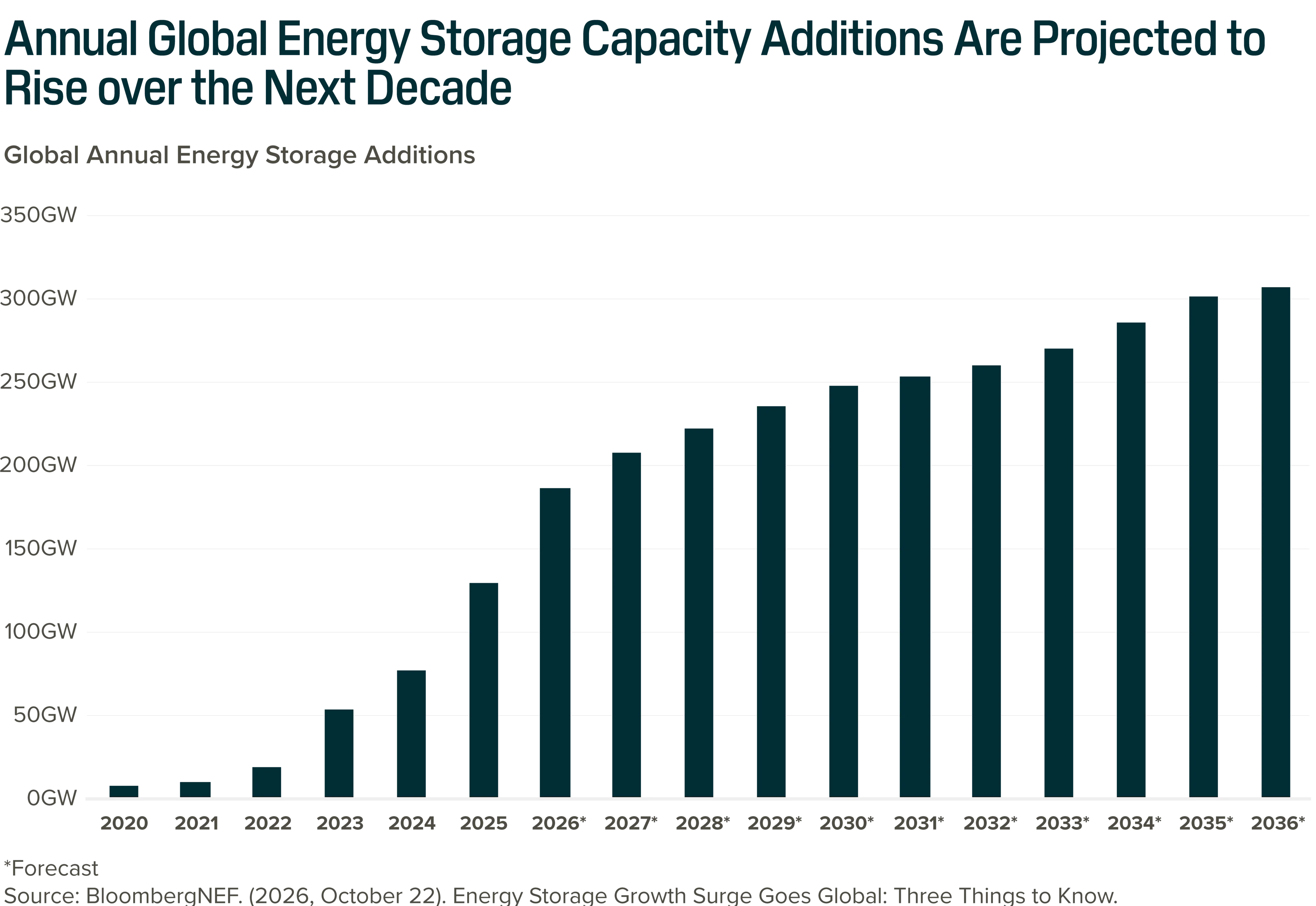
This expanding demand base could make lithium consumption less dependent on any single end market or geography. Unlike EVs, which can be sensitive to consumer spending and policy, battery storage investment is increasingly supported by utility capital expenditure programs and demand for grid flexibility, which could make storage-related lithium demand more resilient.
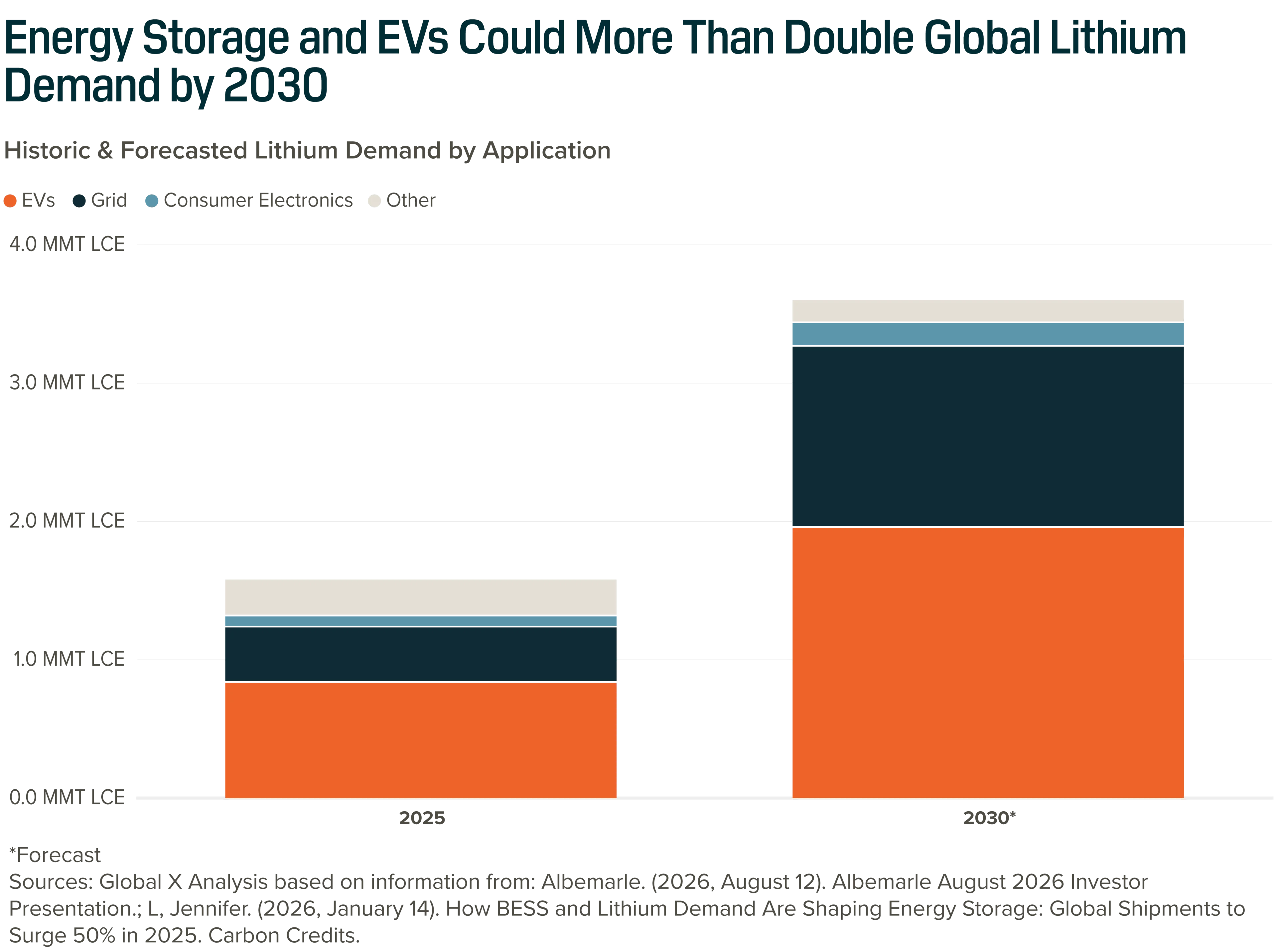
This shift is helping expand the outlook for lithium consumption. Global lithium demand is projected to increase from approximately 1.6 million metric tonnes (MMT) of lithium carbonate equivalent (LCE) in 2025 to as much as 3.6MMT by 2030, with energy storage potentially accounting for 36% of total demand by the end of the decade.10,11 Demand forecasts have been revised upward as energy storage installations have gained pace. For example, lithium mining major Albemarle projects 2030 lithium demand to range from 2.9MMT LCE to 3.6MMT LCE, up from its November 2025 forecast for 2.5MMT LCE to 3.3MMT LCE, attributing much of the improved outlook to stationary energy storage.12,13
Lithium Supply Response Could Fall Short of Long-Term Demand
As lithium demand accelerates, the mining industry faces the challenge of rapidly expanding production capacity following several years of weak prices, reduced capital investment, and delayed projects. While producers are beginning to respond, bringing enough new supply online to meet long-term demand could prove difficult.
Major lithium producers are already committing capital to new capacity, which we believe signals confidence in the demand outlook. In July 2026, SQM and Wesfarmers approved a A$1.4 billion expansion of the Mt Holland project in Western Australia, which is expected to roughly double concentrate output to 760,000 tonnes per year beginning in 2030.14 PLS Group followed in October, committing about A$1.9 billion to expand Pilgangoora, targeting roughly 2 million tonnes a year, with first production expected in late 2029.15,16
Some curtailed capacity could restart relatively quickly in a higher price environment, but even projects already under development face permitting, financing, and construction risks that could delay their contribution to global supply.17
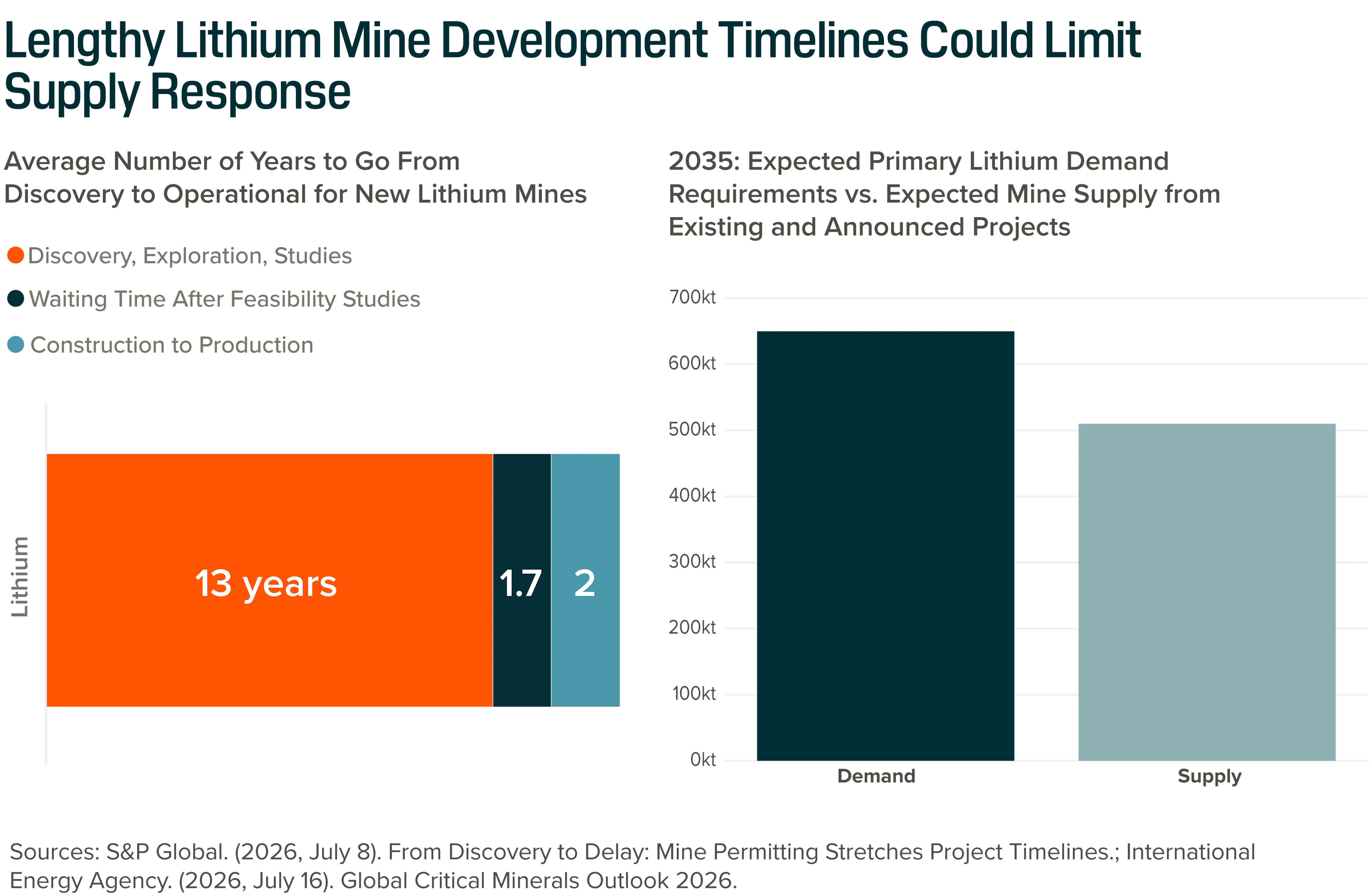
These challenges are reflected in the industry's long development timelines and projected supply shortfalls. New lithium mines take roughly 17 years on average to progress from discovery to production, while projected primary mine supply from existing and announced projects could fall roughly 22% short of requirements by 2035.18,19 Looking further ahead, meeting global demand through 2050 could require the equivalent of 134 additional lithium mines, before any contribution from recycling.20
In our view, these supply challenges could compound over time, limiting how quickly new supply can meet rising demand and increasing the strategic value of established lithium producers. Companies with operating mines, competitive costs, and the capacity to expand existing operations may be better positioned to capture rising demand.
Tightening Supply Could Support a Lithium Price Recovery
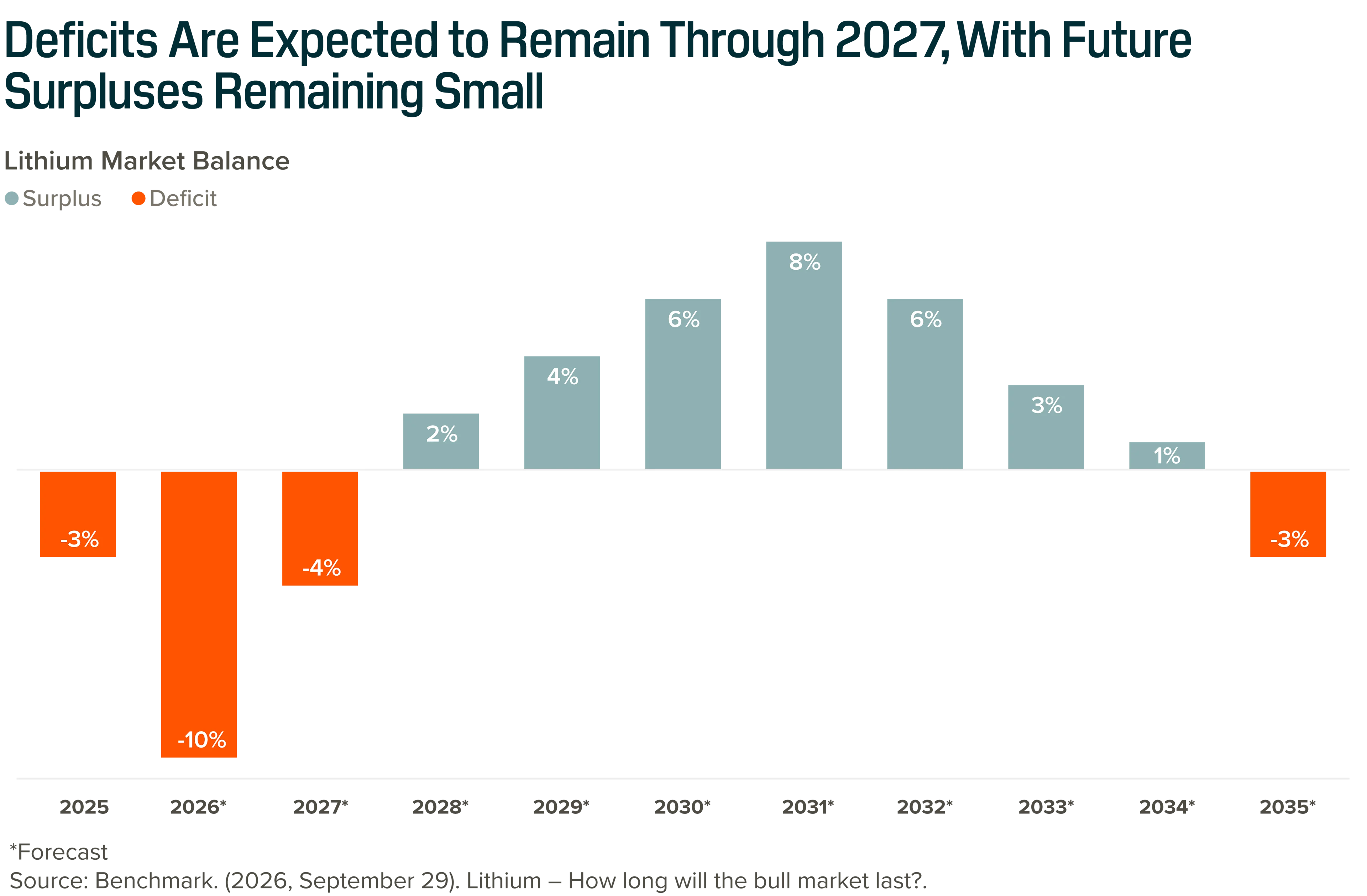
We believe accelerating demand and a lagging supply response could keep the market in deficit through at least 2027, supporting higher lithium prices.21
In the past year, China’s lithium chemicals inventory – the world’s largest and the one with the most impact on sentiment and prices – has struggled to return to July 2025 levels, with levels down 30% since last year’s peak.22 Notably, in 2026, the typical pattern of building inventory in the first half of the year was absent.23 The continued decline was driven by rising demand alongside a mix of regulatory hurdles and new mine execution risks. China also operated in a stricter regulatory environment in 2025, which has delayed the return of full operations for major producers such as CATL. Specifically, CATL’s Jianxiawo mine, China’s largest by capacity, has been shut for most of the past 14 months, with the latest closure following regulators’ revocation of its environmental approval. Historically, Jianxiawo accounted for up to 5% of global lithium production.24,25
There have been other notable supply disruptions caused by policy shifts, including Zimbabwe’s February 2026 export restrictions on all raw minerals and lithium concentrates.26,27 Given these dynamics, lithium supply has struggled to meet demand, with the market continuing to operate in a deficit in 2026.
Forecasts point to a balance returning in 2028, but the projected surpluses are small, never exceeding 8% through 2034, with a return to deficit forecast in 2035.28 That thin cushion means higher-than-anticipated demand growth or additional supply disruptions could quickly tip the market back into deficit, potentially supporting higher prices. Recent revisions show how quickly that can happen: forecasts that had a 3% surplus in 2026 now show a 10% deficit, largely because storage demand has run ahead of expectations.29,30
Higher Lithium Prices Could Drive an Earnings Recovery
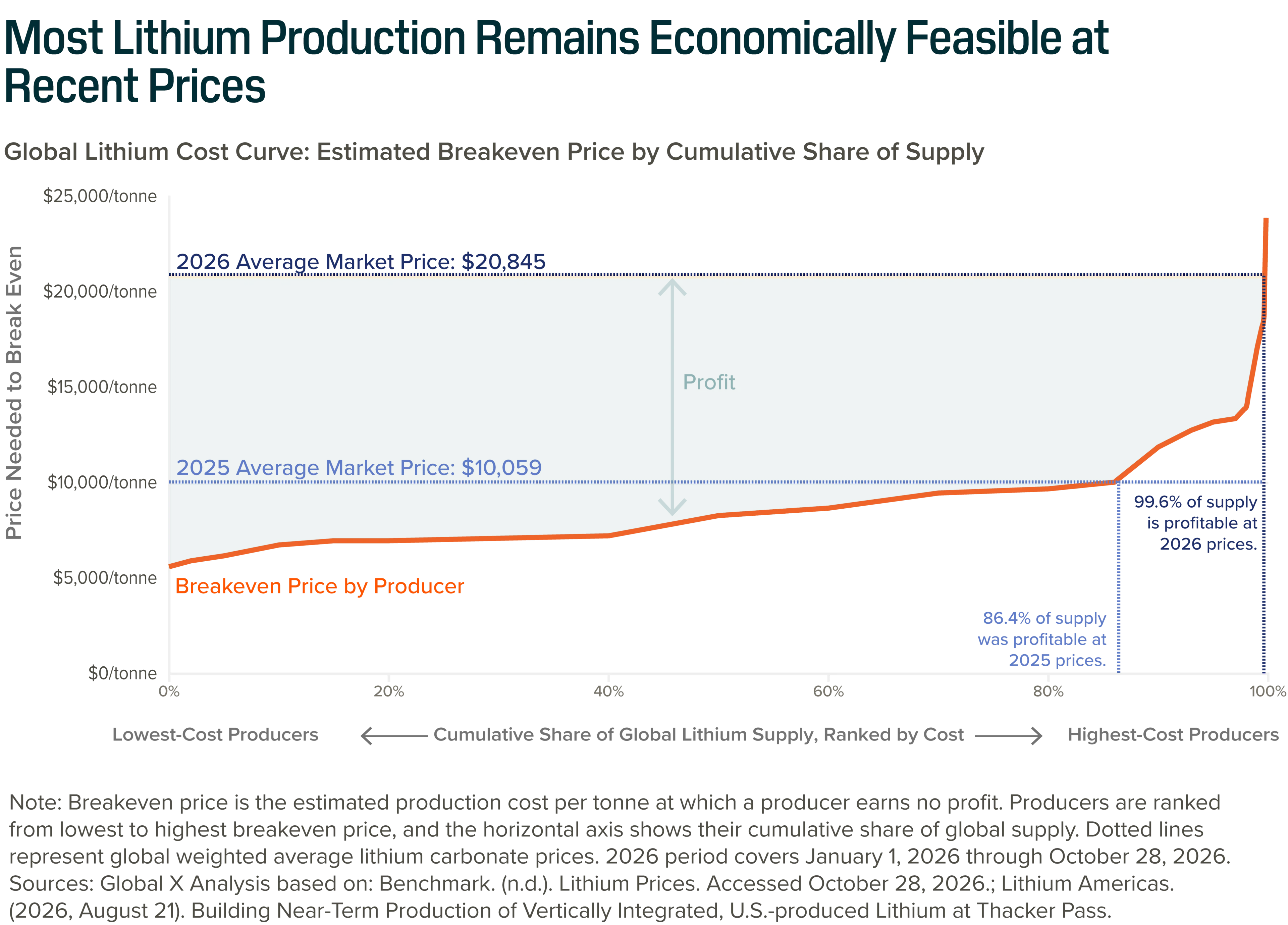
Lithium producers' profitability is highly sensitive to underlying commodity prices, making price movements an important driver of industry margins and earnings. Following a prolonged period of depressed prices, improving demand and tightening supply conditions have helped drive a recovery in lithium prices, potentially creating a more favorable operating environment for producers.
So far in 2026, the average global lithium carbonate price was $20,845/tonne, more than double the 2025 average of $10,059/tonne.31 At that price, unit economics for individual projects are favorable, with more than 99% of modeled production carrying operating costs below $20,845 per tonne of LCE.32 This suggests that stronger lithium prices could improve margins across a substantial portion of existing supply.
Recent earnings illustrate this potential operating leverage. In Q2 2026, Albemarle's net income totaled $480 million, up nearly 2,000% YoY from $22.9 million in Q2 2025, an increase the company attributed largely to higher lithium prices.33 Although operational improvements also contributed, the results demonstrate how recovering lithium prices can translate into substantial earnings growth for established producers. SQM’s net income rose to $660 million in Q2 2026, up 646% YoY from $88.4 million, on stronger sales volume and higher average lithium prices.34
Conclusion: The Investment Case for Lithium Could Be Strengthening
Energy storage has joined electric vehicles as a major source of demand, and global lithium demand could more than double by 2030.35 Meeting that demand will likely require a new cycle of mine investment, and new capacity can take years to bring online.36 In the meantime, the market is forecast to remain in deficit through 2027, and the surpluses projected afterward are small, leaving little cushion if demand or supply surprises.37 With most production costing well below recent prices, producers could see stronger margins than in 2025, though prices may remain volatile.38 Investors with exposure to the lithium and battery value chains may be positioned to benefit from this next phase of the industry.
Related ETFs
LIT – Global X Lithium & Battery Tech ETF
Click the fund name above to view current holdings. Holdings are subject to change. Current and future holdings are subject to risk.