SpaceX is laying the groundwork to challenge established U.S. wireless carriers and expand Starlink’s role in everyday mobile connectivity. Its planned acquisition of low-band spectrum from Grain Management could help integrate Starlink’s global satellite network with terrestrial mobile connectivity, opening a significant recurring revenue opportunity in the U.S. mobile market.1
Beyond wireless competition, the move illustrates how space infrastructure is increasingly becoming the foundation for new commercial avenues and disruptions in established sectors on earth. A nationwide Starlink mobile network could also spur investment in terrestrial network infrastructure, creating potential demand for cell towers, network equipment, and supporting digital infrastructure.
For investors, we see complementary opportunities in the space infrastructure enabling new connectivity services and the terrestrial infrastructure needed to support them. The Global X Space Tech ETF (ORBX) and the Global X Data Center & Digital Infrastructure (DTCR) provide exposure to these two complementary investment themes.
Key Takeaways
SpaceX’s planned low-band spectrum acquisition brings Starlink closer to offering a full-fledged U.S. mobile carrier service that could challenge incumbent U.S. carriers.
A hybrid satellite-terrestrial network could substantially expand SpaceX’s recurring revenue opportunity, with potential applications extending from smartphones to connected machines.
ORBX offers exposure to the space infrastructure opportunity, while DTCR provides exposure to the terrestrial digital infrastructure that could support this network expansion.
Spectrum Deal Brings Starlink Closer to U.S. Mobile Market Entry
SpaceX is taking another step toward turning Starlink from a satellite broadband service into a broader mobile connectivity platform. Its planned acquisition of a nationwide portfolio of low-band spectrum from Grain Management could help SpaceX combine satellite coverage with terrestrial mobile service, bringing Starlink closer to competing directly with established U.S. wireless carriers.2
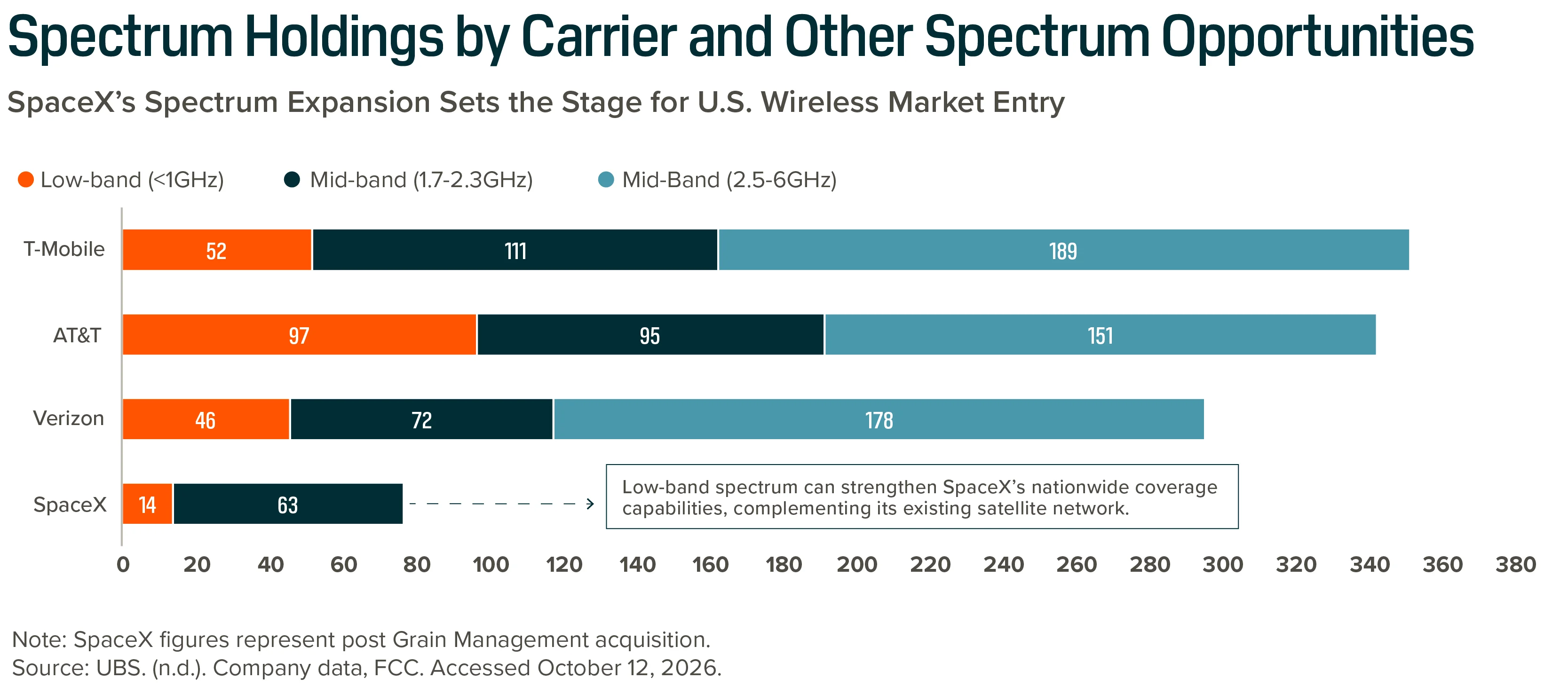
The deal covers up to 14 megahertz (MHz) of paired spectrum in the 800 MHz band, building on SpaceX’s earlier $17 billion spectrum acquisition from EchoStar and regulatory progress toward expanding its direct-to-device satellite service.3 Together, these moves point to a strategy that extends beyond connecting households and businesses to satellite broadband and toward serving the much larger market for everyday mobile connectivity.
Why Low-Band Spectrum Matters
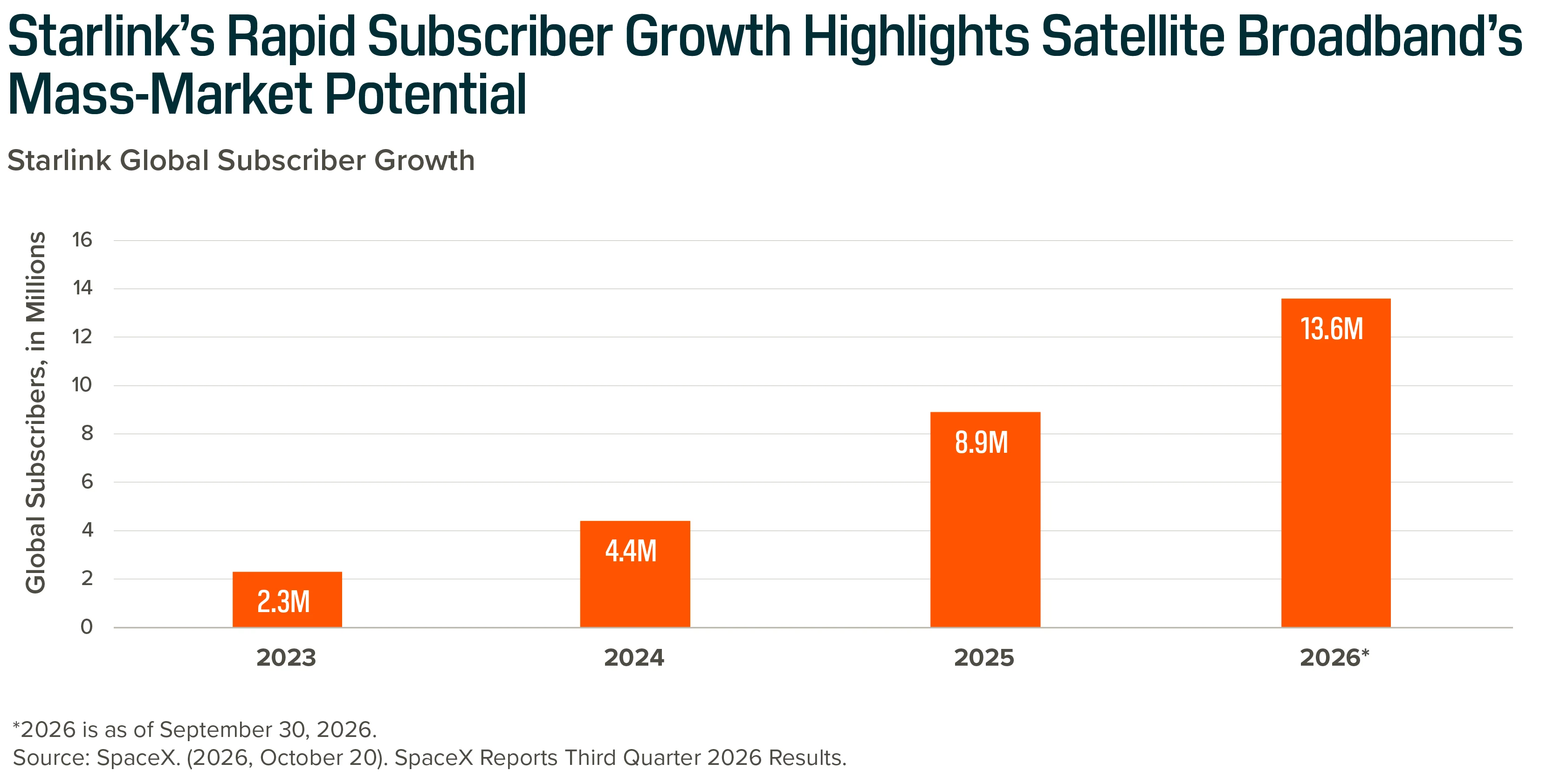
Starlink already operates a network of more than 11,000 satellites in low Earth orbit. Its satellite broadband service reaches customers across 205 countries and had an estimated 13.6 million subscribers as of September 2026, including more than 4 million in the U.S.4 The spectrum acquisition could help extend that existing connectivity platform into a broader mobile offering.
The challenge is that satellite coverage alone can struggle to deliver consistent connectivity indoors and in densely built environments, where buildings and other physical obstructions can weaken or block signals. Low-band spectrum helps address this limitation. Its signals travel farther and penetrate buildings more effectively than higher-frequency signals, making it particularly valuable for broad mobile coverage.
Combining the two networks could give SpaceX complementary coverage layers. Terrestrial infrastructure could support mobile connectivity in populated areas, while Starlink’s satellites could extend service into remote locations beyond the reach of conventional cellular networks. This hybrid model could strengthen Starlink’s competitive position while opening a substantial new recurring revenue opportunity.
Acquiring spectrum, however, is only one part of building a mobile network. SpaceX would still need to deploy terrestrial equipment, integrate satellite and ground coverage, support compatible devices, and secure the necessary regulatory approvals. The deal is an important step toward that ambition, but the scale, timing, and economics of a nationwide service remain uncertain.
A New Multibillion-Dollar Revenue Frontier
SpaceX would be entering one of the largest and most established consumer markets in the world. The three largest U.S. wireless carriers—Verizon, AT&T, and T-Mobile—collectively serve roughly 410 million subscribers and generated over $350 billion in combined revenue in 2025, underscoring the scale of the opportunity.5
Importantly, SpaceX would not need to capture a significant share of this market to create a meaningful new revenue stream. The U.S. has an estimated 324 million smartphone users, with T-Mobile and AT&T reporting monthly service revenue of roughly $51–57 per postpaid phone subscriber in Q4 2025.6,7 At an illustrative $50 per month, capturing just 10 million mobile lines could generate $6 billion in annual service revenue—equivalent to more than half of SpaceX's reported $11.4 billion connectivity revenue in 2025.8
Starlink could also bring a differentiated offering to this market. Combining conventional mobile connectivity with satellite coverage in remote and underserved areas could extend service beyond traditional cellular network footprints, potentially establishing wireless mobility as another meaningful revenue engine for SpaceX.
That advantage could become even more valuable as the next wave of connectivity demand shifts from people to machines. As physical AI advances, autonomous vehicles, humanoids, drones, and industrial equipment could significantly expand the universe of connected devices. Also, many of these applications operate across geographically dispersed environments where consistent network coverage remains challenging, and a hybrid satellite-terrestrial architecture could help bridge these gaps.
That said, execution on the buildout of such a network could take time. SpaceX would still need to deploy terrestrial infrastructure, integrate satellite and ground coverage, support compatible devices, and build the capabilities required for a mass-market mobile service. Low-band spectrum improves coverage, but capacity in densely populated areas remains a separate challenge. The proposed acquisition also remains subject to FCC approval.
From Space Infrastructure to Terrestrial Networks
SpaceX's wireless ambitions bring two complementary investment opportunities in focus: monetizing satellite infrastructure and networks through new services and expanding the terrestrial infrastructure needed to deliver them.
The Space Infrastructure Layer
SpaceX’s move illustrates how expanding space infrastructure can unlock new commercial markets and revenue streams. This can make existing space infrastructure more economically valuable, encouraging further investment in satellites, launch services, and enabling components, reinforcing a broader cycle of commercialization and infrastructure growth across the space tech ecosystem.
The Terrestrial Backbone of Connectivity
Space-based connectivity also depends on infrastructure on the ground. A nationwide Starlink mobile offering could drive demand for tower leases, equipment installations, and network interconnection. For tower operators, adding tenants to existing sites can generate attractive incremental margins with limited additional operating costs. As connectivity expands beyond consumers to autonomous machines and industrial systems, rising network traffic could further drive investment in network densification, equipment upgrades, and tower capacity, creating additional opportunities across digital infrastructure.
Global X Data Center & Digital Infrastructure ETF
Conclusion: Rethinking Connectivity for the Future
SpaceX may be entering the wireless market just as its addressable market begins expanding from connecting people to increasingly connecting intelligence machines. As physical AI and autonomous systems proliferate, and data traffic rises, demand for ubiquitous connectivity could accelerate, positioning satellite networks as an increasingly critical layer of broader digital infrastructure. In our view, this shift marks another step in the commercialization of space technology, unlocking new markets, recurring revenue opportunities, and investment across the broader space ecosystem.
Related ETFs
ORBX – Global X Space Tech ETF
DTCR – Global X Data Center & Digital Infrastructure ETF
Click the fund name above to view current performance and holdings. Holdings are subject to change. Current and future holdings are subject to risk.