
Product ResearchArtificial IntelligenceDefense Tech
Why Multi-Theme Investing? Why GXDW?
T
Tejas Dessai
Apr 1, 20257 min read
Get the latest news and updates from our team.

Ido Caspi
Benjamin Lavine
Tejas Dessai
SEI Investments Distribution Co. (1 Freedom Valley Drive, Oaks, PA, 19456) is the distributor for the Global X Funds.
Check the background of SIDCO and Global X's Registered Representatives on FINRA's BrokerCheck.
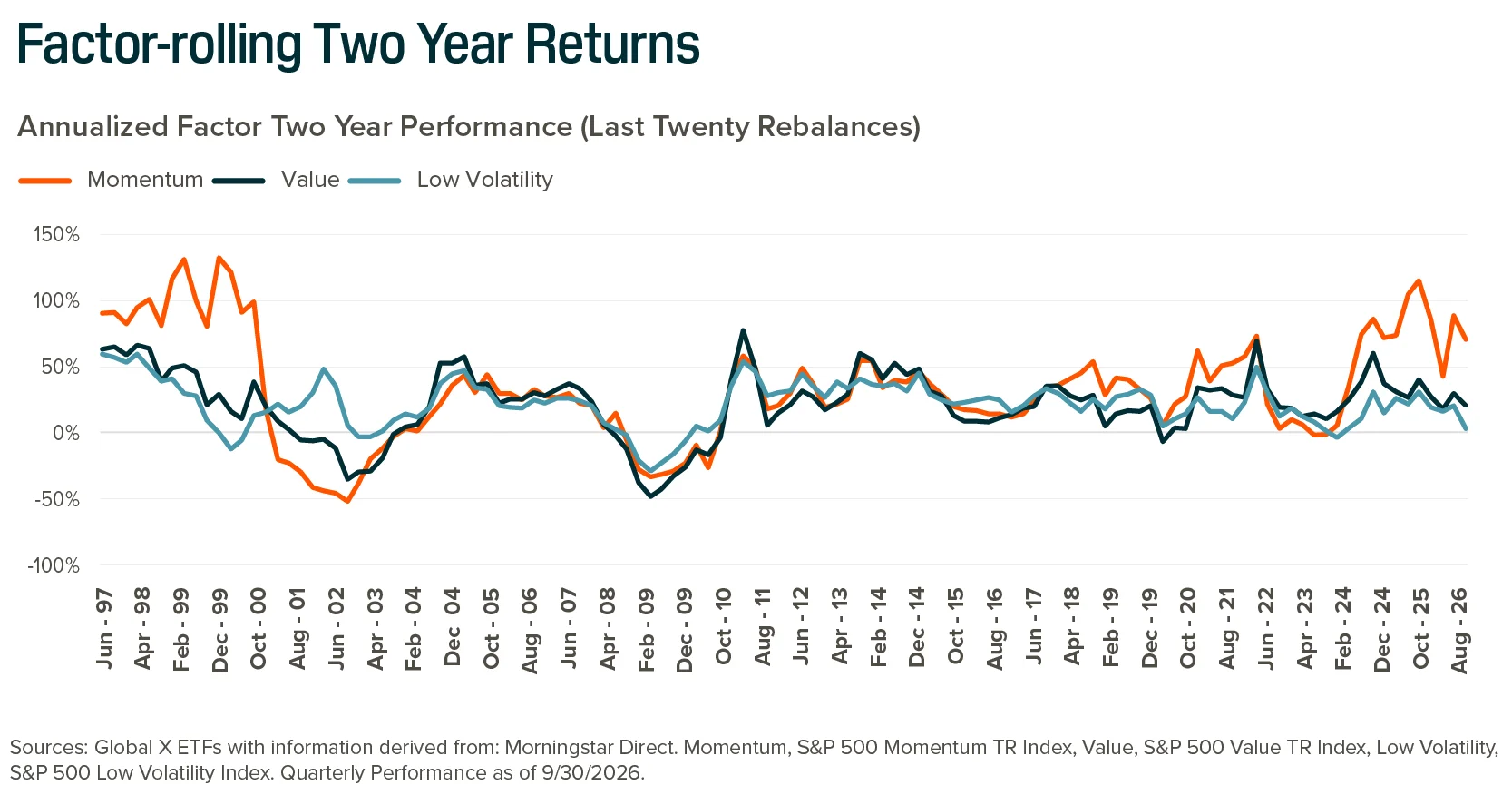
Global X’s Adaptive U.S. Factor ETF (AUSF) strategically allocates across three factor-based sub-indices: momentum, low volatility, and value, presenting an opportunity to capture overlooked and undervalued segments of the market amidst a rapidly changing macroeconomic environment. Markets move in cycles, and factors rotate in and out of favor as economic and investment conditions change. Enthusiasm has lifted many momentum stocks to fresh highs, continuing a trend of strength over the last couple of years. This resilience has been largely driven by the rapid advancements in artificial intelligence, even as macro and geopolitical headwinds continue to build. A sharp reversal can leave investors caught off guard, as seen throughout the month of July as the broader momentum factor sold off, returning -18.98%1.
For investors concerned about a pull back, factor-based strategies like AUSF may offer a more resilient path forward as markets continue to hover near all-time highs. AUSF attempts to capitalize on dislocations in the market while identifying overlooked opportunities given its contrarian rebalancing approach seeking to capture potential mean reversion.
The momentum and value factors have historically been the two factors most prone to sharp reversals, while low volatility is built to act as a stabilizer through market turbulence.
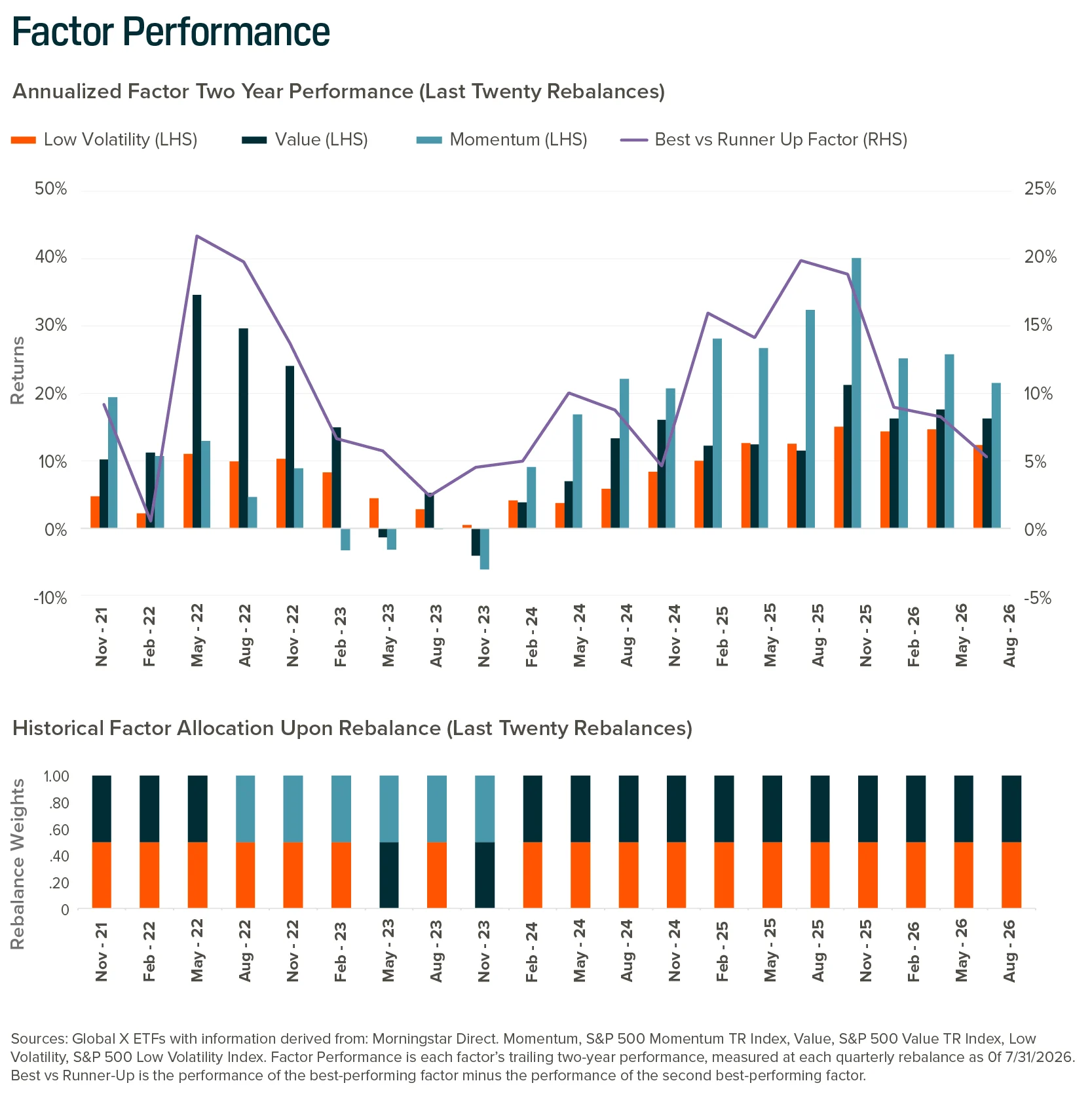
The Global X Adaptive U.S. Factor ETF (AUSF) tracks the Adaptive Wealth Strategies® U.S. Factor Index, which takes a rules-based approach and rotates into underperforming equity factor sub-indices - momentum, low volatility, and value - based on trailing annualized two-year performance.
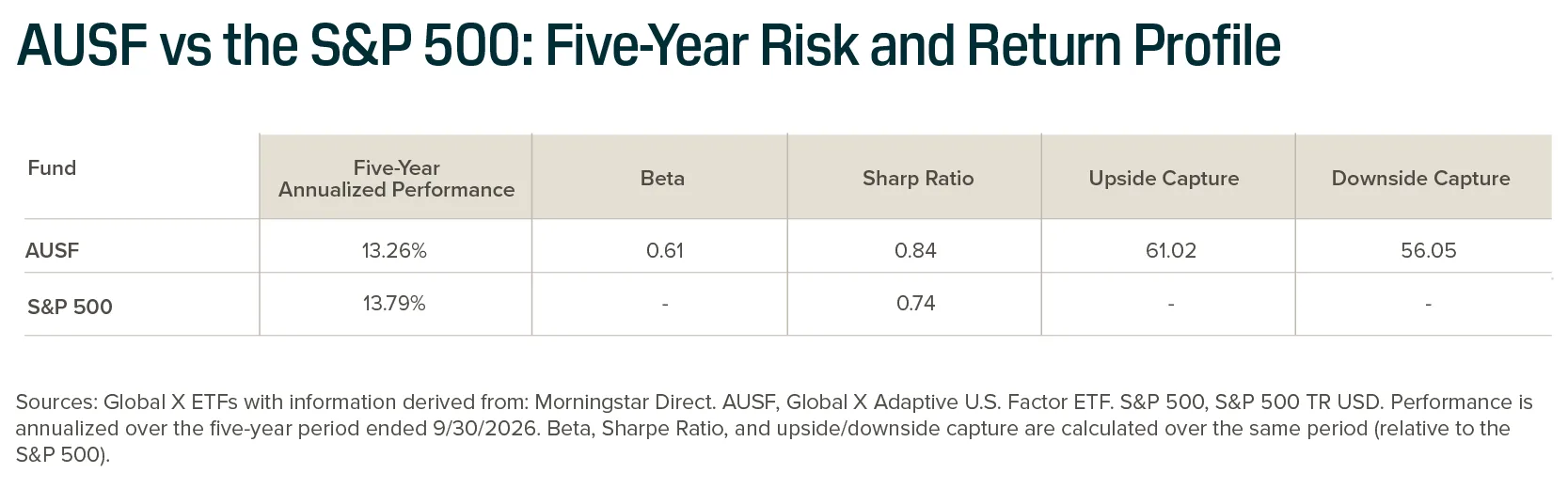
AUSF's contrarian structure has enabled it to perform in-line with the S&P 500 on an annualized five-year basis through September 30th, 2026, with a lower beta2. This positions it as a compelling low-beta core U.S. equity allocation for risk-conscious investors seeking a potentially smoother return profile.
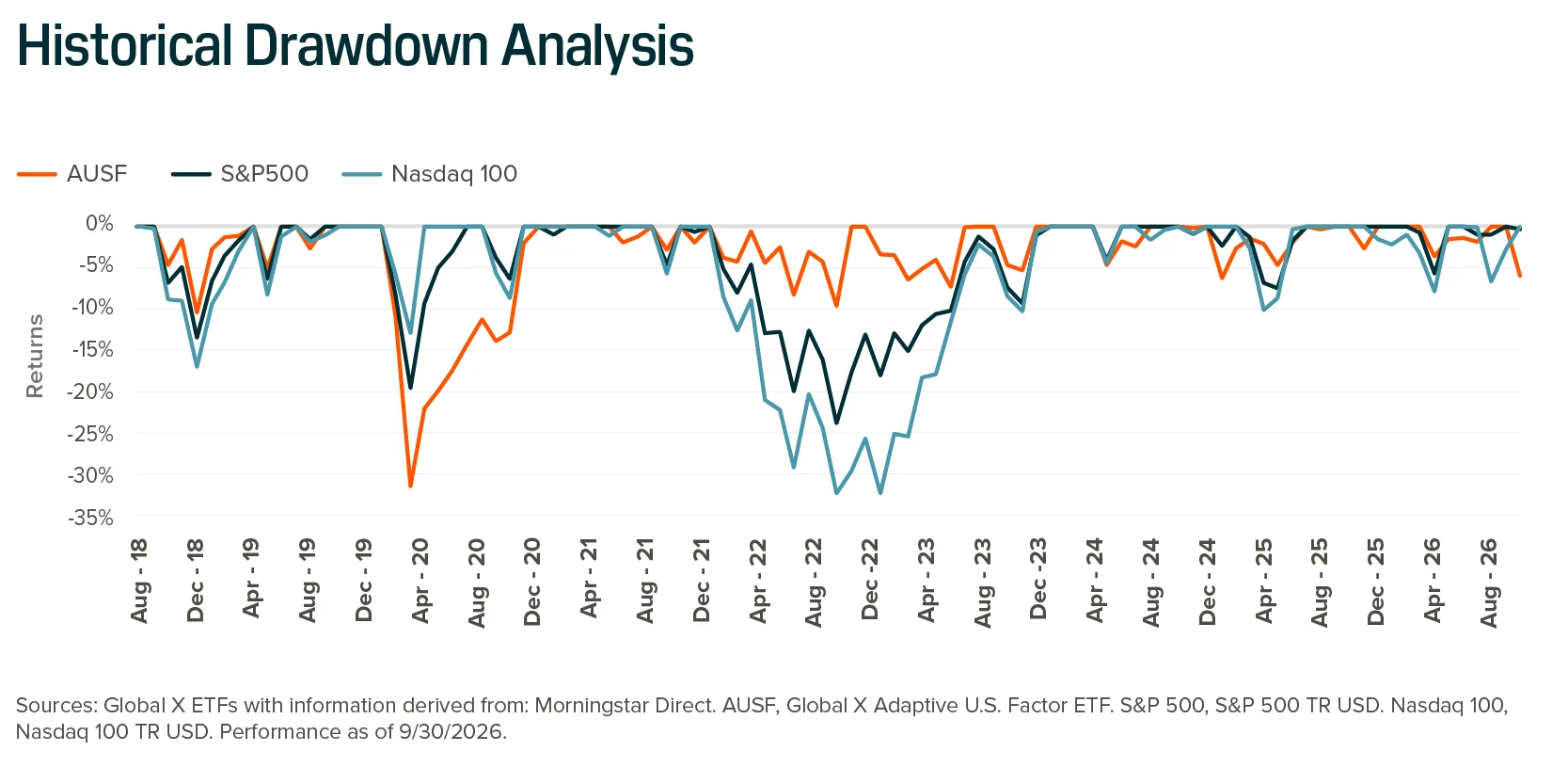
Throughout history, markets have navigated repeated cycles of booms and busts including modern examples like the 2000 dot-com bubble, the 2007-2009 Global Financial Crisis, and the 2020 Covid-19 pandemic. Each of these has reinforced the same point, momentum and value are the two factors most susceptible to sharp reversals in either direction, while low volatility is built to mitigate the worst of the drawdown. Momentum tends to lead a rally because it holds the market’s recent winners, while value lags, weighed down by the inexpensive out-of-favor names it owns. When leadership turns, often at a macro or rate inflection, the dynamic reverses. Momentum is left holding the stocks that are giving back gains, while value’s wider valuation gap can fuel a sharp catch-up.
This concept of reversion is visible across all three market events, and that consistency across unrelated shocks is the foundation for a dynamic multi-factor approach that targets underperforming factors to capture the potential for mean reversion, as factors fall into and out of favor.
Momentum stocks have led the market over the past three years, with much of that leadership running on a single narrative: artificial intelligence. A contrarian, multi-factor approach takes the other side deliberately. Instead of buying into names that already had their moment, it leans toward areas that have been passed over.
That view rests on more than a preference for inexpensive assets. The concern with tilting toward what a rally has passed over is that those areas may be affordable for a reason, with eroding fundamentals supporting the discount. When Arnott, Harvey, Kalesnik, and Linnainmaa examined value's long drawdown through mid-2020, they found close to the opposite3. Essentially the entire decline was a revaluation story rather than a deterioration in fundamentals, as value grew steadily cheaper relative to growth and reached the widest valuation spread in their sample by early 20204. That distinction is what makes the contrarian case more than a bet on sentiment. Cheap areas of the market may carry their discount forward as a potential tailwind, so as the valuation gap closes, the same gap that hurt performance on the way down can be what drives it back up.
The Global X Adaptive U.S. Factor ETF (AUSF) – attempting to replicate the Adaptive Wealth Strategies U.S. Factor Index - implements a rules-based passively managed approach that dynamically allocates to underperforming factors (momentum, low volatility, and value) based on trailing annualized two-year performance. If the performance difference between the top performing factor and the second-best performing factor is greater than 2%, the strategy will allocate an even 50-50 split to the bottom two performing factors. If the difference is less than 2%, the fund allocates 20% to the top performing factor with a 40/40 split between the bottom two performing factors. Its contrarian rebalancing approach positions the fund to potentially benefit from mean reversion, broader market divergence, and sector rotations.
Momentum’s strong performance has driven a meaningful gap versus value and low volatility, but that spread has since narrowed. Value has improved and market leadership has broadened toward more attractively valued areas. This kind of shift in factor leadership is what AUSF’s structure is built to capture.
AUSF’s structure has kept the strategy allocated in low volatility for almost its entire history, supporting a more muted risk profile relative to the S&P 500 - with a beta of 0.61 and Sharpe ratio of 0.84, versus 0.74 for the S&P 5005. In fact, low volatility has been part of the portfolio’s exposure in every quarterly rebalance except three since its inception in 2018. In normal, upward trending markets, it would be rare for low volatility to be the top performing factor, and the three exceptions share a common trigger. In each case low volatility rotated out of the portfolio in the wake of a broad market sell off: May 2020, after the COVID drawdown, and again in May and November 2023, once the trailing two-year lookback had come to reflect the 2022 sell-off rather than the strong 2021 that preceded it. Through most environments the strategy has retained its lower-volatility positioning, seeking the more muted risk profile that has defined most of its history. It has moved away from that positioning only in the narrow set of periods that followed major selloffs, shifting toward the factors better positioned to participate in a potential recovery.
The benefits of this structure were exemplified during the 2022 market sell off. Heading into the year, AUSF held a 50/50 allocation to low volatility and value allowing the fund to better mitigate the broader selloff compared to the S&P 500. AUSF declined just -8.26% during that period, compared to a -19.96% decline for the S&P 500, while the momentum factor alone fell -18.86%6. As the market began to recover in the second half of the year, AUSF rebalanced into a 50/50 allocation between low volatility and momentum. This positioned the fund to capture the market rally. Momentum went on to return 14.35% over that period, significantly outperforming the S&P 500’s 1.43% gain7. Altogether, this dynamic rotation between factors allowed AUSF to outperform the S&P 500 by more than 15% in 2022, highlighting how the fund’s structure can both mitigate a downturn and capture the recovery that follows8.
AUSF can enhance risk-adjusted returns by improving the balance between upside potential and downside risk. Buying into an out-of-favor factor after a drawdown can offer a level of safety where fundamentals remain intact and prices have declined. In contrast, investors who chase performance by piling into recently high-performing factors often do so just as those trends begin to reverse. AUSF has not only performed in-line with the S&P 500 over the past five years, it has done so with a lower beta. This highlights its resilience across varying market cycles and its ability to deliver more consistent returns over time.
Factor investing is not about timing factors in the short term, but about recognizing and capitalizing on market cycles, which typically lasts 3-5 years. Implementing a rules-based, passively managed factor rotation strategy like AUSF can potentially enhance portfolio outcomes. One study found that allocating to the most out-of-favor factor each year delivered consistent excess returns, whereas chasing the prior year’s top performer often led to underperformance9.
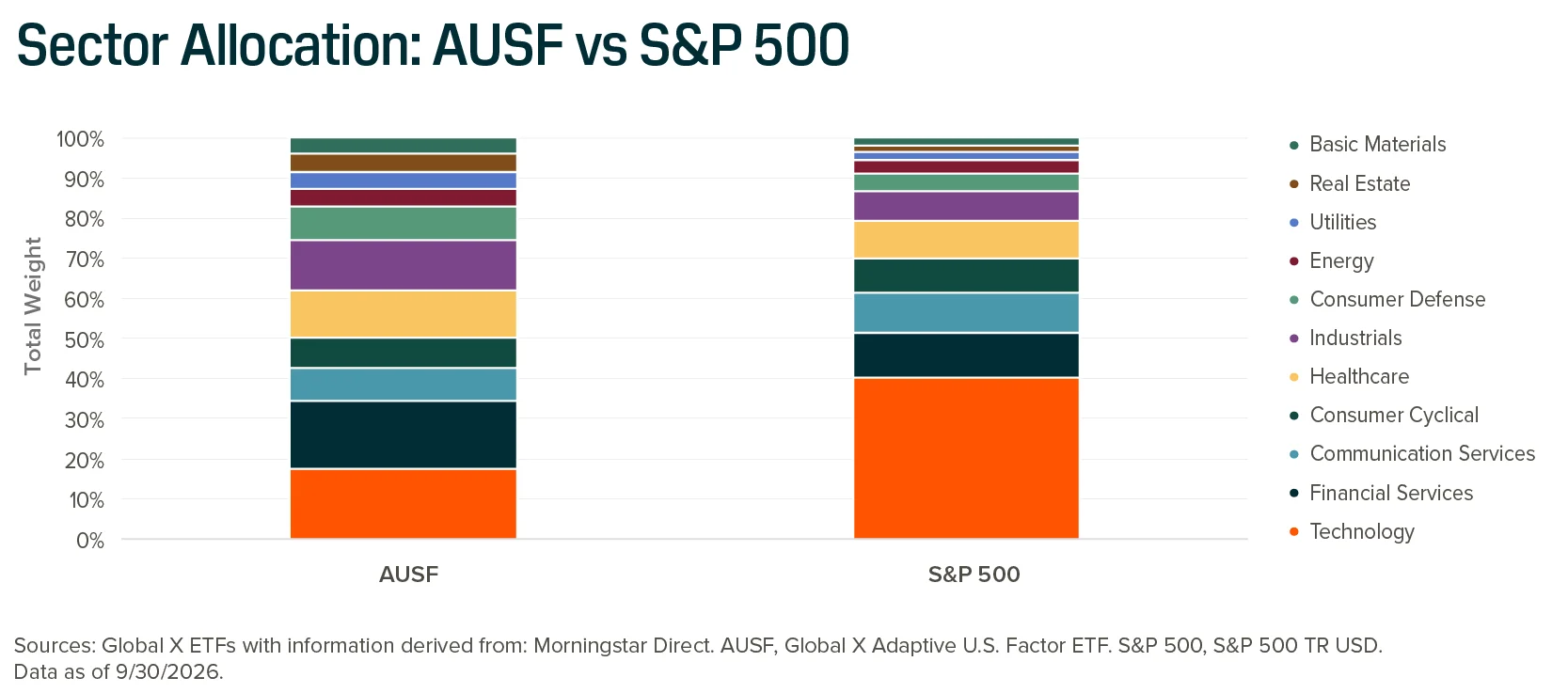
AUSF can act as a low-beta core U.S. equity allocation that helps reduce overall portfolio volatility while complementing growth-oriented or cyclical exposures. As shown in the chart, AUSF maintains a greater breadth in sector exposure relative to the S&P 500, with greater exposure to underrepresented sectors like Financial Services and Industrials, while underweighting Technology. This approach not only has the potential to improve diversification across sectors but can also help reduce concentration risk, with 17.57% of assets in the top 10 holdings compared to 39.06% for the S&P 50010. These traits make AUSF a potential core U.S. equity allocation, diversified both structurally and dynamically, through a rules-based tilt toward areas positioned for a potential recovery paired with wider sector breadth and lower concentration. With the benchmark now unusually concentrated in a single theme, our view is that this combination is what gives AUSF the potential to keep investors in US equities while attempting to cushion the portfolio’s path through periods of market stress.
In a market increasingly driven by headlines, momentum-heavy sectors, particularly technology, have led to recent gains. This has ultimately amplified the concentration risk across traditional benchmarks. AUSF offers a systematic alternative, providing exposure to undervalued and lower-volatility segments of the market that have historically benefitted from mean reversion. By allocating to factors that are out of favor and avoiding performance chasing, AUSF has historically had consistent, risk-adjusted returns across different market cycles. AUSF presents low-beta potential for investors who are seeking diversification away from concentrated exposures like the “Magnificent 7.” In an environment where market trends can reverse quickly, AUSF’s contrarian approach offers potential levels of both volatility reduction and opportunity.
Click the fund name above to view current performance and holdings. Holdings are subject to change. Current and future holdings are subject to risk.
Solactive U.S. Large & Mid Cap Momentum 100 Index TR. Performance Data derived from Morningstar from 7/1/2026-7/31/2026
Per Morningstar as of 9/30/2026.
“Reports of Value’s Death May be Greatly Exaggerated” Robert D Arnott, Campbell R. Harvey, Vitali Kalesnik, Juhani Linnainmaa, 1/8/2021.
Ibid.
Five-Year Risk-Reward Metrics Per Morningstar as of 9/30/2026.
Morningstar Direct, data from 1/1/2022 – 6/30/2022. AUSF, Global X Adaptive U.S. Factor ETF. S&P 500, S&P 500 TR. Momentum, Solactive U.S. Large & Mid Cap Momentum 100 TR Index.
Morningstar Direct, data from 6/30/2022 – 12/31/2022. S&P 500, S&P 500 TR. Momentum, Solactive U.S. Large & Mid Cap Momentum 100 TR Index.
Morningstar Direct, data from 1/1/2022 – 12/31/2022. AUSF, Global X Adaptive U.S. Factor ETF. S&P 500, S&P 500 TR.
“Mean Reversion in Factor Based Investing” Patrick Wolf, 2017.
Morningstar Direct, as of 9/30/2026. AUSF, Global X Adaptive U.S. Factor ETF. S&P 500, S&P 500 TR.
The Global X Nasdaq Dorsey Wright ETF (GXDW) invests in top five themes with the highest relative strength in the market as determined by Nasdaq Dorsey Wright.
The Global X Nasdaq Dorsey Wright ETF (GXDW) invests in top five themes with the highest relative strength in the market as determined by Nasdaq Dorsey Wright.
SpaceX’s proposed spectrum acquisition could challenge incumbent wireless carriers, expand recurring revenue, and drive investment across space technology and terrestrial digital infrastructure.
SpaceX’s proposed spectrum acquisition could challenge incumbent wireless carriers, expand recurring revenue, and drive investment across space technology and terrestrial digital infrastructure.
This month highlights genomics/biotechnology as one of the top trending themes and natural gas as an out-of-favor theme showing possible recovery.
This month highlights genomics/biotechnology as one of the top trending themes and natural gas as an out-of-favor theme showing possible recovery.

