Follow what allocators do, not what they say. With all the talk about the Fed’s next monetary policy moves, one might think that the interest rate trajectory is the most important factor driving risk assets.1 One quarter into 2024, market performance suggests otherwise. At the start the year, the market was pricing in seven rate cuts for 2024. By the April 10th Consumer Price Index (CPI) print, the market was pricing two.2 Yet, the S&P 500 had rallied 9% on the year. In the struggle between the Fed and the innovation economy, the innovation economy seems to be winning.
Markets may move higher on growth and profitability in the coming months rather than the Fed’s decisions. Financial markets stumbled a little bit in April on revised guidance and a modest growth scare, but the economy’s healthy and companies are profitable, the latter historically so.3 An economic regime shift to higher real rates, nominal growth, and profitability might be worth cheering. Markets do not go up in a straight line, and an uptick in volatility may be ahead, but a big positive is that the U.S. economic engine is likely firing on all cylinders.
Key Takeaways:
The innovation economy continues to stymy the Fed’s attempt to slow inflation as the economy mirrors the higher growth period of the 1980s and 1990s.
Higher real rates paired with the current strong nominal economic growth and corporate profitability alone can be positive for financial returns.
Areas with the potential to generate strong returns in that scenario include commodities segments like master limited partnerships (MLPs) and copper miners and themes tied to mid-cycle industrial and technology, such as AI, Robotics, Cloud Computing, Defense Technology, and U.S. Infrastructure.
It’s the Economy, Folks
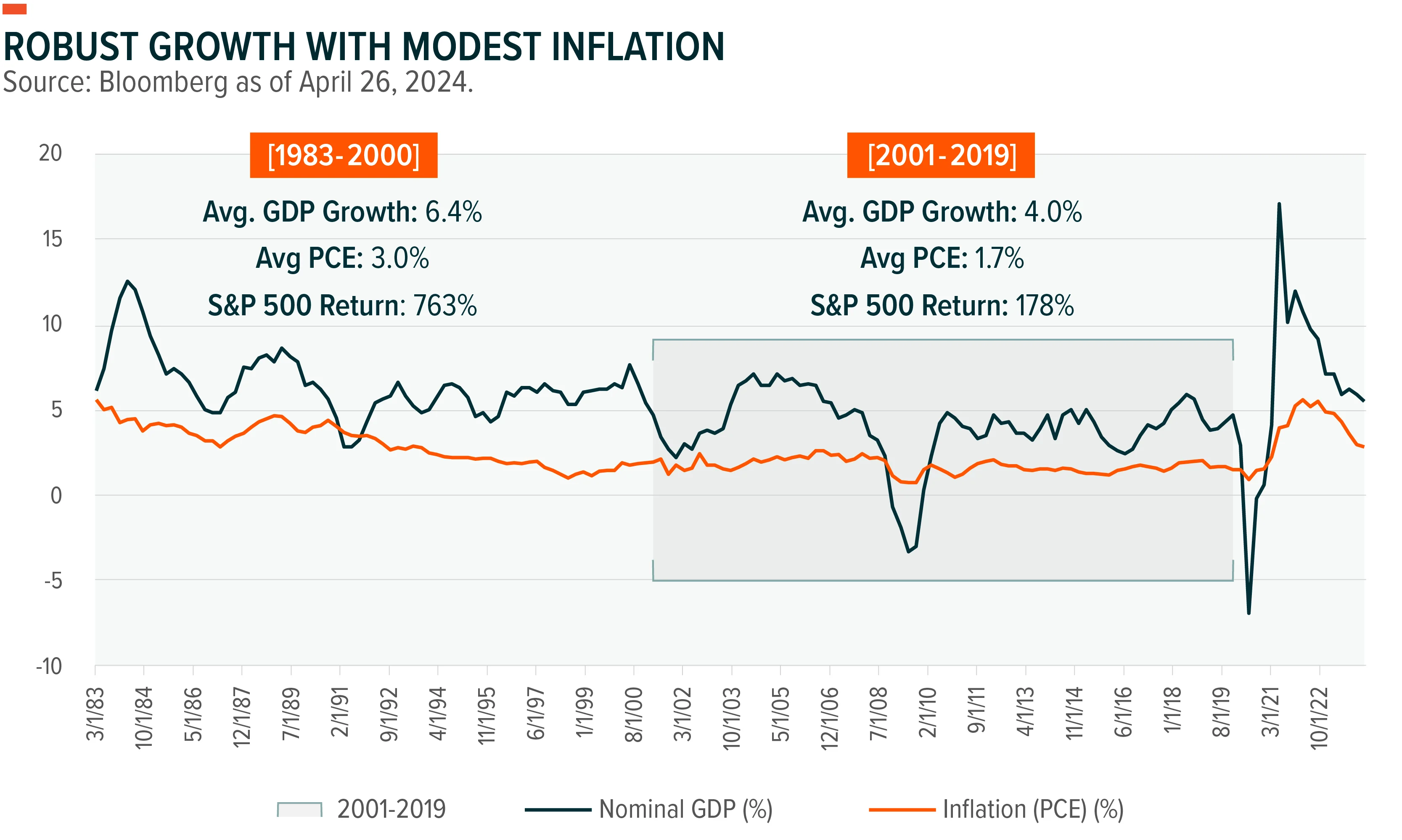
For a fleeting moment, the market seemed to forget how good the economy is currently. The 1.6% quarter-over-quarter (QoQ) GDP growth in Q1 was meaningfully below forecast, but real U.S. GDP growth at 3.0% year-over-year (YoY) was just shy of the 3.1% consensus forecast.4 Nominal GDP grew at 5.5%, well above trend since 2001.5 The most recent personal consumption expenditure (PCE) inflation measure ticked up slightly to 2.7%.6 These numbers likely mean no rate cuts until at least July and, with the elections in November, quite possibly December. Current inflation is above the Fed’s target, but still below the average for 1983-2000.7 Strong nominal growth with modest inflation may be a goldilocks economic situation, or this simply could be a return to the pre-2000 norm, which would still be a positive scenario.
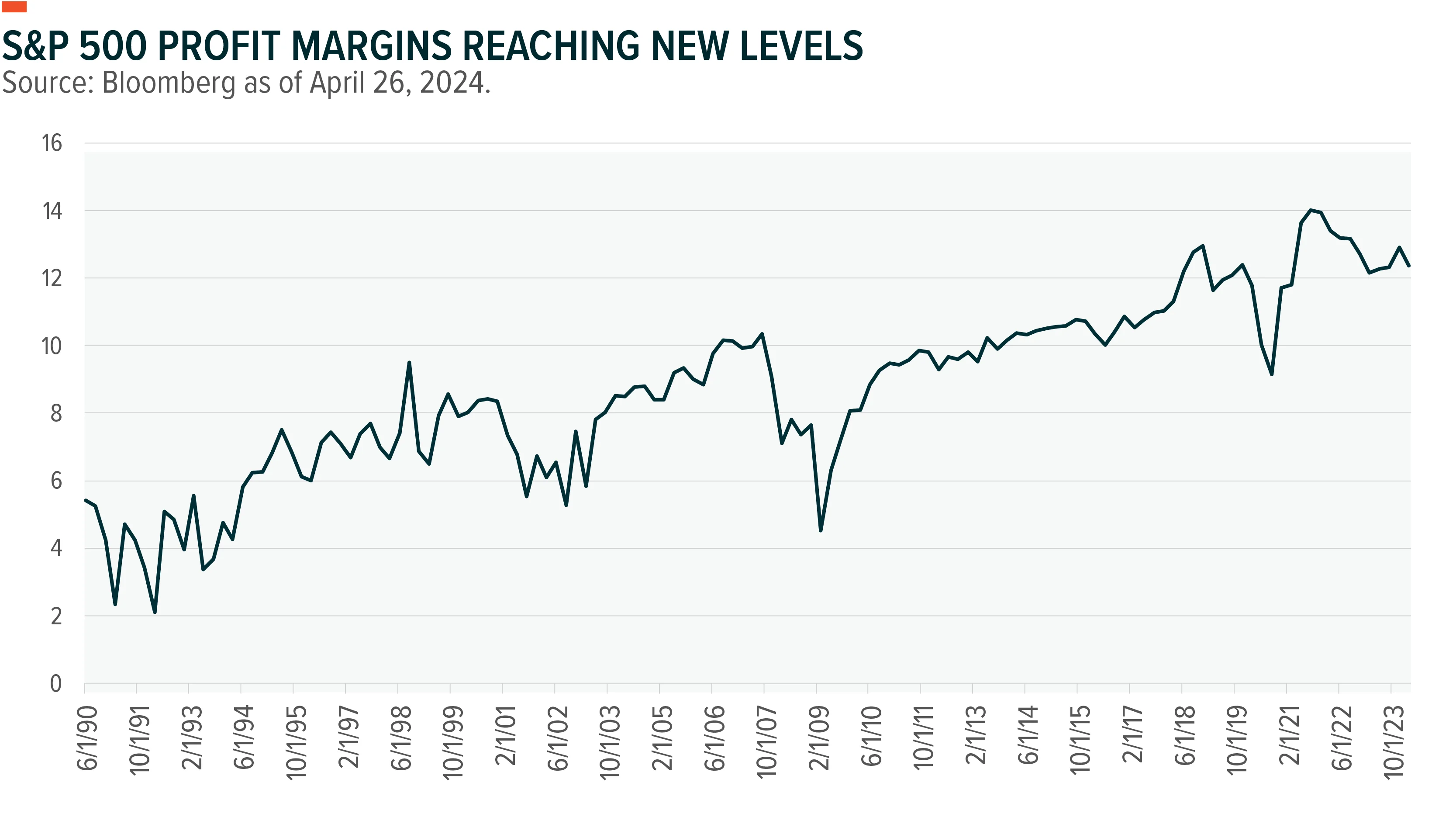
The remarkable strength of the economy is playing out in corporate earnings. For 11 straight quarters, S&P 500 companies delivered profit margins above 12%.8 If companies meet expectations for 12.4% in Q1, that will be an unprecedented 12 straight.9 U.S. companies have never been this profitable. For the 1983-2000 period, profit margins averaged just 5.1%.10 Not only is the economy growing at a good clip, but businesses are also more efficient than ever, which should help to sustain a higher valuation range into the future.
An End to Awkward Teenage Rates
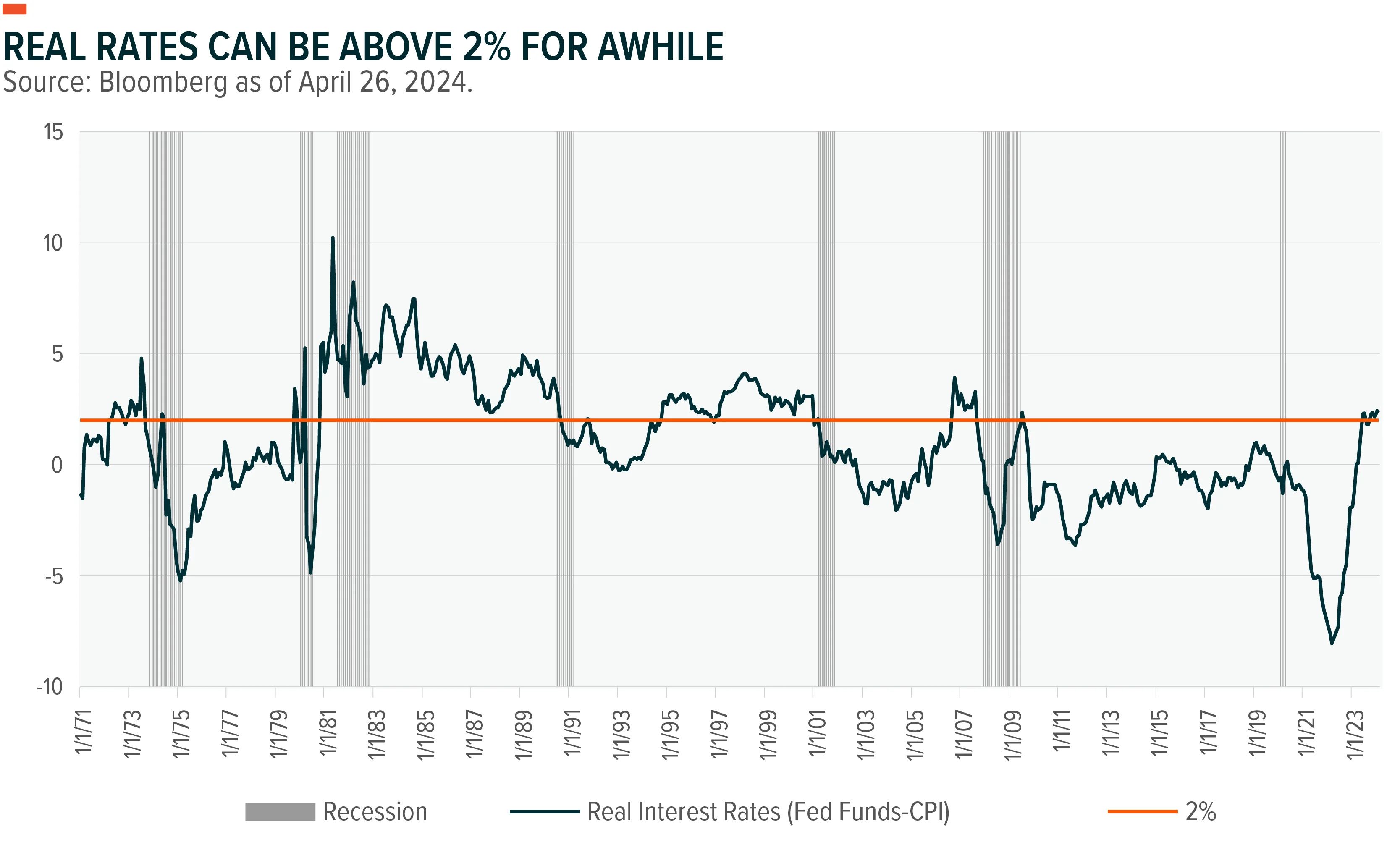
For all the spilled ink about cuts, it’s possible that the Fed has interest rates just right. This story may be best told through real interest rates, or Fed funds rate less inflation. In the two decades following the dotcom bust in 2001, which of course included the Great Financial Crisis, real interest rates were historically low at around 100 basis points.11 That rate regime was a significant departure from the prior 20 years. From the 1983 interest rate cut to 2000, real interest rates were typically above 200 basis points (see chart).12 Notably, the economy operated just fine during that period. Today, a fed funds rate of 5.5% less CPI inflation of 3.5% translates to 200 basis points of real rates, and once again, the economy’s seems to be doing just fine.
For all the romanticizing of low inflation and low interest rates of the oughts and teens, those were difficult years for companies and investors. Financial assets in the decade of the 2000s delivered terrible returns, and companies struggled to generate returns on capital.13 From 1990–1999, S&P 500 companies’ return on capital averaged just 4.9%, and then dropped to an average of 4.0% in the decade that followed, before recovering in the teens.14 Low rates are not a panacea for the economy or growth companies. Higher nominal growth drives the economy and creates opportunities for expansion.
Noisy Narrative of Hikes and Cuts
We continue to believe that the Fed cuts rates when either inflation stays below 3% for multiple months or the economy slows. So, with inflation still sticky and the economy healthy, the Fed is likely in a holding pattern for now. All things considered, this scenario should be viewed as welcome news for equities, as economic conditions that warrant a cut can imply more risk than opportunity.
Since 2001, rate cuts have been accompanied by steep selloffs (see chart).15 The timing of the cuts is pertinent. The 2001 cut followed the dotcom bust, the 2007 cut coincided with the Great Financial Crisis, and the 2020 cuts were in response to liquidity concerns during the pandemic.16 Each of those events warranted a selloff whether the Fed moved or not.
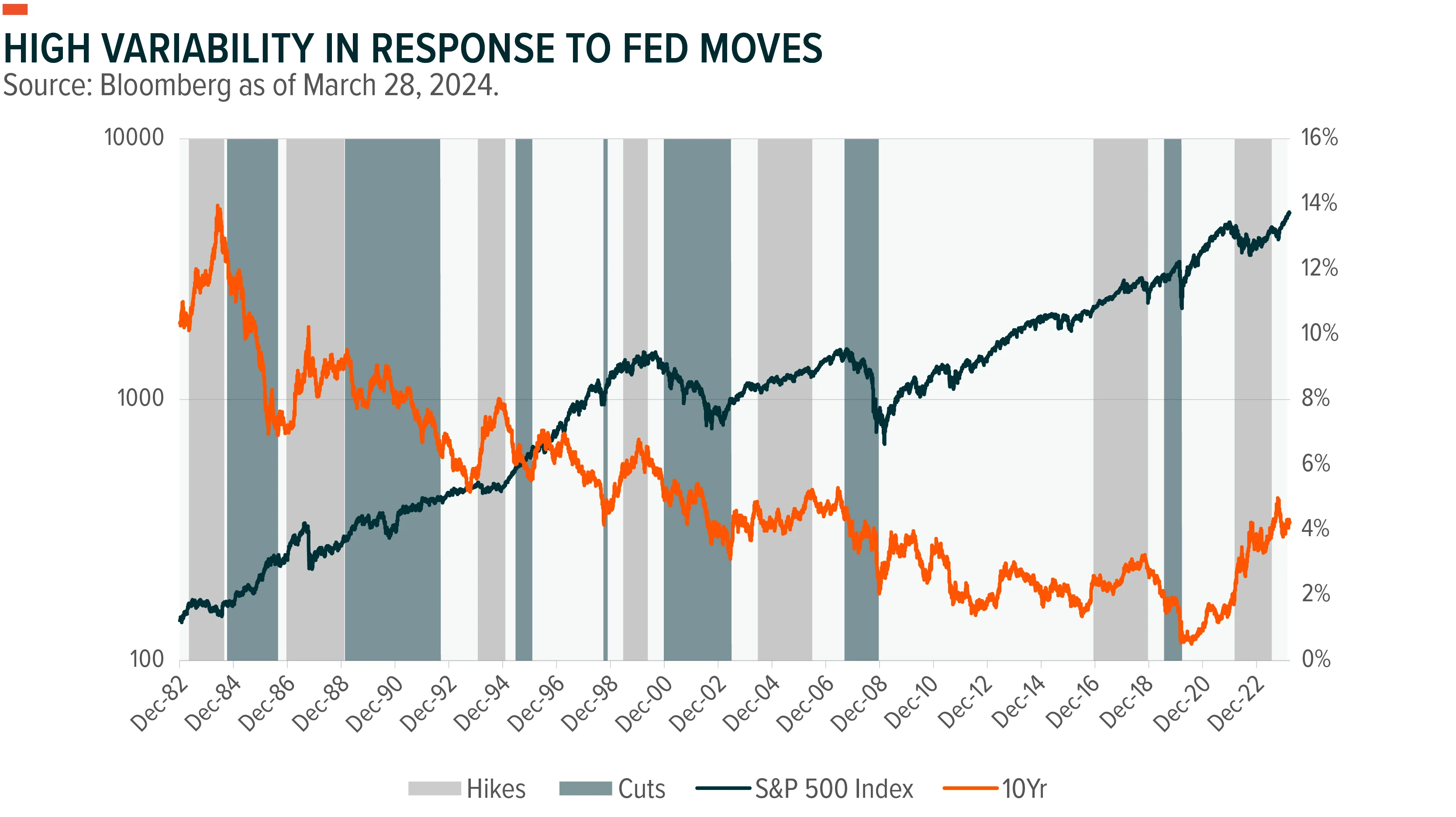
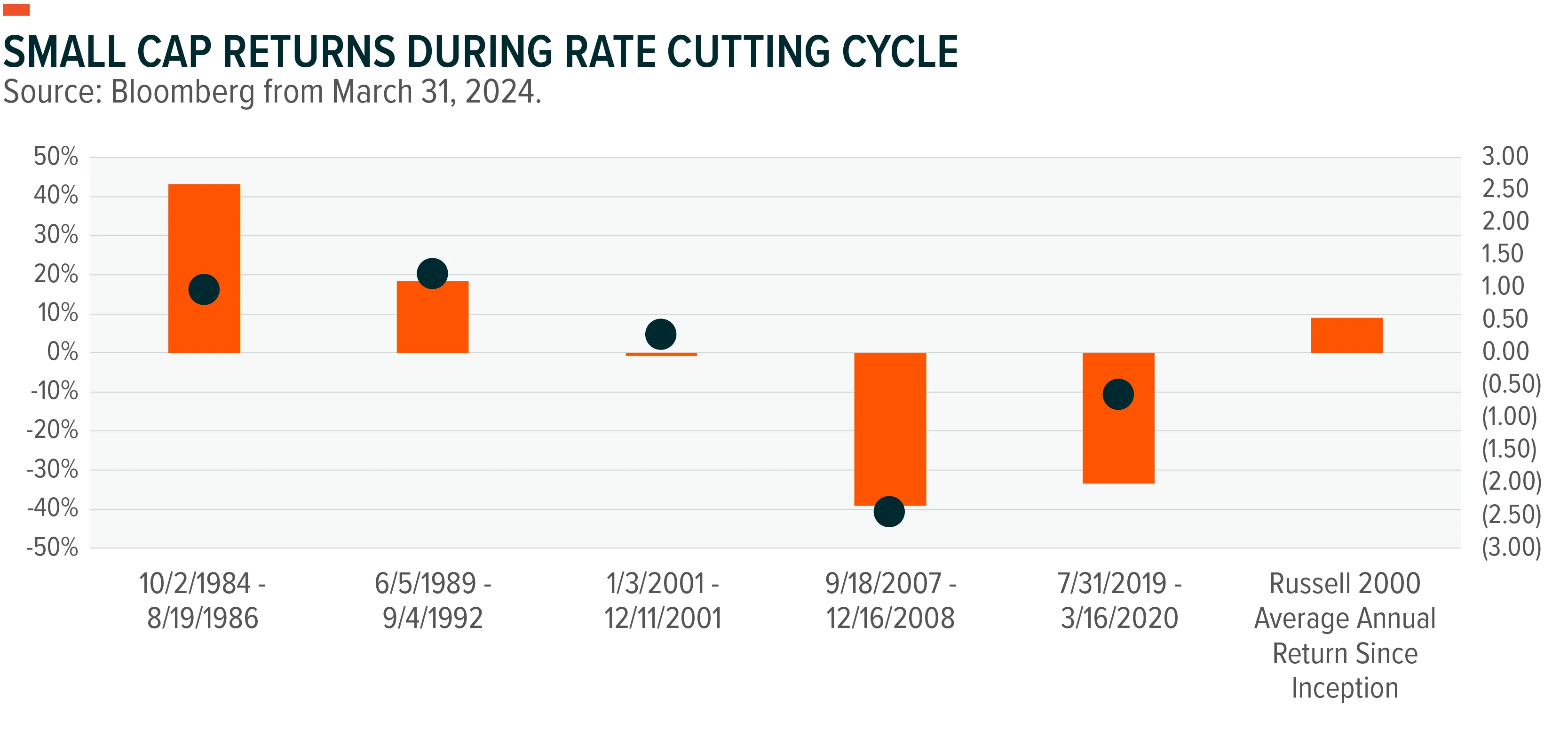
Conversely, equities rallied when the Fed cut rates in the 1980s and 1990s, illustrating that financial conditions prove an important intervening variable.17 The rate cuts prior to 2000 were generally successful in improving liquidity, compared to the most recent cuts where financial conditions tightened even after rates dropped. Tighter financial conditions make it harder for businesses to maintain solvency and grow. This challenge is especially acute for small-cap companies, which lack the balance sheet heft and credit quality of large-cap firms. Historically, when interest rate cuts help add liquidity, small caps rally.18
Strategies for a Potential Cyclical Acceleration
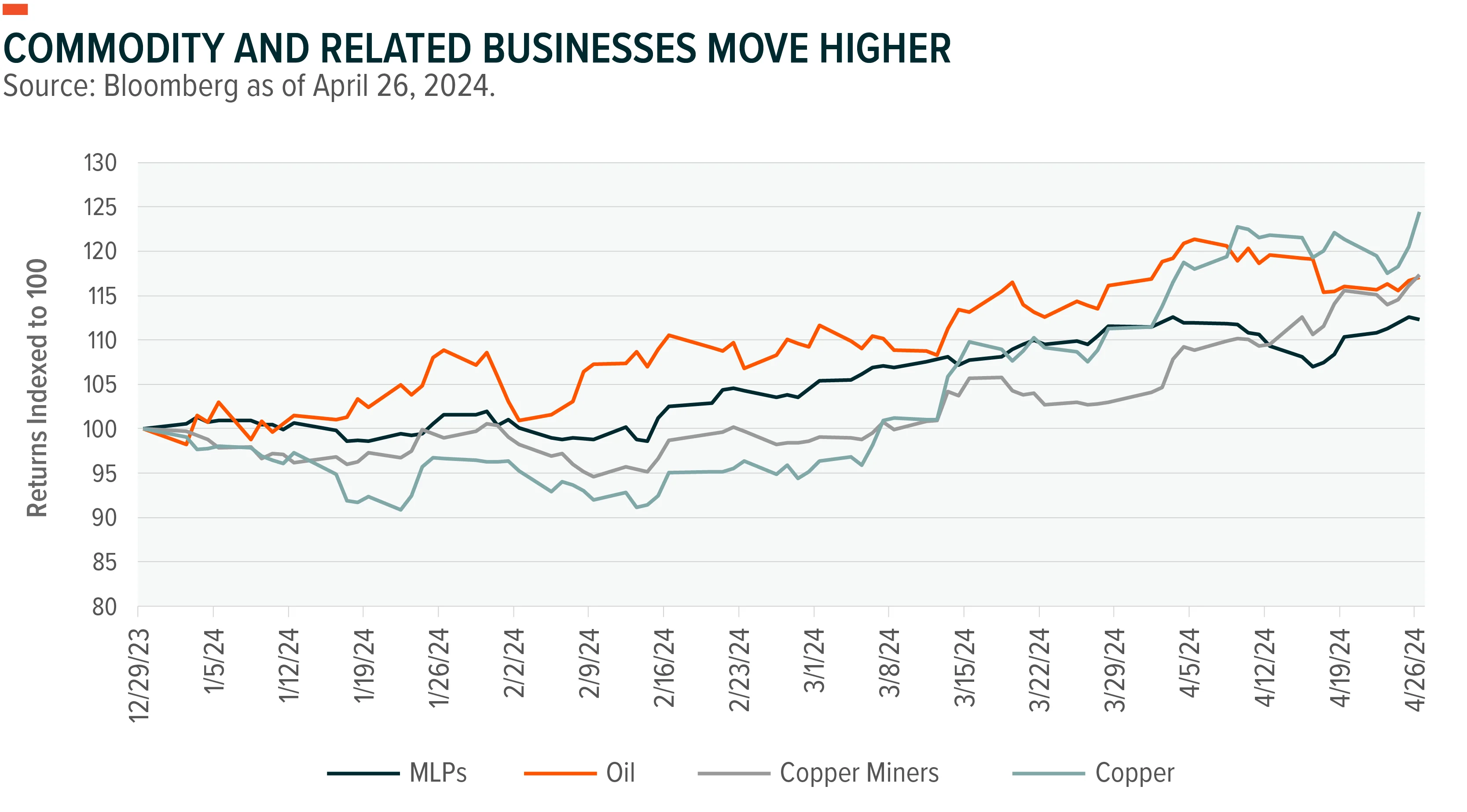
Fast forward to the current environment, where financial conditions have been loosening since March 2023, nominal growth is strong, and inflation seems modest. These factors could be better associated with a cyclical acceleration rather than an economic slowdown. Commodities-related equities, which often perform well during expansions, have been bid up across this year, including MLPs and copper miners.19 Oil prices are up 17% year-to-date (YTD), and MLPs have followed them higher, rising 10%. Copper’s 24% higher.20 Evidence that the Chinese is economy is slowly improving could provide commodities an additional tailwind.
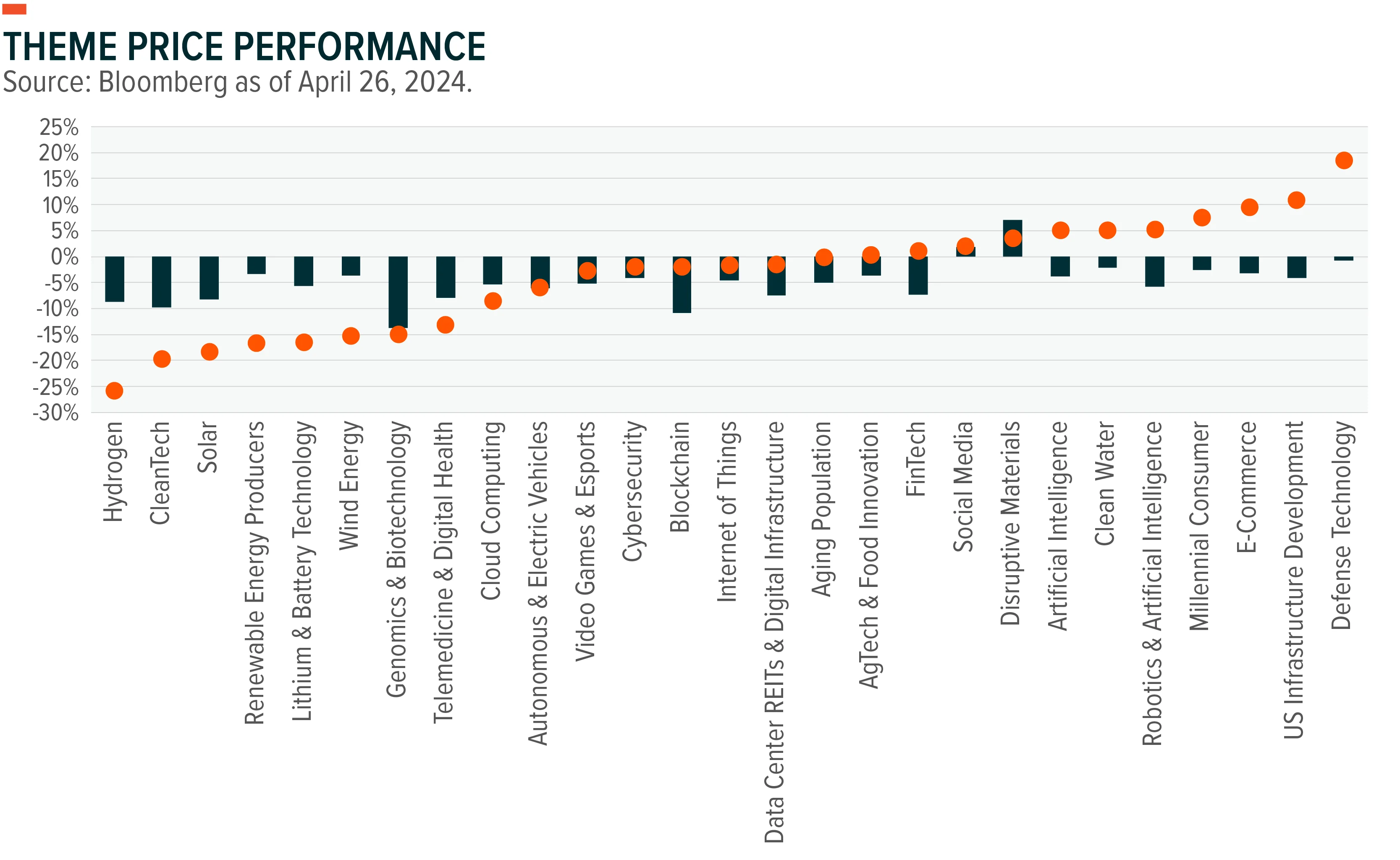
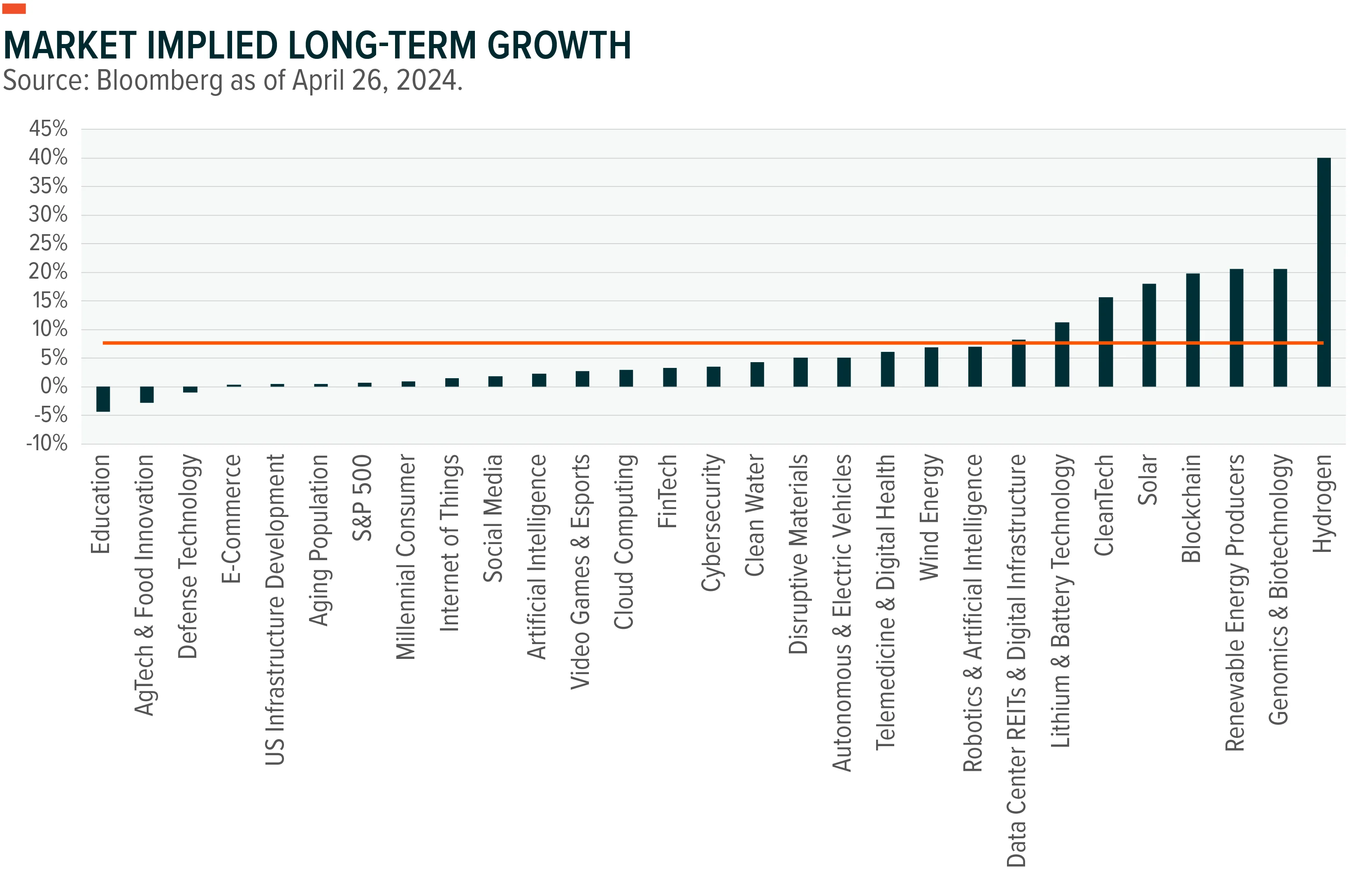
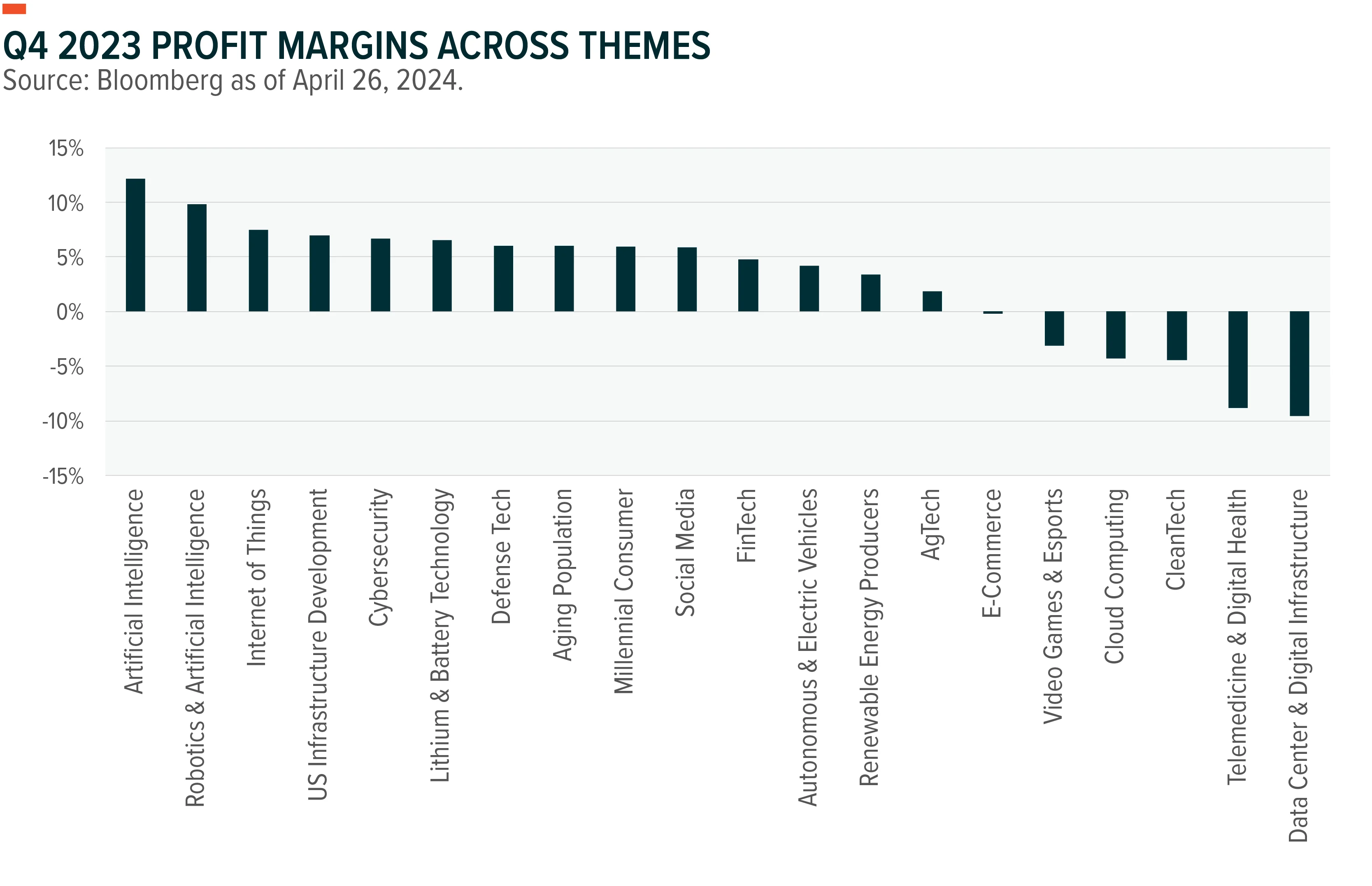
Industrial and Technology sectors typically do well in the mid stages of cyclical acceleration.21 As of April 26th, 71 companies across those two sectors had reported Q1 earnings, and 82% of them beat expectations.22 Familiar themes tied to automation like AI, Cloud Computing, Internet of Things, and Cybersecurity are all expected to deliver double-digit sales growth.23 We continue to believe that the AI theme is in early stages of monetization and that adoption expectations are reasonable. Industrial-related themes like Robotics & AI, U.S. Infrastructure, and Defense Technology are also forecast to grow their toplines above trend with strong margins (see chart).24 Those three themes can also benefit from geopolitical events such as the U.S. election and the ongoing conflicts in Ukraine and the Middle East.
For investors who want growth but remain cautious about asset valuations, hedged strategies can be attractive. Passive strategies that sell covered calls on part of the underlying offer index exposure, modest downside protection, and income by selling premium.25 Partially covered call strategies provide yields that are currently in line with money markets and offer upside opportunity on major indexes. If nominal growth remains strong, like in the 1980s and 1990s, we think they have upside.
Inflection Point Theme Dashboard