
Why Space Tech?
Launch: New Economics Are Reshaping the Industry
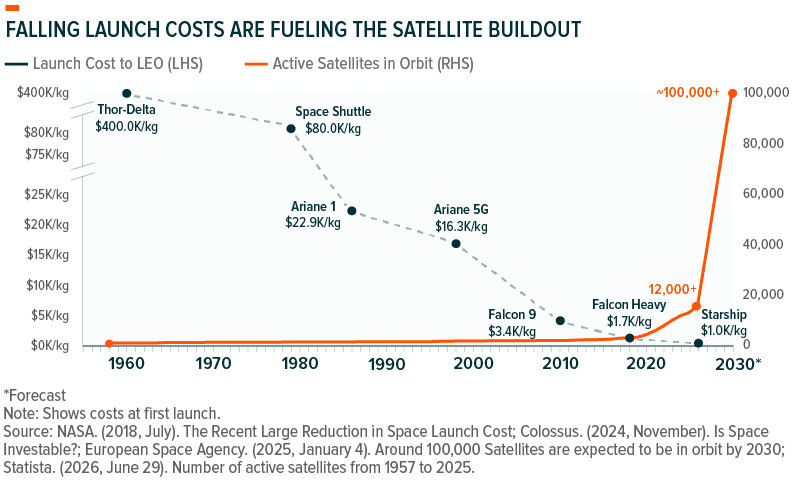
- The average cost of delivering payloads to Low Earth Orbit (LEO) has fallen by over 95% since 1960s to under $3,000/kg on SpaceX’s Falcon 9 this decade, fundamentally changing the economics of operating in space. Reusable rocket boosters – which reduce hardware replacement costs and support higher cadence – underpin this shift.1
- Improving economics have nearly quadrupled global orbital launch attempts over the past decade to roughly 325 in 2025. More importantly, commercial launches now account for 70% of activity, up from just 25% a decade ago, signaling the industry’s shift toward commercial scale.2 The commercial launch market is expected to grow at a 13.4% annual rate to $70 billion by 2035.3
- Lower launch costs are also broadening the competitive landscape. SpaceX remains the dominant, but companies such as Rocket Lab are scaling capabilities and competing for a larger share of the launch market.
Satellites: Rising Orbital Density Creates Investable Infrastructure
- As access to space improves, orbital infrastructure scale is compounding. Active satellites increased from ~1,000 in 2010 to more than 12,000 in 2025 and could approach 100,000 by 2030, transforming orbit from a collection of individual assets into a persistent infrastructure layer.4
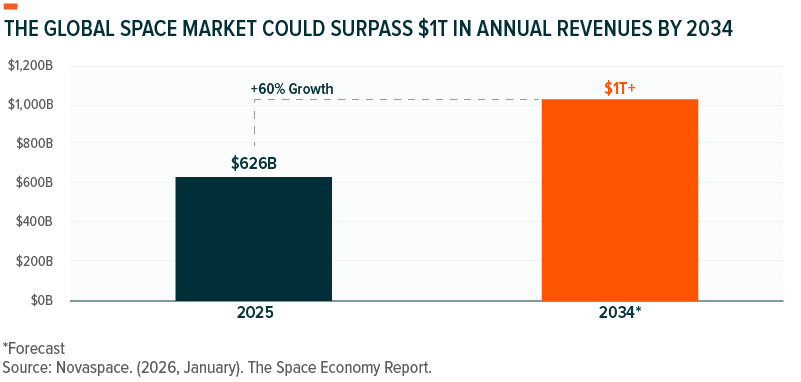
- Satellite-enabled solutions could account for 63% of space revenues by 2034 as constellation density increases and services such as broadband connectivity expand.5 Satellite broadband revenue alone could reach $100 billion by 2035, roughly four times its 2025 level.6 This growth of satellite-services is shifting the economics of the industry from project-based hardware contracts toward recurring revenues for broadband and data services.
Defense & AI: Expanding Long-Term Revenue
- Governments worldwide spent $137 billion on space in 2025, including ~$73 billion on defense.7 Spending should rise further, with the U.S. Space Force proposing $71 billion for FY2027.8 Public spending provides durable demand alongside commercial growth, improving revenue visibility across the space ecosystem.
- AI could create another long-term revenue opportunity through orbital data centers. Orbital data centers could become economically viable as launch costs approach $200/kg, from nearly $2,720/kg they are at today.9 SpaceX has applied to operate an orbital data-center system comprising up to one million satellites, signaling the scale of the opportunity.10
ORBX: A More Targeted Solution to Access Space Tech
Purpose-Built for Today’s Space Economy
- ORBX targets four segments spanning the space tech value chain: (a) rocket launch and reusable rockets, (b) space tech and components, (c) satellite telecommunications and data services, and (d) space transportation, tourism, and exploration. This approach seeks to capture both established and innovative segments in the space economy.
Pure-Play Exposure Where It Matters
- Companies must derive at least 50% of revenues from space tech-related activities to qualify for inclusion, helping distinguish businesses where space isa meaningful driver of fundamentals from those with more incidental exposure.
Designed to Capture Leaders and Emerging Innovators
- ORBX uses a modified market-cap weighted approach designed to give greater representation to innovative industry leaders while retaining exposure to smaller companies that may help shape the next phase of the space economy. Individual securities are capped at 20%, balancing concentration towards leaders with thematic breadth.
Category:Thematic Growth
Topics: