

U.S. Infrastructure
Infrastructure Value Chain Gained on Data Center Boom
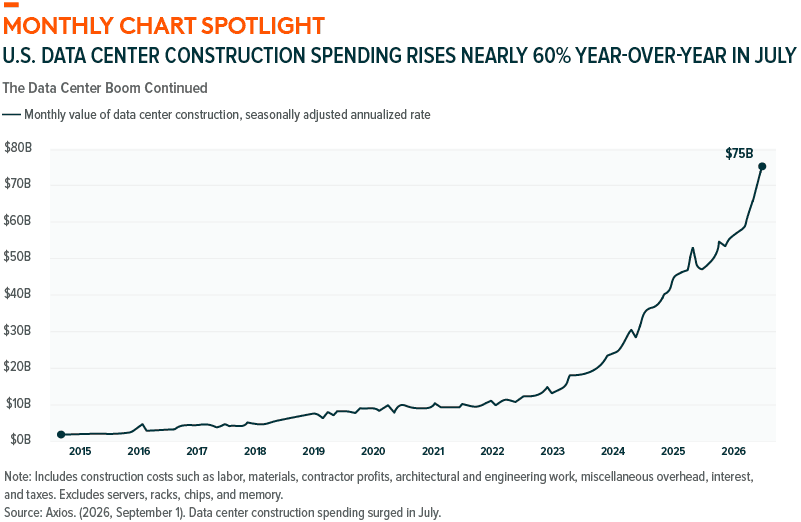
Data center construction spending increased nearly 60% year-over-year (YoY) in July 2026 to surpass a $75 billion annualized pace as AI translates into a major U.S. construction cycle. Supported by significant AI capital expenditure (capex) commitments, the opportunity extends well beyond data centers into power, electrical equipment, and broader site infrastructure.1 For example, shell construction accounts for roughly 20% of total data center investment.2 With hyperscaler capex expected to rise roughly 75% in 2026 and potentially another 30% in 2027, we expect construction activity to remain elevated as every data center becomes a power infrastructure project.3 Moreover, bottlenecks remain persistent, with average U.S. data center equipment lead times around 42 weeks, 83% higher than 2019 levels. Equipment constraints, labor shortages, and grid interconnection delays continue to drive construction costs higher, extending project timelines and supporting multi-year backlogs for contractors and suppliers.4

Artificial Intelligence
Enterprise AI Adoption Fueled Anthropic’s Growth, Nvidia to Deepen Its AI Software Reach
Anthropic’s annual recurring revenue reached $65 billion at the end of July 2026, up from $47 billion in May and roughly seven times higher YoY, highlighting the rapid adoption of its Claude models. The company expects the momentum to continue, projecting 2028 revenue to reach $190 billion to $200 billion.5 Nvidia agreed to acquire Hugging Face for nearly $13 billion, gaining control of a widely used platform that hosts millions of open-source AI models, datasets, and applications for more than 18 million developers and 200,000 companies. The deal expands Nvidia’s reach beyond chips and deeper into the software and developer layers of the AI ecosystem, strengthening its relationship with the builders who drive demand for computing infrastructure. Strategically, the acquisition reinforces Nvidia’s influence across the AI stack as major customers increasingly develop their own chips and open models emerge as viable alternatives to proprietary platforms.6
Defense Tech
White House Moves to Fortify Defense Supply Chains
The Trump administration announced $3 billion in federal investments across critical mineral and battery projects to accelerate rebuilding the domestic supply chains that underpin advanced weapons. The funding targets domestic mining, processing, battery materials, and permanent magnets, areas where U.S. defense manufacturers remain heavily dependent on foreign suppliers.7 Rare earths, tungsten, germanium, and scandium are essential inputs for precision missiles, fighter aircraft, armored vehicles, and infrared sensors. Separately, the administration imposed tariffs of up to 100% on certain imported drones and components, while levying 25% tariffs on smaller or non-defense systems, with lower rates for imports from U.S. allies. It also directed the Commerce Department to establish domestic manufacturing incentives.8 Together, these measures highlight a shift beyond traditional procurement toward securing the domestic industrial capacity required to scale modern defense readiness.
Space Tech
SpaceX to Expand Launch Capacity in Effort to Unlock the Space Economy
SpaceX announced plans for a $100 billion project to build Starbase Louisiana, the company’s fourth and largest launch site to date. Construction begins in 2027, with the first Starship launch targeted for 2029. At full buildout, the site is expected to include five launch complexes with two pads each, alongside propellant production, power generation, and vehicle-processing infrastructure. SpaceX is designing the spaceport to support thousands of launches annually, a substantial increase from today’s frequency.9 The company conducted 170 launches in 2025 and is on track for roughly 155 launches in 2026, with 104 completed through August.10 Scaling launches to 1,000+ annually is key to making space more accessible for broader set of applications. President Trump also signed an updated National Space Transportation Policy targeting more than 1,000 U.S. launches and reentries annually by 2030. The memorandum directs federal agencies to identify additional launch sites, accelerate permitting and environmental reviews, expand launch infrastructure, and modernize range scheduling to increase capacity.11
Genomics
Personalized mRNA Therapy Reaches a Clinical Milestone in Precision Oncology
Moderna and Merck announced the first positive Phase 3 results for an individualized mRNA-based cancer therapy. In the 1,137-patient INTerpath-001 trial, intismeran autogene combined with Keytruda produced statistically significant and clinically meaningful improvements in recurrence-free and distant metastasis-free survival versus Keytruda alone among patients with surgically removed, high-risk stage IIB–IV melanoma. The treatment uses genetic sequencing of each patient’s tumor to identify its unique mutations, then creates a personalized mRNA therapy encoding up to 34 neoantigens. This design helps the immune system to recognize and attack remaining cancer cells. No new safety signals emerged, although overall-survival data and other secondary endpoints remain immature. The results also reinforce earlier five-year Phase 2b findings, in which the combination reduced the risk of recurrence or death by 49%.12 Beyond melanoma, the study validates the broader convergence of genomic sequencing, bioinformatics, mRNA manufacturing, and immunotherapy, potentially opening a path toward more individualized treatments across multiple cancer types.
Robotics
Anthropic Pushes Into Physical AI, Humanoid Shipment Volume Soared
Anthropic introduced the Model Hardware Standard (MHS), a shared framework that allows AI agents to control programmable equipment safely, including microscopes, liquid handlers, lasers, and robotic arms. Early testing suggests MHS can reduce hardware integration timelines from weeks or months to hours while enabling agents to coordinate devices, adjust experiments in real time, and recover from certain operational errors. Anthropic believes MHS could become for physical equipment what its Model Context Protocol (MCP) is for software, accelerating autonomous laboratories, drug discovery, robotics, quantum computing, and manufacturing.13 The humanoid market’s recent growth illustrates physical AI’s potential. Global shipments rose 300% to roughly 22,000 units in the first half of 2026, with full-year forecasts projecting between 50,000 and 85,000 units. While Chinese manufacturers dominate the market, momentum is building in the U.S., Japan, and South Korea.14
KEEP UP WITH THE LATEST THEMATIC RESEARCH FROM GLOBAL X
To learn more about the disruptive themes changing our world, read the latest research from Global X, including:
- The Case for MLCCs: An Emerging AI Bottleneck
- Replenishment is Extending the Defense Tech Earnings Runway
- Why Space Tech? Why ORBX?
- The Next Big Theme: August 2026
- Energy Playbook: Navigating the Global Supercycle
THEMATIC ETF LINEUP
To see individual ETF holdings and current performance across the Global X Thematic Suite, click these links:
- Disruptive Technology: Artificial Intelligence & Technology ETF (AIQ), Blockchain ETF (BKCH), Robotics & Artificial Intelligence ETF (BOTZ), Cybersecurity ETF (BUG), AI Semiconductor & Quantum ETF (CHPX), Cloud Computing ETF (CLOU), Autonomous & Electric Vehicles ETF (DRIV), Data Center & Digital Infrastructure ETF (DTCR), FinTech ETF (FINX), Video Games & Esports ETF (HERO), MLCC & Electronic Components ETF (MLCC), Space Tech ETF (ORBX), Defense Tech ETF (SHLD), Internet of Things ETF (SNSR), Social Media ETF (SOCL)
- Consumer Economy: Millennial Consumer ETF (MILN), E-Commerce ETF (EBIZ), Genomics & Biotechnology ETF (GNOM), Aging Population ETF (AGNG), HealthTech ETF (HEAL)
- Infrastructure & Environment: U.S. Infrastructure Development ETF (PAVE), ClimateTech ETF (CTEC), Renewable Energy Producers ETF (RNRG), Clean Water ETF (AQWA), Hydrogen ETF (HYDR), AgTech & Food Innovation ETF (KROP), Infrastructure Development ex-U.S. ETF (IPAV), U.S. Electrification ETF (ZAP)
- Digital Assets: Blockchain & Bitcoin Strategy ETF (BITS), Bitcoin Trend Strategy ETF (BTRN)
- Multi-Theme: Dorsey Wright Thematic ETF (GXDW)