
Product ResearchThematic GrowthDisruptive Technology
AI Does Not Kill Cybersecurity, It Enhances the Opportunity
I
Ido Caspi
May 15, 20265 min read
Copyright © 2026 Global X. All rights reserved.
SEI Investments Distribution Co. (1 Freedom Valley Drive, Oaks, PA, 19456) is the distributor for the Global X Funds.
Check the background of SIDCO and Global X's Registered Representatives on FINRA's BrokerCheck.
Get the latest news and updates from our team.
Tejas Dessai
Ido Caspi
The Blockchain theme is reaccelerating as substantive digital-asset regulation, rising institutional participation, and growing alignment with the expanding AI computing ecosystem emerge as structural catalysts.
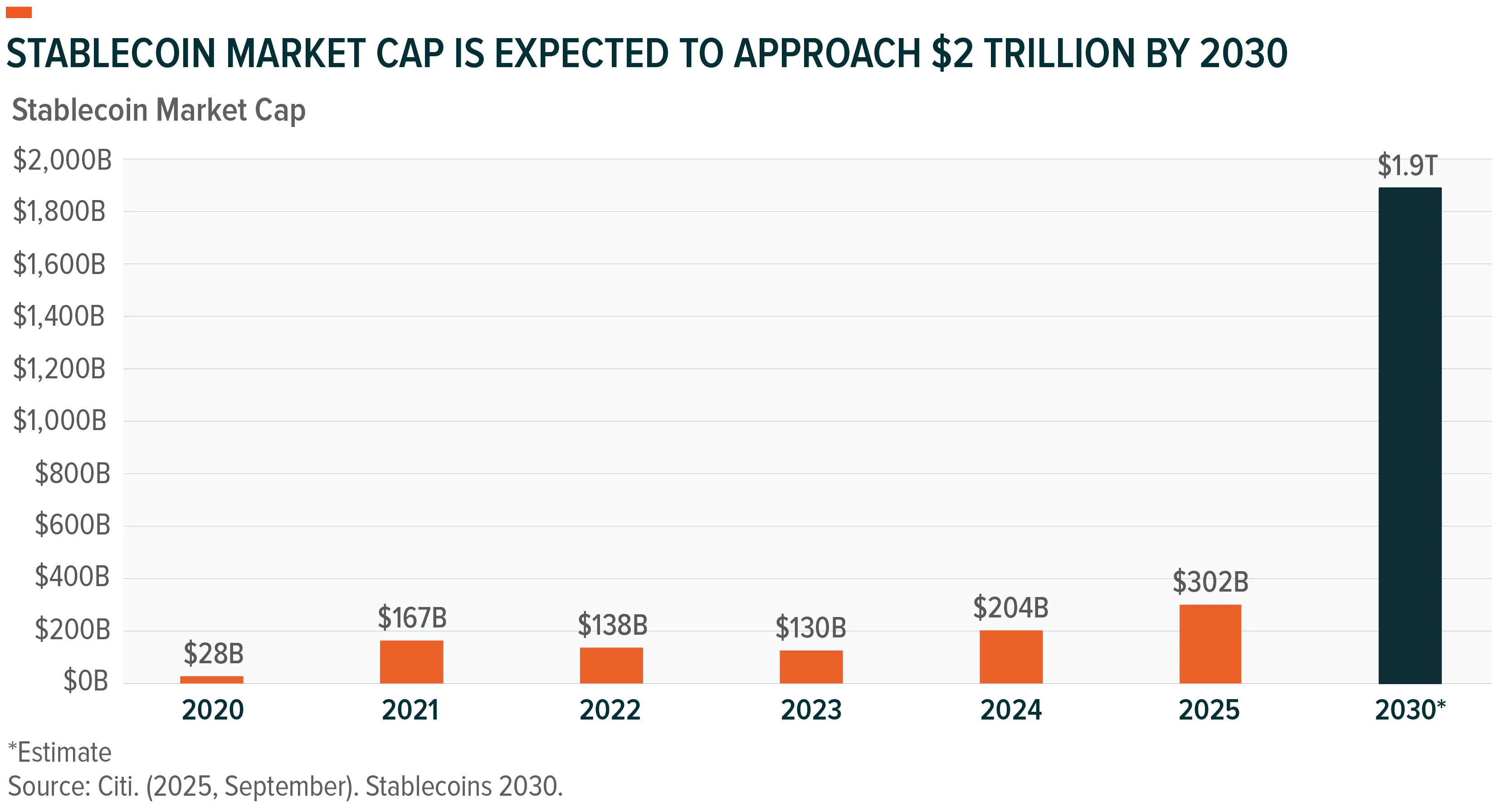
The GENIUS Act in the U.S. and its companion legislation are defining the regulatory landscape for stablecoins, a market forecast to grow from $282 billion in September 2025 to $1.9 trillion by decade’s end.1 By establishing clear guardrails for issuance and integration of stablecoins within financial services, the GENIUS Act lays the foundation for a more seamless integration of these digital assets into the traditional financial system. Meanwhile, institutional digital-asset adoption is evident in the success of spot crypto ETFs in the United States, with institutions now owning nearly 8% of bitcoin in circulation.2 Innovation in areas like tokenization add further tailwinds.
In our view, these converging catalysts are accelerating the mainstream adoption of blockchain technology. For investors seeking equity exposure to companies driving blockchain integration across financial services, portfolios, and real-world use cases, we believe the Global X Blockchain ETF (BKCH) offers a compelling way to participate.
New U.S. digital-asset regulation provides long-awaited clarity for stablecoins and other cryptocurrencies, strengthening investor trust and confidence in blockchain technology. We believe it will mark a pivotal step toward institutional digital-asset adoption and legitimizes stablecoins’ role in the broader financial ecosystem.
The blockchain application layer is accelerating rapidly as stablecoins evolve into core financial infrastructure, powering real-world payments, liquidity, and innovation across finance and digital networks.
Blockchain’s convergence with AI is transforming crypto mining data centers into diversified compute providers, strengthening business models and positioning blockchain as a core pillar of the AI era.
After years of regulatory uncertainty around digital assets, the United States has taken a landmark step with its first comprehensive national crypto legislation, introducing three bills designed to open a path for broader integration of digital assets.
The flagship Guiding and Establishing National Innovation for U.S. Stablecoins (GENIUS) Act, signed into law in July 2025, establishes a clear framework for USD-backed payment stablecoins, a pivotal move toward broader regulatory clarity.3 This development is expected to generate meaningful tailwinds for crypto-related assets and companies, blockchain infrastructure providers, and traditional financial and FinTech institutions integrating on-chain capabilities.
The GENIUS Act introduces a federal framework designed to make dollar-backed stablecoins more transparent, reliable, and interoperable across the traditional financial system. It requires issuers to maintain 1:1 reserves in cash or short-term U.S. Treasurys and mandates monthly reserve disclosures. The legislation also provides legal protection for stablecoin holders in the event of issuer insolvency and sets clear eligibility standards for those who may issue stablecoins, such as banks and licensed entities.4
The GENIUS Act’s overarching goal is to enhance trust and stability by enabling individuals and businesses to use stablecoins confidently while safeguarding consumers, mitigating fraud, and protecting the broader financial system. In practical terms, the Act paves the way for stablecoins to operate seamlessly across payments, banking, and crypto markets. Regulatory oversight also helps legitimize stablecoins’ role, boosting institutional confidence, fostering innovation, and positioning them to evolve from niche crypto assets into mainstream financial infrastructure.
Along with the GENIUS Act, the Digital Asset Market Clarity Act and the Anti-Central Bank Digital Current (CBDC) Surveillance State Act were approved.
The Digital Asset Market Clarity Act seeks to assign oversight based on how cryptocurrencies function. Cryptocurrencies operating like commodities, such as bitcoin, fall under the Commodity Futures Trading Commission’s (CFTC) domain, while the Securities and Exchange Commission (SEC) has oversight of tokens resembling investments or company shares.5
The Anti-CBDC Surveillance State Act prohibits the Federal Reserve from issuing a retail central bank digital currency without explicit congressional approval, aiming to protect Americans from potential financial surveillance.6
New regulation positions stablecoins as the gateway for institutional crypto adoption, combining the trustworthiness of fiat currencies like the U.S. dollar with the speed and flexibility of cryptocurrencies. These assets have expanded beyond just a crypto trading tool and now serve as infrastructure for 24x7 liquidity and money movement.
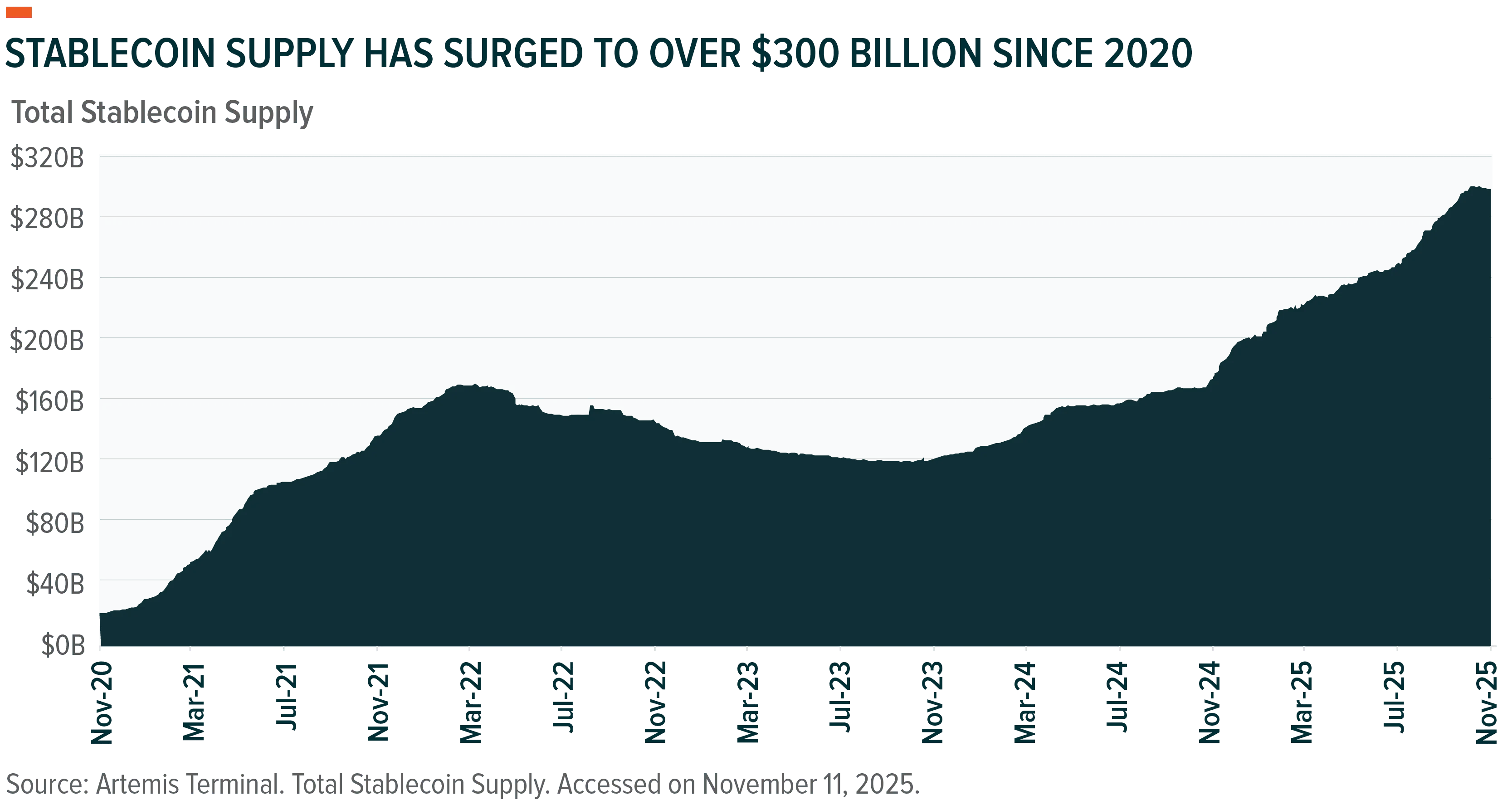
Stablecoin supply and transaction volume have surged following the new regulation, with aggregate supply reaching $280 billion in September 2025, up from $200 billion at the start of the year.7 That surge has benefitted leading stablecoin issuers such as Circle Internet Group, which issues the popular USD coin (USDC), and Tether, which issues USDT. Both report increased demand and meaningful gains. In Q3 2025, Circle Internet Group reported 66% year-over-year (YoY) total revenue growth to $740 million, driven largely by 60% YoY reserve income growth on USDC. Circulation of USDC reached $73.7 billion, representing 108% YoY growth.8
The total addressable market for stablecoins is massive and growing rapidly as adoption picks up. If even a fraction of global payments, remittances, or savings were to shift into stablecoins, it would represent trillions in potential volume, opening the door to a flywheel of innovation. By 2030, estimates suggest stablecoin total issuance can reach over $1.9 trillion from roughly $300 billion as of November 12, 2025.9
As the infrastructure supporting stablecoins continues to mature and improve, the surrounding blockchain application layer is expected to evolve alongside it. In line to benefit are stablecoin issuers, payment and settlement networks, consumer apps, on- and off-ramp providers, and traditional financial institutions. With stablecoin functionality expanding to enable issuance, transfer, conversion, and other real-world uses, these players can gain from a more connected and efficient digital financial ecosystem.
Settlement platforms like Ethereum and Solana may also benefit from rising demand for block space, potentially increasing the value of their native tokens, as evidenced by Ethereum’s strong performance following the GENIUS Act’s passage. Multiple blockchain settlement platforms are also issuing stablecoins. This growing multi-chain footprint sets the stage for intense competition among blockchains as they vie for transaction flow and liquidity, which should also accelerate innovation.
Consumer FinTech applications such as Coinbase and PayPal could expand rapidly as more traditional finance and retail firms integrate stablecoin transactions into their systems. PayPal launched its own stablecoin, PayPal USD, in 2023, while major e-commerce platforms such as Amazon are exploring proprietary stablecoins. These developments could shift substantial transaction activity away from conventional cash and card payments to their own digital payment networks.10
Also, as governance evolves, historically hesitant adopters such as banks and payment networks are now driving adoption in areas such as asset custody, transaction processing, and digital-asset tokenization. For example, U.S. banking giant JPMorgan launched its own stablecoin alternative, JPMD, designed to serve as a digital representation of commercial bank deposits. JPMD offers institutional clients 24/7 settlement and the ability to pay interest to holders.11
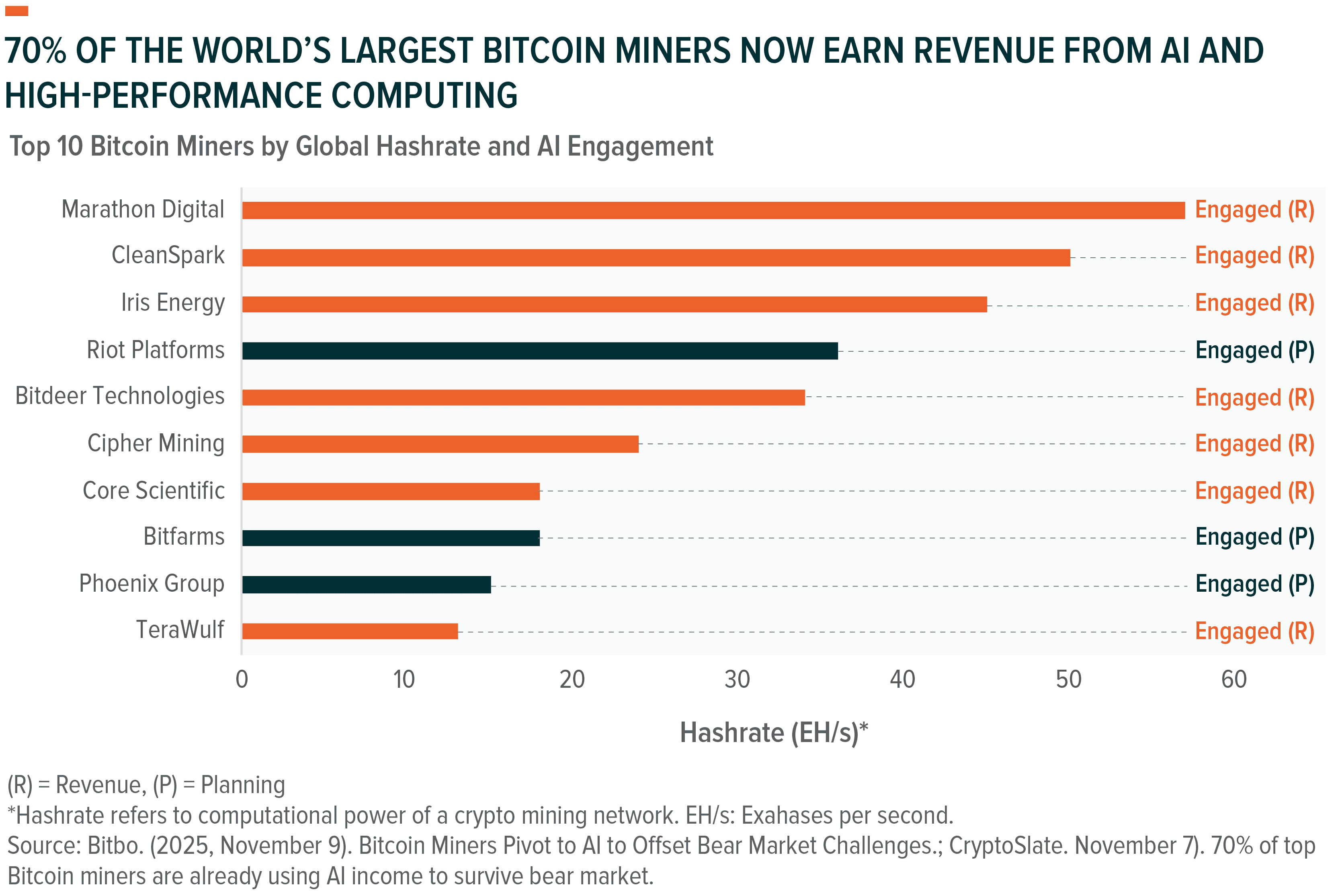
A major but underappreciated driver of recent blockchain momentum is the accelerating convergence between blockchain infrastructure and AI computing. As demand for high-performance computing outpaces traditional data-center capacity, bitcoin mining firms—historically focused on energy-intensive, application-specific chips—are pivoting to graphics processing units (GPU) to support AI workloads. By upgrading their facilities for hyperscale computing needs, these companies are repurposing excess capacity to serve the AI market, effectively transforming from pure-play crypto miners into diversified compute providers. This shift not only helps ease the global AI-compute shortage but also introduces more resilient, multi-revenue business models less tied to digital-asset market volatility.
In this evolving landscape, scale and infrastructure optionality are becoming strategic differentiators. Larger miners are increasingly able to attract capital, secure chip allocations, and sign long-term enterprise contracts, fueling consolidation and accelerating revenue growth. Miners also have access to power, a strategic lever given the broader AI buildout’s electricity bottlenecks.
Google recently acquired an 8% stake in TeraWulf, a leading digital infrastructure and bitcoin‑mining company, by backstopping $1.8 billion in lease obligations tied to over 200 megawatts (MW) of contracted AI compute capacity. The deal helps TeraWulf transition beyond bitcoin mining into high-performance computing, while locking in recurring revenue streams.12 Similarly, Cipher Mining secured a 15-year, $5.5 billion lease agreement with Amazon Web Services (AWS) to supply 300MW of capacity for AI workloads. The project includes both air and liquid-cooled racks and will be delivered in two phases starting in July 2026, with rent payments beginning the following month.13
Deeper integration between blockchain infrastructure and AI could drive a structural re-positioning and de-risking of blockchain companies, establishing them as a critical pillar of the AI infrastructure buildout, which may prompt the market to value them more highly.14
We believe the Blockchain theme is entering a new phase, defined by regulatory clarity, institutional adoption, and technological convergence. Stablecoins are emerging as the connective tissue between traditional finance and digital innovation, while the integration of blockchain infrastructure with AI is broadening both its utility and investment appeal. Together, these forces have set in motion a more resilient, diversified, and mature digital asset landscape. As this transformation unfolds, we believe the theme is poised to continue its secular expansion over the next few years.
Related ETFs
BKCH - Global X Blockchain ETF
Click the fund name above to view holdings. Holdings are subject to change. Current and future holdings are subject to risk.
Citi. (2025, September). Stablecoins 2030.
Bitcoin Magazine. (2025, April 25). Is 8% of Bitcoin Owned by Institutions a Threat to Its Future?
The White House. (2025, July 18). Fact Sheet: President Donald J. Trump Signs GENIUS Act into Law.
Ibid.
1st Source Bank. What the GENIUS Act and Two New Crypto Bills Mean for Digital Currency. Accessed on November 13, 2025.
Ibid.
Citi. (2025, September). Stablecoins 2030.
Circle. (2025, November 12). Circle Reports Third Quarter 2025 Results.
U.S. Department of the Treasury. (2025, November 11). Remarks by Secretary of the Treasury Scott Bessent before the Treasury Market Conference.
The Wall Street Journal, Walmart and Amazon are Exploring Issuing Their Own Stablecoins, 13 June 2025.
CNBC. (2025, June 17). JPMorgan moves further into crypto with stablecoin-like token JPMD.
CNBC. (2025, August 18). TeraWulf stock gains more than 4% as Google boosts stake in data center operator.
Yahoo! Finance. (2025, November 3). Cipher Mining announces $5.5bn Amazon AI lease, posts in-line Q3 EPS; shares jump.
Precedence Research. (2025, July 15). Blockchain AI Market Poised for Strong Growth Fueled by Secure, Intelligent Solutions.
AI expands cyber complexity and attack surfaces, driving higher security demand—making cybersecurity a potential beneficiary, not a casualty, of AI.
AI expands cyber complexity and attack surfaces, driving higher security demand—making cybersecurity a potential beneficiary, not a casualty, of AI.
In volatile markets, thematic strategies can offer a rare mix of resilience and potential structural growth.
In volatile markets, thematic strategies can offer a rare mix of resilience and potential structural growth.