

The MSCI Brazil Index (Net) pulled back in the second quarter, as the broad Emerging Market (EM) rally rotated toward AI linked technology markets, leaving commodity and value-oriented markets, including Brazil, comparatively behind despite a continued domestic rate cutting cycle.
Market Review
After a strong start to the year, Brazilian equities gave back ground in the second quarter, with the MSCI Brazil Index (Net) (“the benchmark”) declining -8.23%.1 The pullback came even as Brazil's central bank continued easing, cutting the benchmark interest rate (Selic) to 14.50% on April 29 and to 14.25% in June, a third consecutive quarter-point reduction.2 The Monetary Policy Committee’s (Copom) tone turned more cautious mid-quarter after an oil-price spike tied to the Iran conflict pushed Brent Crude to the $110-114 range in early May, prompting the bank to raise its inflation forecast and warn that further interest rate cuts would depend on incoming data; crude oil eased as tensions cooled later in the quarter.3
Brazil's presidential election, set for October, remained a live source of volatility. Opposition candidate Flávio Bolsonaro's polling lead over President Lula narrowed and then reversed over the quarter, following a corruption scandal in May tied to a disputed funding request; by early July, Lula had rebuilt a first-round polling lead in the low 40s against Bolsonaro's low-to-mid 30s.4 Foreign investors were net sellers of roughly BRL 7.8 billion in Brazilian equities in June, though they remained net buyers of approximately BRL 33.8 billion year to date through June 30, 2026.5
Fund Review
BRAZ returned -9.14% (NAV) in the second quarter versus -8.23% for the benchmark, trailing by 0.91 percentage points.6 On a market price basis, the fund returned -8.02%, ahead of the benchmark by 0.21 percentage points. Year to date, the fund has returned 7.28% (NAV) and 7.70% based on market price versus 9.30% for the benchmark, and one-year returns stand at 24.46% (NAV) and 23.49% based on market price versus 26.64% for the benchmark.7
From a sector perspective, Communication Services, Industrials, and Health Care contributed the most to relative performance, while Consumer Staples, Energy, and Information Technology detracted the most.
At the stock level, the fund’s underweight positions in XP Inc., Vale, and Banco do Brasil were the largest contributors. Positions in Raia Drogasil, the Petrobras ADR, and Ambev detracted the most from relative performance.
We exited TOTVS and BR Partners during the quarter and made no new additions to the portfolio.
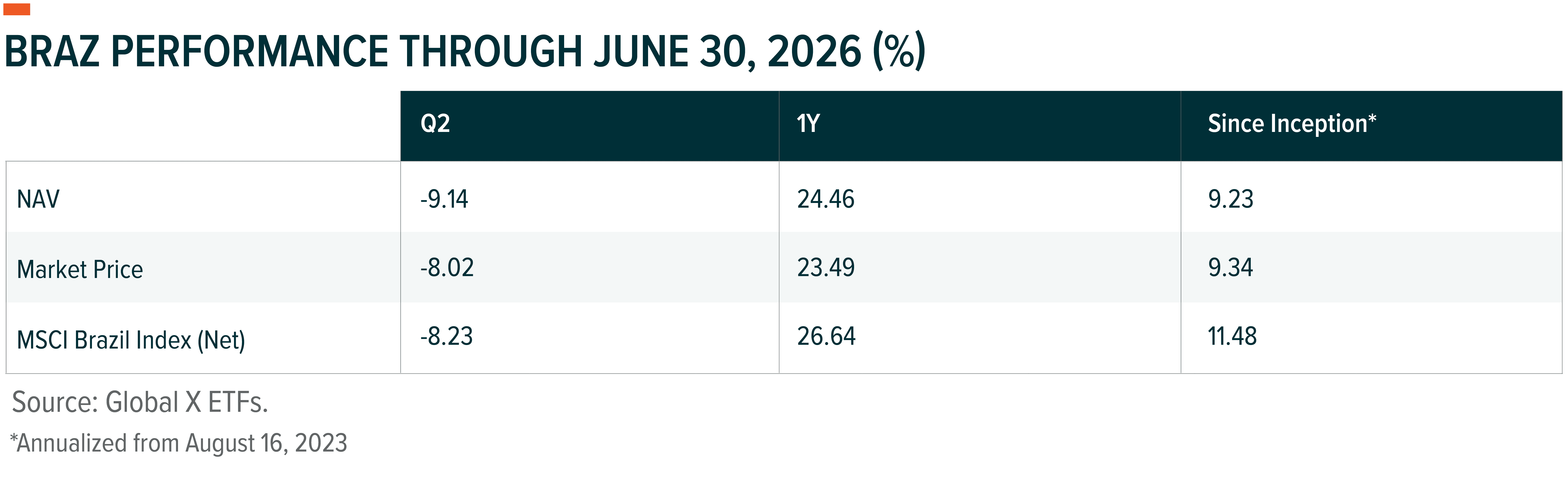
The performance data quoted represents past performance. Past performance does not guarantee future results. The investment return and principal value of an investment will fluctuate so that an investor's shares, when sold or redeemed, may be worth more or less than their original cost and current performance may be lower or higher than the performance quoted. High short-term performance, when observed, is unusual and investors should not expect such performance to be repeated. Performance current to the most recent quarter- and month-end is available at https://www.globalxetfs.com/funds/braz/. Expense Ratio: 0.75%.
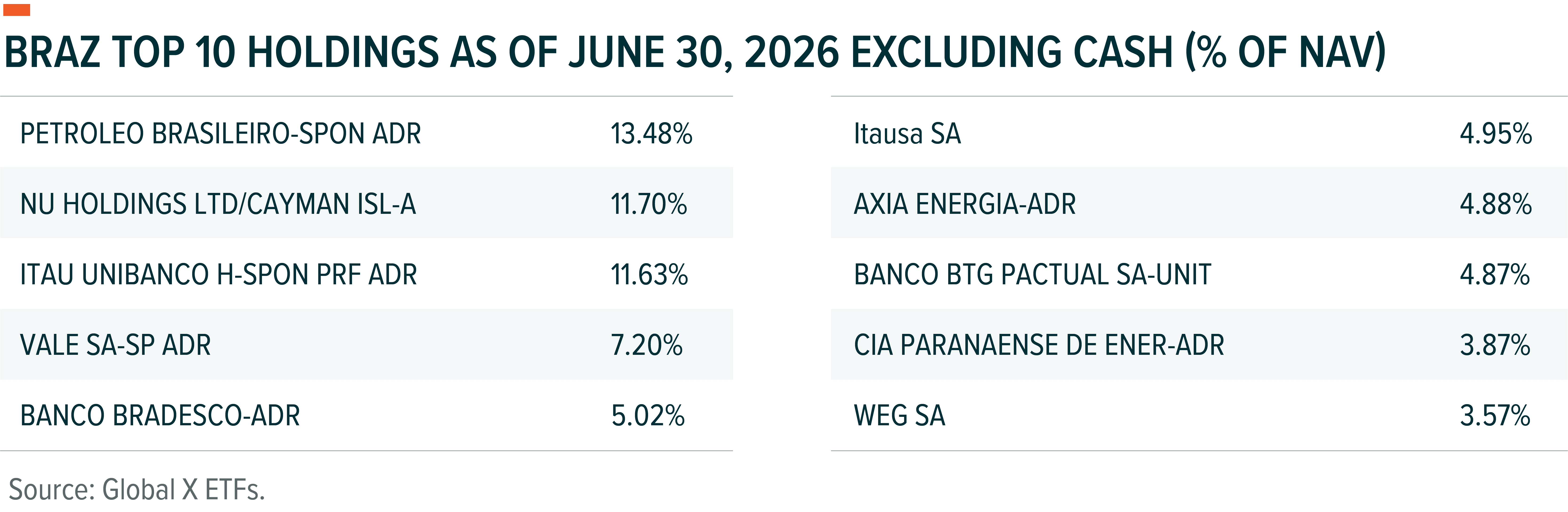
Holdings are subject to change.
Outlook
Brazil remains, in our view, a classic value setup: the MSCI Brazil Index (Net) currently trades at a single-digit price-to-earnings multiple, the currency appears to have stabilized, and the central bank retains room to keep cutting a policy rate that is still among the highest real rates (interest rate minus inflation rate) of any major economy.8 We see three potential tailwinds going forward. First, continued Selic cuts should support credit growth and balance sheet strength for domestically levered companies. Second, a weaker U.S. dollar should benefit companies with dollar-denominated debt and commodity producers broadly. Third, market participants increasingly view the election as a lower-volatility event than earlier feared: the combination of key electoral milestones including party conventions and vice president selections that are still pending, significant differences amongst polling methodology, lower voter engagement, and difficulties in building strong state-level alliances for President Lula in key battleground states leaves us more optimistic on a potentially positive election result than current market consensus. That said, election positioning could still shift again before October, and we would not treat the current polling picture as settled.
Our focus remains on high-quality Brazilian companies with superior returns on capital, disciplined leverage, and durable growth prospects, since we believe markets ultimately reward balance sheet strength and consistent cash generation through different parts of the cycle.
Why This Fund
Despite mid-high teen ROEs (return on equity) and solid growth prospects, the MSCI Brazil Index (Net) currently only trades at a high single digit price-to-earnings ratio (P/E) and even offered a dividend yield of almost 7%.9 The Global X Brazil Active ETF (BRAZ) is the only active fund registered in the U.S. dedicated to Brazilian equities and comes with a client friendly structure that offers bottom-up active management, with the fees, liquidity, and transparency of its ETF structure.10 Furthermore, the fund is managed with the support of a three-person team with deep personal, academic, and professional experience managing Brazil portfolios. The fund is concentrated and holds approximately 20 to 30 names and consistently looks at opportunities beyond the benchmark. The team uses a strict investment process based on a quantitative screen, sector specialists’ stock analysis, and a risk-adjusted portfolio construction process. The fund’s information can and will vary from the MSCI Brazil Index.
Related ETF
BRAZ – Global X Brazil Active ETF
Click the fund name above to view current performance and holdings. Holdings are subject to change. Current and future holdings are subject to risk.