
Emerging Market (EM) sovereign debt, as measured by the JPMorgan EMBI Global Core Index, rallied in the second quarter, led by high-yield issuers, as easing geopolitical and stagflation concerns lifted risk appetite, compressing credit spreads and supporting strong returns despite a volatile and overall strong U.S. dollar environment.
Market Review
Emerging market sovereign credit advanced in the second quarter. The JPMorgan EMBI Global Core Index climbed 4.63%, with spread compression accounting for most of the gain.1 High-yield issuers far outpaced investment grade, reversing the “risk-off” dynamic that had weighed on lower-rated credits earlier in the year. The primary catalyst was a 60-day ceasefire agreement between the Trump administration and Iran, which eased fears around a prolonged Strait of Hormuz disruption and energy price shock. Performance dispersion remained wide, with Ukraine, Sri Lanka, and Argentina outperforming, as distressed and post-restructuring credits repriced sharply higher, while higher-quality investment grade sovereigns lagged the broader rally.
Fund Performance and Attribution
EMBD returned +3.93% (NAV) in 2Q26 versus +4.63% for its benchmark, resulting in 70 basis point (bps) of relative underperformance. On a market price return basis, the fund returned +3.70%, underperforming by 93 bps. Relative performance was driven mainly by country allocation and security selection, with a smaller negative contribution from yield-curve positioning. Egypt, Mexico, South Africa, and Sub-Saharan Africa detracted from relative performance. The primary driver of relative underperformance was the fund's underweight to high-yield, lower-rated issuers. That positioning reflected our view heading into the quarter that tight valuations did not adequately compensate for risks tied to Middle East tensions and a potential energy price shock. The ceasefire agreement removed much of that risk premium quickly, and the resulting rally in lower-quality credits outpaced our overweight positioning in higher-quality issuers. Argentina was the top contributor to relative performance, reflecting successful security selection within our overweight exposure, as improving fundamentals were reinforced by the broader market rally.
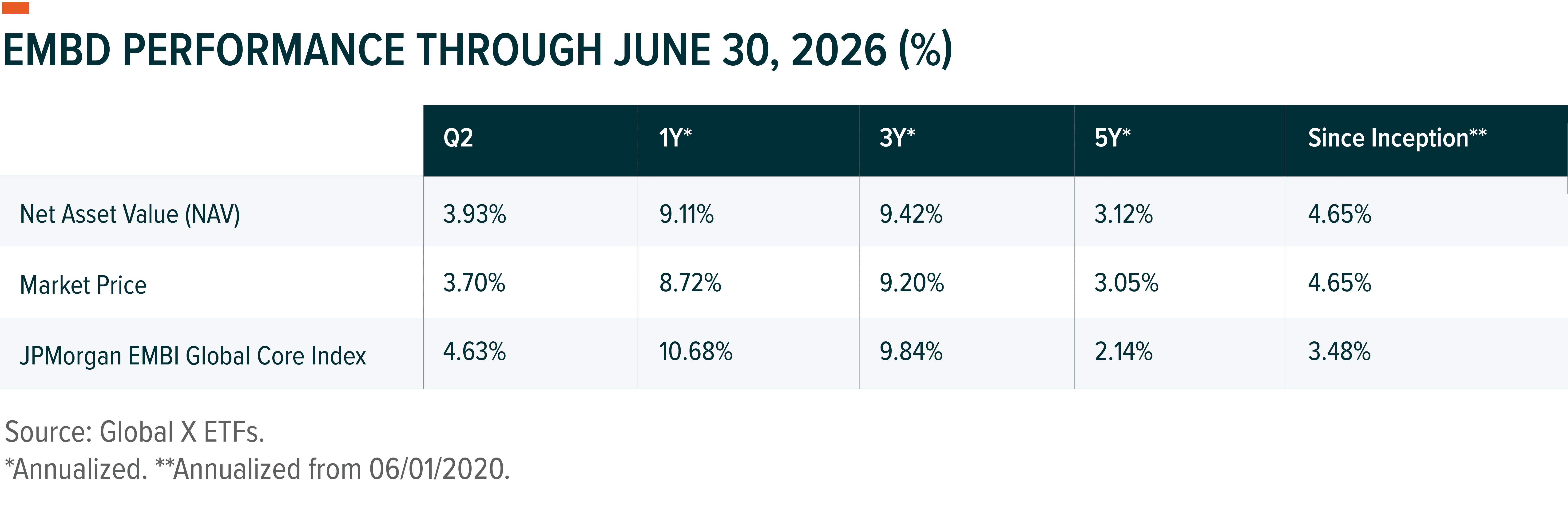
The performance data quoted represents past performance and does not guarantee future results. Investment return and principal value of an investment will fluctuate so that an investor’s shares, when sold or redeemed, may be worth more or less than their original cost. Current performance may be higher or lower than the performance quoted. For performance data current to the most recent month or quarter-end, please click here. Total expense ratio: 0.39%.
Outlook
We remain constructive on EM sovereign debt, supported by continued global expansion, resilient AI-related investment, and supportive fiscal policy, which should keep recession risks low and credit spreads broadly anchored. Key risks include a more hawkish-than-expected monetary policy response to persistent inflation and renewed Middle East tensions. Energy price volatility remains a key risk, though we believe the Trump administration has a strong incentive to limit sustained disruptions to global energy markets ahead of the U.S. midterm elections. Spreads remain tight, but we see attractive all-in yields, resilient sovereign fundamentals, and improving policy credibility that we believe could continue to support returns. Given current valuations, we expect potential future relative returns to come primarily from security selection and improving credit fundamentals rather than broad-based spread compression.
EMBD maintains a quality bias, favoring issuers with improving fundamentals and adequate valuation cushions over higher-beta credits trading on sentiment alone. This positioning is designed for an environment where broad spread compression has run its course and returns depend increasingly on security selection rather than beta. We believe opportunities remain in selective higher-yield credits where fundamentals are improving and reform momentum is strengthening, such as Argentina and Ecuador. Conversely, we remain cautious on higher-yield issuers where valuations have become less attractive and returns may be driven more by idiosyncratic or geopolitical events, such as Egypt. While we expect a supportive macro backdrop to continue underpinning EM sovereign credit, we believe current valuations provide limited room for further spread tightening and reinforce the importance of disciplined country allocation, security selection, and focus on resilient sovereign fundamentals.
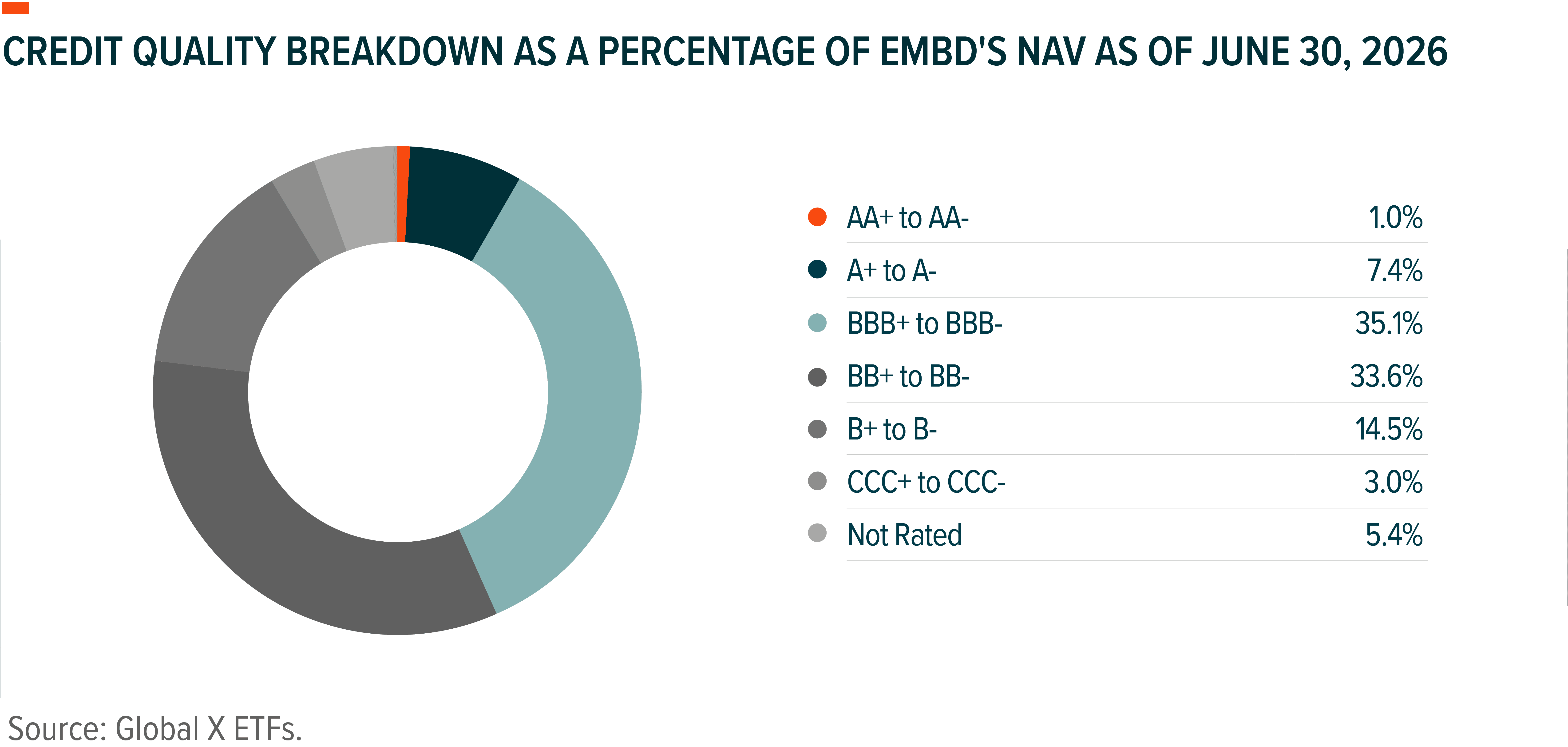
Credit Quality Methodology: All rated securities are rated by at least one of the three major rating agencies (Moody's, S&P, & Fitch). If more than one of these rating agencies rated the security, then an average of the ratings was taken to decide the security's rating. Ratings are measured on a scale that generally ranges from AAA (highest) to D (lowest).
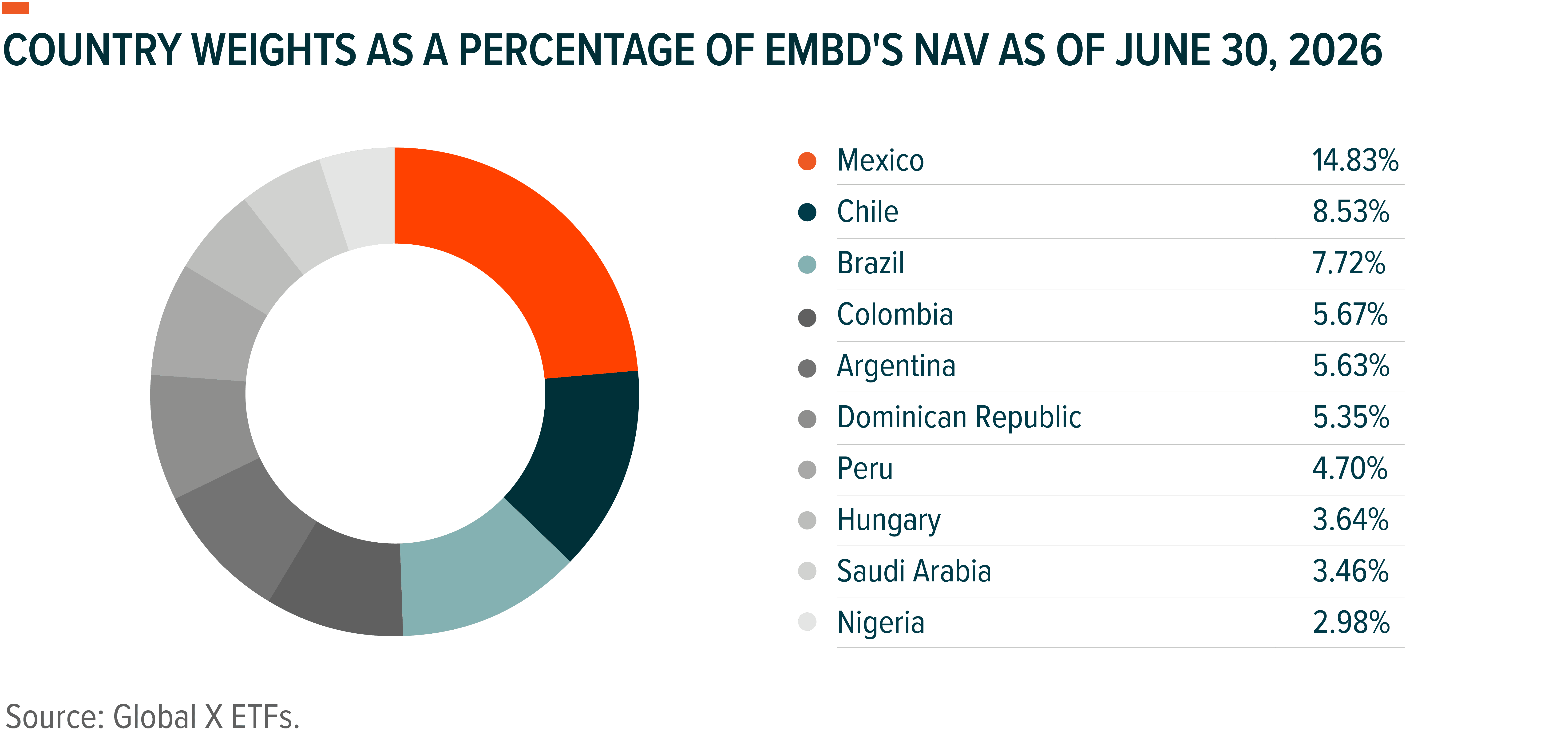
Geographic breakdowns are based on equity positions held by the ETF and exclude cash, currencies, and other holdings.
Related ETFs
EMBD – Global X Emerging Markets Bond ETF
Click the fund name above to view current performance and holdings. Holdings are subject to change. Current and future holdings are subject to risk.