

Indian equities, as defined by MSCI India Index, declined in a volatile quarter, while active positioning and stock selection in NDIA drove outperformance versus the broad Indian equity market.
Market Review
Indian equities declined in the first quarter, with the MSCI India Index (Net) (the “benchmark”) falling 18.13%, as geopolitical volatility and the country’s reliance on energy imports weighed on sentiment. India imports roughly 90% of its oil, with a significant portion flowing through the Strait of Hormuz1. The 76.49% spike in oil prices (measured by the Generic 1st ‘CO’ Future) raised concerns around trade balances and inflation2.
Despite these pressures, India maintained some access to supply through negotiations with Iran, while a temporary U.S. reprieve on Russian sanctions allowed continued purchases of crude oil.
Several supportive factors also remained in place, including progress on trade agreements, elevated gold prices, consumer-focused fiscal measures, and gross domestic product (GDP) growth above 7% for the fiscal year ending March 31, 20263. We believe the pullback reflects a macro-driven shock rather than a deterioration in underlying fundamentals, leaving India well positioned to benefit from normalization in energy markets or geopolitics.
Fund Performance & Attribution
NDIA returned -15.04% (NAV return) in 1Q 2026 versus -18.13% for its benchmark, resulting in +3.09% of relative outperformance4. On a market price return basis, the fund returned -13.15%, outperforming by 4.98%5.
At the sector level, the most notable contributions to returns came from consumer discretionary (+0.86%), financials (+0.43%), and industrials (+0.43%).6 Outperformance within consumer discretionary was driven by stock selection. Financials benefited from positioning in higher-quality lenders and selective off-benchmark exposures. The biggest detractors from relative returns came from overweight positioning in Real Estate (-0.56%) and stock selection within Energy (-0.42%).
At the stock level, Mahindra & Mahindra (+0.54%) was the largest contributor, followed by Bajaj Finance (+0.42%) and Timken (+0.40%). On the negative, side, overweight positions in Prestige Estates (-0.88%), United Spirits (-0.58%), and Tata Consultancy (-0.46%) represented the largest single name detractions.
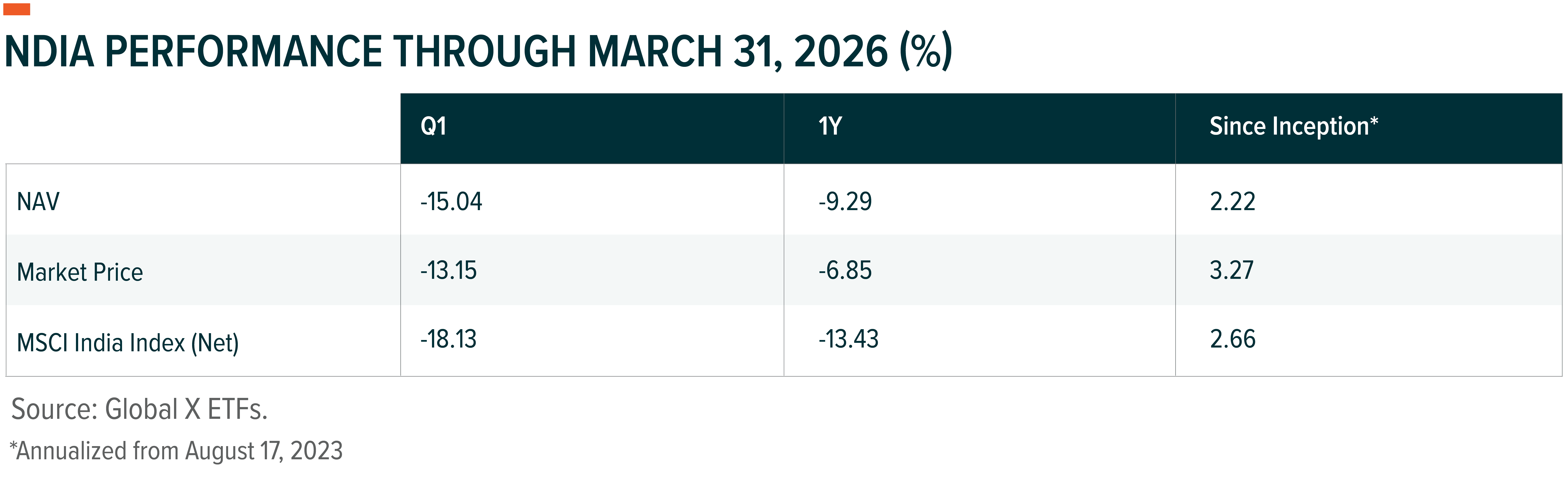
The performance data quoted represents past performance. Past performance does not guarantee future results. The investment return and principal value of an investment will fluctuate so that an investor's shares, when sold or redeemed, may be worth more or less than their original cost and current performance may be lower or higher than the performance quoted. Performance current to the most recent quarter- and month-end is available at https://www.globalxetfs.com/funds/ndia/. Expense Ratio: 0.75%.
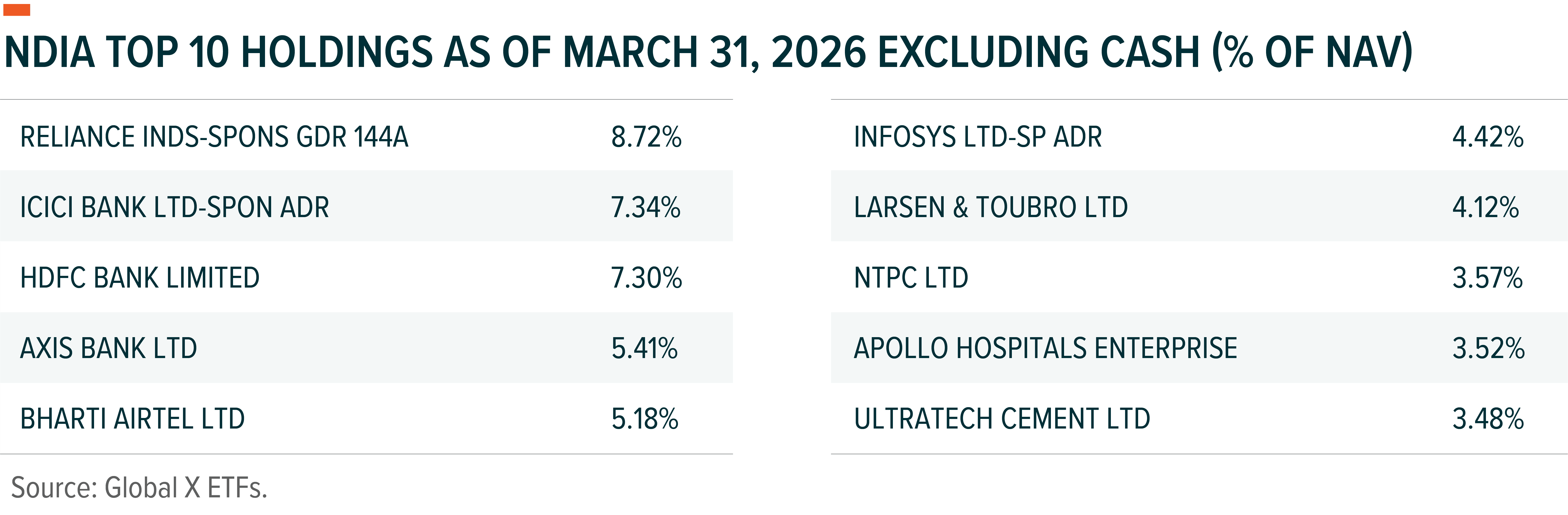
Holdings subject to change.
Outlook
India lagged EM peers last year due to trade-related uncertainty, which largely resolved earlier this year, before pulling back again on geopolitical concerns tied to energy imports. With India importing roughly 90% of its oil, normalization in the Middle East remains a key catalyst for sentiment and capital flows10.
Valuations have reset meaningfully and now sit more than one standard deviation below historical averages, creating a more attractive entry point.
Over the longer term, we believe that India remains one of the most compelling structural growth opportunities globally. Strong demographics, a growing middle class, and continued supply chain diversification support sustained GDP growth above emerging market (EM) peers. Structural reforms, including digital infrastructure, tax simplification, and manufacturing incentives, continue to improve productivity and the ease of doing business.
We believe active management remains critical. The strategy focuses on identifying companies with durable competitive advantages, strong management teams, and the ability to compound returns above their cost of capital. NDIA delivers bottom-up fundamental analysis with the fee structure, liquidity, and transparency of its ETF wrapper.
Related ETF
NDIA – Global X India Active ETF
Click the fund name above to view current performance and holdings. Holdings are subject to change. Current and future holdings are subject to risk.