
September is usually a tough month for the market with the S&P 500 averaging a 1.1% decline going back to 1928.1 Meaningful, though often short-lived, seasonal headwinds stem from an air pocket in fundamental data as investors await third-quarter earnings. Coinciding during this period is often cooling labor market data with the end of temporary college and tourist jobs.2 Election years tend to compound these drags amid uncertainty over legislative control and potential economic policy. Questions about the Federal Reserve’s willingness to make moves ahead of elections are another variable, though in 2026, the market seems prepared for a modest hike.3
What potentially makes this cycle distinct is the paradigm-shifting technology that is AI and expectations for monetization for the tech sector and beyond. We are still big believers in the automation revolution and the remaking of productivity and profitability in the coming years. That said, concerns about revenue and earnings combined with expenses and investment are weighing on markets heading into the fall.4 Recent headline-making statements from AI leaders calling for a slowdown in AI development are adding to mixed sentiment.5
A deeper look, however, suggests that the risk is not forecasted earnings growth but growing uncertainty and dispersion in expectations of winners and losers.6 One month, the market embraces hardware as the darling and eschews software, only to reverse the trade a few weeks later. In our view, this behavior is more about behavioral economics and sentiment than fundamentals, making short-term or tactical pullbacks potential opportunities to access some under-owned or unloved segments of the AI ecosystem.
Key Takeaways
- AI investment and the resulting forecasts for revenue generation are a source of equity volatility even while helping to drive economic growth and corporate profitability.
- Investors have been more discerning in recent months, attempting to reward AI winners and hold losers accountable, a dynamic that increases the outcome variance, even if median expectations are unchanged.
- Perception is especially important as investors pull forward or push out growth expectations without aligning improvement or headwinds in near-term earnings with long-term growth forecasts.
Geopolitics and AI as Sources of Volatility
Geopolitics can be a source of near-term volatility, but markets are typically quick to move past these headlines and refocus on fundamentals. For many investors, geopolitically induced volatility is a nuisance rather than a meaningful driver of, or risk to, long-term performance. This time, however, inflation expectations are in the crosshairs.
Inflation’s two sides mirror the broad economy.7 Demand-side inflation stems from an overheating economy that grows too fast with ample liquidity. Supply-side inflation often arises from constraints that prevent products from reaching the market in sufficient quantities. While higher rates can temper exuberant demand, they do not directly relieve supply constraints, making supply-side inflation more challenging for central banks.8 Shelter is a prime example. Prior to the start of the Iran conflict in March 2026, shelter was the largest driver of U.S. inflation for more than two years.9 Higher rates do not help bring housing costs down; instead, they make house purchasing less affordable and push more people into the rental market, ultimately driving prices higher.10
Equities are not typically sensitive to long-duration rates.11 Higher rates affect the cost of capital, but markets tend to price that adjustment quickly and move on. Current conditions are an exception. In 2023 and 2024, the average correlation between the S&P 500 volatility and changes in the 10-year rate ran at a modest 0.3. Since then, that correlation has spiked to almost 0.7, suggesting that equity investors are concerned about inflation, supply challenges tied to conflict and trade, and the valuation impact.12
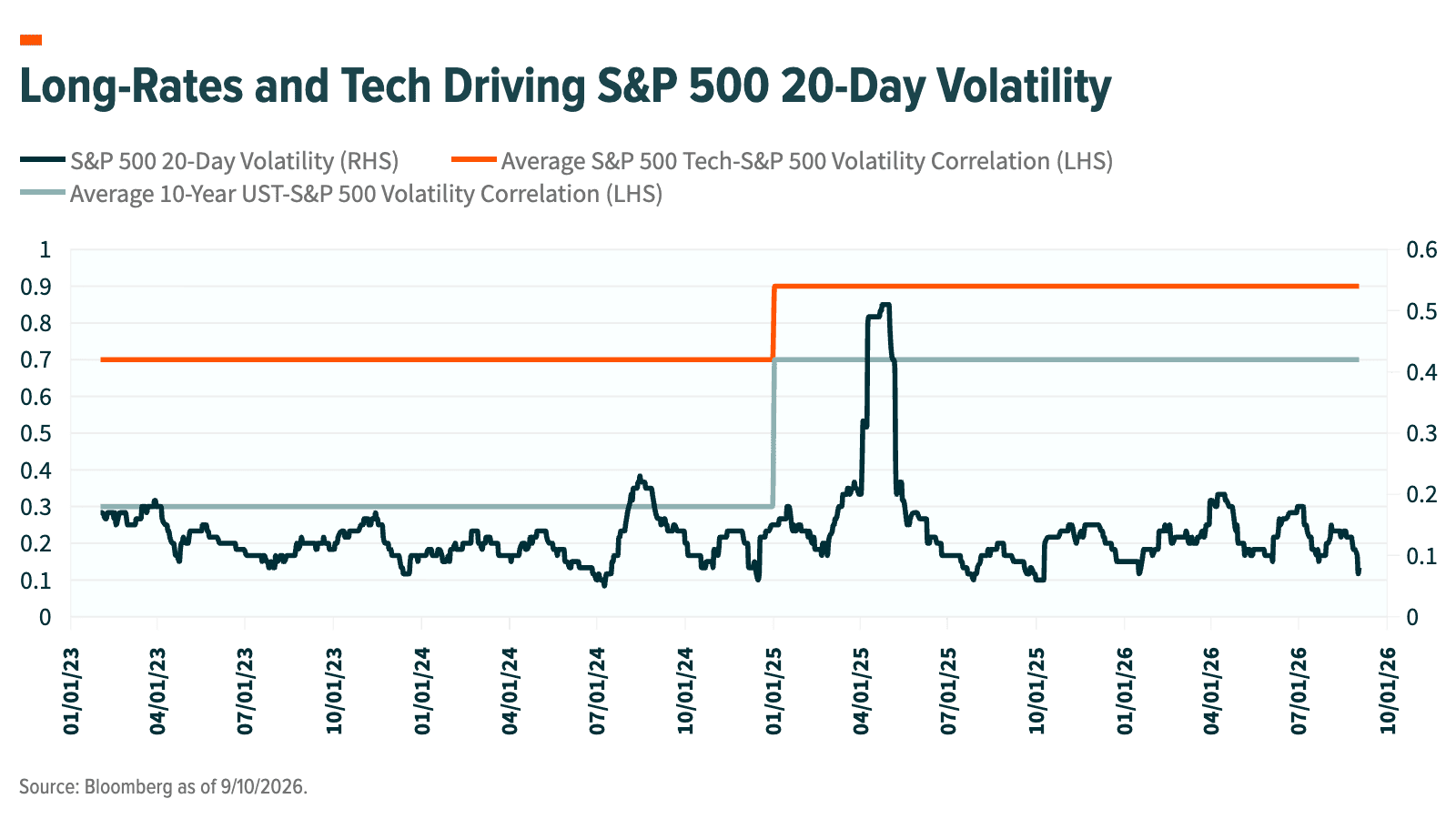
On the other hand, broad equity markets are reasonably sensitive to volatility in the technology sector. When perturbations hit the largest sector by market cap, it’s only natural for the market to move.13 The difference now is that the impact is larger. From 2023 to 2024, the correlation between S&P 500 volatility and tech volatility was roughly 0.7, but since the start of 2025 that correlation has jumped to 0.9.14
Since concerns around AI monetization are at the core of recent tech volatility, clarifying the growth outlook is critical to market stability. That need unveils a Catch-22, though: the AI monetization story relies heavily on continued investments in infrastructure, but markets also perceive this spending as a risk to cash flows and balance sheet quality.15
The market’s dual-sided conundrum, tech as a primary source of earnings growth and corporate investment to sustain the AI cycle, raises the stakes. Tech earnings are forecasted to grow over 70% this year, with profit margins exceeding 38% and expanding to 43% in 2027.16 These forecasts underpin S&P 500 earnings, which have been revised up 15% this year and are projected to grow nearly 30% over 2025, leaving the market vulnerable should AI monetization lag.17
AI investment has also propelled upward revisions beyond tech and communications to sectors like industrials and utilities.18 Higher interest rates could put some of this continued investment at risk, linking the two main drivers of volatility.
Statistical Moments of AI Monetization
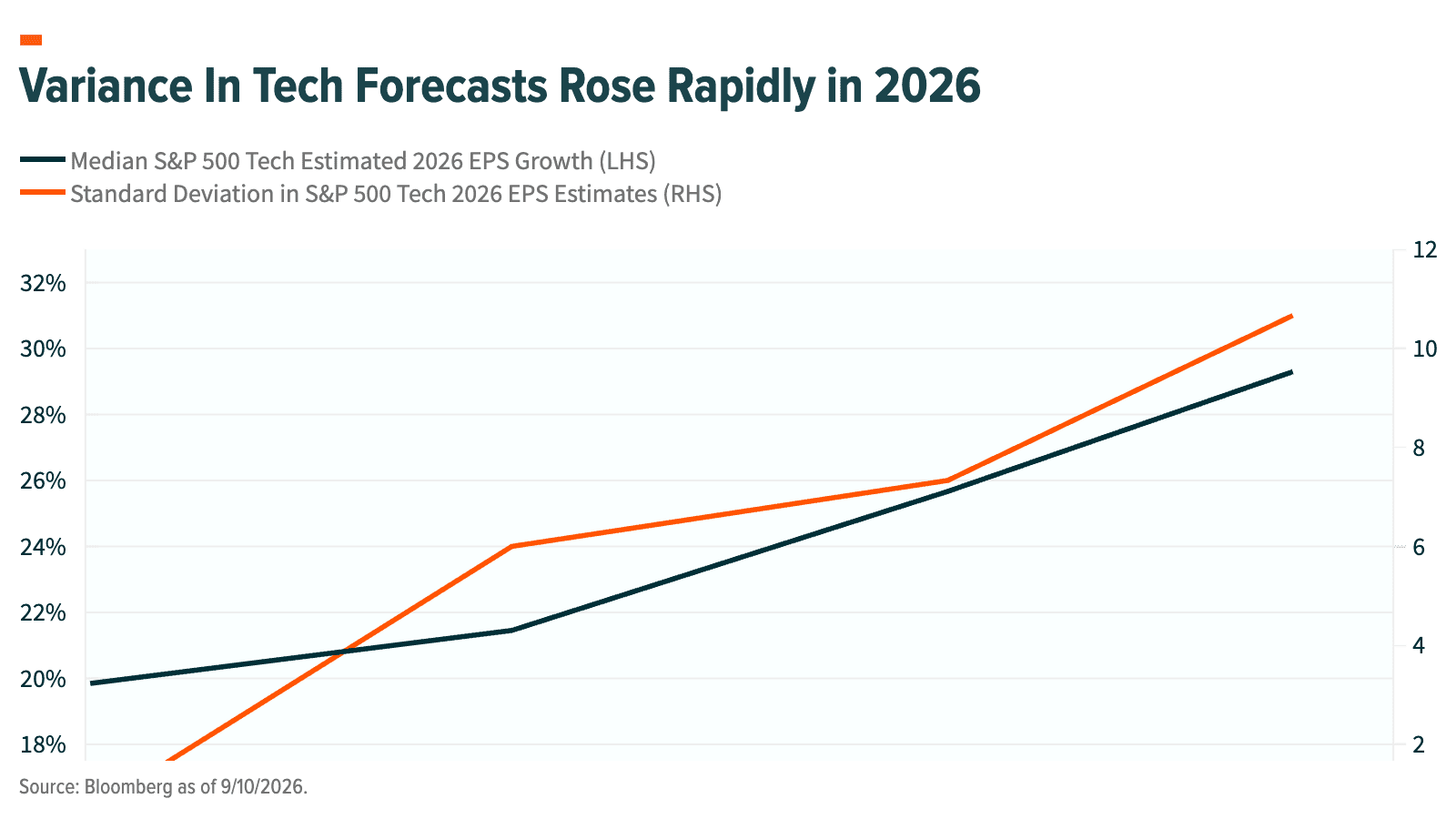
If rising tech earnings and profitability are not the source of volatility around AI monetization, we need to look elsewhere. A major source would be widespread earnings downgrades, but consensus expectations remain intact.19 Instead, our analysis points to statistical dispersion as the culprit.
The first two statistical moments used to describe data are mean and variance. As expectation variance increases, market participants position for a broader range of outcomes, even if the mean forecast trends higher. We see this dynamic playing out in the tech sector today. Year-to-date, the median expectation for earnings growth has almost doubled from 16% to 31%, yet the standard deviation of earnings growth for sector constituents has more than tripled.20 In other words, the outlook is positive, but variance in expectations opens the door to a wider dispersion in outcomes.
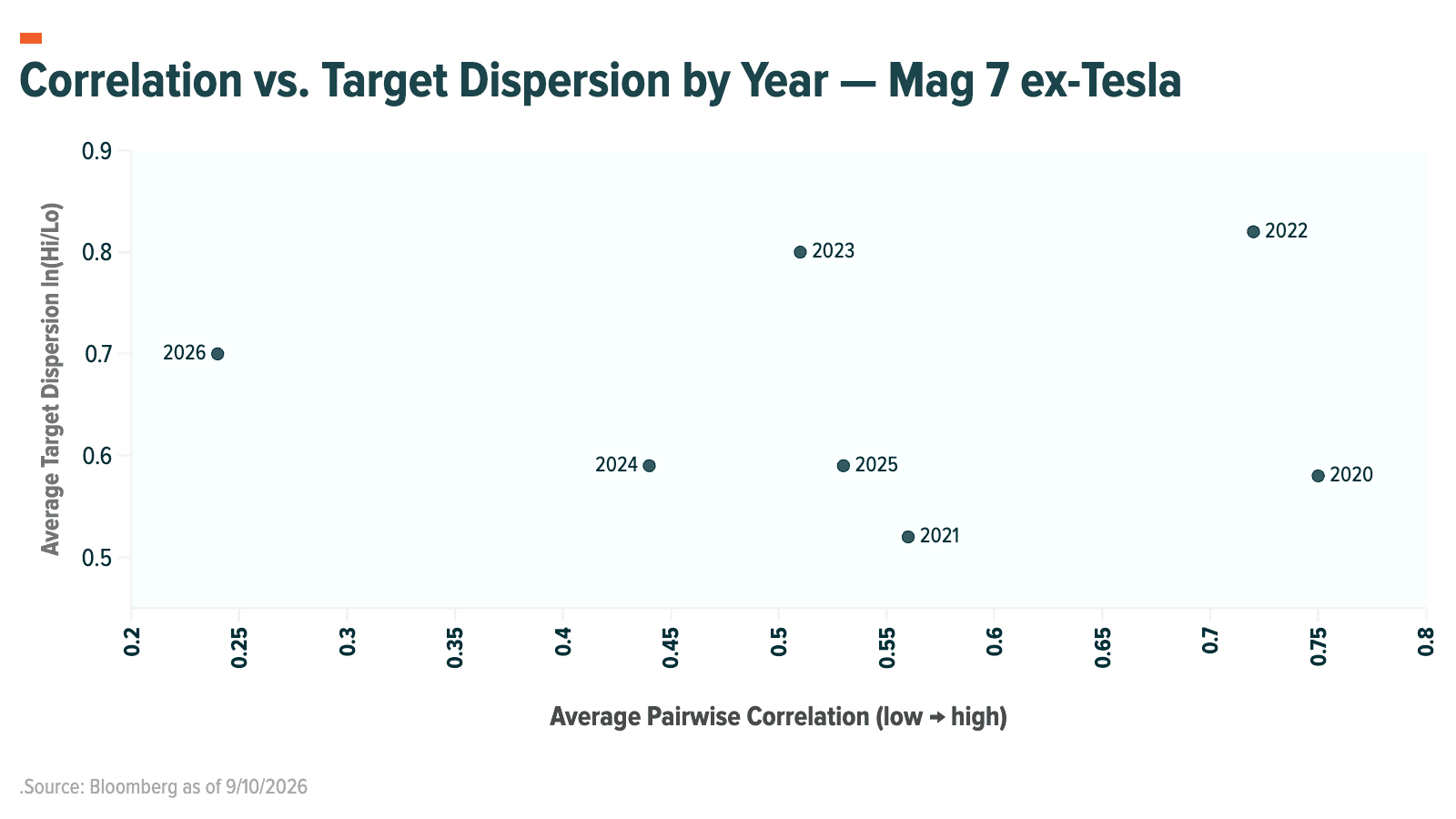
The Mag 7 excluding Tesla exhibit a similar trend. While forecast dispersion is consistent with prior periods, the six hyperscalers are moving more independently than at any time in the past six years.21 Investors are more discerning, which has reduced correlations. Varying market reactions to capital expenditure and AI contract announcements now trigger big shifts in individual names rather than the whole group.22 We do not expect this divergence to result in a broader drawdown, but it suggests market performance may decouple further from them in the coming months.
Perception and Valuation Disconnects
We believe AI monetization concerns create an intriguing backdrop for both strategic and tactical opportunities. Increased variance stems, in part, from expectations pulled forward. While tech sector earnings have been revised up, expectations for hardware and software have diverged: software estimates are lower over the next two years and semiconductor estimates are more than 30% higher in both 2026 and 2027.23

Markets should react to revisions like these, but valuations have disconnected from them. Long-term growth expectations for semiconductors and hardware plummeted from 14% down to 7% even as earnings revisions improved.24 Meanwhile, despite downward revisions in near-term software earnings, long-term growth expectations increased from 9% to 12%.25 The market appears to be largely shifting these adjustments into long-term valuation assumptions.
A clear example of this disconnect is the Philadelphia Semiconductor Index (SOX). Currently, the SOX index is priced for the same long-term growth as the S&P 500, but that is probably an anomaly given that SOX stocks are forecast to grow much faster in the near term.26 Semiconductor companies tied to the AI buildout and data centers with existing capacity could be attractive. Expectations for near-term weakness may also create an opportunity in software. Should AI and cloud software companies beat revised expectations, tactical upside may follow even as the market revises long-term expectations.