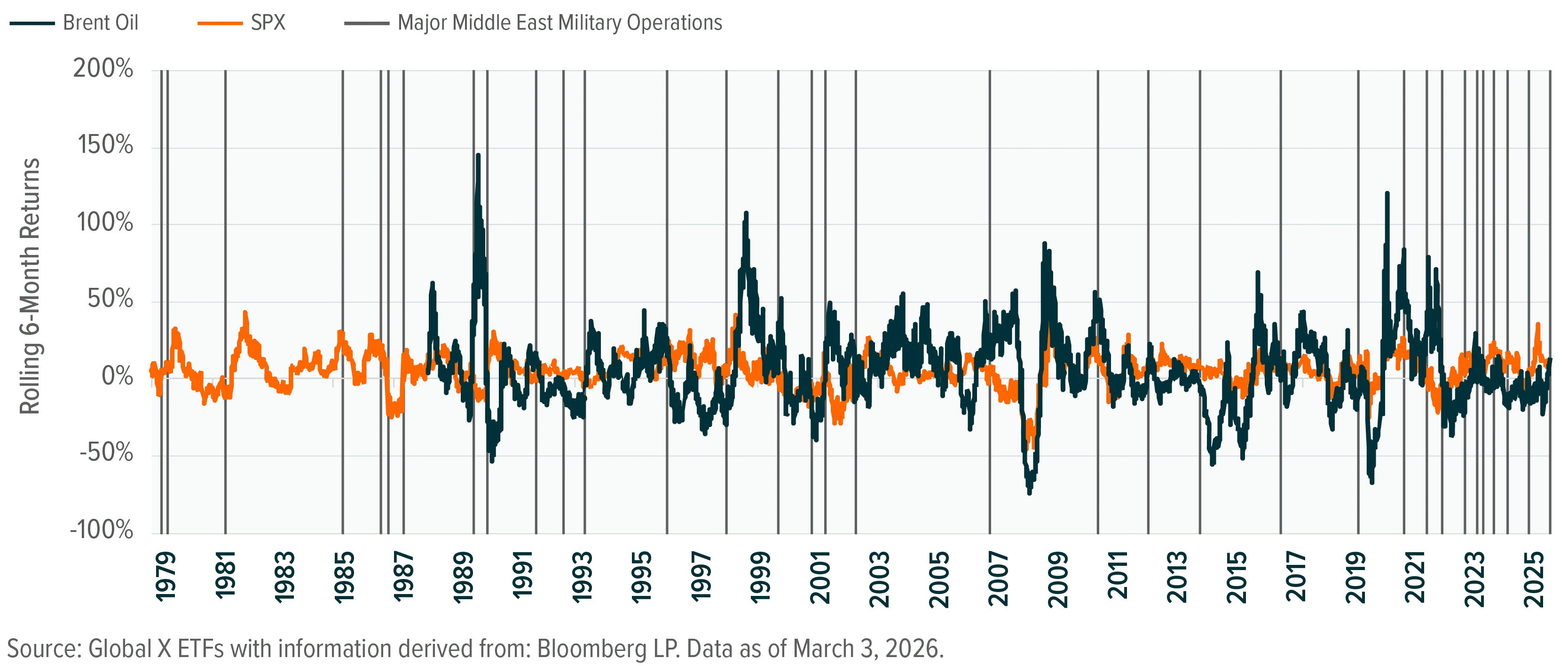
The U.S. and Israel military operation targeting Iran is the second such operation in two years and already involved 11 countries with the possibility of drawing in more.1 The campaign is intended to reduce Iran’s regional threat to the Middle East by degrading military forces while also weakening the regime’s ability to clamp down on domestic protestors, but perhaps more importantly, this is an attempt at reestablishing U.S. deterrent posture with respect to Russia and China. There are multiple strategic and tactical goals to consider.
Key Takeaways
The military operation in Iran has a much broader geopolitical rationale with regards to U.S. defense posture and strategy.
Structural disruption to energy supply translating to higher long-term prices seems unlikely, potentially limiting the impact on the U.S. economy and Fed policy.
Think beyond the short-term tactical investing environment to focus on themes with strategic implications like defense technology, cybersecurity, U.S. energy production and infrastructure, and materials and mining.
War is Politics by Other Means
The U.S. has viewed Iran as a pariah state since the 1979 revolution. In that time, Iran has built one of the largest militaries in the region, established a network of non-state terrorist proxies, pursued a nuclear weapons capability, increased the range of rocket and drone programs, all while committed to ideological goals counter to U.S and partner interests.2 The operation to degrade its capabilities should not really surprise, but the speed with which the conflict has spread across the region and even to Europe is notable.3
This new military action is bigger than just striking Iran and limiting its military capability. Iran and Russia have defense ties going back years. Iran supplied Russia with drones used in Ukraine and Russia has sent surface-to-air missiles to Iran.4 Following the successful capture of Nicolas Maduro in Venezuela, the attack on Iran essentially takes another Russian partner off the table and weakens its hand in Europe. Russia will not be able to rely on Iranian weapons supply, particularly drones. Messaging is also intended to resonate beyond Moscow to Beijing. The U.S. is attempting to showcase both its singular global force projection capabilities and resolve on core interests.
Signal to Noise of Energy Pricing
Oil and energy supply is front and center days into the conflict but beware of headline head fakes particularly on prices and Fed policy. Oil prices unsurprisingly moved higher on news of the strikes, but the price pop may be short-lived provided there are no structural shifts in supply.5 Should Iran either block oil shipments through the Strait of Hormuz for an extended period or attack the energy infrastructure of other Middle East producers, there could be a shift in the cost curve. That is not our base case. U.S. efforts to destroy the Iranian navy aims at ensuring the Strait remains open, and ironically, Iran’s oil shipments also rely on safe passage.6 The threat to energy infrastructure in Saudi Arabia, UAE, Kuwait, Qatar and others is credible, but Iranian retaliation has focused largely on military targets around the region thus far. According to Iran’s spokespeople, they only intend to target U.S. and Israeli interests even if their actions do not quite align.7
Oil prices tend to move when geopolitical turmoil hits the Middle East, but long-term supply and demand tend to win out with oil prices declining an average of 3% in the six months after Middle East military actions since 1980.8 Further, the impact of higher oil prices on U.S. inflation or Fed policy is probably overdone. Higher energy costs typically slow economic growth which ultimately reduces demand. The Fed may be more concerned about a slowing labor market than a transient energy-driven bump in inflation.
Strategic Opportunities with Tactical Catalysts
Geopolitical events generally lead to brief periods of heightened volatility, but markets are usually quick to recover losses and tend to move higher in the subsequent weeks (below).9 The military operation does not really change the economic backdrop for U.S. companies unless energy prices hit margins or slow consumption. The U.S. is not as reliant on energy imports as other major economies such as China, possibly putting the U.S. in a good position to ride out energy supply chain issues and even trigger a reversal of the recent capital outflow.
A multi-week air campaign should be good for defense technology firms, as the U.S. is deploying new weapons systems like one-way drones and using advanced intelligence systems for target selection. At a minimum, weapon stocks will be depleted and must be rebuilt. Cybersecurity may come to the fore if Iran attempts disruptive operations. Following the selloff in software, there may be some attractive buying opportunities.
U.S. energy producers and infrastructure may profit from supply disruptions. With Qatar closing their largest natural gas refinery and Saudi Arabia halting shipments, U.S. exporters may capture additional market share. Domestic producers and infrastructure firms may see also increased demand from import gaps. A strong domestic energy market may buttress U.S. cyclicals and materials companies from disruptions and cost pressures.