
Growth and adoption of the Exchange Traded Fund (ETF) structure have given way to new interpretations around portfolio composition over the years, and there are few examples that can better illustrate this case than the rise of covered call ETFs. Covered call strategies that once required bespoke account approvals, capital-intensive execution, and persistent quality control monitoring can now be accessed through a single ticker and, through these funds, investors have gained access to experienced portfolio managers that handle the complexity of options writing to pursue income that may meaningfully reshape their portfolio’s risk/return profile.
Key Takeaways
- The covered call is a fundamental two-legged options trade that attempts to monetize volatility by exchanging upside price appreciation potential for premium income.
- Covered call ETFs can be structured in many ways. Understanding their individual strengths and weaknesses can help rationalize how they can be applicable as carveouts in the fixed income or equity sleeves of a traditional portfolio.
- The ETF structure has removed some operational and regulatory friction that formerly made these strategies more institutionally focused, but due diligence remains key to efficient application.
Covered Calls Aim at Sourcing Premium Income from Market Volatility
Even the most constructive market outlook should come equipped with the consideration of risk. This is a base argument for diversification, and it’s what has led investors to pursue fixed income exposures, seek to manage equity volatility, and balance portfolios with cash-equivalent assets over the years. With the incorporation of derivative instruments into the ETF structure, however, there is an even more differentiated way by which investors can seek out income and manage their risk exposures. Covered call strategies, in particular, grant investors the opportunity to turn market volatility into a potential source of income, transforming what is typically characterized as a source of risk into a productive portfolio tool.
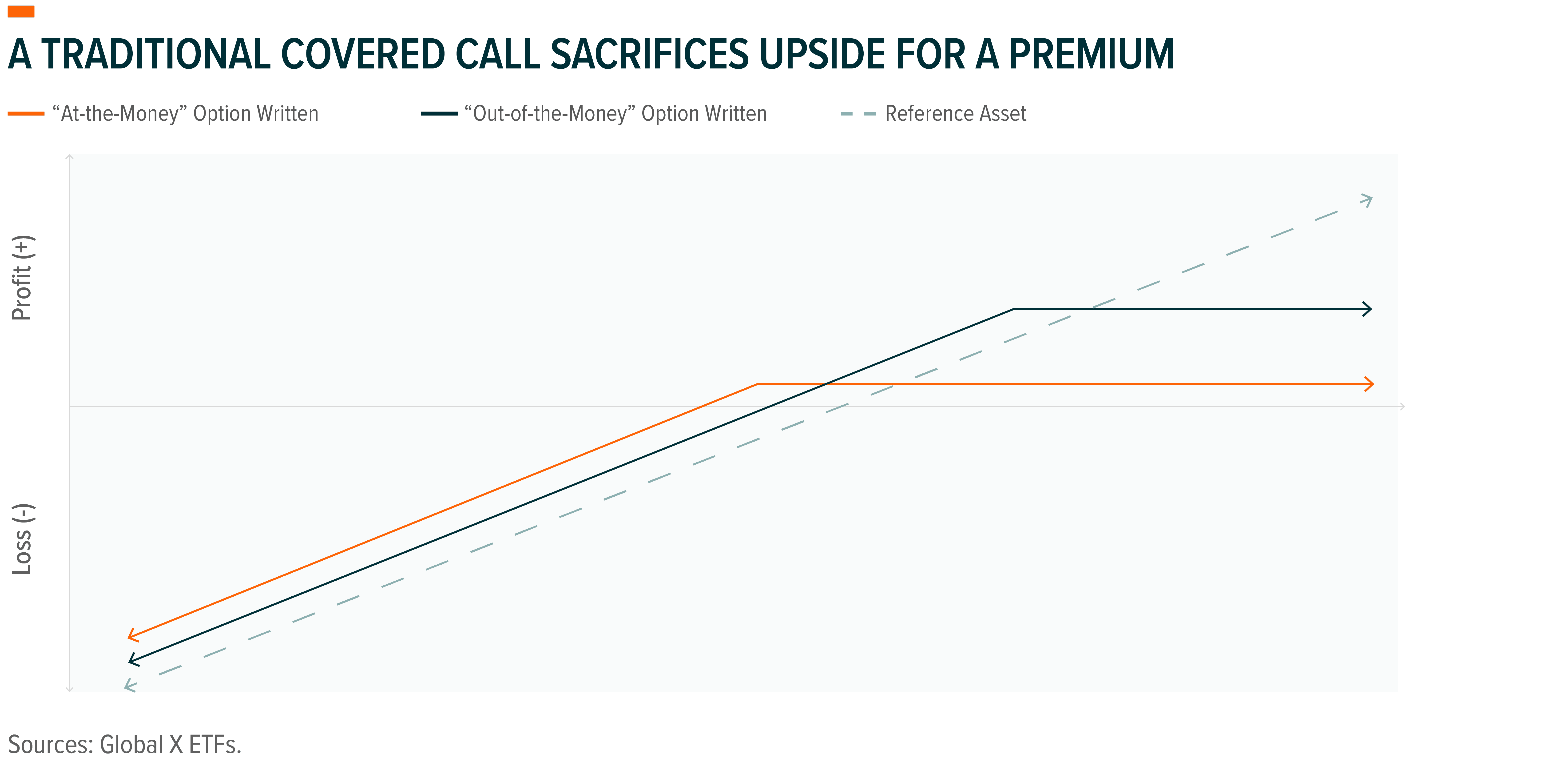
At its core, the covered call is a two-legged trade. An investor will purchase, or maintain long exposure to an asset. Then they will write, or short, a call option on the same asset. In exchange for selling the right to buy the asset above a set strike price (the price at which the option becomes exercisable), the investor collects a premium. A covered call can be employed tactically, when an investor looking to accrue current income might have trouble rationalizing price appreciation potential for an asset class in the near term. It can also be systematic, where an investor perpetually sells call options in an effort to pursue a periodic distribution stream.
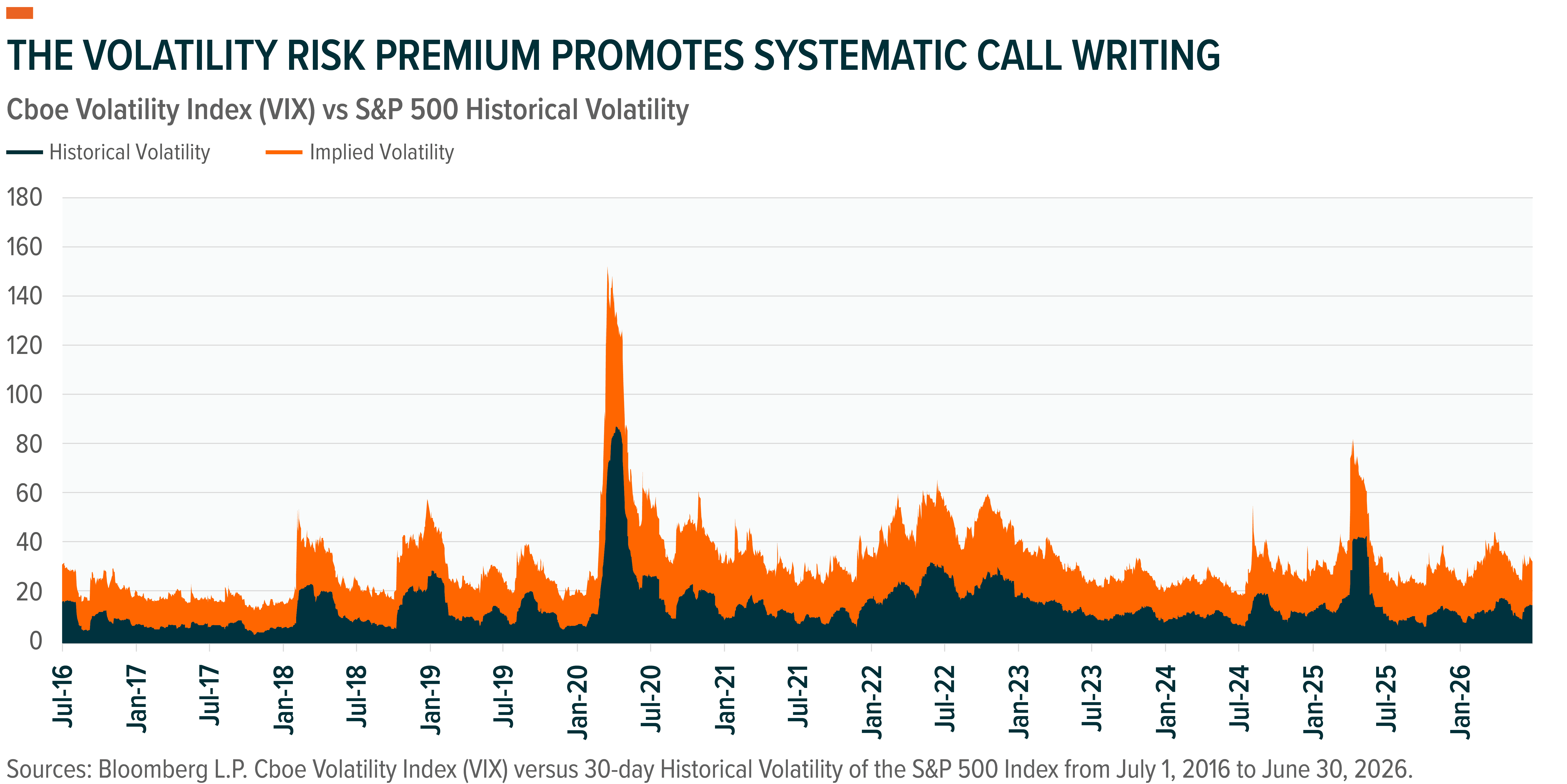
The economic basis behind incorporating covered calls into a portfolio is the presence of the volatility risk premium, which is a phenomenon that exists because of the persistent uncertainty that centers around unforeseen price shocks to the market. Options are priced based on implied volatility, which is an estimation of future volatility established by bets on these price shocks in the options market, reflected in indices like the Cboe Volatility Index (VIX). However, because volatility, when ultimately realized, tends to fall short of what the options market is anticipating, options have an overwhelming tendency to be overpriced at initiation. The value gap creates an almost perpetual opportunity to sell call options and collect premiums that are often overvalued.
Formerly, an investor operating outside the institutional arena might have had a variety of hurdles deterring them from utilizing covered call strategies in their portfolios. The capital intensity required to write options is an often-overlooked factor, particularly for higher-priced stocks since a typical option contract is required to cover 100 shares. The complexity associated with understanding the return structure is another, based on the many features of an option such as contract type, strike level, and time to expiration. Perhaps most notable, however, is the time and attentiveness required to manage such strategies, which is a burden that not many retail investors might be willing to take on.
The ETF structure helps alleviate a lot of these concerns, democratizing access to these innovative strategies for the average investor. It can also allow investors to employ strategies that write call options not only on individual securities, but on entire indexes with portfolio managers aiming to help rebalance underlying long exposures in a capital-efficient manner. Many ETFs have daily holdings transparency, which also keeps investors informed, and the presence of experienced financial professionals managing things like price discovery, portfolio rebalances, and liquidity sourcing removes much of the operational onus that might have formerly fallen on the shoulders of the investor.
Covered Call ETFs Can Represent Fixed Income or Equity Replacements
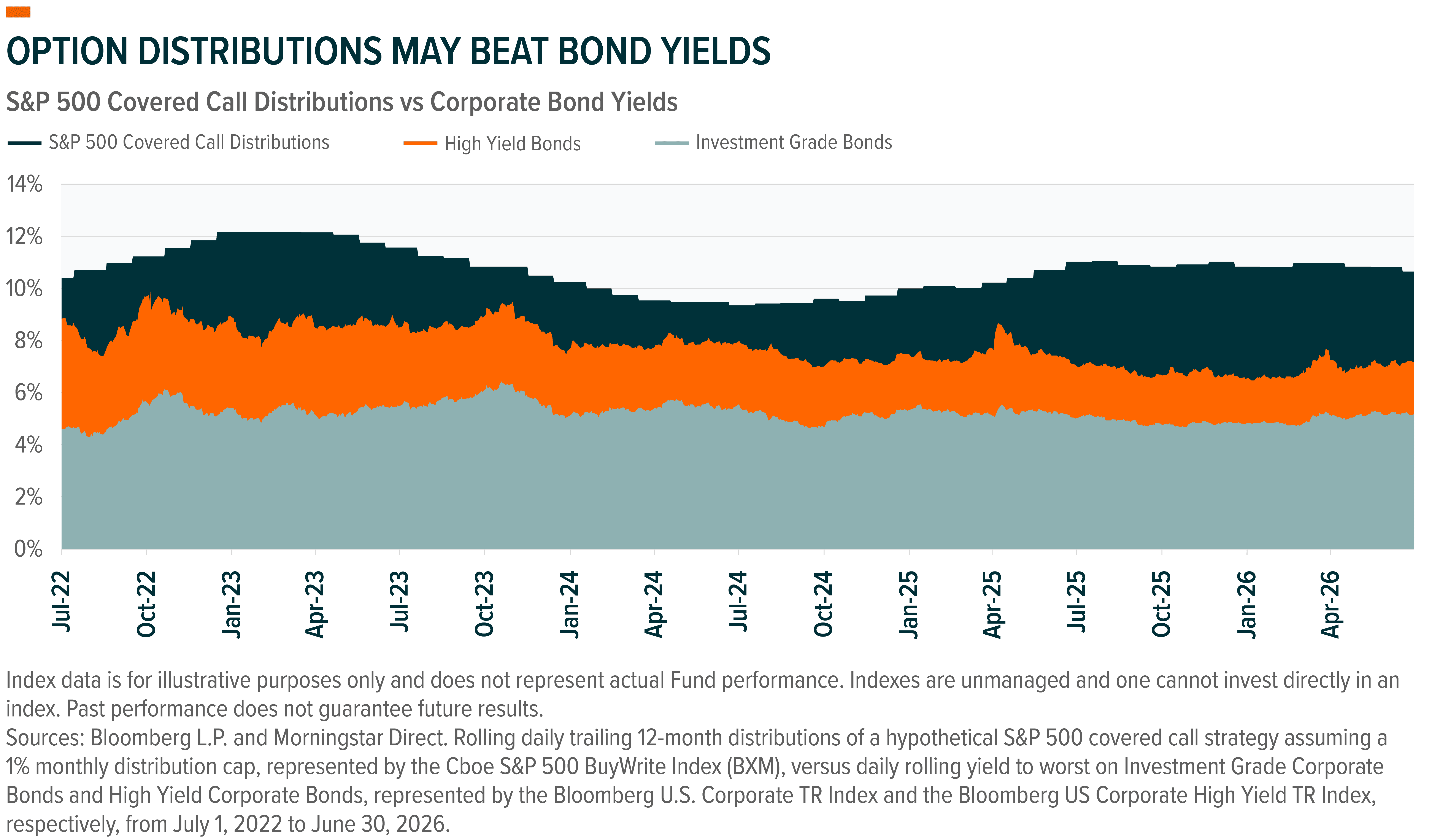
When a bond investor is looking to boost income potential, they are typically at the mercy of the rate markets. They can choose to take on additional credit risk by branching out into investment grade or high-yield debt instruments, extend their portfolio’s duration, or both, but covered call ETFs offer a different route entirely. Depending upon the volatility profile of a reference asset, such as the S&P 500® or Nasdaq-100® indexes, the premiums that can be generated by systematically writing of call options can rival or even exceed that of the yields that have historically been made available by fixed income instruments. At the same time, equity covered call ETFs introduce a fundamentally different risk profile that can include equity market participation and a potentially positive relationship with volatility.
One of the key tradeoffs of a covered call strategy is upside participation; those that are designed most vehemently to maximize premium income are typically those that most limit upside participation. This tradeoff stems from two straightforward relationships: premium income is influenced by both how close the call option is to the current stock price, and how much of the portfolio is covered by the strategy.
On the first point, the closer a call option's strike price is to the current market price the more valuable the contract (as it is more likely to be exercised), and therefore the higher the premium collected. A strategy oriented toward maximizing income may therefore write its calls at or near the current price, rather than further above it. On the second point, the greater the share of the portfolio against which calls are written, the more premium income the strategy can generate.
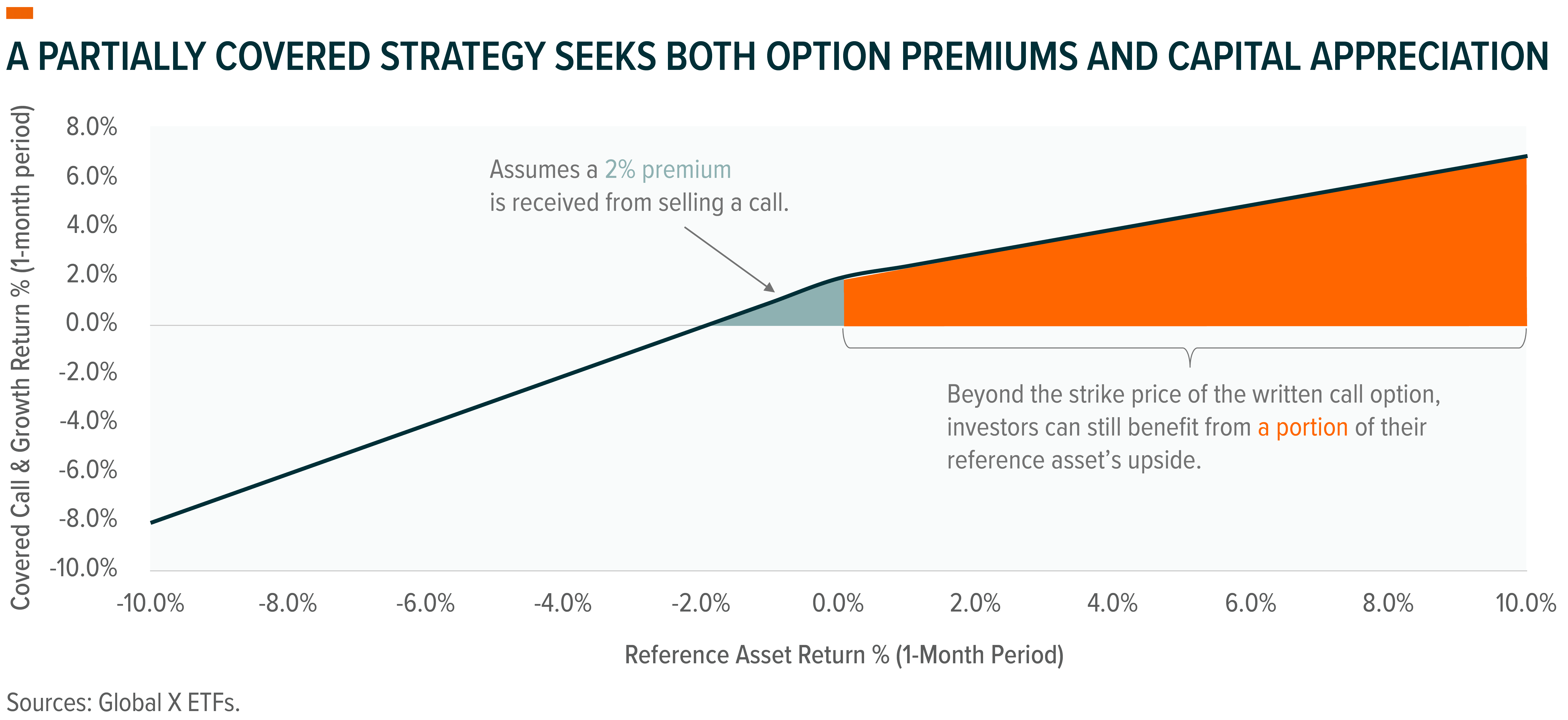
The consequence of both levers, however, is constraint on the upside: a strike price set near the current market price leaves little room for the call writer to participate in further gains, and broader notional coverage means that cap applies across more of the portfolio. A straightforward example of this type of dynamic would be a covered call strategy that writes options on 100% of its notional holdings versus a strategy that writes options on 50% of the same notional holdings. The 50% portfolio might expect to receive roughly half the premium that could be accrued by writing call options on 100% of a portfolio. The tradeoff, however, is that the investor’s long holdings are not capped to the upside. Instead, they can take advantage of approximately 50% of their reference assets’ potential upside, while still reaping the option premiums.
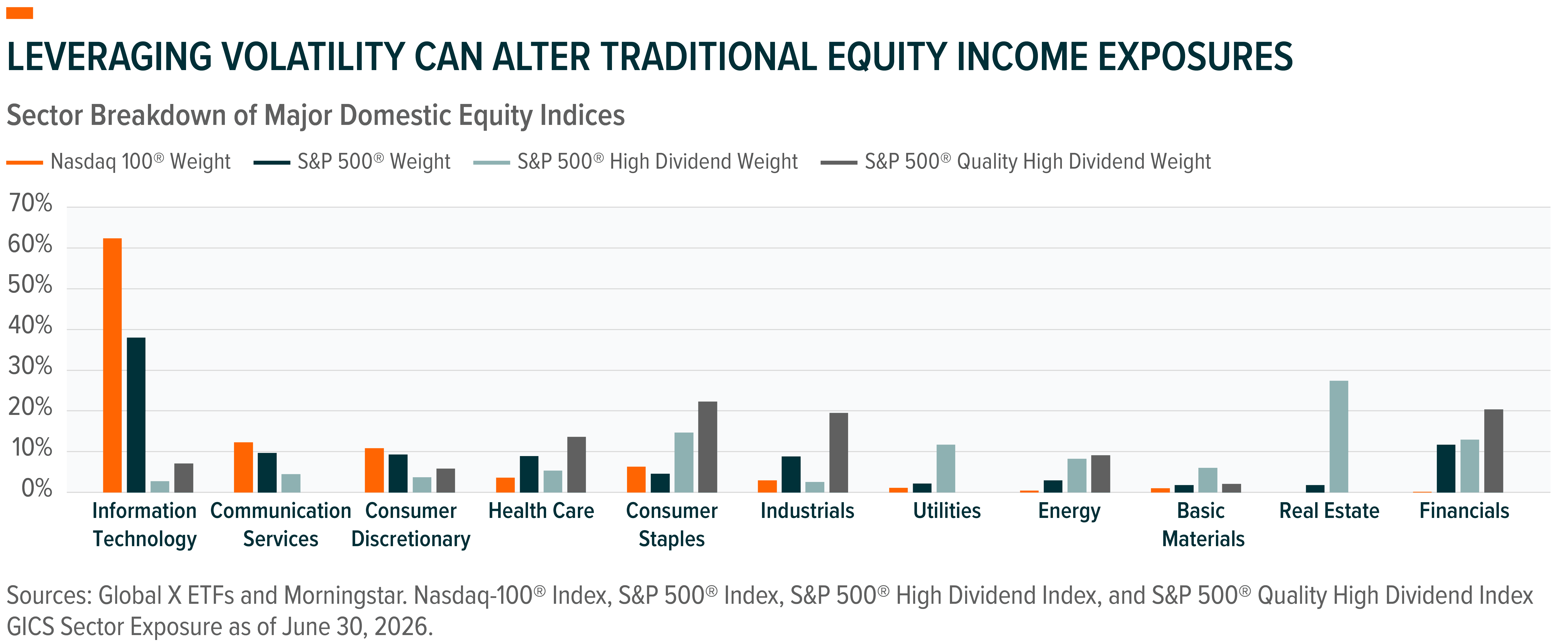
This structural flexibility is precisely what allows equity covered call ETFs to act as either fixed income or equity substitutes within a traditional portfolio. At higher coverage levels, distributions can rival or exceed fixed income coupons. At lower coverage levels, distributions may be more competitive with dividend-paying equities. However, there are ancillary factors to consider, as well, like the fact that traditional dividend strategies tend to concentrate in value-oriented sectors like financials and real estate. Meanwhile, equity covered call ETFs can generate comparable income while maintaining exposure to the growth-oriented companies that have driven a greater share of long-run market performance.
Dynamic Portfolio Applications Have Bred New Market Developments
It is difficult to overstate the degree to which the options landscape has expanded over the last few years. From 2020 through 2025, total U.S. options volume roughly doubled, from 7.5 billion contracts to more than 15 billion.1 That growth spans across index options, ETF options, and FLEX options, the last of which has perhaps represented the most notable development. Unlike standard listed options, FLEX options allow counterparties to customize key contract terms such as strike price, expiration date, and settlement style, making them functionally similar to over-the-counter derivatives but within a centrally cleared exchange framework. Expansion of the participant base, the introduction of more instruments, and a deeper wealth of capital have all contributed, however, to a broadening of the market that covered call strategies depend on to secure effective execution.
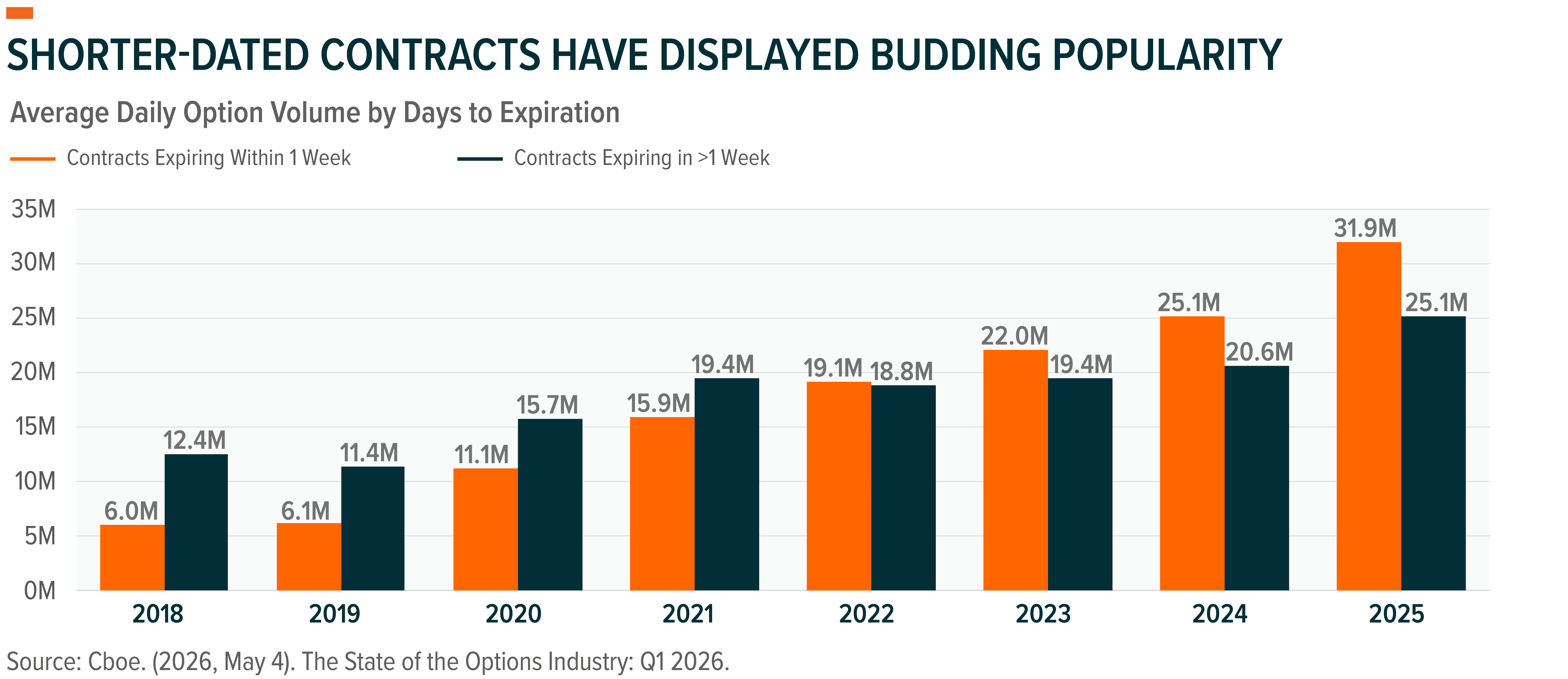
This volume expansion has also supported structural changes that have taken hold. One such change is the more frequent use of shorter-dated options that have been largely en vogue. The logic here comes down to time decay (theta decay for the Greeks), which is the idea that an option progressively loses value as it approaches its expiration date, and that as that date approaches the rate of this erosion accelerates. With less time on the clock, there is simply less opportunity for the underlying asset's price to move in a way that benefits the option buyer, which causes the option to shed value quickly. For the seller, that represents an opportunity because the time value priced into the contract can be captured more efficiently. In 2022, the average daily volume of option contracts traded within the U.S. actually shifted to more heavily favor contracts that expire in less than one week.2 This has promoted the opportunity for covered call ETFs to take advantage of this widening pool of liquidity, and it has even influenced issuers operationally to start offering things like more frequent weekly distribution payouts.
A Diverse Set of Covered Call Models Can Suit Differing Market Environments
The index that is tracked by some of the longest-standing covered call ETFs on the market is the Cboe S&P 500 BuyWrite Index (BXM). Launched in 2002, it tracks the performance of a hypothetical portfolio that holds S&P 500 stocks and systematically writes monthly call options against the entire portfolio. Those options are deemed written “at-the-money”, meaning that the strike price is set at or near the current market price.3 The index “writes” a call on 100% of its holdings each month and requires that each option be held to maturity. A strategy tracking this index might utilize European-style call options to mimic this function, as they cannot be called away prior to expiration like that of an American-style option.
Global X's S&P 500 Covered Call ETF (XYLD) tracks the BXM and, having launched in 2013, stands as one of the pioneers of the covered call ETF space. By design, it would not be expected to keep pace with the S&P 500 in a strongly rising market. In exchange for the capped upside, however, XYLD has been able to generate competitive distribution rates relative to fixed income alternatives. Within the fund structure, portfolio managers can also tactically reinvest a portion of the premium that is collected by operating the strategy, influencing both price and total returns over time.4 When paired with a broader, uncovered equity position, it may help dampen broader portfolio volatility in flat-to-down markets. This return profile will likely feel most familiar to investors who have experience running covered call trades outside of a fund structure.
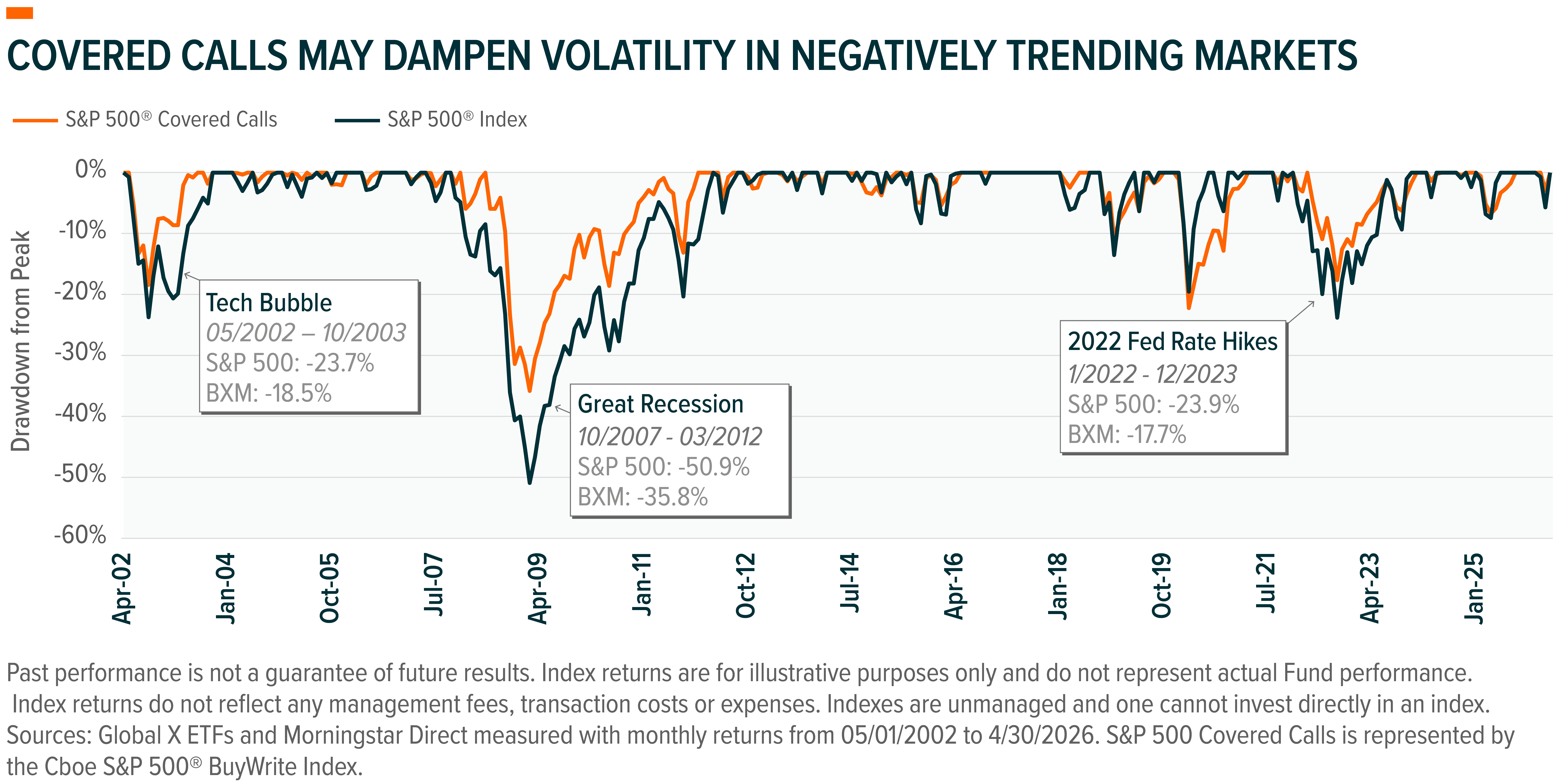
A strategy like XYLD that tracks the BXM Index may be best positioned as a fixed income carveout, maximizing premiums while accepting the full equity risk of the S&P 500. As we think about the many tradeoffs that typically come as a product of options trading, however, it can be gleaned how seamlessly such an exposure can be transformed into a potential equity replacement as well.
The Cboe S&P 500 Half BuyWrite Index (BXMH) tracks a similar strategy, the only difference lies in the fact that it “writes” call options on 50% of its long position as opposed to 100%. The result is roughly half the premium income, but the index retains meaningful upside participation. Where a fully covered strategy on the S&P 500 caps price appreciation entirely, a 50% covered approach allows the strategy to benefit from approximately half of the S&P 500's potential monthly price gains, striking a middle ground between premium generation and growth potential.
This partial participation makes a half-covered S&P 500 strategy a more natural fit for the equity sleeve of a traditional 60 equity/40 fixed income portfolio. It allows investors to source premium income from market volatility rather than from dividend-heavy, cash-flow-oriented businesses, while retaining meaningful exposure to the full breadth of the S&P 500, including the growth-oriented companies across sectors like Information Technology and Consumer Discretionary that have driven a significant share of the index's long-term return. Interestingly, these same 100% and 50% coverage approaches are being taken by Global X utilizing a multitude of major domestic equity indices as their reference assets, including the Nasdaq 100, Russell 2000, and Dow Jones Industrial Average.
Trade-offs associated with market participation versus option premium collection are a core competency of the derivative investment landscape, and they highlight the challenges that come with attempting to address income potential and market participation within a single strategy. For that reason, fund issuers, including Global X, have expanded their covered call offerings over time. The natural evolution of the space has brought actively managed approaches that seek to navigate changing market conditions and shifting volatility regimes into the fold, giving investors a broader toolkit to pursue their specific income and growth objectives.
Global X’s actively managed Income EdgeSM series represents a direct response to this challenge. The Global X US 500 Income EdgeSM ETF (EDGX) and Global X Nasdaq-100® Income EdgeSM ETF (EDGQ) do not seek to maximize premium income in absolute terms. Instead, they are anchored to target annualized distribution rates of 9% and 13%, respectively. To do so, both funds employ shorter-dated, weekly, at- or near-the-money call options that are written in succession, leaning into the time decay dynamics that have become increasingly prominent across the broader options market as trading activity has shifted toward near-term contracts.
Because weekly options generate less absolute premium than longer-dated counterparts, the Income EdgeSM funds might expect to experience less buffering during a market drawdown than a 100% or 50% covered call strategy that rolls its options monthly on the same underlying asset. The offsetting benefit is the ability to compound that time decay into a potentially competitive annualized distribution rate while still retaining meaningful participation in the market’s potential upside. And, unlike a fixed rules-based approach, the degree of that upside participation can be adjusted dynamically in response to prevailing volatility conditions.
EDGQ’s 13% annualized distribution rate target, for example, requires a weekly premium (and distribution) of approximately 0.25%, but the coverage ratio needed to hit that figure intuitively varies week after week depending upon market conditions. In high-volatility environments, which tend to follow market declines, option prices are elevated, meaning that the fund can write calls on a smaller portion of its portfolio to generate the necessary premium. That leaves more of the portfolio uncovered and positioned to participate in a potential recovery. In low-volatility environments, which tend to coincide with markets that have already priced in meaningful upside, a higher coverage ratio is needed, but capping a portfolio that has already rallied might be a meaningfully smaller sacrifice as growth is progressively baked in. The dynamic coverage mechanism thus aligns more naturally with market conditions than a fixed coverage approach. While the premium may be determined at the writing of the calls, the subsequent market activity is not guaranteed.
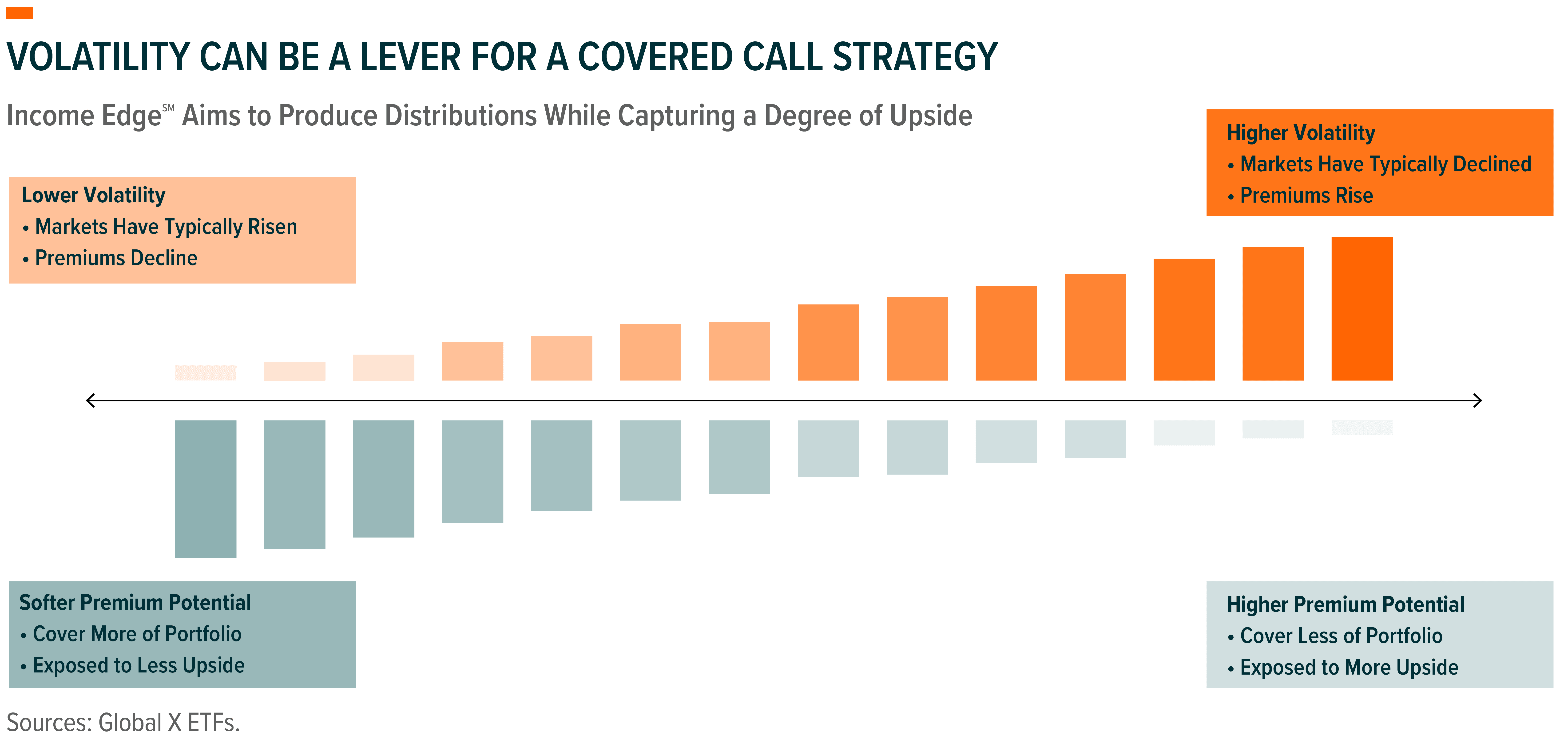
On average, the Income EdgeSM funds are expected to operate under weekly coverage ratios of about 25%.5 This is expected to allow them to pursue the aforementioned distribution rates of 9% for EDGX and 13% for EDGQ, but still actively pursue market upside. The lower coverage ratio may also prove critical to potentially preserving NAV over the long haul - an important consideration for any covered call investor regardless of strategy design.
NAV erosion is a term often evaluated when discussing covered call funds. It refers to the gradual decline in a fund's net asset value over time that typically stems from performing distributions that exceed the amount of income that a fund takes in. It tends to be most relevant in strategies that are heavily covered, highly leveraged to volatility, or that distribute premiums without retaining any income to support the underlying portfolio's value and can be gleaned by evaluating a fund’s total return performance, which may be positive, versus its price performance, that may be showing depletion. For investors evaluating covered call ETFs, it serves as an important reminder that yield alone is an incomplete lens, and that the source and sustainability of those distributions matters just as much as their size.
Covered call strategies like those tracking the BXM require a deliberate distribution framework to manage this dynamic over time. But even partially covered or uncapped strategies are not immune. In low-growth environments, overdistribution can erode NAV just as meaningfully because the option premiums that a fund is harvesting may fail to counterbalance losses that it incurs from declining markets. The Income EdgeSM funds approach this through their dynamic coverage mechanism, which anchors distributions to target rates rather than maximizing premiums, and adjusts portfolio coverage based on market conditions to help protect NAV while keeping distributions sustainable.
Covered Call ETFs Are a Deep Market with Many Options
The expansion of the covered call ETF landscape is itself a reflection of how much demand has grown for these strategies and how much the investment community has come to appreciate their versatility. That versatility, however, also underscores the importance of evaluating each strategy on its own terms. Reference assets, coverage ratios, option tenors, strike levels, and distribution methodologies all vary meaningfully across products, and those differences have real implications for how a strategy behaves in varying market environments. The distinction between a thoughtfully constructed covered call ETF and one built around a headline yield is not always visible at the surface level.
The level of demand has widely broadened the breadth of strategies and reference assets being utilized to operate covered calls, including treasury instruments, cryptocurrencies, and other ETFs, all of which have been aimed at being transformed into volatility risk premium harvesting mechanisms and tools that can be used in an effort to mitigate volatility across a broader portfolio.
In this vein, for investors willing to look deeper, the covered call universe - from benchmark-tracking income pursuers to actively managed, NAV-conscious designs - offers a genuinely expanded toolkit for portfolio construction. We believe the traditional 60/40 portfolio was built for a different era of markets and instruments. Covered call ETFs represent one of the more compelling additions to that framework that the evolution of financial markets has produced.
Related ETFs
XYLD – Global X S&P 500 Covered Call ETF
EDGX – Global X U.S. 500 Income Edge℠ ETF
EDGQ – Global X Nasdaq-100® Income Edge℠ ETF
Click the fund name above to view current performance and holdings. Holdings are subject to change. Current and future holdings are subject to risk.