This piece is one in a series that delves further into the leading themes emerging from this year’s iteration of our flagship research project, Charting Disruption.
Innovation is one of the most persistent drivers of long-term growth – reshaping industries, creating new markets, and unleashing economic cycles. Each new wave also reaches scale faster than the last. The internet took about 15 years to reach 1 billion users, while ChatGPT took about three.1,2 As adoption compresses from decades into years, recognizing innovation early can offer a clearer view of where future growth may emerge across equity markets.
AI is one powerful example of innovation at work, but it is far from the only one. The promise of AI has drawn capital toward the companies building its foundation – including model developers, semiconductor makers, and data center operators. Innovation, however, extends well beyond that group. The same buildout depends on copper, power grids, water systems, and new factories, and its applications reach defense, robotics, genomics, and cybersecurity. Breakthroughs increasingly emerge where technologies, infrastructure, and resources converge. That means innovation is unfolding across a broader landscape than many investors recognize, with developments in each area reinforcing one another.
Themes can provide a more targeted way to capture this breadth than sector exposure, since innovation increasingly cuts across traditional industry lines. Charting Disruption 2027 explores five key chapters this year: AI, defense and space tech, infrastructure and automation, energy, and critical resources. Each presents distinct opportunities, and together they touch on different parts of the broader innovation chain – from key inputs to the applications they enable.
Key Takeaways
Innovation drives long-term growth and now reaches scale within years, making early identification more important than ever.
AI is one part of a broader innovation wave, with defense and space technology, infrastructure and automation, energy, and critical resources each adding distinct opportunities that build on one another.
Amid growing market concentration, understanding how themes relate, overlap, and correlate is increasingly important, particularly for identifying emerging or underappreciated areas that broad market exposure may only partially capture.
Innovation Is Moving from Promise to Evidence
Innovation has been an indisputable driver of earnings growth over the past three decades. Despite multiple economic downturns and periods of market volatility, S&P 500 earnings per share have increased sevenfold since 1998, supported in part by major technological shifts like the internet, smartphones, and cloud computing.3 Earnings are expected to grow an additional 24% over the next twelve months.4 Today, we believe a new wave of innovation could drive the next phase of productivity gains, market expansion, and corporate earnings growth.
This innovation cycle could be particularly consequential as several transformative technologies are advancing simultaneously. AI is becoming more capable and affordable, robotics is moving closer to commercial viability, and declining launch costs are opening new possibilities in space. Meanwhile, advances in autonomous defense systems and AI-drug discovery are beginning to reshape industries historically constrained by high costs and lengthy development cycles.
Across these areas, the focus is shifting from what technology can do to how it can scale commercially. As capabilities improve and deployment costs decline, applications that once appeared economically impractical can become commercially attractive. That transition could expand addressable markets, accelerate adoption, and create new sources of revenue and productivity growth across the global economy.
Evidence of this shift is emerging across several major innovation themes:
Artificial Intelligence: AI agents are completing longer and more complex work, as the length of tasks they can complete with 50% reliability has doubled about every seven months from 2019 to 2025.5 Cheaper intelligence puts that capability within reach of more users, with the price of GPT-3.5-class tokens – the units AI models use to measure input and output – forecast to fall roughly 1,000-fold over the three years through 2026.6 Adoption is following – agentic use now accounts for 64% of OpenAI enterprise customers’ combined output tokens, ahead of ordinary chat.7
Robotics: Lower hardware costs are making humanoid robots more practical to deploy, with the estimated cost of a standard humanoid robot down about two-thirds between 2023 and 2026, to roughly $50,000.8
Space: Rocket reuse has become routine since the first Falcon 9 booster re-flight in 2017.9 Launch costs to low Earth orbit could reach $500 per kilogram by 2030, 97% below 2000 levels.10 That access is helping the satellite network expand, with an estimated 100,000 satellites expected in orbit by 2030.11
Defense: Intercepting a low-cost drone can cost defenders millions of dollars using conventional interceptors. That imbalance is increasing demand for cheaper systems that can be fielded at scale, with AI to detect and track threats. These systems can also help militaries expand their capabilities while keeping personnel out of harm’s way.12
Drug Discovery: By leveraging millions of medical data points at a scale not previously possible, AI-assisted methods could reduce preclinical candidate selection by 30% to 50% and lower costs by up to 50%.13
Across these examples, we believe the pattern is clear: falling costs and improving capabilities can move technologies from experimental to everyday use, creating demand well beyond the companies that built them.
Five Connected Stages of Innovation
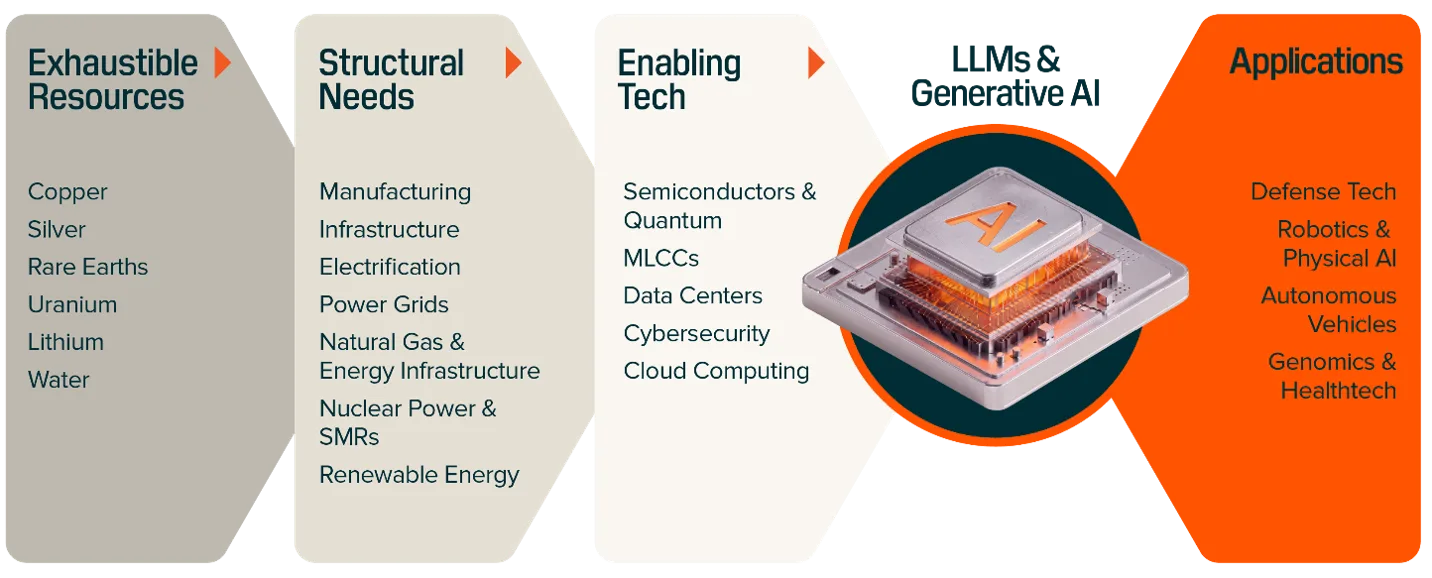
Innovation rarely advances on its own. AI shows how one breakthrough can reverberate across industries: a single model depends on a long list of inputs and, in turn, creates demand for them. Raw materials feed the structural systems that power and house the technology. Those systems support the enabling hardware and software. That capacity runs the large language models and generative AI that applications put to work. As demand moves from one stage to the next, a single breakthrough can create opportunities across a chain that spans multiple industries.
These stages reinforce one another. Limited power can slow data center expansion, and constrained mineral supply can slow power equipment. At the same time, wider adoption of applications can increase demand for every earlier stage.
Why Breadth Matters Now
Innovation is broader than market indexes may suggest. The 10 largest S&P 500 constituents by index weight now account for about 37% of the index, roughly double their share in 1990.26 Investors who rely on broad market exposure remain concentrated in a handful of leaders and may be underweight many structural themes driving growth. Themes can help investors reach beyond those leaders to a broader set of growth drivers. Overlap with the S&P 500 is low for many of these areas, including U.S. Infrastructure Development at 2.6%, U.S. Electrification at 2.1%, Defense Tech at 1.7%, Cybersecurity at 1.1%, and Space Tech at 0.1%, so broad market exposure may capture only a small part of them.27
Thematic opportunities span different stages of maturity, yet compelling evidence of growth, adoption, and capital deployment is emerging across the landscape. AI is widely seen as the defining theme of the moment, but its opportunity extends beyond the largest hyperscalers: each layer responds to its own drivers, and exposure to one layer does not capture the others.
That breadth is reflected in demand and investment across several themes. Company backlogs provide one signal: leading European defense suppliers hold backlogs equal to 2.2 to 4.1 times their 2026 forecast revenue, and backlogs at three leading U.S. grid equipment and construction companies rose more than 50% between the third quarter of 2024 and the second quarter of 2026.28,29 Capital commitments provide another: large technology companies sign nuclear energy agreements, including Amazon with X-energy for a project that could reach 960 MW and Meta with Oklo for a planned 1.2 GW campus in Ohio.30 Together, these signals point to revenue visibility across several themes and suggest innovation is translating into earnings potential across a broader set of companies.
Conclusion
In a market where a small group of companies accounts for a growing share of index weight, thematic investing offers a way to look beyond today’s leaders and toward the forces reshaping the economy. This year’s five chapters – AI, defense and space technology, infrastructure and automation, energy, and critical resources – trace those forces across different stages of maturity. While the timing and pace vary, each is showing evidence of growth, adoption, and capital deployment. Together, these themes make the case for thematic investing: exposure to the companies building, powering, and applying innovation across the economy.
For additional insights, please view our full report, Charting Disruption: Outlook for 2027 and Beyond.