Product ResearchConstruction and EngineeringInfrastructure & Environment
Manufacturing Revival Creates Tailwinds for U.S. Infrastructure Spending
M
Madeline Ruid
Oct 16, 20255 min read
Get the latest news and updates from our team.
Copyright © 2026 Global X. All rights reserved.
SEI Investments Distribution Co. (1 Freedom Valley Drive, Oaks, PA, 19456) is the distributor for the Global X Funds.
Check the background of SIDCO and Global X's Registered Representatives on FINRA's BrokerCheck.

Madeline Ruid
Madeline Ruid
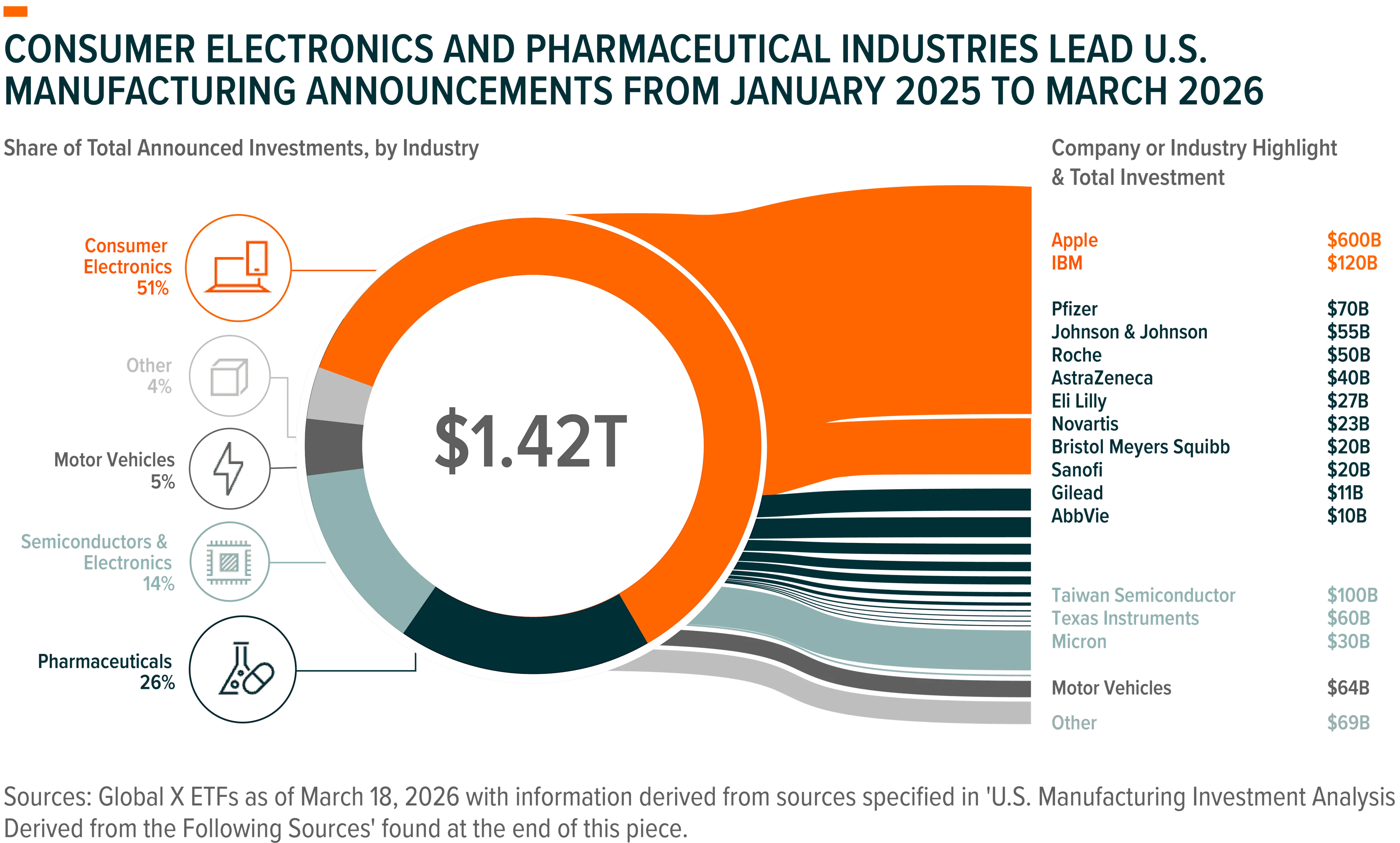
America is in the middle of a construction boom as it rebuilds its industrial core. What began as a broad effort is now taking shape as a unified build cycle, with AI infrastructure, advanced manufacturing, and energy security converging into a single push for long-term economic resilience. The scale of this buildout is already visible in the data. Data centers accounted for the largest commercial projects entering the planning phase in 2025.1 And, our analysis indicates that companies announced $1.42 trillion in planned U.S. manufacturing investment between January 2025 and mid-March 2026, led by strategically important industries such as semiconductors and pharmaceuticals.2
As major infrastructure projects make their way through planning and development, we expect significant opportunities to materialize for companies throughout the U.S. infrastructure development value chain, including construction and engineering services providers, raw material suppliers, equipment suppliers, and industrial transportation service providers. This piece evaluates the next wave of mega-projects and how they’re taking shape across the country.
Companies are ramping up capital spending on infrastructure assets, from factories and data centers to the power grid, bolstering the U.S. infrastructure development pipeline.
The pipeline of megaprojects, defined as projects costing at least $1 billion, grew to over $3 trillion in 2025, creating sizeable potential opportunities for the U.S. infrastructure development value chain.3,4
Completed manufacturing and data center projects can provide helpful context on the amount of materials, construction, and labor that are often needed for these megaprojects.
America is in the middle of a generational buildout to lay the physical foundation for the next stage of its innovation economy. In our view, today’s cycle rests on two core pillars: building AI infrastructure that will enable the automation age and building next-gen manufacturing facilities that modernize the industrial base and reshore critical production. Together, these pillars represent multi-trillion-dollar demand for the full U.S. infrastructure development value chain.
This momentum is most visible today in manufacturing. Company efforts to boost U.S.-based manufacturing and position the country as a leader in the global AI race are leading to a growing manufacturing facility project pipeline. Investments began to accelerate at the start of 2025 amid the implementation of tariffs and rising global trade tensions. Between January 2025 and mid-March 2026, companies announced dozens of new or expanded manufacturing facilities totaling $1.4 trillion in potential investments.5
AI data center infrastructure is also rapidly scaling, as shown by commercial planning stats. In 2025, 460 projects each valued at over $100 million entered the planning stage, with data centers consistently representing the highest-valued projects each month.6 The Dodge Momentum Index, which measures commercial and institutional planning that could translate into construction within 12 to 18 months, grew 34% year over year (y-o-y) in 2025.7 The sizeable y-o-y growth points to sustained momentum for new infrastructure as well as the potential for nonresidential construction starts to accelerate throughout 2026 and early 2027.
Notably, megaprojects, defined as projects costing at least $1 billion, represent one of the largest and potentially most impactful project pipelines for companies involved in U.S. infrastructure development. Megaprojects can fall into any asset category, from major road and bridge expansions to medical complexes and entertainment venues. However, in 2025, data centers accounted for 54% of mega project planning activity, with the majority of the remaining total coming from reshoring efforts.8
In total, $937 billion of project value were added to the North America megaproject backlog in 2025, representing 30% y-o-y growth.9 As of Q4, the backlog totaled $3 trillion across 866 megaprojects, and only 16% of those projects had started construction, highlighting the multi-year runway that could be provided from these projects.10
The sheer scale and complexity of many upcoming infrastructure projects means that they are likely to require significant materials, construction, and labor resources. For example, Intel estimates that building one of its semiconductor manufacturing facilities requires 600,000 cubic meters of concrete, 75,000 tons of steel reinforcement, 35,000 tons of structural steel, and 29.5 million feet of cable. Each factory also requires the removal of more than 1 million cubic meters of soil and rock, with each project requiring an estimated 6,000 construction workers.11 Data centers also require significant materials and labor, including concrete, steel, and copper wiring. Many of the planned facilities are in remote locations, which can require the buildout of roads and power infrastructure as well.
For further context, completed projects can provide clarity on the potential scale of materials, time, and labor that it takes to build a large manufacturing or data center site.
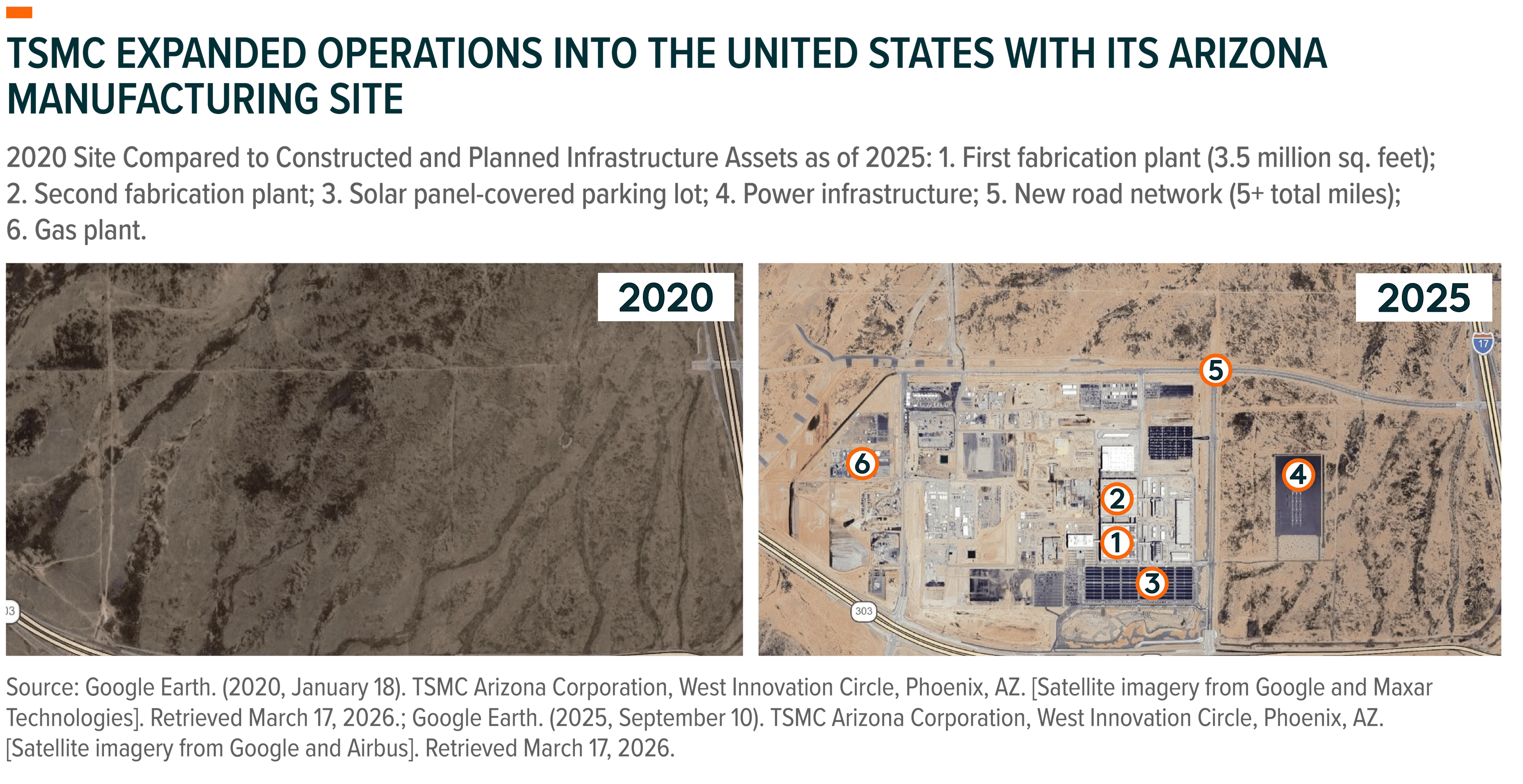
TSMC plans to invest a total of $165 billion into the construction of its first six U.S.-based semiconductor manufacturing facilities, two packaging plants, a water reclamation facility, and a research center in Phoenix, Arizona.12 The company acquired the 1,129 acre site in December 2020, and structural construction on the first fabrication facility (fab), which spans over 3.5 million square feet, took place from April 2021 to July 2022.13 As of September 2025, the site included two completed semiconductor fabrication facilities, an extensive road and parking network, a gas plant, power infrastructure, and other support buildings.
While there are several stages of construction remaining, the site already consumes significant levels of power. TSMC’s first fab alone is estimated to require 2.85GWh of electricity per day, equivalent to the needs of about 100,000 homes.14 TSMC aims to cover a small percentage of the expected power demand with the 1.65 million square feet, 14.5MW onsite solar-panel installation that also serves as a covered parking lot.15 There is also one operational gas plant, with two more planned for future phases, as well as new transmission and distribution infrastructure that allow the plant to tap into the power grid.
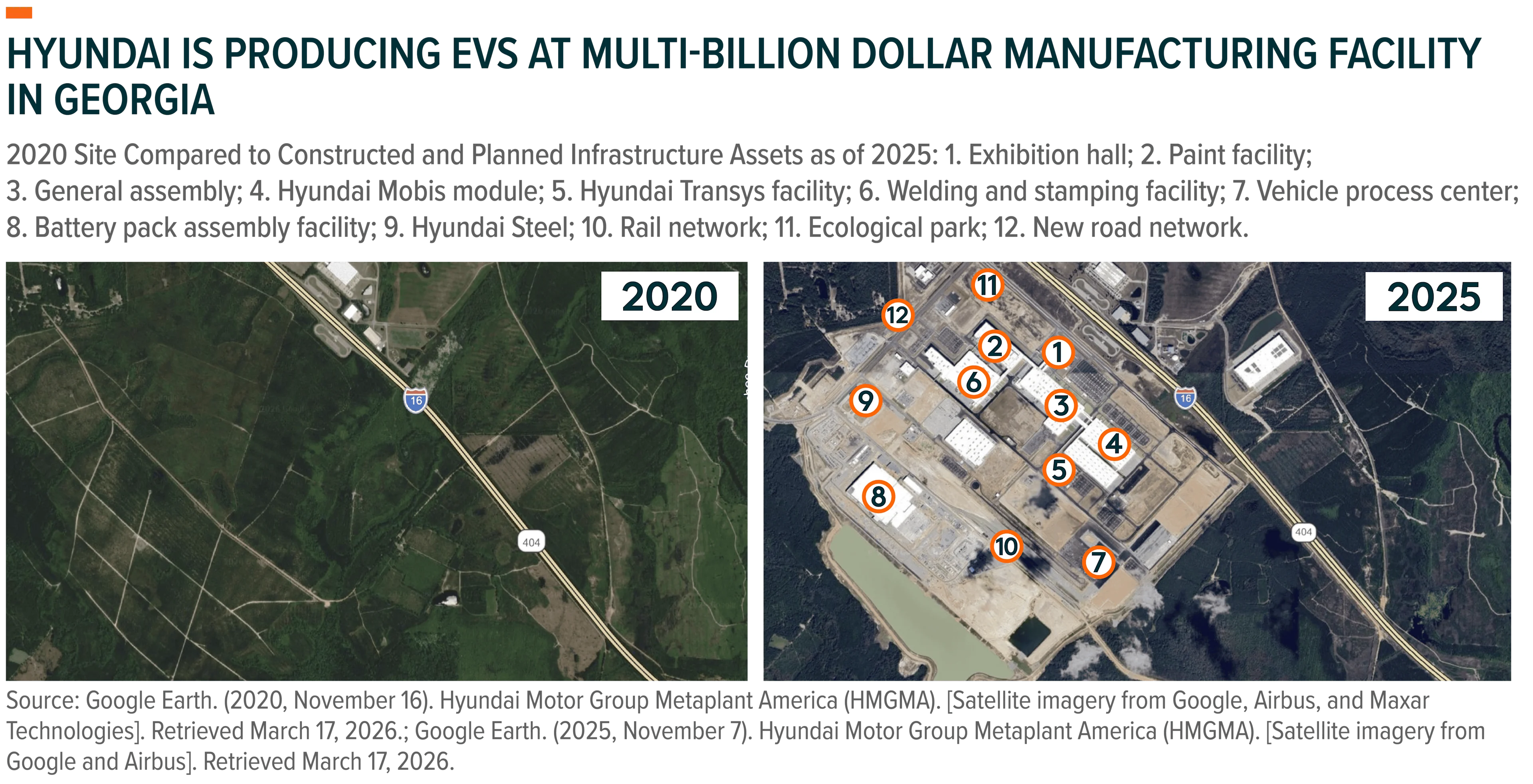
Hyundai fully opened its $7.6 billion electric vehicle production facility in Georgia in March 2025, following 30 months of construction.16 The site spans nearly 3,000 acres, and it was the largest economic development project in the state’s history.17 The plant is highly automated, initially expected to produce 300,000 vehicles annually, focusing on Hyundai’s IONIQ and hybrid models, although annual capacity could eventually reach 500,000 units.18
The site includes 11 buildings totaling more than 7.5 million square feet, including an exhibition hall, main office, highly specialized production buildings such as for battery pack production, general assembly, welding, and paint, as well as a vehicle processing center.19 Within the first year, 81% of the steel framing of the buildings was completed, using 27,045 tons of steel.20 The site also includes an on-site train terminal, additional rail and road infrastructure, solar-covered parking, and an ecological park.
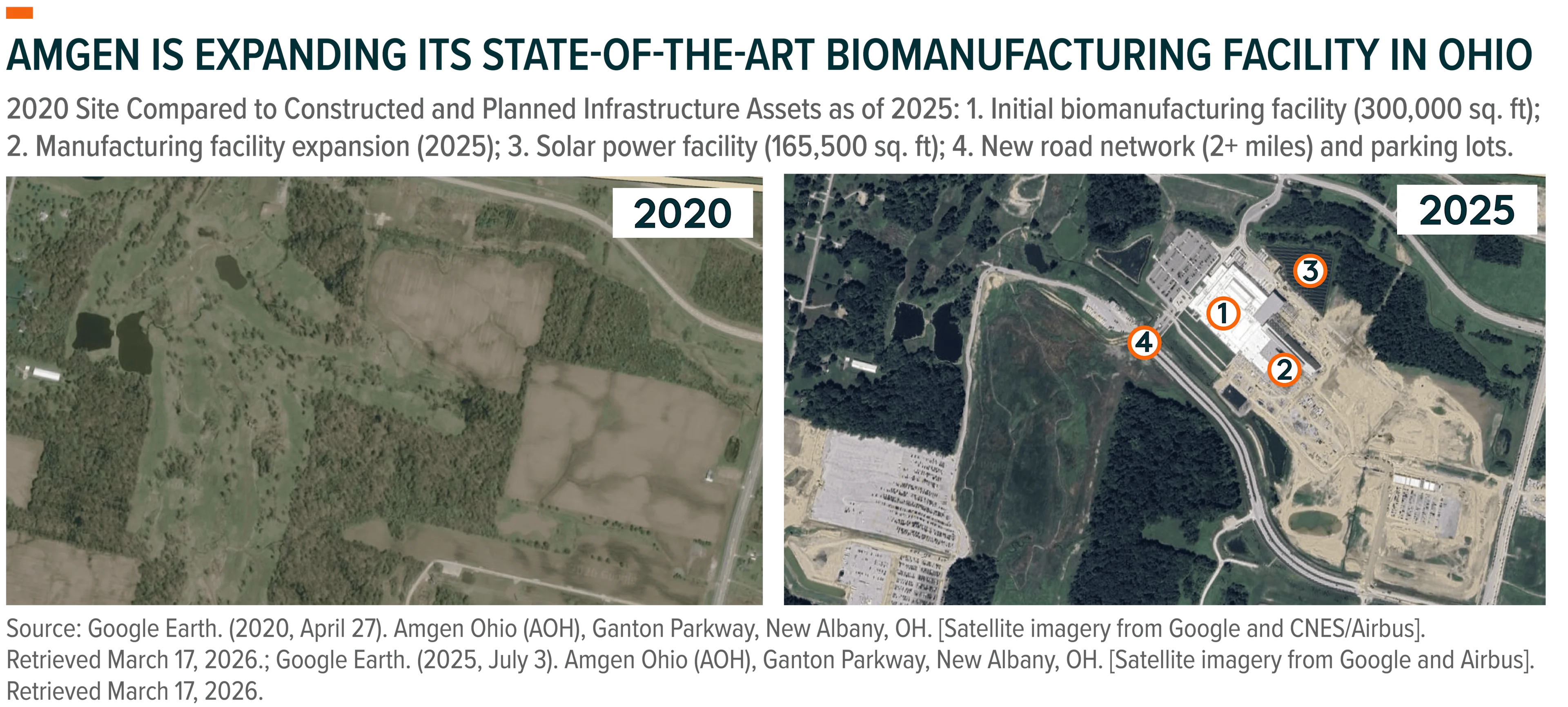
Amgen plans to invest a total of $1.4 billion into its biomanufacturing site in Central Ohio.21 The U.S.-based manufacturer of biologic medicines first announced plans to invest more than $400 million into the site in June 2021. Construction of the initial 300,000 square foot facility and the surrounding infrastructure took 26 months, and the site was approved by the FDA in January 2024, making it the fastest site completion in company history.22 In April 2025, Amgen announced plans to invest an additional $900 million to expand capacity at the site, and construction was still underway as of late 2025.23
Additional onsite construction has involved building an extensive road network and parking lots. Amgen also installed a large onsite ground-mounted solar power facility, which is expected to reduce plant electricity consumption by approximately 20%.24
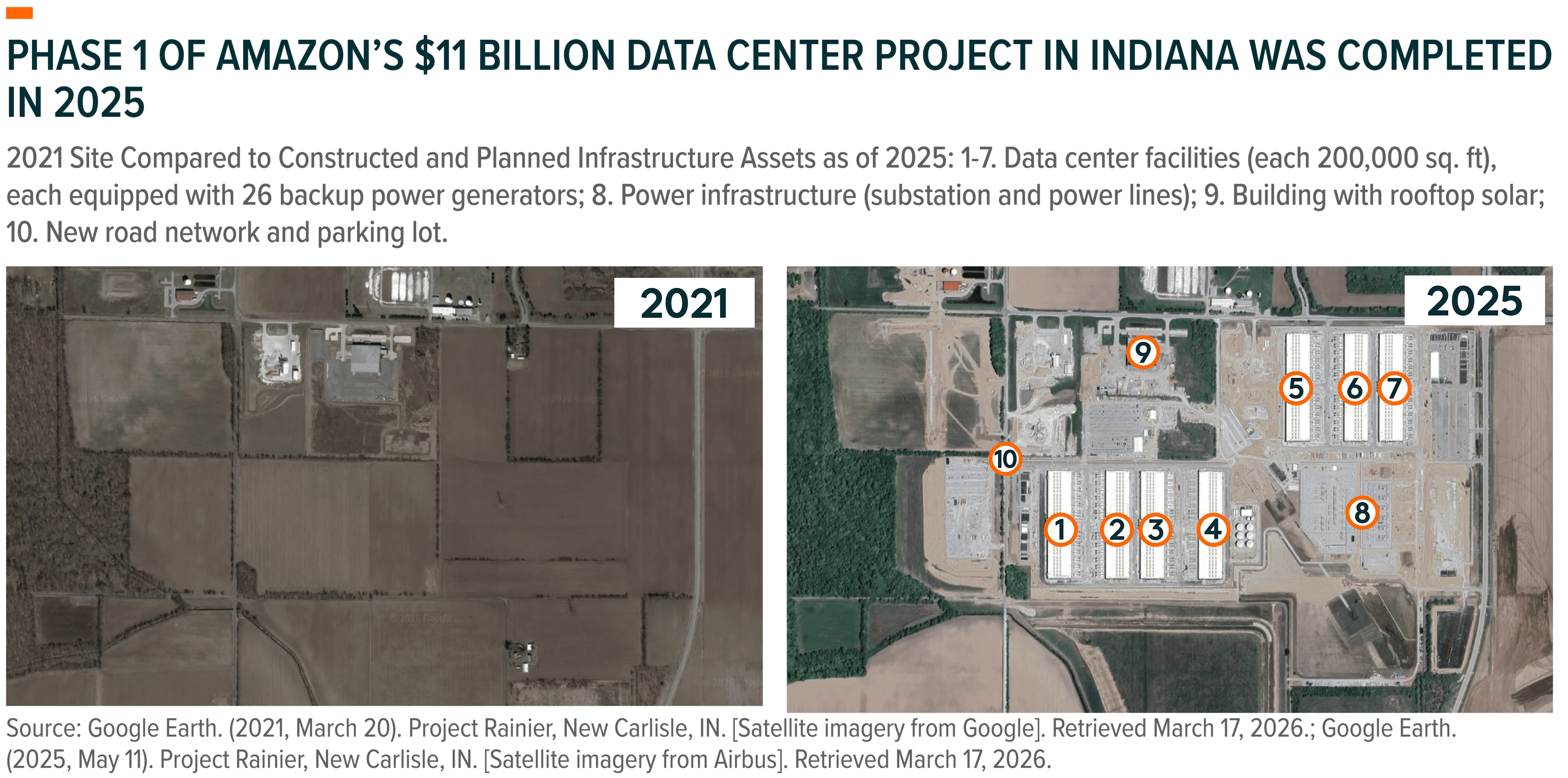
Amazon plans to invest at least $11 billion to build more than two dozen data center facilities at its 1,200 acre Project Rainier site in Indiana.25 Between September 2024 and October 2025, Amazon transformed the first of three parcels of farmland into a data center campus with seven facilities that power the Anthropic AI model.26 As of early 2026, construction is underway on the remaining two campuses at nearby sites to the south.
To complete construction on the first campus within 12 months, Amazon hired four general contractors to work simultaneously.27 The phase one buildout included seven data center facilities, each equipped with 26 backup power generators, as well as extensive power, road, and parking networks. Once all three campuses are complete, the site will include a total of 30 data center facilities.
In total, these facilities could require 2.2GW of electricity, which is enough electricity to power over 1 million homes.28 Given the significant power draw and infrastructure needs, Amazon contributed $114 million to utility upgrades in the area, as well as $7 million to highway improvements.29
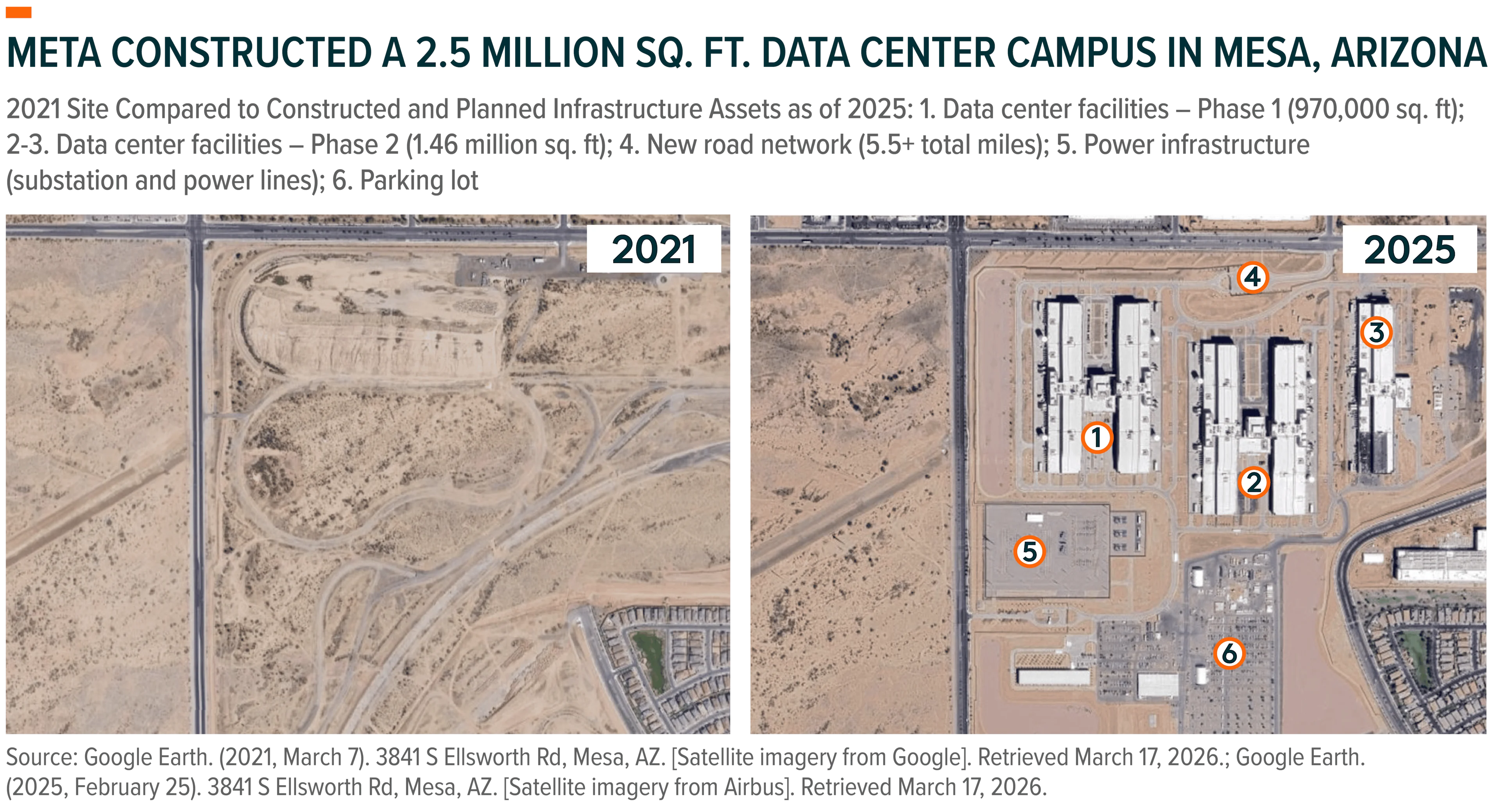
Meta invested a total of $1 billion over two construction phases for its data center site in Mesa, Arizona.30 The project includes five data center buildings totaling roughly 2.5 million square feet, as well as office space, an extensive road and fence network, a parking lot, and a power substation.31 Between 2021 and 2026, Meta transformed the site using more than 20,000 tons of steel and roughly 287,000 cubic meters of concrete. At its peak, there were more than 2,000 skilled trade workers on site.32
In addition to the onsite infrastructure, Meta is supporting 12 regional water conservation and restoration projects, which aim to restore approximately 200 million gallons of water per year in the Colorado River and Salt River basins.33 Additionally, Meta is investing in a 450MW solar power facility to cover at least part of the data center’s power needs.34
The confluence of long-term structural drivers, such as an increased focus on supply-chain resilience and rising AI adoption, is driving investments into large-scale infrastructure projects across the United States. The result is a surge in demand for infrastructure development, which spans services, equipment, and materials that enable large-scale development, from data centers and factories to power generation, transmission, and logistics infrastructure. As the project pipeline expands, significant potential opportunities for companies across the entire infrastructure development value chain will likely materialize.
Related ETFs
PAVE – Global X U.S. Infrastructure Development ETF
ZAP – Global X U.S. Electrification ETF
AQWA – Global X Clean Water ETF
Click the fund name above to view current performance and holdings. Holdings are subject to change. Current and future holdings are subject to risk.
Global X ETFs Analysis as of March 14, 2026 from several sources. See ‘U.S. Project Planning Analysis Derived from the Following Sources’ below for the full list.
Global X ETFs analysis as of March 17, 2026 from a variety of sources. See ‘U.S. Manufacturing Investment Analysis Derived from the Following Sources’ below for the full list.
FMI. (2024, November). The Megaproject Boom: Building the Future Today.
Eaton Corp. (2026, February 3). Fourth Quarter 2025 Earnings Release. [Presentation].
Global X ETFs analysis as of March 17, 2026 from a variety of sources. See ‘U.S. Manufacturing Investment Analysis Derived from the Following Sources’ below for the full list.
Global X ETFs Analysis as of March 14, 2026 from several sources. See ‘U.S. Project Planning Analysis Derived from the Following Sources’ below for the full list.
Dodge Construction Network. (2026, January 8). Dodge Momentum Index Grows 7% in December.
The Motley Fool. (2026, February 3). Eaton (ETN) Q4 2025 Earnings Call Transcript.
Ibid.
Eaton Corp. (2026, February 3). Fourth Quarter 2025 Earnings Release. [Presentation].
Intel. (2023, June 9). How a Semiconductor Factory Works.
TSMC. (2025, March 4). TSMC Intends to Expand Its Investment in the United States to US$165 Billion to Power the Future of AI.
TSMC. (n.d.). TSMC Arizona. Accessed March 1, 2026.
Tarasov, K. (2024, December 13). TSMC says first advanced U.S. chip plant ‘dang near back’ on schedule. Here’s an inside look at the Arizona fab. CNBC.
TSMC. (n.d.). TSMC Arizona. Accessed March 1, 2026.
Hyundai Motor Group. (2025, April 18). Hyundai Motor Group Metaplant America Ushers in the Era of Future Mobility.
Alexandria Hyundai. (2025, March 26). Hyundai Motor Group held the Grand Opening Ceremony of its $12.6 billion Metaplant America.
Ibid.
Business Insider. (2025, May 31). Hyundai just built a $7.6 billion EV factory in Georgia to compete with Tesla and GM — see inside.
Hyundai Motor Group. (2023, October 25). Hyundai Motor Group Metaplant America Celebrates Anniversary of Groundbreaking.
Amgen. (2025, April 25). Amgen Announces $900 Million Manufacturing Expansion, Creation of 350 New Jobs in Ohio.
Amgen. (2024, February 26). Amgen Goes “OH-IO” with Opening of Newest Manufacturing Facility.
Amgen. (2025, April 25). Amgen Announces $900 Million Manufacturing Expansion, Creation of 350 New Jobs in Ohio.
Amgen. (n.d.). Climate Change 2023. Accessed March 1, 2026.
The New York Times. (2025, June 24). At Amazon’s Biggest Data Center, Everything Is Supersized for A.I.
CNBC. (2025, October 29). Amazon opens $11 billion AI data center in rural Indiana as rivals race to break ground.
Ibid.
Ibid.
DataCenterNews. (2025, November 2). AWS’s $11bn Indiana data centre powers Antropic’s AI growth.
Data Center Dynamics. (2025, January 30). Meta’s Mesa, Arizona, data center comes online.
Ibid.
Ibid.
Ibid.
Data Center Dynamics. (2022, May 5). Meta expanding Mesa, Arizona, data center campus with three new buildings.
Dodge Construction Network. (2026, January 8). Dodge Momentum Index Grows 7% in December.
Dodge Construction Network. (2025, December 5). Dodge Momentum Index Decreases 1% in November.
Dodge Construction Network. (2025, November 7). Dodge Momentum Index Falls Back 7% in October.
Dodge Construction Network. (2025, October 7). Dodge Momentum Index Increases 3% in September.
Dodge Construction Network. (2025, September 8). Dodge Momentum Index Grows 8% in August.
Dodge Construction Network. (2025, August 7). Dodge Momentum Index Surges 21% in July.
Dodge Construction Network. (2025, July 8). Dodge Momentum Index Expands 7% in June.
Dodge Construction Network. (2025, June 6). Dodge Momentum Index Increases 4% in May.
Dodge Construction Network. (2025, May 7). Dodge Momentum Index Increases 1% in April.
Dodge Construction Network. (2025, April 9). Dodge Momentum Index Declines 7% in March.
Dodge Construction Network. (2025, March 12). Dodge Momentum Index Gros 1% in February
Dodge Construction Network. (2025, February 7). Dodge Momentum Index Grows 6% in January.
American Machinist. (2025, August 19). Deere Pledges $20B for U.S. Investments.
Amgen. (2025, April 25). AMGEN ANNOUNCES $900 MILLION MANUFACTURING EXPANSION, CREATION OF 350 NEW JOBS IN OHIO.
Amgen. (2025, September 30). Amgen to expand US drug production with $650M investment.
Apple. (2025, August 6). Apple increases U.S. commitment to $600 billion, announces American Manufacturing Program.
Arizona Commerce Authority. (2025, October 6). Amkor Technology Breaks Ground on New Semiconductor Advanced Packaging and Test Facility in Arizona; Expands Investment to $7 Billion.
AstraZeneca. (2025, July 21). AstraZeneca plans to invest $50 billion in America for medicines manufacturing and R&D.
ATP Adhesives. (2025, September 16). ATP Launches North America Business With $70 Million Manufacturing Facility in Columbia, South Carolina.
Barret, R. (2025, August 7). Milwaukee-based Rockwell says it's spending $2 billion nationwide to boost manufacturing. Milwaukee Journal Sentinal.
Bel. (2025, May 2). BEL STRENGTHENS ITS INDUSTRIAL FOOTPRINT WITH MORE THAN $350 MILLION INVESTMENT IN THE U.S.
Biogen. (2025, July 21). Biogen Announces $2 Billion Manufacturing Investment in North Carolina’s Research Triangle Park in Conjunction with its 30th Anniversary.
BioSpace. (2025, April 22). Regeneron Announces New Investment in Manufacturing of its Industry-Leading Biologic Medicines.
Campbell, J. (2025, June 10). Stellantis confirms 2027 reopening of Belvidere plant, scraps battery facility plans. CBT News.
Carrier. (2025, May 13). Carrier Announces Additional $1 Billion Investment in U.S. Manufacturing Footprint, Advanced Cutting-Edge R&D and Workforce Expansion.
Casey, C. (2025, May 14). Anheuser-Busch invests $300M in US manufacturing amid beer optimism. ManufacturingDive.
Century Aluminum Company. (2025, August 7). Citing Benefits of 232 Tariffs, Century Aluminum Announces Restart to Bring Mt. Holly SC Plant to Full Production, Increasing U.S. Aluminum Production by 10%.
Cerullo, M. (2025, April 28). IBM announces $150 billion investment in U.S. manufacturing, research. CBS News.
Clarios. (2025, March 3). Clarios Announces $6 Billion American Energy Manufacturing Strategy.
Corning. (2025, April 29). Corning Expands Advanced Manufacturing Capacity To Meet Increased Demand for U.S.-Made Solar Products.
Diageo. (2025, January 30). Diageo North America Announces New Manufacturing and Warehousing Facility in Alabama.
Denso. (2026, January 15). Denso Invests $69M to Build New Stat-of-the-Art Facility in Lebanon, Tenn.
Doering, C. (2025, October 6). JM Smucker to spend over $120M on Hostess plant expansion. ManufacturingDive.
Eaton. (2025, February 12). Eaton invests in new South Carolina transformer manufacturing site to power data centers, grid modernization, electrification and industrialization.
Economic Development Partnership of North Carolina. (2025, July 22). Kingsun to Invest Over $80 Million in North Carolina for First US Manufacturing Facility; Will Create Up to 515 Jobs.
Eli Lilly and Company. (2025, February 26). Lilly plans to more than double U.S. manufacturing investment since 2020 exceeding $50 billion.
Esposito, C. (2026, March 3). First Quality To Build Detergent Production Facility in Ohio. Happi.
Fick, M. (2025, September 17). GSK commits 30 billion to US research and development, factory expansion, as Trump visits UK.
Ford Motor Company. (2025, August 11). Ford’s $5B Bet on America: Innovation Meets Efficiency in New EV Platform, Assembly Process and Midsize Truck.
Gajewski, A. (2025, March 25). Saint-Gobain invests $40M to build catalyst carrier manufacturing facility in New York. Plant Services.
The U.S. manufacturing footprint is expanding, potentially creating significant opportunities for companies across the infrastructure value chain.
The U.S. manufacturing footprint is expanding, potentially creating significant opportunities for companies across the infrastructure value chain.
U.S. Infrastructure increased to a C overall grade in the latest report card, but more investments are likely needed to see further improvements.
U.S. Infrastructure increased to a C overall grade in the latest report card, but more investments are likely needed to see further improvements.
Gajewski, A. (2025, April 14). JCB invests $500M to expand construction equipment manufacturing facility in Texas. Plant Services.
Gajewski, A. (2025, May 9). Solx invests $64M to open solar panel manufacturing facility in Puerto Rico. Plant Services.
Gardner, J. (2025, April 10). Amid tariff turmoil, Novartis commits to spending $23B on US manufacturing. BiopharmaDive.
GE Aerospace. (2026, March 9). GE Aerospace to Invest Another $1B in U.S. Manufacturing.
GE Vernova. (2025, January 29). GE Vernova to invest almost $600 million in U.S. factories and facilities over next two years.
General Motors. (2025, June 10). GM to invest $4 billion in its U.S. manufacturing plants.
Governor Glenn Youngkin. (2025, February 28). Clasen Quality Chocolate to Open New Manufacturing Facility in Virginia. Commonwealth of Virginia.
Governor Kathy Hochul's Press Office. (2025, April 22). Governor Hochul Announces Chobani to Make the Nation’s Largest Investment Ever in a Natural Food Production Facility in the Mohawk Valley. New York State.
Governor of Virginia Abagail D. Spanberger. (2026, February 23). Governor Spanberger Announces Avio selects Pittsylvania County for More Than $500 Million Investment.
Guardian Bikes. (2025, April 10). Guardian Bikes Powers American Comeback with Nation’s First High-Volume Bicycle Frame Manufacturing Plant.
Hagel, J. (2026, February 26). Steel startup announces $875M factory, hundreds of jobs in northeastern North Carolina. WRAL News.
Hikma Pharmaceuticals USA. (2025, June 28). Hikma Pharmaceuticals USA announces $1 Billion of new US investment to further expand its domestic manufacturing and development of essential generic medicines.
Hitachi Energy. (2025, April 9). Hitachi announces historic $1 billion USD manufacturing investment to power America’s energy future through production of critical grid infrastructure.
Hollon, A. (2025, July 29). Silver Hills’ $48.5 million investment strengthens growth trajectory. Commercial Baking.
Hotpack. (2025, May 5). Hotpack to invest $100m in ints first US manufacturing facility in New Jersey.
Hyundai Motor Group. (2025, March 24). Hyundai Motor Group Commits to U.S. Growth with USD 21 Billion Investment.
Investing.com. (2025, May 14). Kraft Heinz invests $3 billion in U.S. factories amid tariff challenges – Reuters.
Isuzu Motors Limited. (2025, February 12). Isuzu to establish new production facility in South Carolina, strengthening North American business - State-of-the-art facility to drive commercial vehicle electrification -.
Jackson, A. (2025, June 19). Jabil’s US$500m Manufacturing Expansion for AI Data Centres. DataCentre.
Janney, J. (2026, January 13). Solstice Advanced Materials to invest $220M in Chesterfield expansion. Virginia Business.
Jensen, K. (2025, May 9). Gilead plans $11B in US drug production. ManufacturingDive.
Jensen, K. (2025, August 18). AbbVie to build API plant in Illinois as it steps up US production. ManufacturingDive.
Johnson & Johnson. (2025, March 21). Johnson & Johnson Increases U.S. Investment to More than $55 Billion Over the Next Four Years.
Kimberly-Clark. (2025, May 1). Kimberly-Clark announces plans to invest over $2 Billion to Expand US Manufacturing, Accelerate Innovation and Fuel Growth.
LaRoue, J. (2025, December 13). LS Cable & System makes nearly $700M investment in Chesapeake, adds 430 jobs.
Lego. (2025, November 13). The LEGO Group breaks ground on new Regional Distribution Center in Virginia to support its US factory under construction.
Mars, Incorporated. (2025, July 29). Mars To Invest $2 Billion Into U.S. Manufacturing Through 2026.
Merck. (2025, March 11). Merck Unveils New Facility to Increase Vaccine Production Capacity.
Micron. (2025, June 12). Micron and Trump Administration Announce Expanded U.S. Investments in Leading-Edge DRAM.
Mission Solar Energy. (2025, March 20). Mission Solar Energy Expands Operations with Solar Cell Manufacturing.
MP Materials. (2026, February 26). MP Materials Selects Northlake, Texas, as the site of “10X,” a New U.S. Rare Earth Magnet Manufacturing Campus.
Muller, M. (2025, April 16). Abbott to Expand US Manufacturing as Tariffs Loom. Bloomberg.
Murdaugh, S. (2025, March 14). Manufacturer bringing 462 jobs to Jasper County with $134 million investment. Bluffton Today.
Narciso, D. (2026, March 2). Delaware manufacturer PPG to add 100 jobs in $280 million expansion. The Columbus Dispatch.
Narioka, K. (2025, March 12). Japan Beer Maker Asahi Looks to Invest More in the U.S. as President Trump Wields Tariffs. Wall Street Journal.
New York State. (2025, November 13). Governor Hochul Announces Regeneron to Invest More Than $2 Billion Into Saratoga County Facility, Creating 1,000 New Jobs.
Nvidia. (2026, March 2). NVIDIA Announces Strategic Partnership With Lumentum to Develop State-of-the-Art Optics Technology.
O’Brien, C. (2025, February 12). Governor Lee, Commissioner McWhorter Announce Charms LLC to Expand in Tipton County. Tennessee Department of Economic & Community Development.
Owens, N. (2025, March 10). ABB to invest $120M in US manufacturing. ManufacturingDive.
Paris Baguette North America. (2025, February 12). Paris Baguette North America Announces Expansion With First North American Manufacturing Plant in Texas.
Pennsylvania Department of Community & Economic Development. (2025, September 18). Governor Shapiro Announces $20 Million Investment from B. Braun to Expand Medical Device Manufacturing in the Lehigh Valley, Creating 200 New Jobs.
Pfizer. (2025, September 30). Pfizer Reaches Landmark Agreement with U.S. Government to Lower Drug Costs for American Patients.
Pharmaceutical Technology. (2025, May 6). Bristol Myers Squibb announces $40bn US investment plan over five years.
PPG. (2025, May 8). PPG to invest $380 million to build new U.S. manufacturing facility in Shelby, N.C. for aerospace coatings and sealants.
Pratt Industries. (2025, April 30). Anthony Pratt announces $5 billion investment.
PVTech. (2025, October 31). First Solar to open 3.7GW US manufacturing plant in 2026.
Reuters. (2025, May 6). Wistron Corp to invest additional $455 million in new U.S. unit.
Reuters. (2025, August 13). GE Appliances to invest over $3 billion in US manufacturing push.
Reuters. (2025, November 19). Moderna to complete US mRNA manufacturing network with $140 million investment.
Rivian. (2025, May 5). Rivian to Bring More Jobs to Central Illinois with Supplier Park.
Roche. (2025, April 21). Roche to invest USD 50 billion in pharmaceuticals and diagnostics in the United States over the next five years.
Rolls-Royce. (2025, July 15). Rolls-Royce increases U.S. manufacturing capabilities in South Carolina.
RTX. (2026, February 24). RTX’s Pratt & Whitney broadens manufacturing capabilities with $200 million investment in Columbus, Geogria.
Saica Group. (2025, March 11). Saica Group announces a second investment in USA with more than $110 Million.
Samora, S. (2025, March 13). GE Aerospace to spend nearly $1B on US manufacturing. ManufacturingDive.
Samora, S. (2025, May 16). GlobalWafers to spend additional $4B on US manufacturing. ManufacturingDive.
Sanofi. (2025, May 14). Sanofi to invest at least $20 billion in the US through 2030, growing investments in science and expanding domestic manufacturing.
Schneider Electric. (2025, March 25). Schneider Electric Plans to Invest Over $700 million in the U.S., Supporting Energy & AI Sectors and Job Growth.
Shepardson, D. (2025, January 29). Honda boosting investment in three Ohio auto plants by $300 million. Reuters.
Siemens. (2025, March 6). Siemens boosting U.S. investments by more than $10 billion for American manufacturing jobs, software and AI infrastructure.
Sikes, A. (2025, March 17). Nortian Foodtech to establish manufacturing facility in St. Joseph. KBIA.
Stempniak, M. (2025, May 15). Siemens Healthineers invests $150M, with eye on ‘bringing manufacturing back to the US’. Radiology Business.
Stellantis. (2025, October 14). Stellantis to Invest $13 Billion to Grow in the United States.
Taiwan Semiconductor Manufacturing Company (TSMC). (2025, March 4). TSMC Intends to Expand Its Investment in the United States to US$165 Billion to Power the Future of AI.
Tennessee Department of Economic & Community Development. (2025, December 15). Korea Zinc Selects Tennessee for First U.S. Operations, Announces $6 Billion Investment.
Texas Instruments. (2025, June 18). Texas Instruments plans to invest more than $60 billion to manufacture billions of foundational semiconductors in the U.S.
The EV Report. (2025, September 19). Scout Motors Boosts SC with $300M Park.
The Healthcare Technology Report. (2025, September 8). Philips Announces $150M U.S. Manufacturing and R&D Investment to Expand AI Health Technology.
Thermo Fisher Scientific Inc. (2025, April 24). Thermo Fisher Scientific Invests to Enhance U.S. Innovation and Support Customers’ Manufacturing.
Transformer Magazine. (2025, April 22). Delta Star’s $35 M investment to bring 300 jobs.
Toyota. (2025, November 13). Toyota to Invest Up to $10 Billion Additional in Its U.S. Operations Over the Next Five Years.
UCB. (2025, June 12). UCB Announces Major U.S. Investment to Expand Biologics Manufacturing Capacity.
Underwood, J. (2025, July 9). Germany’s Butting selects Alabama for HQ and its first U.S. production facility. Made in Alabama.
Walz, E. (2025, November 19). Toyota investing $912M to build more hybrids in the US. ManufacturingDive.
Whirlpool Corporation Announces $300 Million Investment in U.S. Laundry Operations, Creating 400-600 New Jobs.
Wilk, T. (2025, August 20). Hadrian invests $200M to build advanced manufacturing facility in Arizona. Plant Services.
Young, Liz. (2025, November 5). Drug Distributor Cencora to Invest $1 Billion in U.S. Supply Chain. The Wall Street Journal.