
U.S. Treasury yields ended the second quarter up, and volatility in interest rates and credit spreads increased due to the Iran war. The Global X Investment Grade Corporate Bond ETF (GXIG) underperformed the benchmark Bloomberg U.S. Corporate Index in sector allocation, yield curve positioning, and security selection.
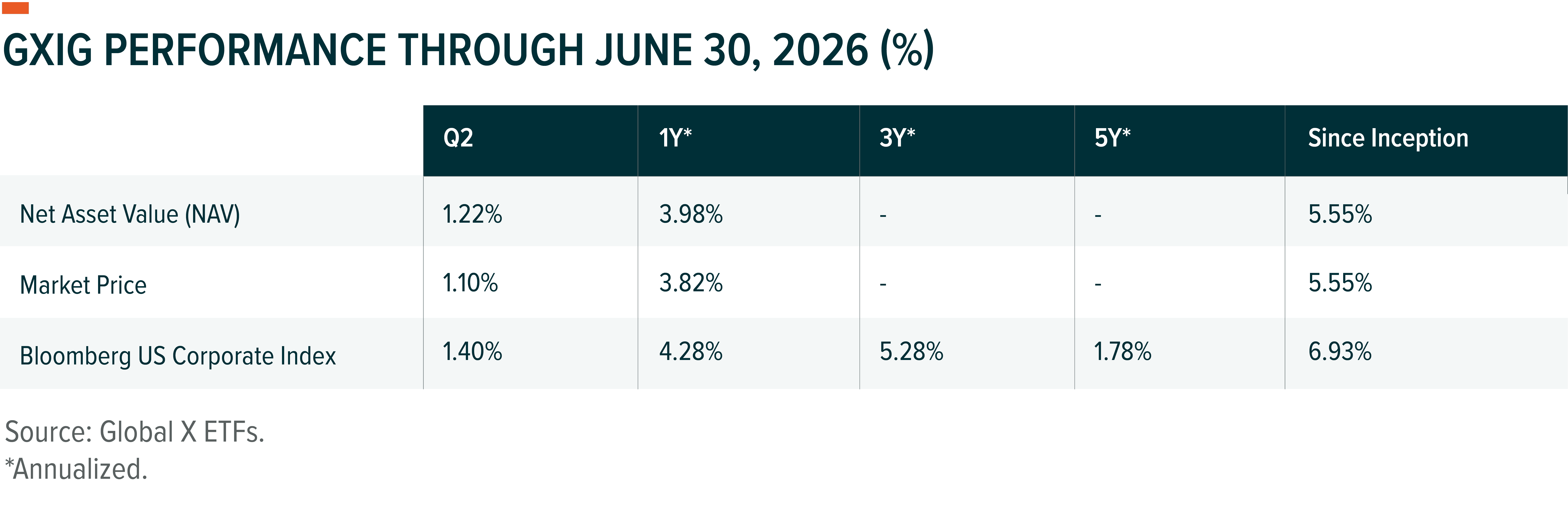
The performance data quoted represents past performance and does not guarantee future results. Investment return and principal value of an investment will fluctuate so that an investor’s shares, when sold or redeemed, may be worth more or less than their original cost. Current performance may be higher or lower than the performance quoted. For performance data current to the most recent month- or quarter-end, please click here. Total expense ratio: 0.15%. Inception date: 6/16/25.
Market Review
The Bloomberg U.S. Corporate Index recorded a return of 1.40% in the second quarter. Despite the rise in U.S. Treasury yields driven by heightened inflation expectations from higher oil prices, the tightening of credit spreads offset this, resulting in solid returns.
Although more than a month had passed since the outbreak of the Iran war, the second quarter began with the conflict still unresolved, and the war appeared to drag on longer than expected. As high oil prices persisted and both U.S. Consumer and Producer Price Inflation (CPI and PPI) came in elevated, inflation concerns intensified and U.S. Treasury yields continued to rise through mid-May. However, after mid-May, expectations for a ceasefire negotiation grew, and Treasury yields reversed to a downward trend. As an initial ceasefire agreement was reached in mid-June, the decline in U.S. Treasury yields was extended. Nevertheless, they did not fully retrace the yield increases seen in April and May.
During the same period, the U.S. Investment Grade (IG) option-adjusted spread tightened by 15 basis points (bps), with most of the tightening occurring in April and May.1 Several factors had a positive effect in the second quarter: concerns related to private credit eased; U.S. corporate first-quarter earnings significantly exceeded expectations; hyperscalers such as Google and Amazon diversified their funding by issuing bonds in currencies other than the dollar and conducting equity offerings; and expectations for a ceasefire negotiation increased. In June, when the initial ceasefire agreement was reached, credit spreads widened slightly.
Fund Performance and Attribution
During the period, the fund underperformed the Bloomberg U.S. Corporate Index by 17bps based on NAV returns, recording underperformance of 2bps in yield curve positioning, 11bps in sector allocation, and 4bps in security selection.
Treasury yields ended the second quarter up, and the fund's slightly overweight duration detracted 2bps from performance in yield curve positioning. In addition, holding a certain proportion of U.S. Treasuries in an environment of tightening credit spreads had a negative impact on sector allocation. On the security selection side, although some long-dated BBB-rated bonds outperformed, the underperformance of long-dated bonds in the Communications sector, combined with transaction costs, resulted in a slight underperformance.
Specifically, Comcast, which had spin-off news, and Meta Platforms and Google, which faced concerns over overinvestment and bond supply, underperformed in security selection.
During the second quarter, the fund avoided private credit-related risks while reducing its exposure to names in the Consumer Non-Cyclical and Capital Goods sectors, which were viewed as having expensive valuations. It also reduced its exposure to U.S. Treasuries. On the other hand, the fund increased its exposure to names in the Technology and Communications sectors, where spreads had widened significantly despite no major issues with fundamentals.
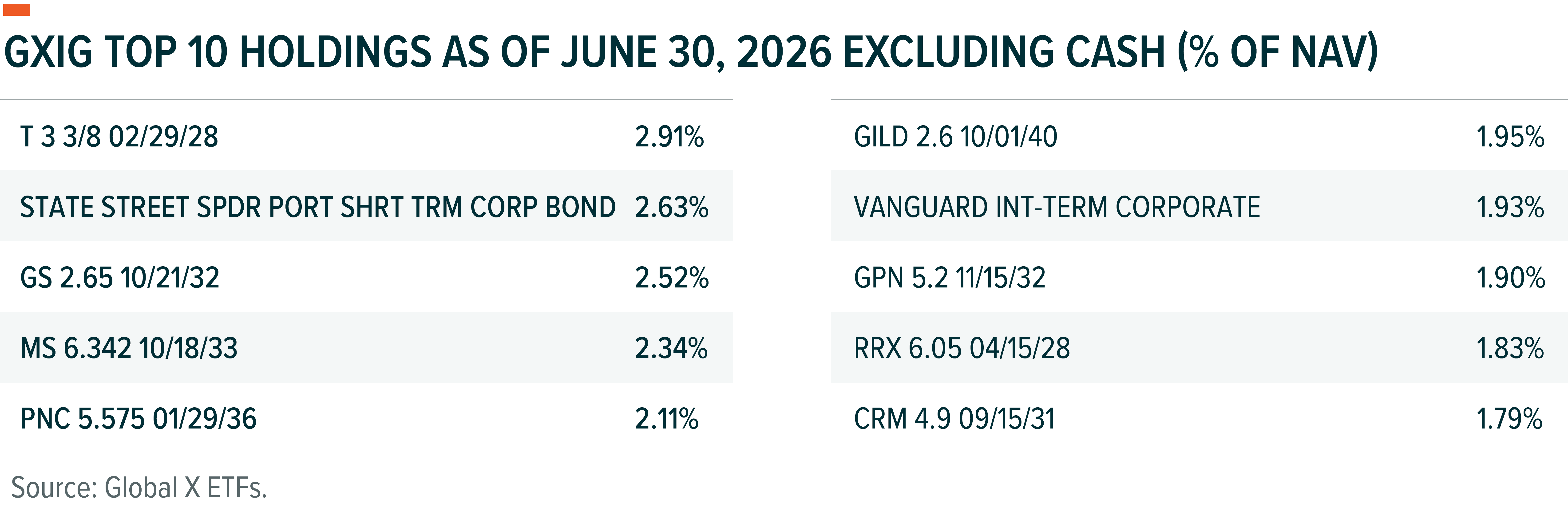
Holdings are subject to change.
Outlook
The U.S. and Iran reached a ceasefire memorandum of understanding (MOU) in mid-June, and oil prices fell significantly. However, geopolitical tensions rose in July, with the two countries resuming attacks. Nevertheless, considering the interests of both parties, we believe there is a high likelihood that it will lead to an end to the war one way or another, and oil prices are unlikely to rise significantly higher. While the easing of oil prices and the war issue would likely be favorable for U.S. Treasury yields, the large U.S. fiscal deficit, the Federal Reserve's shift toward a hawkish stance, and the weakening of U.S. dollar hegemony are unfavorable for Treasury yields. Therefore, for the time being, we expect U.S. Treasury yields to fluctuate around current levels rather than falling or rising significantly.
The U.S. IG option-adjusted spread returned to very tight levels, below 76bps as of June 30th.2 The fundamentals and earnings of U.S. corporates remain solid, supporting the tight credit spreads. However, the continued large-scale bond supply centered on hyperscalers is negative for supply-demand dynamics, and we believe that it is likely to lead to a widening of credit spreads. That said, fund inflows continued on the back of demand for high yields, and second-quarter earnings are also expected to be solid, so we expect the extent of spread widening to be limited.
The fund has been reducing the degree of its duration overweight and plans to keep duration close to neutral. The fund is expected to reduce its exposure to sectors and names that could be significantly affected by bond supply, while continuing attempting to identify and invest in undervalued securities. The fund will selectively avoid issuers where credit spreads are expected to widen due to idiosyncratic risks. The fund’s investment strategy and models will be monitored in an effort to flexibly adapt to changes in macroeconomic conditions and market dynamics, and positioning can be adjusted quickly if needed.
Related ETFs
GXIG – Global X Investment Grade Corporate Bond ETF
Click the fund name above to view current performance and holdings. Holdings are subject to change. Current and future holdings are subject to risk.