
“The reports of my death have been greatly exaggerated,” Mark Twain, 1897
Towards the middle of May 2026, traditional fixed income had been on track for posting a 1st half 2026 loss1, with duration risk failing to provide the portfolio ballast it historically has during equity volatility, as the recent Strait of Hormuz episode illustrated. Rising global interest rates have reignited the debate over whether conventional fixed income remains relevant in a world of structurally higher inflation, unchecked government spending, and elevated geopolitical risk.
Compounding the rate challenge, credit valuations in investment grade corporate bonds are stretched beyond pre-COVID levels, leaving investors with less compensation for default risk than at virtually any prior point in the cycle.
The result is a conflicted landscape: real (inflation-adjusted) yields on longer-duration government debt are more attractive than they've been in years, yet the case for reaching into credit is weaker than ever. Does today's fixed income market adequately compensate investors for risks that were less prominent during the disinflationary period between the 2008 Financial Crisis and 2020 pandemic shutdown?
Key Takeaways
- The Iran conflict is unlikely to cause lasting disruption to U.S. economic fundamentals. Higher input costs may eventually soften consumer demand and corporate investment, which could, in turn, ease the inflationary pressures currently being priced into the bond market.
- Rising real yields can support returns across fixed income sectors, even richly valued ones. In the absence of a meaningful economic downturn, we believe credit spreads are likely to remain range-bound from current levels.
- Despite the complexity of today's backdrop, the rate environment may present a compelling entry point for fixed income broadly. A diversified fixed income program, spanning both traditional and non-traditional sectors, can be constructed in an effort to capture the current yield opportunity while selectively adding incremental yield beyond government debt.
Climbing the Inflation Wall of Worry
After recovering from steep 2022 losses, fixed income is facing challenges. After having dropped to just over 1% year-to-date (YTD) through mid-May (5/19/2026), the Bloomberg US Aggregate Index ended the first half of 2026 up 0.60% through 6/30/2026, with the Bloomberg US Long Treasury Index up 0.44% YTD after having dropped over 3% YTD through 5/19/2026 (source: Bloomberg). Once again, yield curves steepening and duration risks had re-emerged as total return detractors for allocators.
The year began with optimism. Spending on Artificial Intelligence (AI) and anticipated Federal Reserve (Fed) rate cuts (up to three 0.25% reductions through the end of 2026 from the 3.75% Fed Overnight Rate)2 set a constructive tone for both equities and fixed income. While the AI spending narrative has accelerated, the outlook for Fed easing in 2026 has since reversed sharply. Strong economic data following the 3Q2025 government shutdown, combined with the March 2026 Strait of Hormuz (SoH) conflict, has reignited inflationary pressures globally, pushing central bank expectations from easing back toward tightening.
The near-term inflation picture is unambiguously elevated. The SoH conflict has disrupted not just energy exports but critical feedstock inputs including alumina, sulfuric acid, and helium, the latter being a key input in semiconductor manufacturing. These supply constraints risk cascading into knock-on effects across fuel, fertilizer, and intermediate industrial goods, driving inflation expectations higher and compounding investors' already cautious stance toward fixed income following 2022's historic selloff that had been catalyzed by high inflation not experienced since the 1980s.
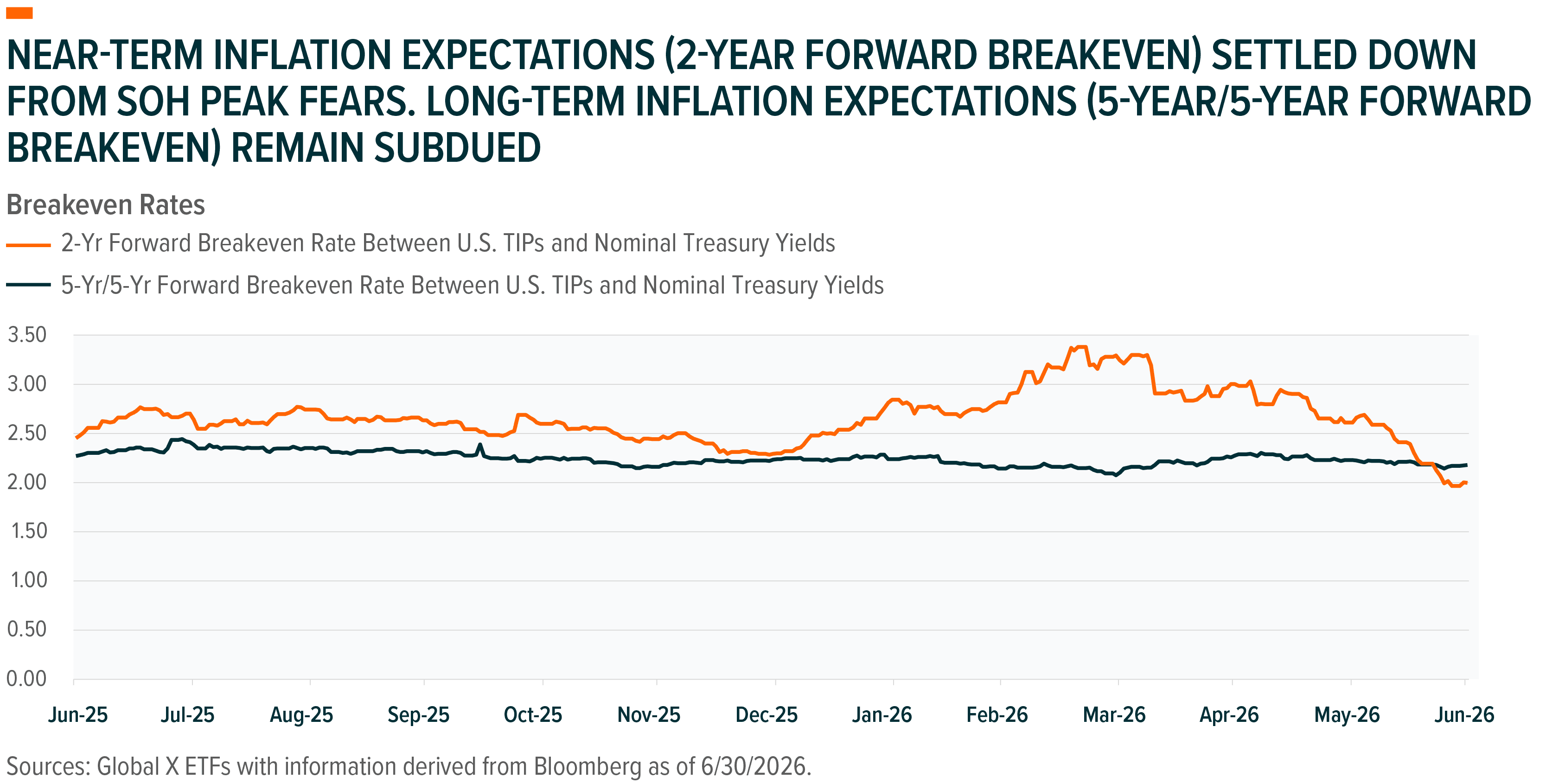
Near-term inflation readings will likely determine whether the Fed keeps rates on hold or acts to raise rates. TIPS-implied 2-year breakeven inflation rates spiked to 3.4% at the height of the SoH conflict before settling at 2.2% as of 6/30/2026 (source: Bloomberg), which is still above the Fed's 2% long-term inflation target3. Notably, longer-term inflation expectations remain better anchored, with the 5-Year/5-Year Forward Breakeven Rate at 2.2%, suggesting the market is not yet pricing in a permanent inflation regime shift.
Long-term inflation expectations are the key input into the real interest rate when distilling the risk premium associated with holding long-term debt maturities. Based on the 10-Year Constant Real Rate monitored by the Federal Reserve, real interest rates remain at elevated levels as long-term nominal yields have risen with rising inflation expectations.
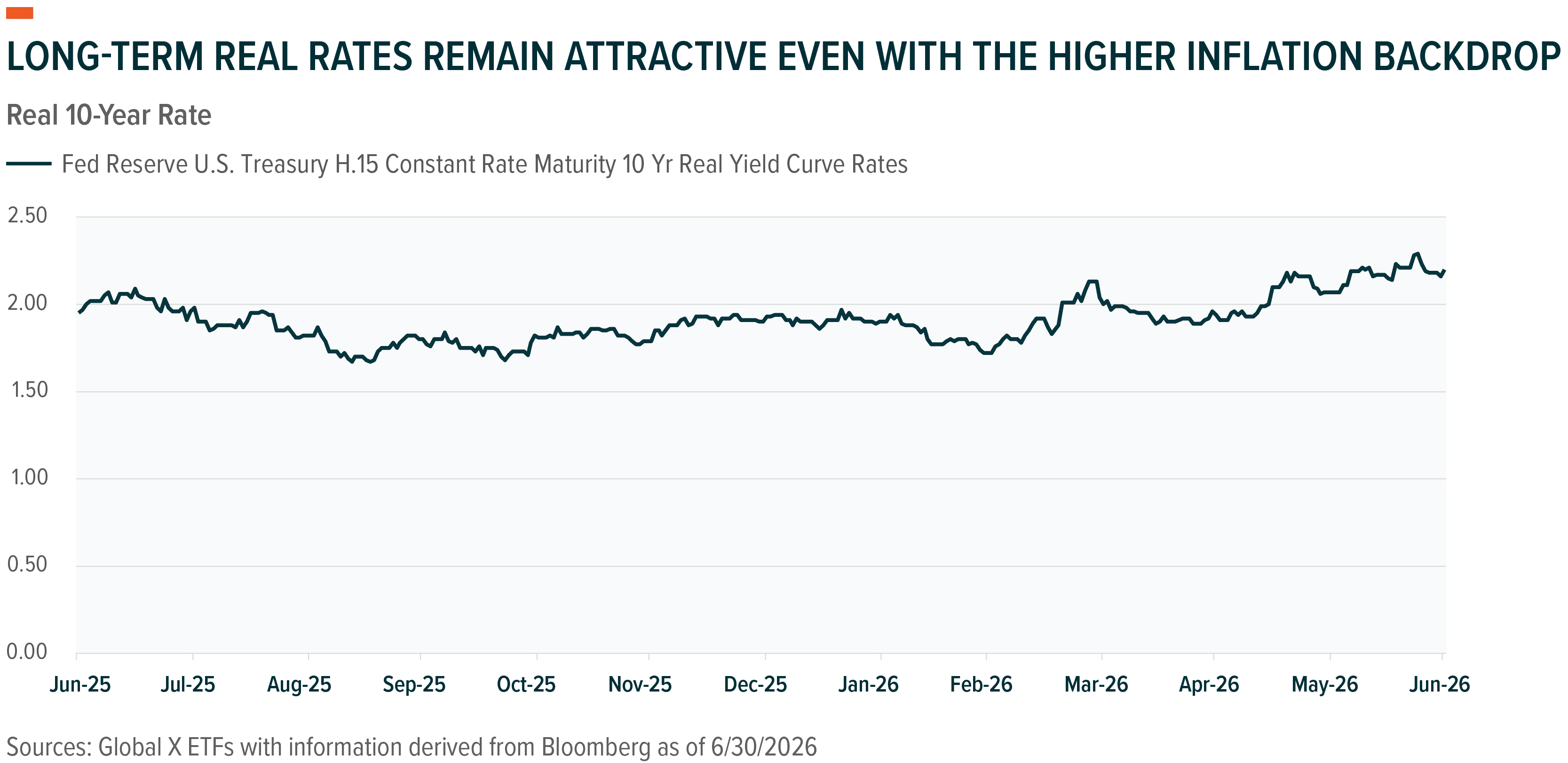
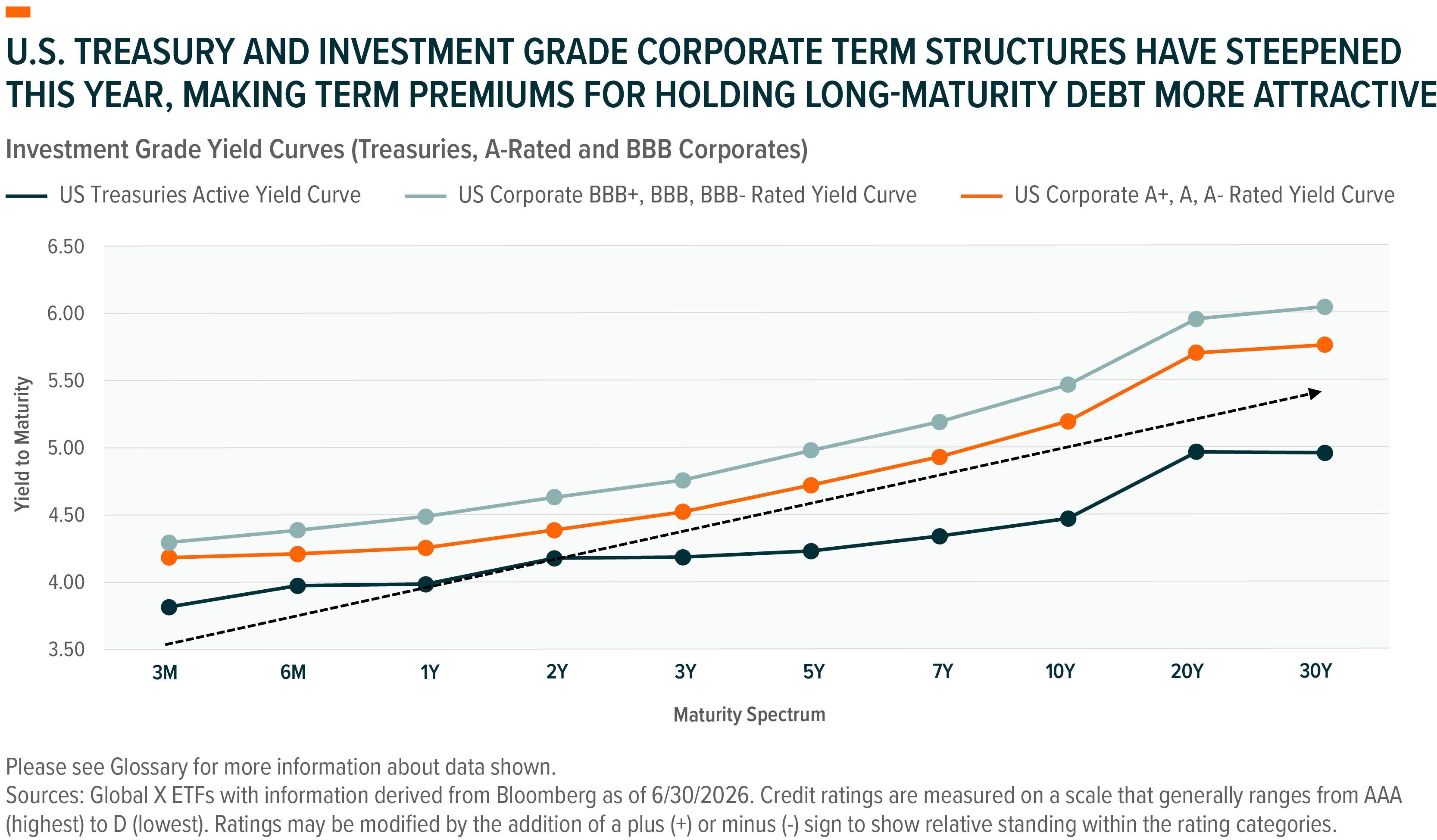
Despite this diminished backdrop for holding long duration risk, real rates remain attractive at above 2%, presuming that the Fed maintains its inflation-fighting credibility. Widening term premiums as compensation for holding long-term debt have made duration risk more attractive from a valuation standpoint. Investors are now being compensated for much of the risk priced into fixed income.
Yet, greater compensation (yield) for taking on interest rate risk is being partially offset by lesser compensation for taking on credit (default) risk. Corporate credit spreads versus 10-Year U.S. Treasury yields have narrowed from their SoH stress highs, as a strong economic backdrop is supportive of credit risk while the headline pressures weighing on private credit may be alleviating, based on the recovery of leveraged loan prices, a public proxy for private credit valuations.
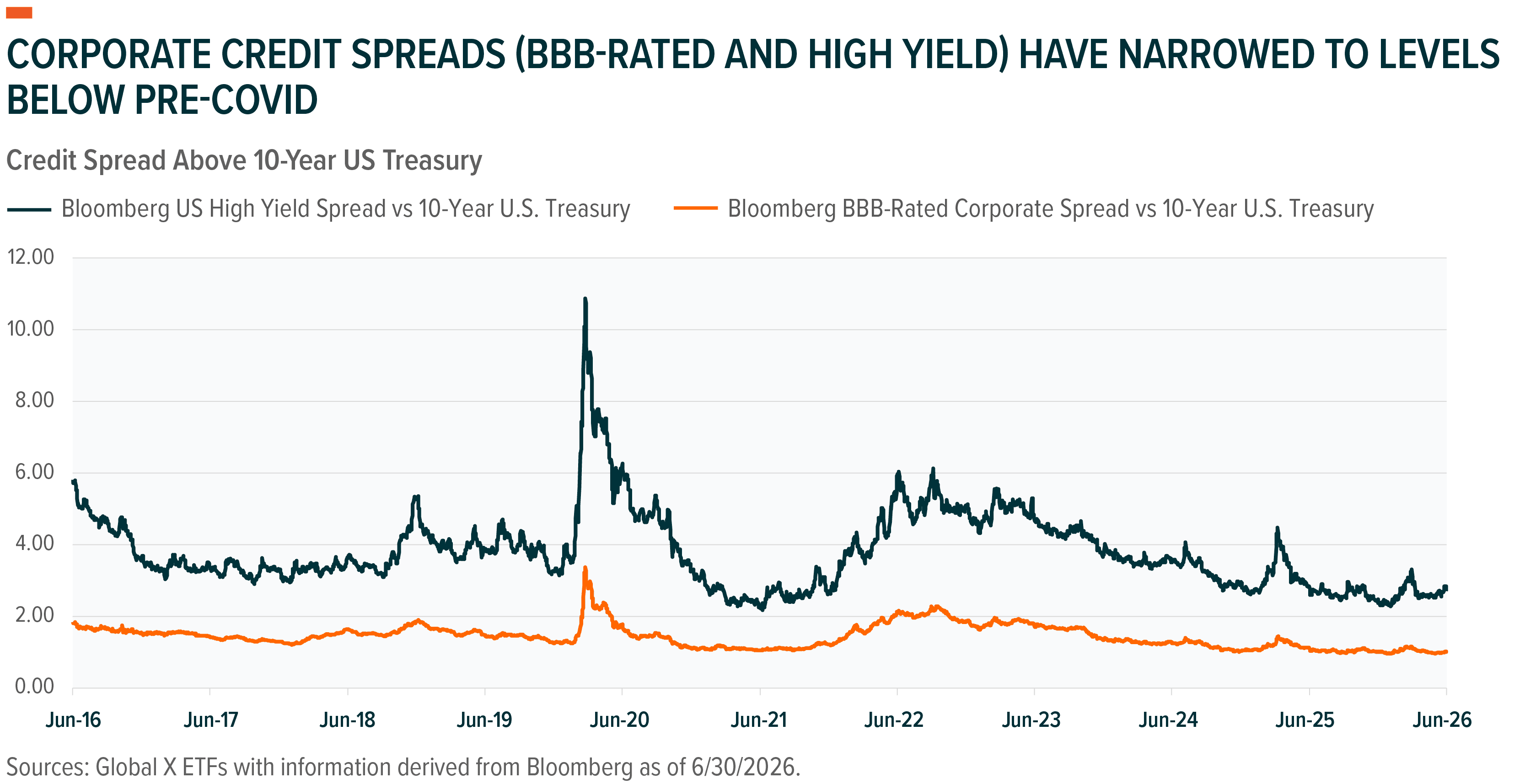
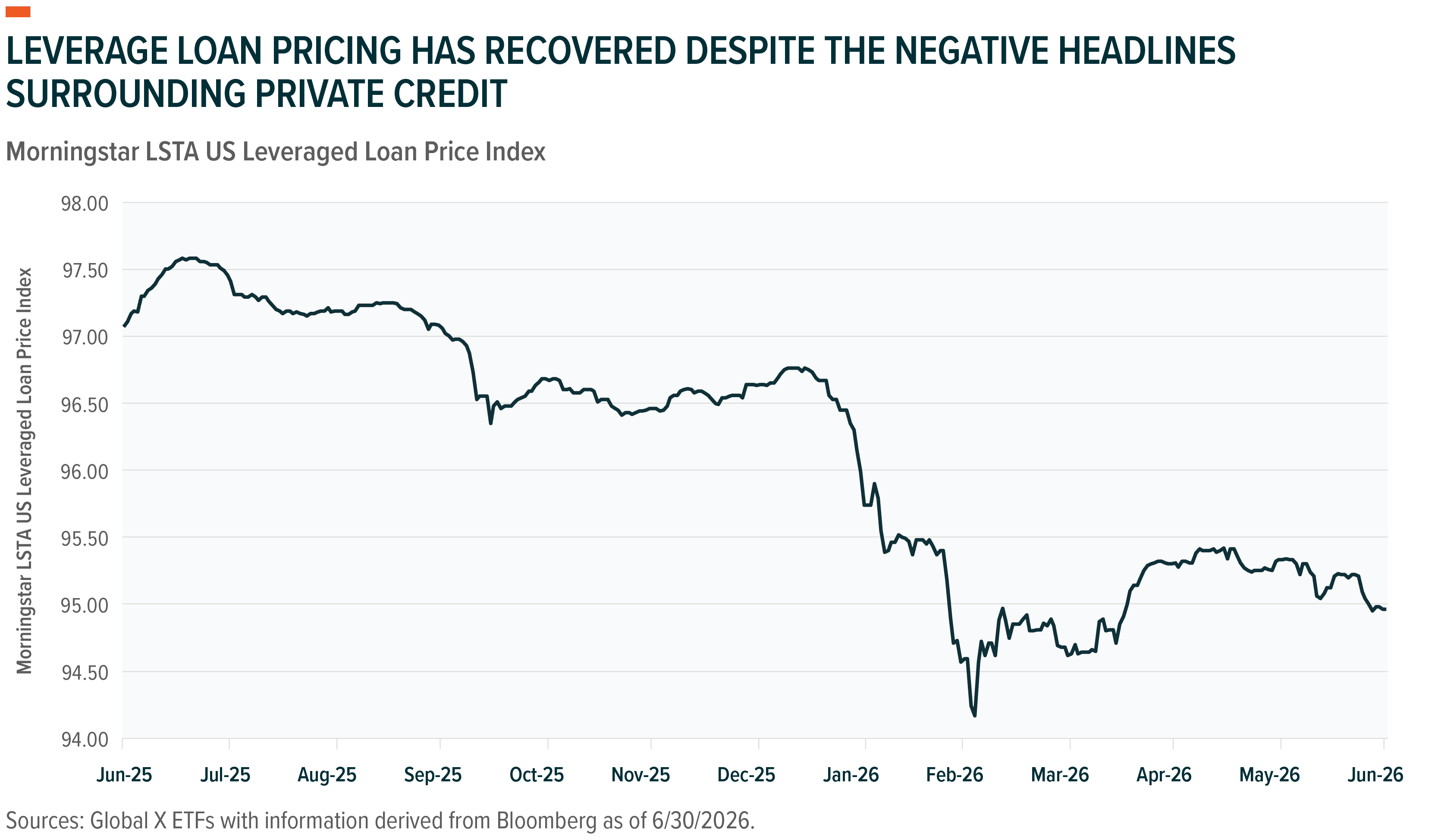
Despite a brief spread widening during the Iran conflict, corporate credit spreads have since retraced to near pre-COVID lows. Resilient economic growth and strong corporate earnings, largely AI infrastructure-driven, have kept investors positioned in credit over sovereigns. Agentic AI coding tools continue to threaten established software providers, pressuring both equity valuations and debt, particularly for private credit borrowers taken private at peak 2021–2022 valuations, who now face refinancing at higher rates and lower multiples. Narrow credit spreads and private credit headline risks make us cautious on high yield and would lead us to favor investment grade credit for defensive positioning.
Catching the Fixed Income Bird-In-Hand
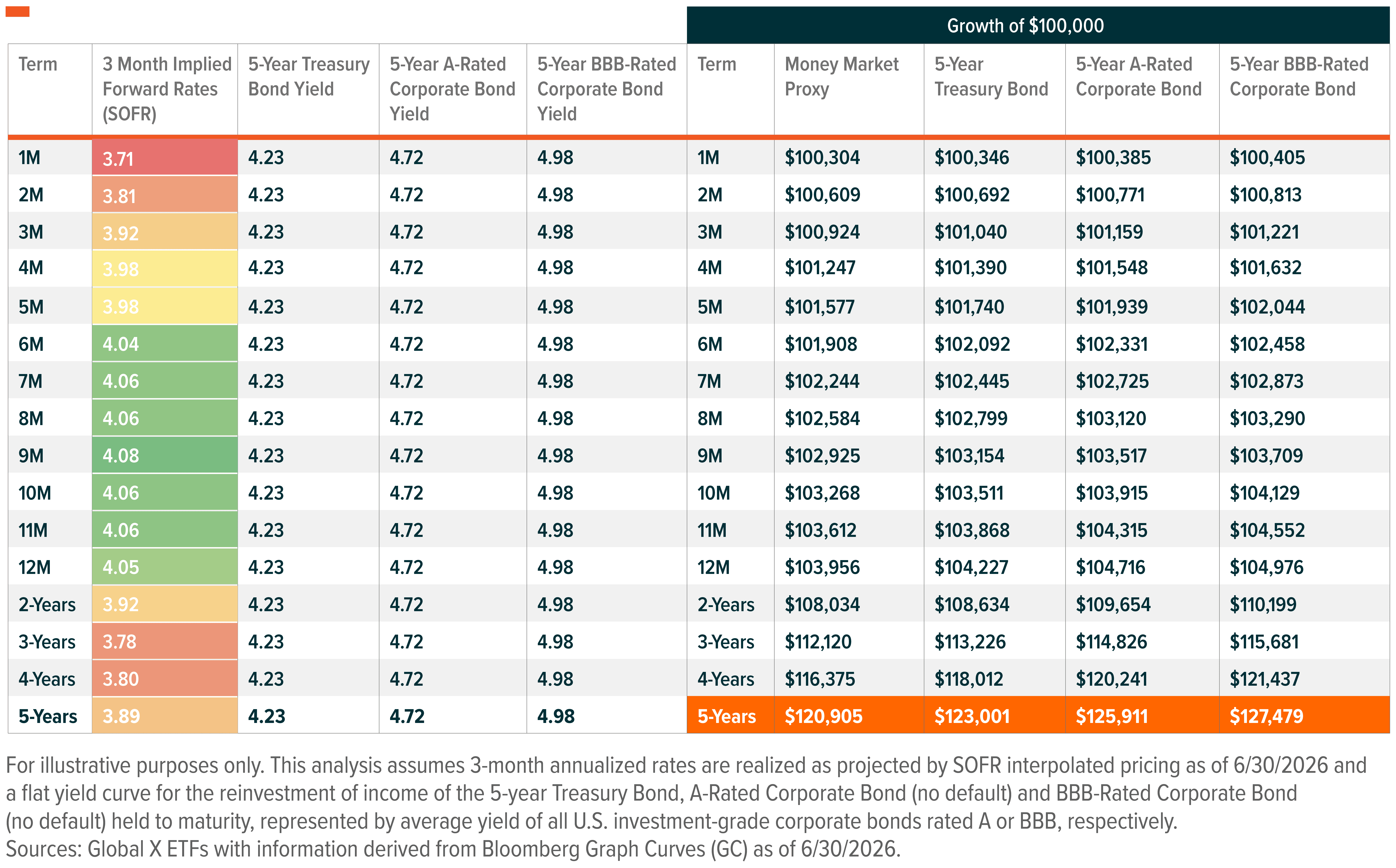
Today's steeper yield curve means investors no longer face the multi-year wait for intermediate-term bonds to outpace money market returns. Measured against 3-month Secured Overnight Financing Rate (SOFR), a reliable proxy for current and anticipated interest rates underpinning money market funds, both 5-Year Treasuries and 5-Year Corporate Bonds (A- and BBB-rated)4 currently provide a higher yield and those higher yields can be compounded as the interest rate futures market prices in not only a Fed pause on further rate cuts, but now a growing probability of rate hikes over the coming year.
Should fears of future rate hikes prove unfounded, holders of longer-maturity debt stand to benefit from potential price appreciation as well, adding a potential return tailwind on top of the yield advantage.
The Need for Creativity: Global X ETFs for a Fixed Income Program
In this environment of uncertain inflation and rich fixed income valuations, one may consider tilting fixed income risk towards duration over corporate credit. A framework for investors to consider follows a barbell structure, supplemented by selective spread diversifiers.
The following solutions reference Bloomberg fixed income analytics as of 6/30/2026, except where noted.
Duration Core: A Barbell of U.S. Treasuries, Favoring Short- and Long Maturities.
- Real yields are attractive, particularly at longer maturities given the steepness of global yield curves. One may consider anchoring a fixed income allocation in U.S. Treasuries via the Global X Short- and Long-Term Treasury Ladder ETFs (Tickers: SLDR, LLDR) and/or Zero-Coupon Treasury Bond ETFs (Tickers: ZCBA, ZCBB, ZCBC, ZCBE, ZCBF, ZCBG)) to target your desired maturity profile.
For short-term liquidity needs, we suggest the Global X 1-3 Month T-Bill ETF (Ticker: CLIP), with a 30-day SEC yield of 3.56% as of 6/30/2026.
Past performance is not a guarantee of future results. Click here for CLIP’s 30-day SEC yield, standard performance, and prospectus.
Corporate Credit: Cautious and Selective
Narrow credit spreads may make risk-taking beyond investment grade unattractive. One may consider underweighting high yield bonds and private credit, where compensation for default risk and illiquidity remains thin. Within investment grade, consider the following:
- Global X Investment Grade Corporate Bond ETF (Ticker: GXIG): Actively managed with a systematic security selection methodology. Option-adjusted duration (OAD) is 7.0 years with a yield-to-worst (YTW) of 5.23%.
Global X U.S. Preferred ETF (Ticker: PFFD): A passive fund, seeking to track the ICE BofA Diversified Core U.S. Preferred Securities Index, with a yield-to-worst (YTW) of 5.29% with moderate rate sensitivity (OAD of 4.3 years). Unlike GXIG, fixed income risk is distributed more evenly across credit spread, equity market, and interest rate factors. The callability of many preferred securities will likely limit upside participation in a rate rally, and the fund carries greater sensitivity to credit spread volatility than straight corporate bonds.
Past performance is not a guarantee of future results. Click for GXIG and PFFD’s 30-day SEC yield, standard performance, and prospectus.
Incremental Yield Diversifiers
- Global X Emerging Markets Bond ETF (Ticker: EMBD): Emerging Market (EM) debt offers a structural yield premium over developed markets; the fund has a yield-to-worst of 6.23% with an OAD of 5.8 years. The fund is actively managed by New York and Asia-based teams combining top-down macro and bottom-up credit analysis across sovereign and corporate EM issuers.
Global X Treasury Bond Enhanced Income ETF (Ticker: TLTX): May be best suited to a flat rate environment. The fund pairs long-term Treasuries with weekly covered calls on one or more U.S. Treasury ETFs on approximately 50%5 of the portfolio’s duration exposure. Option premiums are driven primarily by the MOVE Index (the implied rate volatility analog to the VIX). The latest distribution rate was 17.45% as of 6/30/2026.
The covered call premium represents a distinct potential risk premium category from traditional credit spreads, one that tends to exhibit moderate correlation with credit spread and mortgage basis risk, providing potential diversification value. The trade-off: covered calls introduce return asymmetry, limiting upside participation in a meaningful Treasury rally driven by falling rates.
The distribution rate is estimated to include a return of capital. This does not imply rates for any future distributions. Past performance is not a guarantee of future results. Click for EMDB and TLTX’s 30-day SEC yield, standard performance, and prospectus.
Related ETFs
CLIP – Global X 1-3 Month T-Bill ETF
EMBD – Global X Emerging Markets Bond ETF
GXIG – Global X Investment Grade Corporate Bond ETF
LLDR – Global X Long-Term Treasury Ladder ETF
PFFD – Global X U.S. Preferred ETF
SLDR – Global X Short-Term Treasury Ladder ETF
TLTX – Global X Treasury Bond Enhanced Income ETF
ZCBA – Global X Zero Coupon Bond 2030 ETF
ZCBB – Global X Zero Coupon Bond 2031 ETF
ZCBC – Global X Zero Coupon Bond 2032 ETF
ZCBE – Global X Zero Coupon Bond 2033 ETF
ZCBF – Global X Zero Coupon Bond 2034 ETF
ZCBG – Global X Zero Coupon Bond 2035 ETF
Click the fund name above to view current performance and holdings. Holdings are subject to change. Current and future holdings are subject to risk.