Technology has undergone a profound shift over the past several decades. What was once a specialized industry focused on hardware and software has evolved into the connective infrastructure of the global economy. Today, technology capabilities power nearly every sector, blurring the lines between traditional industry boundaries. Yet many of the investment strategies used to access technology exposure were built for an earlier era. To address this disconnect, we are introducing the Global X NYSE® 100 ETF (NYSX)—a modern tool designed to capture true innovation.
Key Takeaways
Technology expertise and deployment have moved from specialized skills of a few to a core competency that powers the modern tech-enabled interconnected ecosystem.
Technology leaders increasingly cross sector boundaries, reflecting how next-generation innovations power a deeply interconnected ecosystem. Passive investment strategies commonly used to add technology exposure often employ single sector frameworks or restrict their universe to one exchange, potentially limiting exposure to today’s opportunity set.
The Global X NYSE® 100 ETF’s index looks across the major U.S. stock exchanges and is designed as a modern approach to capturing technology-driven exposure across today’s evolving digital economy.
Technology Is the Economy
Despite a proliferation of new and innovative investment solutions, the means of gaining exposure to broad-based growth and technology has been remarkably static for almost 30 years. The net result is increasingly large positions in funds that track indexes or sub-indexes that we believe decreasingly capture the nature of innovation and growth across the economy.
For many years, publicly-traded technology companies were concentrated in particular exchanges, but today, development and deployment of new technology is a competitive imperative that touches just about every business. From financial technology firms that help companies reduce transactions costs to automated vehicles that help drive operational efficiency, the nature of technological leadership continues to evolve.
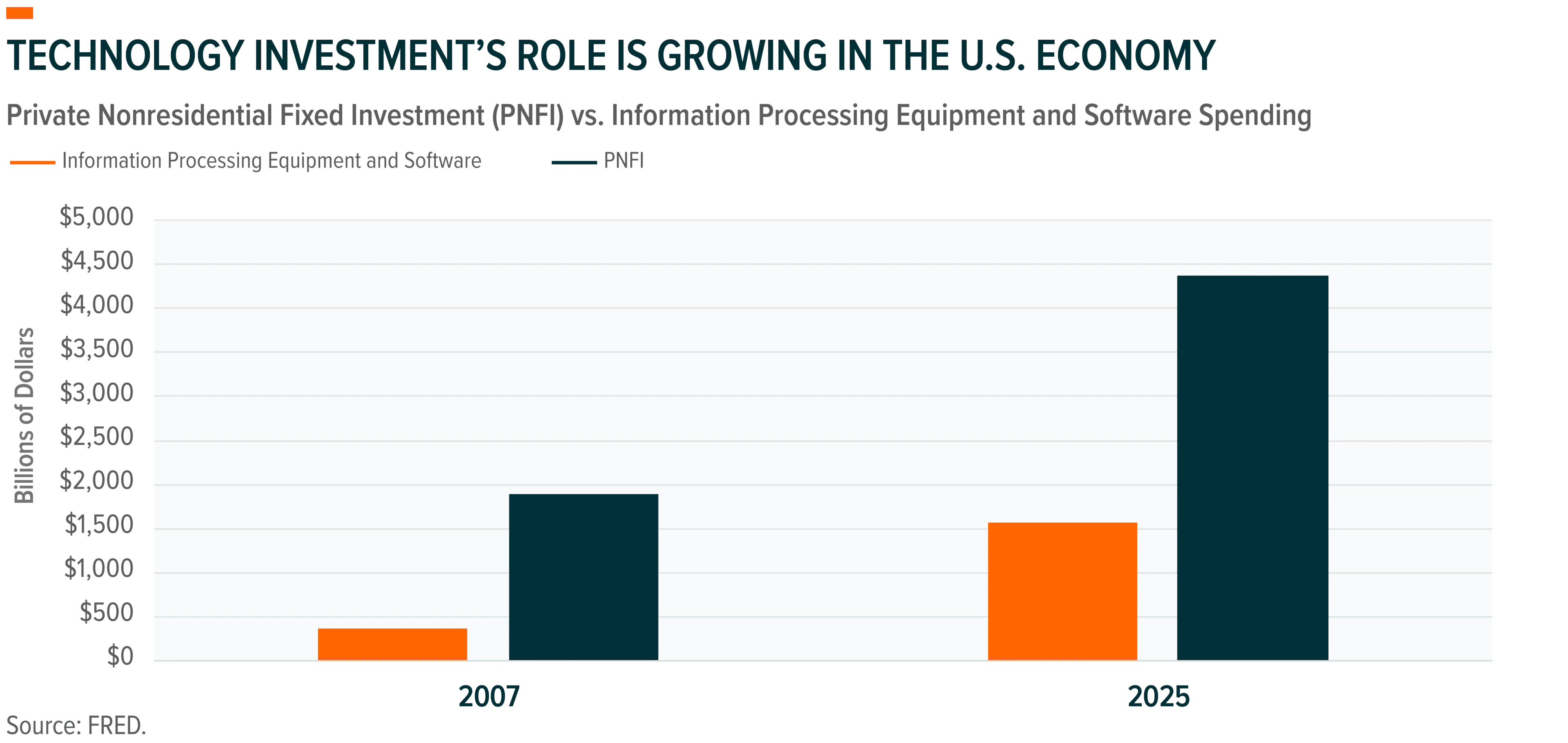
Current investment trends highlight the prominence of technology utilization across the broader economy. Information Processing Equipment and Software now accounts for more than 1/3 of all Private Nonresidential Fixed Investments, up from just 20% in 2007.1 Equipment and software producers are helping companies deploy new automation and digitalization technologies to stay on the leading edge of their respective industries. Technology leadership is not confined to a few companies or a single sector; it is one of the central organizing principles of the modern economy.
Limitation of Traditional Technology Proxies
Investors often turn to funds that track familiar benchmarks when seeking technology exposure, but as technology has expanded beyond traditional boundaries, common proxy approaches based on legacy indexes may no longer fully capture the leaders of the technology ecosystem.
Indexes based on a listing exchange have been a common means of seeking out technology-driven exposure. Yet we believe those indexes face two structural limitations. First, restricting eligibility to a single exchange can exclude technology leaders listed elsewhere. Historically, the requirements for listing on exchanges were different, and that drove corporate decision-making.2 Those distinctions are less relevant for companies going public today. While companies choose listing venues for a variety of structural and regulatory reasons, no major U.S. exchange holds a monopoly on next-generation technology.
Second, no major exchange is composed exclusively of technology-driven companies. Many exchange-based indexes are designed to measure the performance of that exchange or a subset of the exchange, such as the largest companies. As a result, exchange-based benchmarks can include businesses in traditional industries such as retail or consumer staples that may not align with a targeted technology allocation. The outcome can lead to exposure that is both incomplete and diluted for funds aiming to replicate these indexes.
Another common approach to isolating leading-edge companies is through indexes tracking the technology sector within a broader index. While intuitive, this framework relies on classification systems that were built for an earlier era. Consider the so-called "Magnificent 7” companies, often viewed as bellwethers of U.S. technology leadership. Despite this informal grouping, they span three GICS sectors and six industries by classification. Fewer than half are even formally categorized as technology companies.
A sector-based approach may appear to offer precision, but traditional classifications increasingly fail to reflect how next-generation technology now spans multiple sectors and underpins the broader economy.
Introducing the Global X NYSE® 100 ETF: A Modern Tool for Evolving Markets
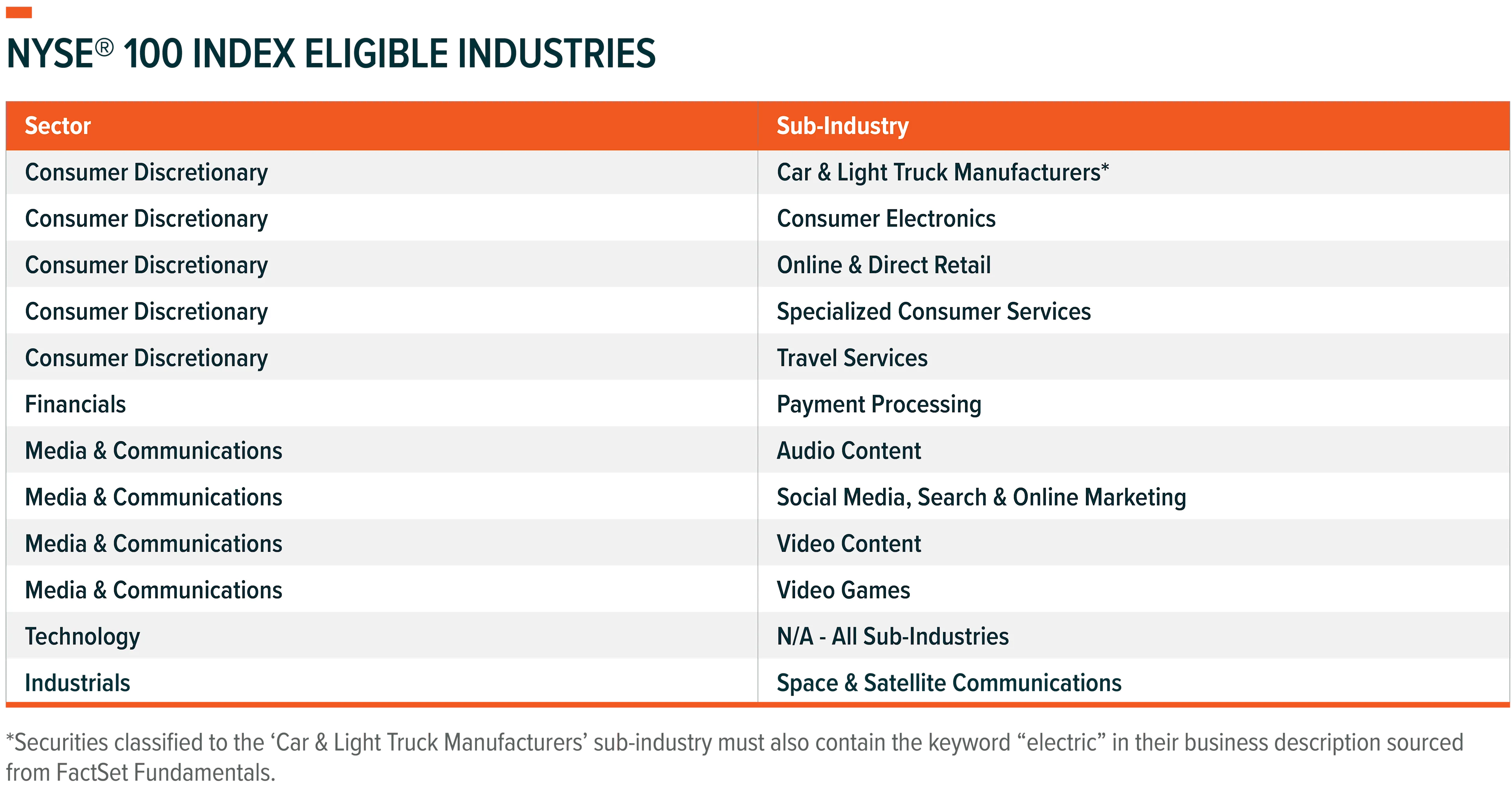
The evolution of the digital ecosystem and its increasing penetration across the economy requires new tools for investors. The Global X NYSE® 100 ETF seeks to track the NYSE® 100 Index, comprised of 100 leading companies listed on any major U.S. exchange.3 Rather than constraining the definition of technology to one sector, the NYSE® 100 Index reflects the economic reality of innovation by expanding eligibility to select sub-industries within the Consumer Discretionary, Financials, Industrials, and Media & Communications sectors in addition to the entire Technology sector.
Expanding beyond traditional sector boundaries broadens the opportunity set, but without a thoughtful selection framework, size alone may still shape which companies rise to the top. Rather than relying solely on size to determine inclusion, the NYSE® 100 Index applies a weighted scoring framework to identify the 100 highest ranked companies that reflect the scale, liquidity, and growth characteristics of today’s expanding technology ecosystem.
Once selected, constituents are weighted by modified market capitalization. This approach allows the index to retain the transparency of market cap weighting while applying a more intentional lens to identifying companies that have been shaping next-generation technology growth.
Why NYSX Matters Today
Technology’s expansion into a cross-sector ecosystem has become a defining feature of today’s market leadership. Many of the largest and most influential U.S. companies now operate as interconnected platforms spanning hardware, software, media, payments, mobility, and artificial intelligence. Their scale, profitability, and reinvestment capacity have positioned them at the center of equity market performance in recent years.
At the same time, the drivers of next-generation technology growth are broadening. Artificial intelligence infrastructure, cloud computing, digital advertising, e-commerce logistics, electronic payments, and connected mobility are increasingly interdependent. Leadership in one area often reinforces leadership in another, creating a circular ecosystem dynamic rather than isolated sector growth.
For investors, this environment presents a portfolio construction challenge. Traditional sector definitions may underrepresent key participants in this ecosystem, while investing in products that track broad market indexes may dilute exposure with companies less directly tied to technology-enabled growth. As technology continues to function as a foundational layer of the U.S. economy, a more intentional approach to capturing that ecosystem may be increasingly relevant.
The NYSE® 100 Index that NYSX tracks was designed with this modern market structure in mind, as it aims to reflect where technology-driven growth is occurring today and how it may continue to evolve.
Conclusion
As technology becomes increasingly embedded across industries, investors may need tools that better reflect this evolving structure of the economy. Traditional approaches based on exchange listings or single sector classifications can struggle to capture the full breadth of companies driving technology-enabled growth. By tracking an index that expands the opportunity set across exchanges and sectors and applies a structured selection framework, the Global X NYSE® 100 ETF seeks to provide a modern approach to accessing the companies shaping today’s technology ecosystem.
Related ETFs
Click the fund name above to view current performance and holdings. Holdings are subject to change. Current and future holdings are subject to risk.