
The AI buildout has reached its prove-it phase. Its first three years were defined by infrastructure investment running ahead of proven demand. The next few years will require clearer evidence that AI adoption can generate revenues and returns commensurate with the industry’s rising capital intensity.
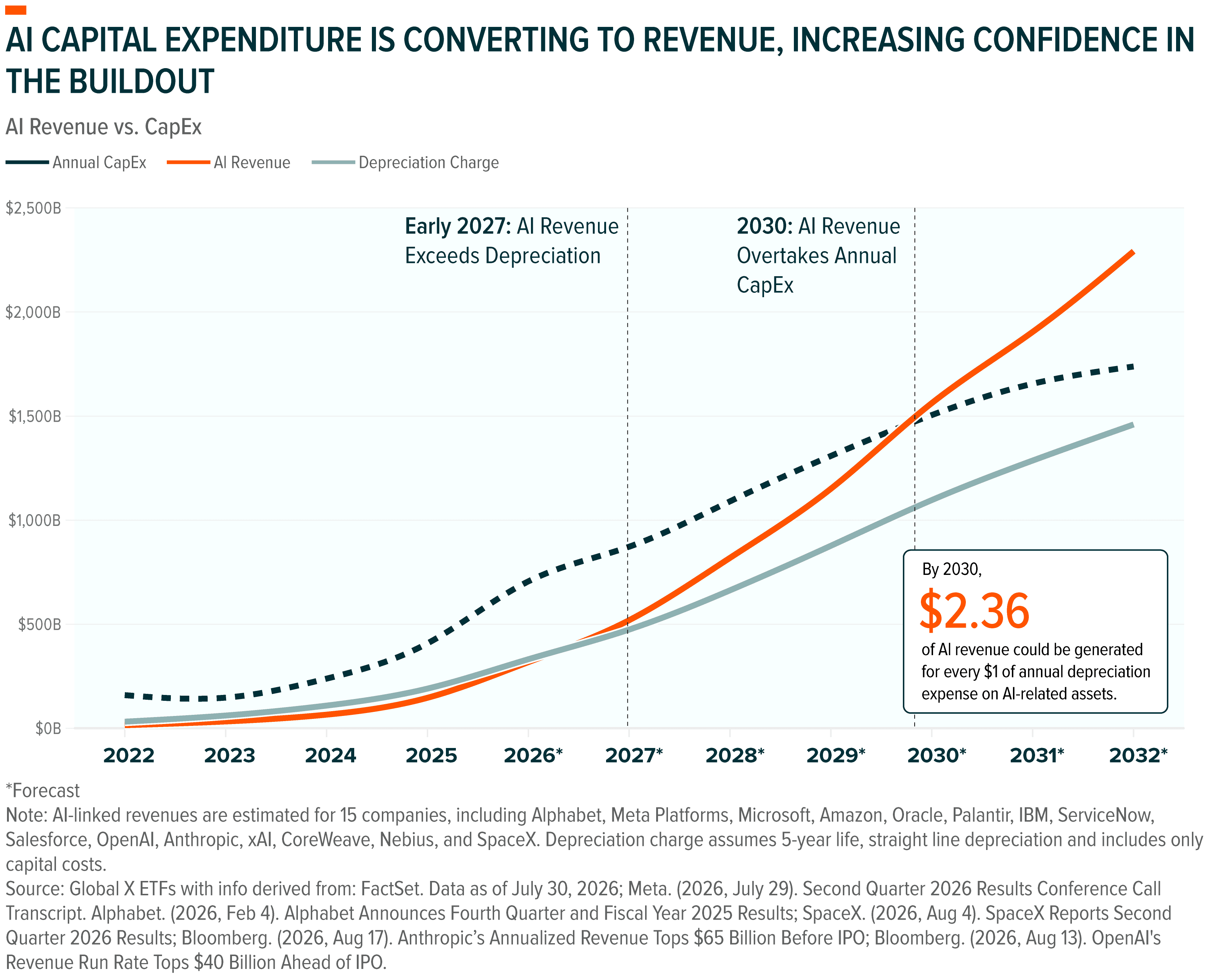
That evidence is beginning to emerge. Our analysis suggests a basket of leading public and private software and application layer companies monetizing AI across model development, cloud computing, digital advertising, and subscriptions are on pace to generate nearly $320 billion in annualized AI-linked revenue in 2026. At current growth rates, those revenues could surpass estimated infrastructure depreciation as early as 2027, marking an important inflection in the economics of the buildout.1 While depreciation captures only part of the cost base, this crossover would mark an important inflection, with AI revenue beginning to underwrite the next wave of investment before the current buildout has fully matured.
This emerging monetization is making the investment cycle increasingly self-reinforcing. Greater capacity supports more capable and cost-efficient models; lower inference costs can broaden adoption; rising usage generates revenue; and stronger revenue visibility supports further infrastructure spending. We expect this loop to remain central to the AI trade in the near to medium term. Hardware should remain the clearest near-term beneficiary as capital flows through semiconductors, memory, networking, data centers, and power. But ultimately, the opportunity should broaden toward software platforms and applications capable of converting AI usage into durable recurring revenue.
Key Takeaways
- AI monetization is becoming measurable across frontier models, cloud infrastructure, enterprise software, and digital advertising.
- Revenues could surpass the depreciation burden associated with the buildout around 2027, providing increasingly tangible evidence that the investment cycle can generate positive economic returns.2
- Inference and agentic AI should extend the investment cycle by turning AI into a recurring computing workload, while also expanding the breadth of beneficiaries into areas like software and cybersecurity.
AI Monetization Is Becoming More Visible
For the past three years, AI has traded primarily as a capital cycle, with investors backing the buildout on the strength of rapid user adoption and the expectation that generative AI would become a foundational computing platform. Infrastructure investment ran well ahead of monetization. That gap is now narrowing as AI demand converts into model revenue, cloud consumption, paid subscriptions, and improved economics across existing digital businesses.
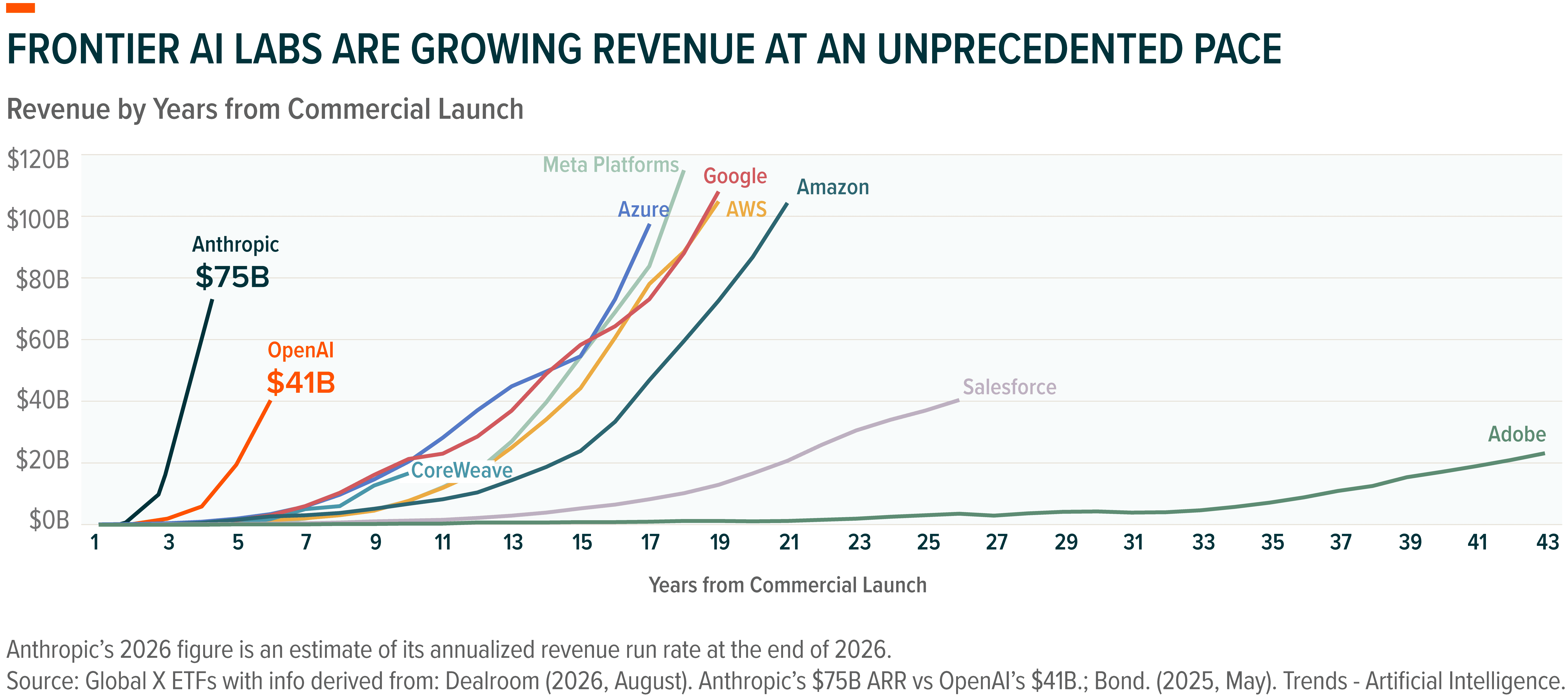
The most direct evidence comes from frontier AI labs, where intelligence itself is being sold through subscriptions and usage-based pricing. Anthropic’s annual revenue run-rate (ARR) surpassed an estimated $75 billion in July 2026, nearly doubling in three months and increasing more than eightfold from $9 billion at the end of 2025.3 OpenAI’s ARR also surpassed $40 billion, roughly doubling from the end of 2025.4 Few technology businesses have scaled revenue this quickly, demonstrating that frontier models can support large and rapidly growing revenue pools. But with AI penetration still under 20% globally, frontier models have substantial runway ahead for monetization to scale.5
The next proof point is contracted cloud demand. Microsoft’s commercial remaining performance obligations increased 84% year-over-year (YoY) in the most recent quarter to $678 billion, while Google Cloud’s backlog reached $514 billion, with just over half expected to convert into revenue over the next 24 months.6,7 These measures extend beyond AI, but both companies identify AI infrastructure and services as important growth drivers. More importantly, these contracted commitments are beginning to underwrite the next phase of the buildout. Monetization is also becoming more explicit: AWS disclosed that its AI business had surpassed $25 billion in ARR and was growing at a triple-digit pace, while Microsoft reported more than 30 million paid Microsoft 365 Copilot seats.8
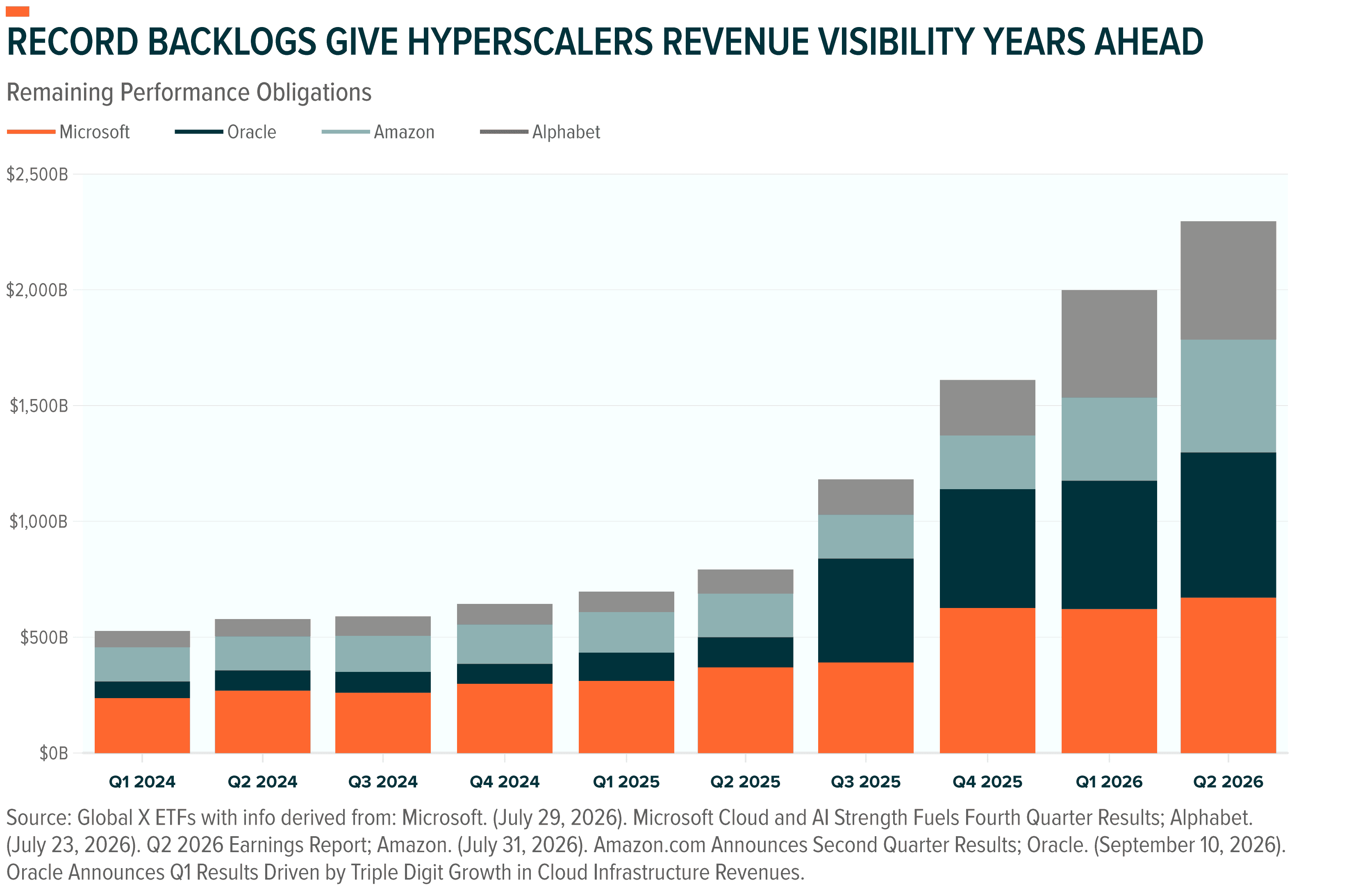
Neocloud providers offer another particularly direct read on AI infrastructure monetization because their revenues are directly tied to the sale of AI computing capacity. CoreWeave could exit 2026 with an ARR-rate above $20 billion, with backlogs surpassing $125 billion as of early Q3.9 Nebius and other emerging providers such as SpaceX have also begun securing large, multi-year compute agreements.10,11 Across this expanding group, the signal is consistent: demand is being contracted well before capacity comes online, improving revenue visibility and helping finance the next wave of chips, data centers, and power infrastructure.
AI is also monetizing through existing business models. Meta, itself a leading frontier model developer, has delivered ad-revenue growth above 20% YoY for five consecutive quarters supported by AI-driven improvements in content recommendations, ad targeting, and campaign performance.12 Within Advantage+, Meta’s AI-powered suite of ad products, the company now reports $75 billion annual revenue run rate.13 Google’s advertising revenue has also posted double-digit growth for five consecutive quarters, increasing approximately 15% to $81.7 billion in the latest quarter as search and broader targeting leverages AI.14 For both companies, AI is strengthening the economics of already-scaled digital platforms.
Across our basket of 15 AI platforms and providers AI-linked revenue could rise from roughly $146 billion in 2025 to $317 billion in 2026 and $518 billion in 2027. Revenue could ultimately approach $1.5 trillion by 2030, growing at a 60% compounded annual growth rate (CAGR) between 2025 and 2030. On this trajectory, AI-linked revenue could exceed our estimate of annual infrastructure depreciation around 2027, signaling that monetization is beginning to catch up with the accounting cost of the installed asset base.15 That improving revenue visibility matters because the capacity required to serve future demand must be financed and built years in advance.
Revenue Is Beginning to Underwrite the Next Round of CapEx
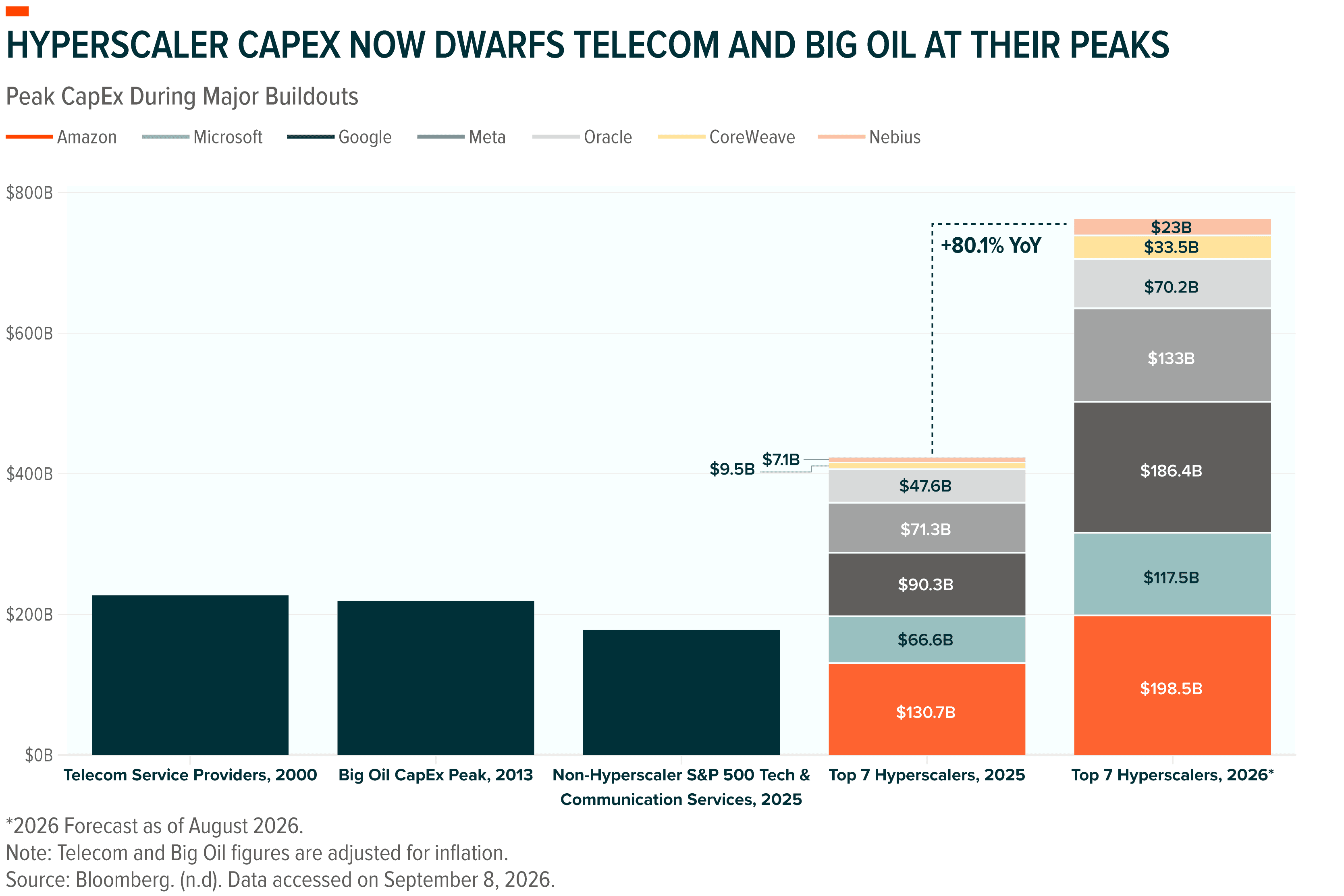
That next round of AI infrastructure investment is already taking shape, and the sheer scale of the infrastructure investment likely to unfold over the next few years is difficult to overstate. Between 2025 and 2030, nearly $6.7 trillion could be invested in AI infrastructure, with nearly $5.9 trillion being invested by hyperscalers alone.16,17 On an annual basis, hyperscaler capital expenditure (CapEx) is projected to reach $880 billion in 2026, an increase of about 108% YoY.18 Hyperscaler spending could reach roughly $1.13 trillion in 2027 and exceed $1.25 trillion annually by 2028, forming the backbone of what may become one of the largest infrastructure buildouts in modern history.19
Capital intensity is also rising at the project level. Data centers built before 2020 typically provided tens of megawatts of capacity, while new AI campuses are designed at nearly 50x the scale, extending into gigawatt power needs.20 At this scale, investment extends across dedicated power generation and transmission, substations, backup systems, liquid cooling, high-capacity networking, fiber connectivity, and extensive site development.
The buildout also takes time: multi-year power, interconnection, and transmission timelines effectively pace the capex cycle, giving monetization room to catch up with invested capital and lending durability to the AI trade.
Intensifying Spending Exposes Supply Chokepoints
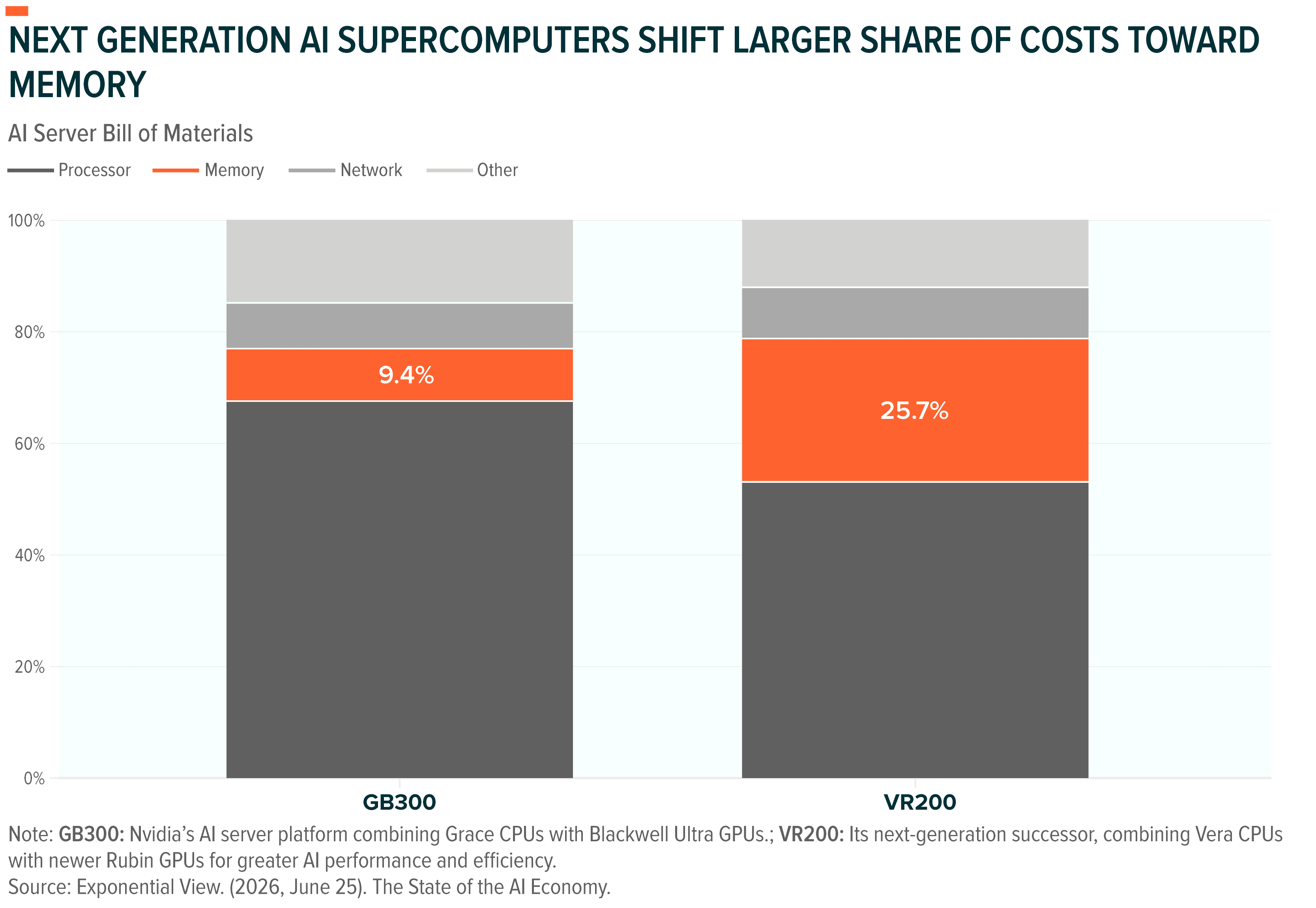
The supporting hardware ecosystem, spanning memory, networking and interconnects, power infrastructure, cooling, and data-center construction, is not designed to expand at the pace of AI demand, creating chokepoints across the enabling value chain.
For example, high-bandwidth memory (HBM) emerged as a critical limitation in 2026. Increasingly powerful accelerators require significantly more memory bandwidth and capacity to remain fully utilized, potentially driving HBM spending from roughly $35 billion in 2025 to $100 billion by 2028 and $130 billion by 2030.21,22
Capacitors and passive components are another example. AI-server demand for capacitors could rise by 4.3x by 2030, while supply, controlled by a small set of companies primarily based in Asia, can rise only 10-15% annually through the end of the decade.23,24 Networking represents another emerging constraint. Clusters containing millions of accelerators require increasingly sophisticated interconnects to function as a unified computing system. For example, NVIDIA’s Vera Rubin NVL72 rack connects 72 GPUs within a single rack using 260 terabytes per second of aggregate bandwidth, which is comparable with the bandwidth of the entire internet.25
Inference Shifts Economic Value Toward Applications
The economics of the buildout change once models move from training into deployment. Training generates large, episodic bursts of compute demand, but inference recurs every time a user generates content, writes code, searches enterprise data, or delegates work to an AI agent. Inference could account for nearly 60% of AI data-center demand by 2030, transforming AI from a series of discrete capital projects into a persistent, recurring computing workload.26
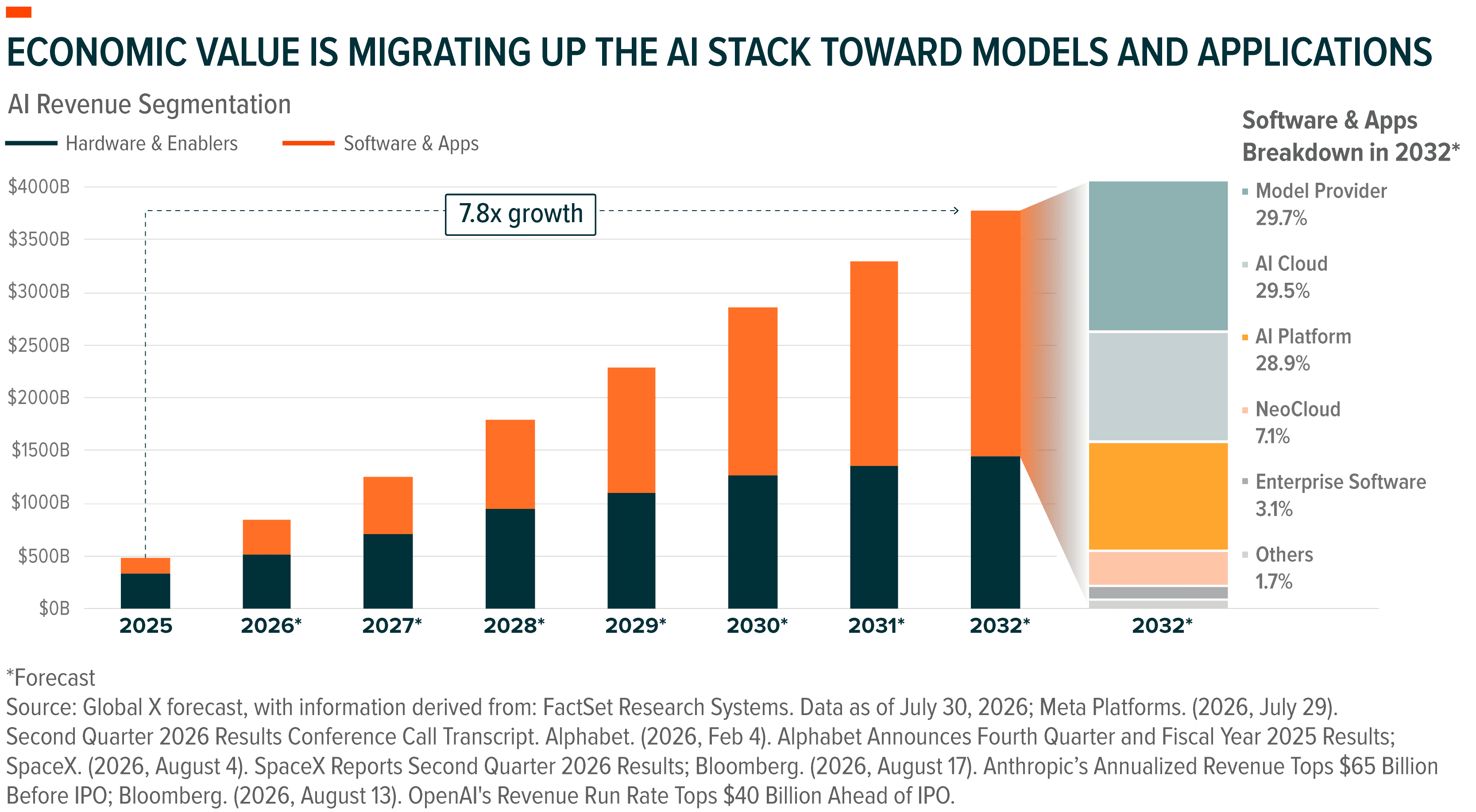
This is where the capex cycle and the application layer connect. Each wave of infrastructure investment expands available capacity and lowers the marginal cost of intelligence, as evidenced by token costs for GPT-3.5-level model performance falling nearly 1,000-fold since ChatGPT’s November 2022 launch.27 Each leg down in cost, in turn, makes a new tier of applications commercially viable. As more capital comes online, economic value effectively moves up the AI stack, from raw compute to the models running on it, to the applications built on top of them.
Agentic AI should accelerate this migration. Because agents execute chains of actions, retrieve information, call external tools, and evaluate their own outputs, they consume orders of magnitude more compute per task than single-query interactions. Consumer and enterprise agents could drive a 24-fold increase in token consumption between 2026 and 2030, embedding inference demand directly into everyday workflows.28
The application layer is where that usage converts into durable revenue. Semiconductors and infrastructure suppliers benefit from rising compute intensity, but it is the model developers and software companies that package these capabilities into products tied to specific workflows and consumer experiences, making it the layer where recurring, subscription-like economics take hold. Critically, this revenue flows back down the stack: every successful application generates incremental demand for the compute, memory, networking, and power beneath it, reinforcing the investment loop described above.
For investors, this dynamic keeps the hardware cycle investable while broadening the opportunity set. We believe hardware and physical infrastructure should remain the most direct near-term beneficiaries of capital spending, but as inference scales, more value should accrue to model platforms and applications capable of converting capacity into recurring revenue. The shift also creates opportunities across the adjacent IT stack, with cybersecurity a notable example: AI cybersecurity spending could nearly double from $25.9 billion in 2025 to $51.3 billion in 2026 and rise a further 68% to approximately $86 billion in 2027.29
Conclusion: Monetization Is Extending the AI Investment Cycle
The AI buildout is entering a more commercially grounded phase. Frontier labs, cloud providers, neoclouds, software platforms, and digital advertisers are producing increasingly visible AI-linked revenue, while contracted demand is giving infrastructure providers greater confidence to commit capital several years ahead of deployment.
We expect this interplay between monetization and infrastructure investment to define the next phase of the AI trade. Hardware and physical infrastructure should remain the primary near-term earnings engine, while falling inference costs and broader adoption gradually expand the opportunity toward software, applications, and physical AI. If AI revenues continue scaling alongside usage, today’s capex cycle may provide the economic foundation for the next wave of investment.
Related ETFs
AIQ – Global X Artificial Intelligence & Technology ETF
DTCR – Global X Data Center & Digital Infrastructure ETF
CHPX – Global X AI Semiconductor & Quantum ETF
BOTZ – Global X Robotics & Artificial Intelligence ETF
BUG – Global X Cybersecurity ETF
MLCC – Global X MLCC & Electronic Components ETF
Click the fund name above to view current performance and holdings. Holdings are subject to change.