
As demand for AI infrastructure continues to outpace supply on earth, investors are beginning to focus on orbit as the next frontier to sustainably scale AI processing capacity. These facilities would place AI computing systems in sun-synchronous orbit, where they could access near-continuous solar power and connect with terrestrial networks. We believe the concept has real merit and should not be dismissed, though launch costs may need to fall by more than 90% before the economics become viable.1
Even at this early stage, the investment implications are meaningful: the constraints motivating orbital data centers reinforce the value of scarce terrestrial capacity today, while efforts to overcome them could accelerate demand across launch services, satellite infrastructure, space-based power, and connectivity. In other words, orbital data centers could strengthen the case for both the infrastructure supporting AI now and the space economy that may support its next phase.
Key Takeaways
- Orbital data centers are technically feasible, but the economics remain premature. Launch costs likely need to fall nearly 90% to roughly $200/kg for the model to become viable, a threshold that may not be reached until the mid-2030s.2
- Reaching that cost curve depends on next-gen launch systems, particularly fully reusable platforms such as SpaceX’s Starship.
- Orbital data centers could expand the AI infrastructure market beyond Earth. Their most compelling initial role is likely to complement terrestrial hyperscale facilities by enabling space-native inference and edge processing for Earth observation, defense, communications, and other latency-sensitive applications in orbit.
Why Is AI Moving to Space?
The case for orbital data centers rests on their ability to alleviate two constraints facing terrestrial AI infrastructure: power availability and cooling. Although orbital facilities are not currently cost competitive, their operating advantages could become increasingly relevant as power, grid access, land, water, and permitting constrain data center development on Earth.
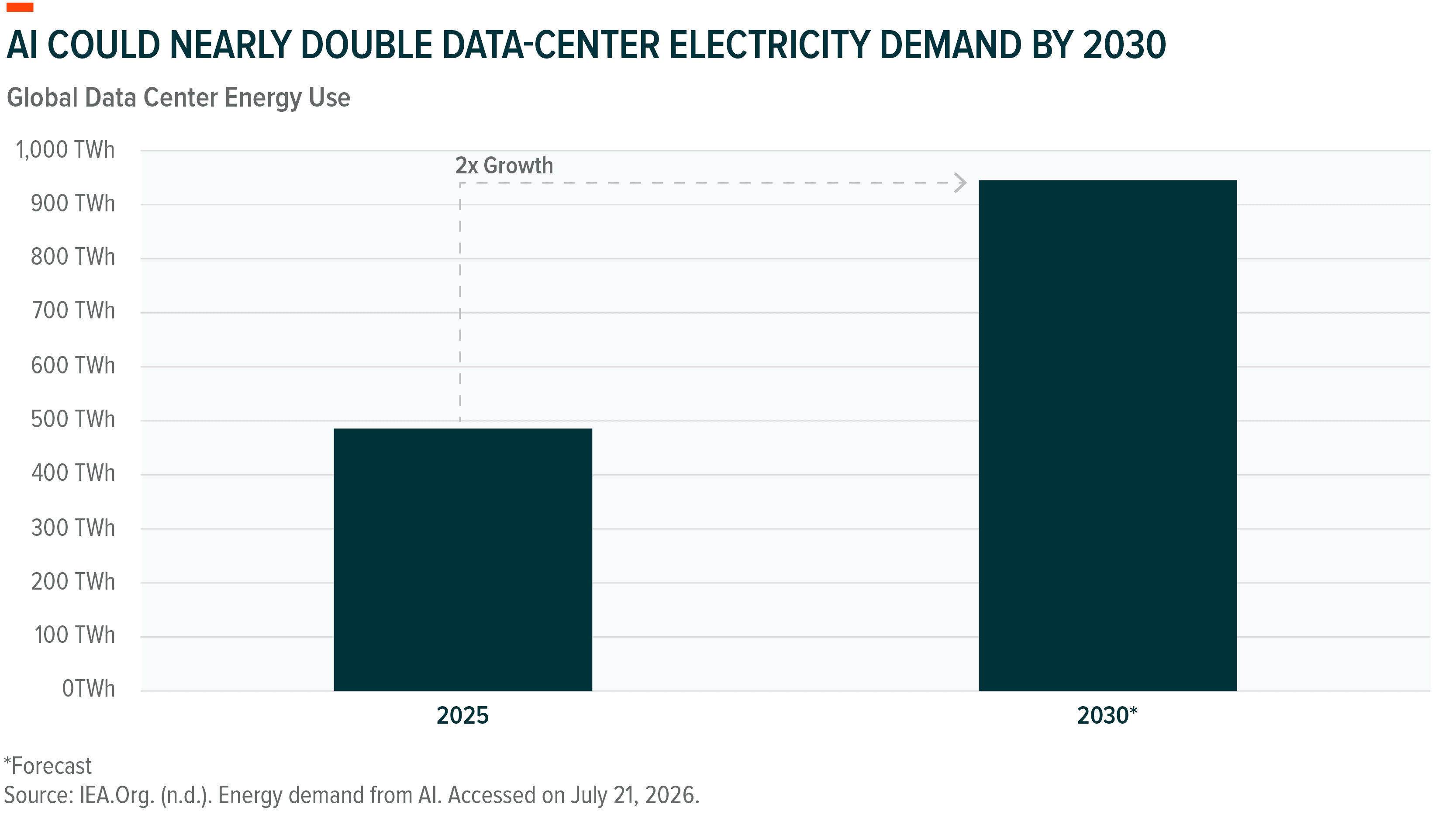
AI’s computing needs have risen sharply as models progress from reasoning toward agentic and, ultimately, autonomous capabilities. As a result, the primary infrastructure constraint is shifting from access to semiconductors and capital to access to reliable power. Global data center electricity consumption is expected to nearly double between 2025 and 2030 to around 945 TWh, growing nearly four times faster than overall electricity demand.3 In the U.S. alone, more than 100 GW of new data center capacity could come online between 2025 and 2035.4 The terrestrial grid is struggling to keep pace with that level of growth and energy intensity.
The challenge is compounded by permitting delays, slow transmission buildout, long interconnection queues, and increasing pushback from local communities. Roughly 20% of planned data center projects face significant delays, while interconnection wait times can reach a decade in key regions. Developers are responding by securing behind-the-meter generation, including nuclear power. The small-modular-reactor pipeline linked to data centers has nearly doubled, from approximately 25 GW at the end of 2024 to roughly 45 GW today.5 In our view, the AI infrastructure buildout is increasingly a competition for reliable energy – a constraint that orbital data centers could eventually help alleviate.
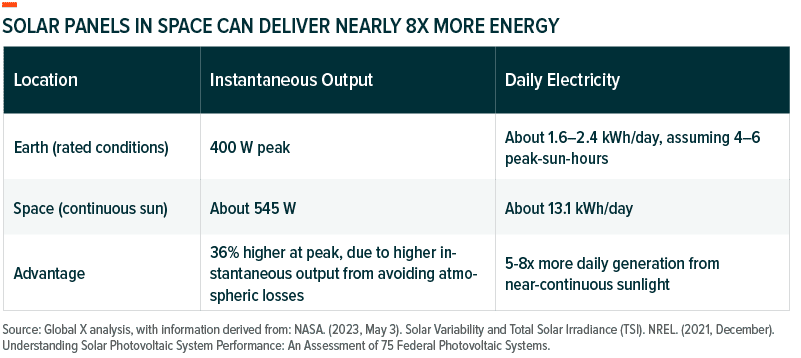
Space offers two operating advantages for power-intensive data centers: more consistent and abundant solar power, and reduced reliance on water-based cooling. In a dawn-to-dusk sun-synchronous orbit, a satellite can remain in near-continuous sunlight avoiding nighttime, cloud cover, weather, and atmospheric energy losses. As a result, solar panels could generate up to eight times more energy than comparable terrestrial systems. Orbital facilities would also eliminate the need for evaporative water cooling, instead rejecting heat through radiative cooling systems.
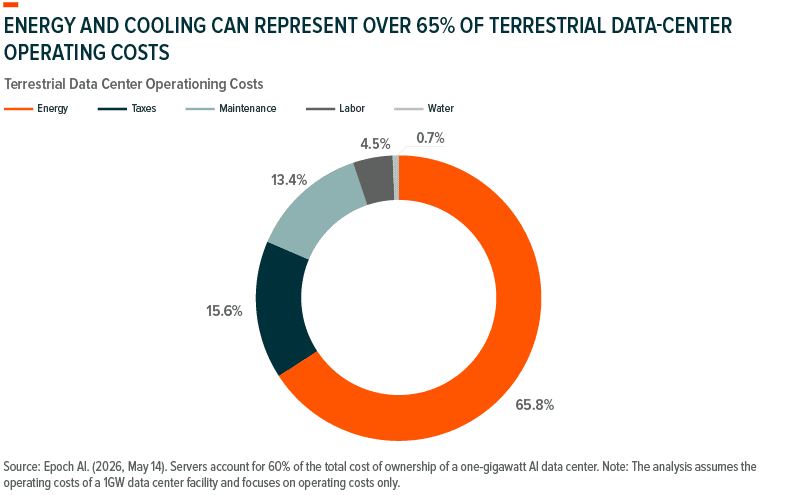
Together, these advantages could reduce orbital data center operating costs by nearly 67% relative to terrestrial facilities, where energy and cooling represent significant ongoing expenses.6 At the same time, a facility in orbit also sidesteps many constraints that delay development on Earth, including land acquisition, transmission siting, water-withdrawal permits, local zoning, and decades-long grid interconnection queues. If launch economics improve sufficiently, these structural advantages could support faster capacity deployment and expand the infrastructure available to meet rising AI demand.
Launch Costs Are the Key Economic Hurdle
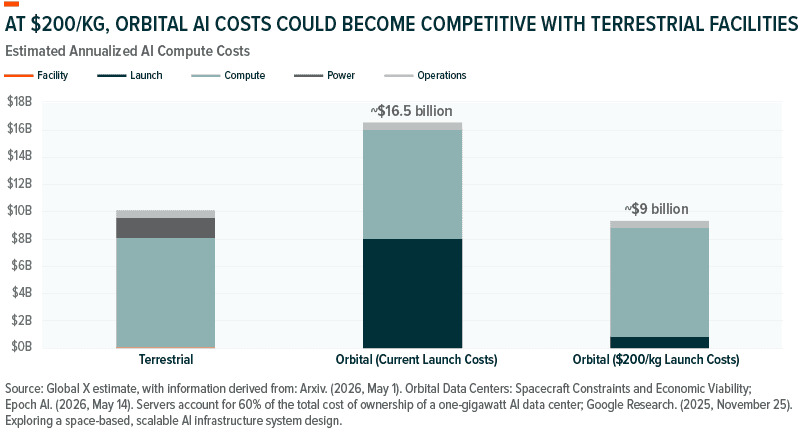
While space offers a meaningful operating cost advantage, the upfront infrastructure costs remain substantial. More specifically, the cost of delivering mass to orbit is the single largest barrier to economic viability. For example, a representative orbital data-center node can require roughly 40 kilograms of hardware for every delivered kilowatt of compute capacity.7 Scaling that to a single gigawatt-class data center could mean lifting roughly 40,000 metric tons to orbit. At today’s prices, that could imply well over $80 billion in launch cost alone.
By comparison, a one-gigawatt terrestrial AI data center may require roughly $40 billion in upfront capital. Spread over the equipment’s useful life, that investment contributes to an annualized cost of roughly $9-10 billion, including operating expenses.8 Assuming the IT equipment costs are similar in space, orbital data centers would have only ~$7 to $10 billion of launch-cost headroom per giga-watt to remain competitive, even after accounting for operating costs that could be roughly 67% lower. That suggests launch costs may need to fall by more than 90% before orbital AI infrastructure becomes economically viable at scale.9
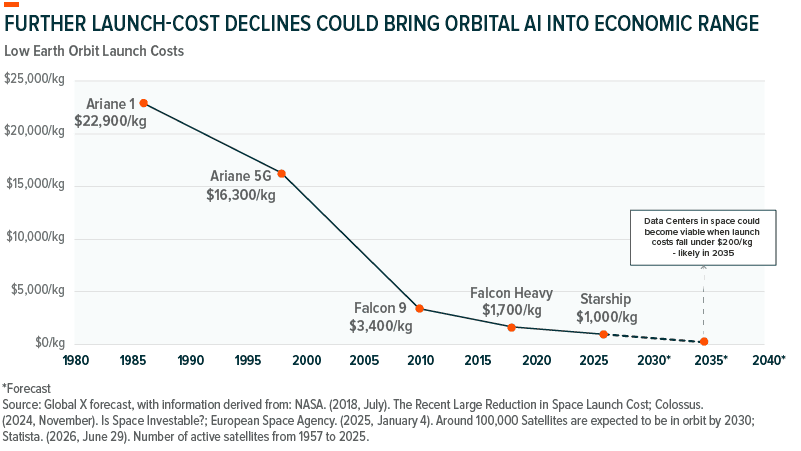
Google estimates the economics could begin to shift at a launch cost of approximately $200 per kilogram.10 At that level, launch costs amortized over a spacecraft's life could become broadly comparable to terrestrial data-center energy costs on a per-kilowatt basis. Reaching that threshold remains a significant challenge but launch costs have already declined by approximately 90% over the past decade to roughly $2,700 per kilogram, with estimates that the $200-per-kilogram threshold could be reached by the mid-2030s.11Further progress will likely depend on fully reusable and higher capacity launch vehicles, combined with a substantial increase in launch cadence.
Launch is not the only cost penalty. Orbital data centers also require hardware that terrestrial facilities do not need at comparable scale. Radiators and solar arrays can account for 65% to 70% of satellite mass, while space-rated photovoltaics remain far more expensive than terrestrial panels and depend on more specialized supply chains, including germanium substrates sourced largely from China.12
Improving Launch Economics Could Accelerate Technical Development
Economic viability is not the only hurdle. Radiation remains a primary engineering challenge, as today’s AI chips were not built for constant exposure to trapped particles, solar protons, and other space-based anomalies.
Google’s radiation testing of AI chips has shown encouraging data, but an orbital data center requires far more than processors alone. Testing, validating, and scaling production of the broader component stack – including memory, networking, power, and other system components – could take years.13
Thermal management and connectivity present additional challenges. Without air or water to carry heat away, orbital facilities must reject waste heat through large radiator arrays, which can rival solar arrays in size and represent a significant portion of spacecraft mass. Orbital data centers would also require network links capable of transmitting tens of terabits per second across satellites flying in close formation to approximate the connectivity of terrestrial facilities. Current systems remain well below these requirements.
Adoption Is Likely to Begin with Space-Native Computing
Gigawatt-scale orbital data centers remain a longer-term prospect, but smaller computing systems could become commercially relevant sooner. The most practical initial use case is processing data already generated in space.
Earth-observation satellites, defense assets, and disaster-monitoring platforms in space already generate substantial data in orbit. Transmitting all that data to Earth for processing is inefficient. Adding AI processing capacity in orbit would allow these systems to analyze data at the source and transmit only the relevant output, reducing bandwidth requirements and response times.
Defense applications could provide an early source of demand and funding. The U.S. Space Development Agency's Proliferated Warfighter Space Architecture already includes in-orbit processing requirements.14 The Department of War’s proposed Golden Dome project could potentially leverage 7,800+ space-based interceptor missiles, adding trillions in funding tailwinds for space infrastructure and creating associated demand for in-orbit processing.15
Today, SpaceX is the most credible infrastructure-scale player positioned to meet this cumulative emerging demand. The company could begin deploying its proposed constellation of up to one million satellites as early as 2028 but scaling that vision will depend heavily on reducing launch costs.16 Starship – SpaceX’s fully reusable heavy-lift platform – is the critical unlock, which could potentially bring launch costs closer to $200 per kilogram in our view, materially improving launch economics.
Private innovation is also advancing. Starcloud deployed the first data-center-class GPU in orbit in November 2025 and plans a laser-equipped follow-on mission in early 2027.17 Google's Project Suncatcher, developed in partnership with Planet Labs, is also targeting a prototype launch in 2027.18
These initial deployments would not compete directly with terrestrial hyperscale data centers. Instead, they could establish an early market for orbital computing, validate the underlying technology, and provide a pathway toward larger systems over time.
Conclusion: Data Centers Extend Space Tech’s Growth Optionality
In our view, the near-term monetization of the space economy will continue to come from where it comes from today: satellite connectivity, broadband, and Earth-observation data services, the profitable backbone of a market on track to grow from roughly $630 billion in 2024 toward $1 trillion by 2034.19
Orbital compute could add a new layer to that foundation, with space-native inference providing the most credible path to early commercialization. Over time, declining launch costs and continued engineering progress could extend that opportunity to larger computing systems. The near-term opportunity is therefore more targeted than the concept of hyperscale data centers in orbit suggests, but it also provides tangible evidence of how computing could expand the addressable market for space infrastructure.
Related ETFs
ORBX - Global X Space Tech ETF
AIQ - Global X Artificial Intelligence & Technology ETF
Click the fund name above to view current performance and holdings. Holdings are subject to change. Current and future holdings are subject to risk.