
U.S. data center power demand is surging, with data centers expected to consume 20% of U.S. electricity by 2035.1 By 2040, total U.S. electricity demand could rise 55% from 2025 levels, driven by the expansion of data centers as well as new factories, transport electrification, and the use of other power-intensive technologies.2,3 Meeting this demand while avoiding growth-constraining bottlenecks will require trillions of dollars in investment across power generation, energy storage, and grid infrastructure.4 In this piece, we highlight five key charts that outline the transformational shift that the U.S. power landscape is currently undergoing, and the potential opportunities that come with it.
Key Takeaways
- U.S. electricity demand is forecast to increase by as much as 55% through 2040, with data centers driving the largest increase in added power use.5,6
- Data center power demand is rising faster than previously projected as project pipelines expand throughout the country. By 2035, data centers could consume 20% of U.S. electricity, up from 5% today.7
- Electric utilities are planning to spend over $1.4 trillion on new power generation capacity and grid infrastructure to meet rising demand across the country, creating new opportunities for companies throughout the U.S. electrification value chain.8
1. U.S. Electricity Consumption Could Rise Up to 55% by 2040
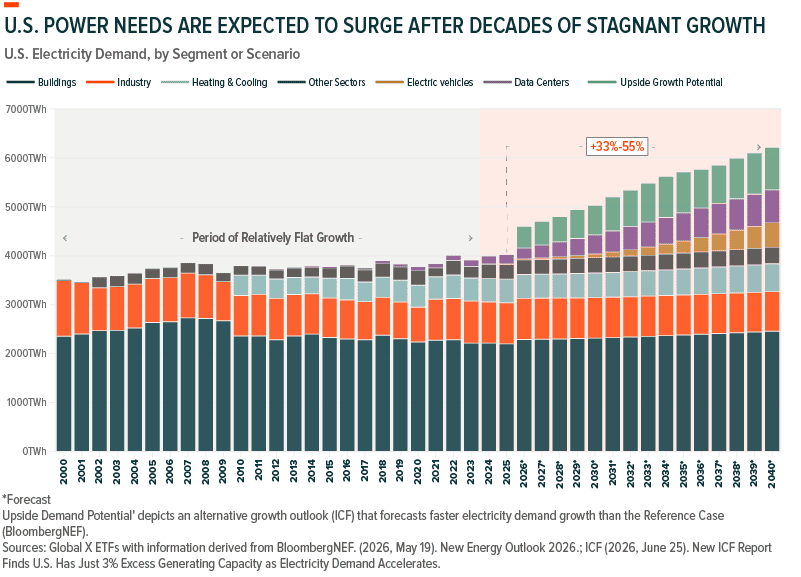
U.S. electricity demand growth has been accelerating since 2024, contrasting the roughly two prior decades of stagnant growth.9 Between 2025 and 2040, the country’s total electricity needs could surge above 6,200TWh, up from 4,024TWh in 2025.10,11 Data centers are anticipated to be the largest growth driver over the next 15 years, and they also account for the largest upside potential to overall forecasts. The segment is currently forecast to account for up to 20% of U.S. electricity demand by the middle of the next decade, which would be nearly 3.5x growth from 2025.12 For context, that is the equivalent to 194GW of data center power needs, up from 47GW last year.13
In total, the projected U.S. power demand growth of up to 2,192TWh through 2040 is roughly equal to double the electricity output of Japan or more than four Frances.14 Put another way, that amount of electricity would cover the addition of about 204 million average U.S. homes.15
2. Data Centers Drive Sharp Upward Revisions to Power Demand Forecasts
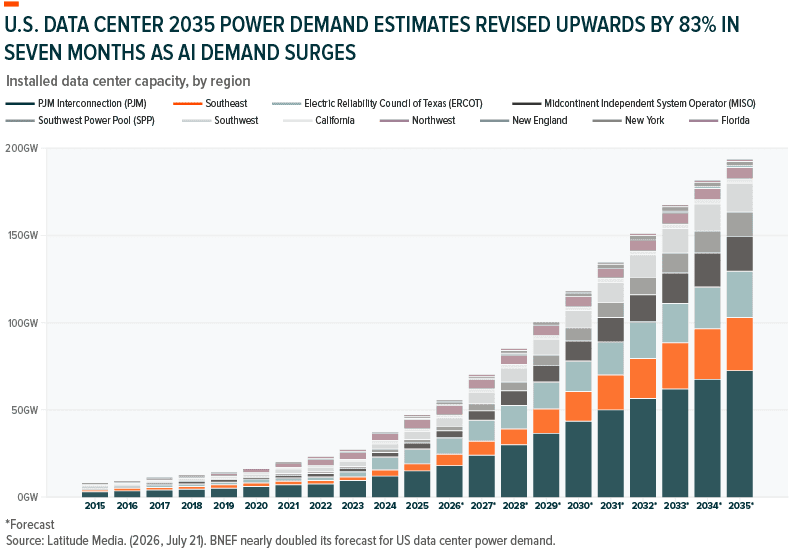
The significant upside potential to U.S. electricity demand growth forecasts is largely the result of the rapidly expanding project pipeline for data centers. Over the past year, data center power demand forecasts have been revised up as AI infrastructure investment has accelerated and the data center development pipeline has expanded. For example, as of July 2026, BloombergNEF forecasts installed U.S. data center capacity to reach 118GW in 2030, which is an upward revision of 52% above their December 2025 forecast. By 2035, data center capacity could reach 194GW, which is 83% higher than last year’s forecast.16 The resulting impact on total electricity use is likely to be significant, with data centers expected to account for 12% of U.S. electricity needs by 2030 and 20% of the country’s electricity by the middle of the next decade – up from 6% currently.17
The Mid-Atlantic, Southeast, and Texas grids are expected to experience the largest leaps in installed data center capacity. For example, the PJM (Pennsylvania-New Jersey-Maryland) including Virginia, the current data center capital of the world, could reach 72.5GW of new data center capacity added through 2035.18 This would amount to a nearly 5x increase in total installed capacity between 2025 and 2035, requiring significant new investment into power infrastructure.19
Through the end of this decade, electricity demand growth from data centers is expected to average 41TWh annually, which would be nearly 3x higher than average annual growth from the segment between 2015 and 2025.20 In total, the rapid expansion of data centers could account for nearly 50% of the base case scenario of ~420TWh in U.S. power demand growth over the next five years.21
3. Utilities Are Increasing Investment in Power Generation and Grid Infrastructure
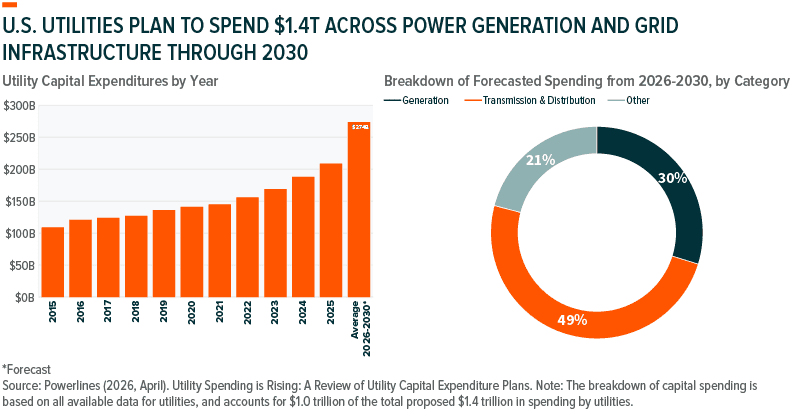
Electric utilities, grid operators, and tech companies are increasingly collaborating to rapidly modernize and expand grid capabilities to meet both near-term and long-term power needs. In total, U.S. utilities are planning to spend at least $1.4 trillion between 2026 and 2030 to expand power generation and transmission and distribution (T&D) infrastructure, up from $870 billion spent in the five years prior.22
Of the $1 trillion that has already been allotted towards specific projects, nearly half is expected to go towards grid infrastructure development. Of the remaining 50% of capital expenditure (capex) spending, nearly 30% is expected to go towards power generation, with the remaining allocated towards other areas such as smart metering.23 Most utilities cite data centers and load growth as the top driver of capex plans, although system resiliency and extreme weather mitigation and aging infrastructure are also key factors in higher planned spending rates.24
4. AI Power Demand Is Running into Grid Equipment Constraints
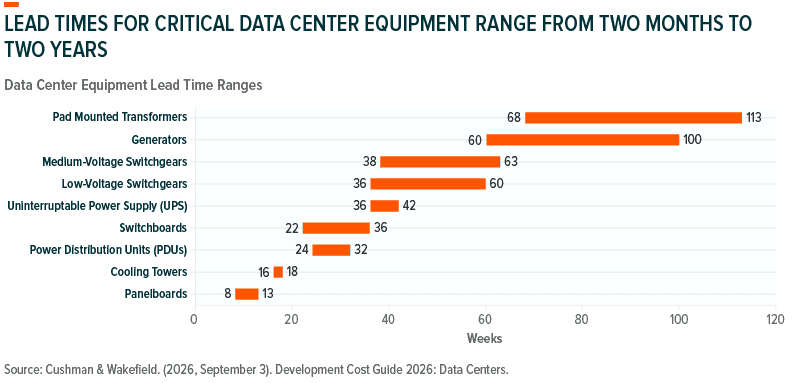
AI data center growth is beginning to test the physical limits of U.S. grid infrastructure. Bringing large new loads online requires transformers, substations, switchgear, circuit breakers, and other T&D equipment, many of which are already facing significant supply constraints. Lead times for some critical grid components such as transformers have now extended to two years or more.25
Data centers are adding directly to these pressures because their infrastructure requirements extend well beyond securing generation capacity. Large campuses require substations and transformers to bring power onto site, as well as medium- and low-voltage switchgear, circuit protection, UPS systems, and busways to distribute electricity safely to increasingly power-dense computing equipment. AI workloads can also create rapid, multi-megawatt swings in electricity demand, placing additional stress on switchgear, backup power systems, and upstream grid connections. The impact is already visible in equipment orders: Eaton reported that its data center orders increased approximately 240% year over year in the first quarter of 2026, while data center revenue increased approximately 50%.26,27
These pressures are colliding with an aging T&D equipment base and long interconnection queues. Roughly 55% of U.S. distribution transformers are more than 33 years old and approaching the end of their expected useful lives.28 In addition, interconnection queues for new power projects have been growing. New power generation facilities can take an average of 5 years to go from initial request to commercial operation.29 This is up from 3.5 years in 2020.30 As electricity demand from data centers and other large loads accelerates, expanding the grid therefore requires not only substantially higher utility investment, but also a corresponding expansion in the manufacturing capacity for the equipment that physically delivers that power.
5. Grid Bottlenecks Could Accelerate Onsite Generation, Including Fuel Cell Adoption
Given the discrepancy between average power generation development timelines and near-term power demands, most U.S. utilities increasingly view onsite power as a long-term solution that can complement how large load customers get served.31 In total, utilities expect onsite power to service roughly one-third of large load electricity demand by 2030, creating a sizeable market for onsite power providers.32
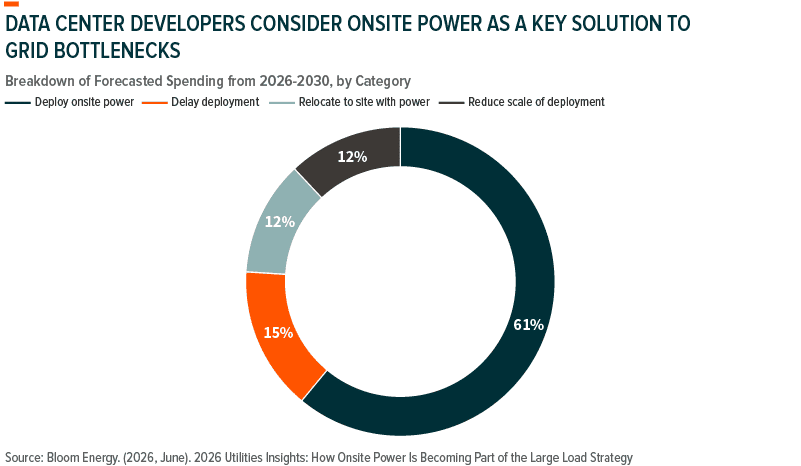
Data center developers are already preparing for this dynamic. A Q2 2026 survey found that 61% of data center developers would turn to onsite power as their primary choice in the event of a power bottleneck, versus relocating, delaying, or resizing.33 Fuel cells are among the technologies that could benefit, as their flexibility and short development timelines have begun to grab the attention of data center developers. Most fuel cell technologies can run on both natural gas and hydrogen, can operate continuously if needed, and can be deployed in a matter of weeks. Bloom Energy and FuelCell Energy are among the fuel cell producers that have signed agreements with hyperscalers to provide onsite power operations over the past several quarters. For example, Bloom Energy signed an agreement with Oracle in April 2026 for up to 2.8GW of fuel cell capacity to power AI infrastructure across the United States.34
Conclusion: Potential Opportunities in the “Grid Rush”
Surging data center power demand will likely be a main driver of power infrastructure investment across the United States over the next 15 years. Through 2030 alone, utilities plan to spend at least $1.4 trillion to meet the rising electricity needs of hyperscalers, as well as the manufacturing and mobility segments.35 At the same time, many data center developers and other large load customers are likely to incorporate onsite power solutions to supplement grid-connected services and boost operational resilience. As investments into the power landscape pick up, we expect significant opportunities to emerge for companies throughout the entire electrification value chain, from traditional utilities and alternative electricity producers, such as fuel cell manufacturers, to grid infrastructure developers.
Related ETFs
ZAP – Global X U.S. Electrification ETF
Click the fund name above to view current performance and holdings. Holdings are subject to change. Current and future holdings are subject to risk.