Space Tech
Space Race Heats Up Among Heavyweights
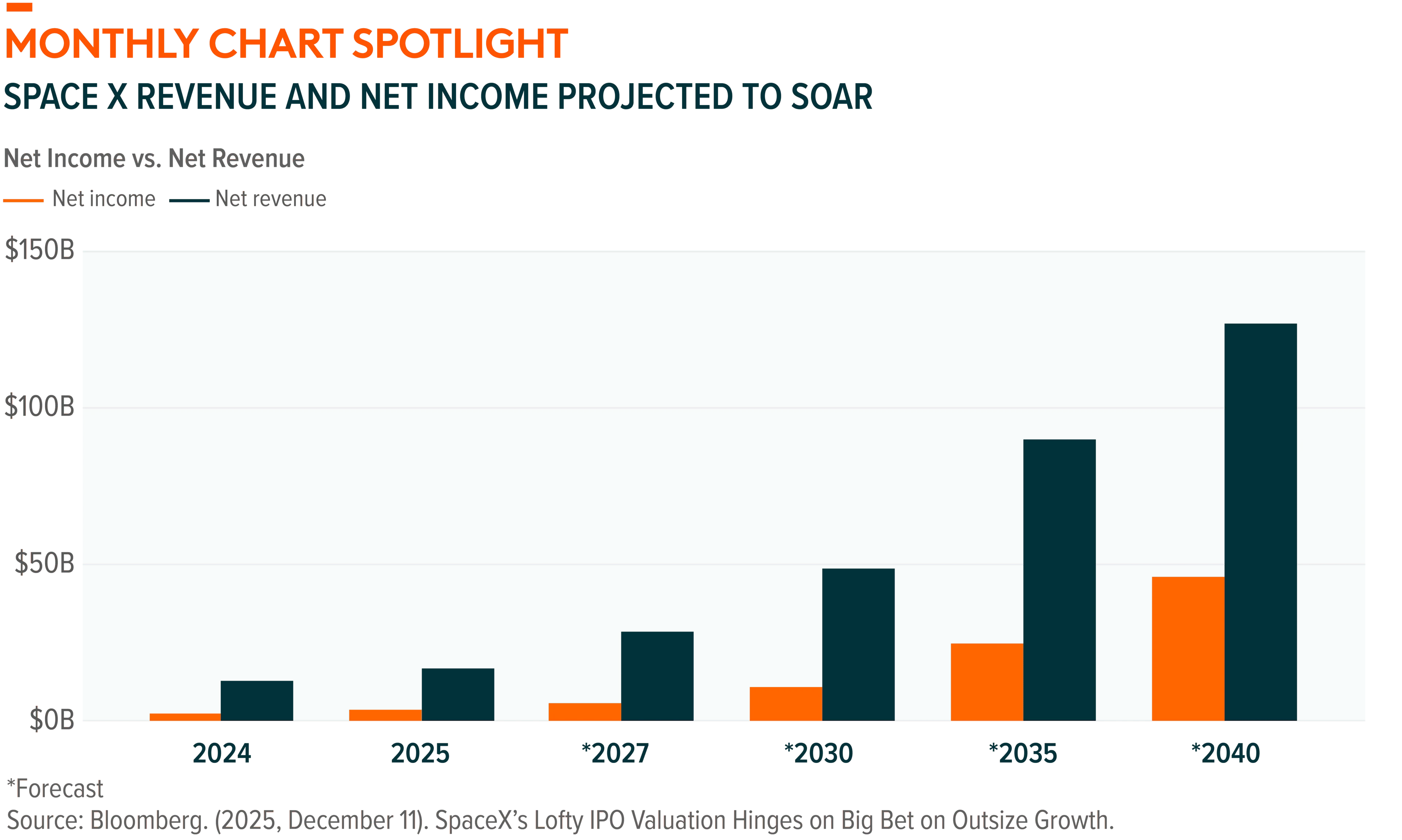
SpaceX’s watershed IPO highlighted how rapidly space has evolved from a niche market into a strategically important sector. While SpaceX is best known for its leadership in reusable rockets, its Starlink business is a major growth engine generating billions in recurring revenue and demonstrating the commercial viability of satellite connectivity at scale.1 Elsewhere, Rocket Lab agreed to acquire satellite communications provider Iridium for $8 billion, which will transform it from a launch company into a vertically integrated space business with launch capabilities, spacecraft manufacturing, and a global communications network. The deal gives Rocket Lab access to Iridium’s L-band satellite network, licensed spectrum, government contracts, and millions of subscribers.2 Amazon has deployed enough Amazon Leo satellites to begin commercial low-Earth orbit (LEO) broadband service later this year, marking its biggest milestone yet in challenging Starlink. Service will be limited initially and then expand as Amazon launches more satellites.3

Data Centers
China Readies Robust Nationwide AI Data Center Buildout
China plans to invest approximately $295 billion on AI data center projects over the next five years in one of the largest AI infrastructure initiatives globally to date. While the investment is modest compared to the roughly $725 billion that U.S. hyperscalers such as Meta, Microsoft, Amazon, and Alphabet are collectively earmarking for AI in 2026 alone, the raw numbers don’t tell the whole story. Chinese data centers generally cost less to build due to cheaper labor, less expensive components, and local government incentives. As a result, the capacity per dollar China could bring online is likely to be higher than the headline comparison implies.4 The big takeaway is that the U.S. and China are building two distinct AI ecosystems, a separation that is likely to become more visible over time, potentially adding competitive tailwinds to the broader AI story.
U.S. Infrastructure
Manufacturing Momentum Reinforces the Infrastructure Investment Cycle
U.S. manufacturing expanded for the sixth consecutive month in June, with the Institute for Supply Management's Manufacturing PMI (Purchasing Managers' Index) registering a 53.3 reading, where a reading about 50 indicates expansion. The performance signals continued growth, despite moderating slightly from 54.0 in May. New orders remained firmly in expansion territory at 56.0 while production continued to grow and customer inventories stayed historically low, which suggests manufacturers will need to sustain output in the months ahead. Although employment remained just below expansion levels, hiring improved and price pressures eased from May as energy costs moderated. Survey respondents highlighted continued strength in sectors tied to defense, semiconductors, and industrial equipment, even as geopolitical uncertainty and tariffs weighed on sentiment.5 For the U.S infrastructure theme, the June report reinforces the resilience of America's industrial base and supports the broader trend of domestic manufacturing, reshoring, and capital investment. Sustained factory activity should continue driving demand for industrial facilities, power infrastructure, transportation networks, and supply chain modernization as the U.S. expands manufacturing capacity to support long-term growth in advanced industries.
U.S. Electrification
Federal Support Strengthens Nuclear Power Supply Chain
The U.S. Department of Energy (DOE) announced a conditional $17.5 billion loan commitment through its Office of Energy Dominance Financing to bolster the domestic nuclear supply chain and its role in powering the U.S. The initiative aims to accelerate the construction of 10 new Westinghouse AP1000 nuclear reactors across up to five project sites. Rather than funding reactor construction directly, the loans will finance the procurement of long-lead components that often create costly delays, including reactor pressure vessels, steam generators, and coolant pumps. By enabling bulk purchasing and early manufacturing, the DOE expects to shorten construction timelines by up to three years, lower project costs, and rebuild the country’s manufacturing capacity for critical nuclear equipment. Each project requires $1 billion in upfront private equity before federal funds are drawn, aligning public and private incentives. The initiative supports the administration's goal of having 10 new large-scale reactors under construction by 2030, adding approximately 11 gigawatts of reliable baseload power. The expansion strengthens energy security and helps meet rising electricity demand from industrial growth and AI-driven data centers.6
Health Tech
Anthropic Makes Its Biggest Push Yet Into Life Sciences
Anthropic launched Claude Science, a specialized AI platform designed to help researchers streamline drug discovery, analyze biological data, and accelerate scientific workflows. Going a step further than many AI vendors, the company also announced an internal drug discovery program focused on developing treatments for neglected diseases, giving it firsthand experience as both a technology provider and drug developer. The move reflects a broader shift in healthcare AI, where vendors are building domain-specific tools with features tailored for protein analysis, literature review, and computational biology, rather than using general-purpose models. To address concerns around data privacy and scientific reproducibility, Anthropic emphasizes auditability and secure deployment on researchers' own infrastructure. As AI capabilities advance, these tools are helping researchers identify promising drug candidates faster, generate new scientific insights, and make earlier stages of drug development more efficient.7 While clinical testing and regulatory review remain essential, AI has become a core enabler of innovation across the biopharma R&D pipeline.
Climate Tech
Solar Continued to Anchor America’s Clean Energy Buildout
The Energy Information Administration (EIA) expects U.S. utility-scale solar generation to increase 19% this summer compared to last year, driven by a 20% increase in installed solar capacity. This growth comes as the country braces for hotter-than-normal summer temperatures, with cooling demand projected to rise 3% year-over-year. Rather than relying on fossil fuels, the EIA expects nearly all incremental electricity demand to be met by renewable energy, underscoring solar’s expanding role as the backbone of new U.S. power generation. The EIA forecasts a 10% rise in wind generation and modest increases in hydro and nuclear output. Meanwhile, coal generation is expected to continue to decline, reflecting lower natural gas prices and the structural shift toward clean sources of electricity. This outlook reinforces that renewable energy is turning into one of the lowest-cost and fastest-to-deploy solutions for meeting rising electricity demand driven by economic growth, electrification, and AI-powered data centers.8
KEEP UP WITH THE LATEST THEMATIC RESEARCH FROM GLOBAL X
To learn more about the disruptive themes changing our world, read the latest research from Global X, including:
THEMATIC ETF LINEUP
To see individual ETF holdings and current performance across the Global X Thematic Suite, including information on the indexes shown, click these links: