


U.S. Electrification
White House Invokes the Defense Production Act to Boost Domestic Energy and Power Production
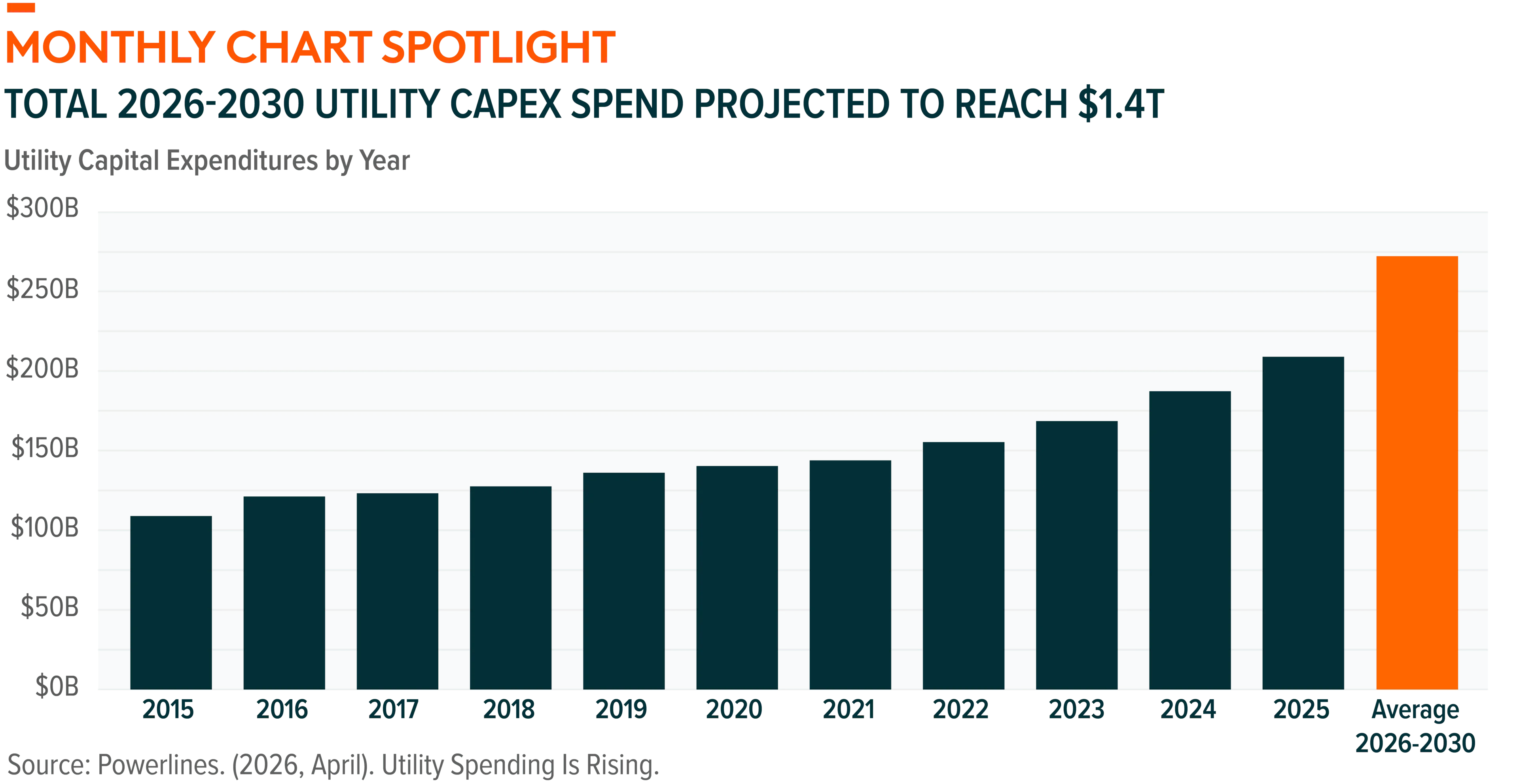
The Trump administration issued several determinations under the Defense Product Act (DPA) to accelerate U.S. energy supply growth and lower prices. The determinations target 1) grid infrastructure and its upstream supply chains, including transmission lines, substations, raw materials, power control electronics, and transformers; 2) large-scale energy systems and infrastructure development and deployment, including permitting and site acquisition; and 3) coal, natural gas, and petroleum production. The DPA provides broad, though temporary, authority to support capacity buildout across these categories, including through grants, loans, equity investments, and offtake agreements. The White House intends to expedite the deployment of funds allocated to the Department of Energy in the One Big Beautiful Bill Act.1 Its use of the DPA supports our view that U.S. power demand growth is accelerating rapidly and that energy security concerns could prompt the federal government to introduce policies to support grid expansion. We believe the DPA could prove particularly useful if it leads to permitting reform or boosts grid component manufacturing investments.

Cybersecurity
Anthropic Initiative Illustrates Cybersecurity’s Emergence as AI’s Enforcement Layer
Anthropic’s new Project Glasswing convenes major technology and security players like CrowdStrike and Palo Alto Networks to deploy advanced AI models in a controlled, defensive setting to identify vulnerabilities at scale. One such model, Claude Mythos Preview, has already uncovered thousands of high-severity flaws across major operating systems and web browsers, underscoring both the power of AI and the urgency to secure it.2 As the gap between vulnerability discovery and exploitation narrows, systemic risk is rising across enterprises and critical infrastructure. Greater complexity, faster development cycles, and more sophisticated threats are likely to increase demand for integrated, real-time security solutions, supporting the sector’s durable growth outlook. In this environment, cybersecurity is emerging as the enforcement layer of AI, rather than a function at risk of disruption.
U.S. Infrastructure
Construction Rebounded in March, Reinforcing Infrastructure’s Momentum
In March, total construction starts rose roughly 13% month-over-month to a $1.22 trillion annualized rate, reversing February’s decline. Nonbuilding infrastructure propelled the rebound, driven by a 38% surge in power and utility megaprojects alongside a sharp increase in manufacturing construction. While residential activity remained mixed and certain commercial segments have faced short-term pullbacks, the broader trend points to continued expansion in industrial, energy, and infrastructure-related spending. Importantly, on a 12-month basis, total construction starts were up approximately 5%, with nonbuilding and nonresidential categories leading growth.3 Overall, the data underscores a likely multi-year buildout cycle driven by large-scale infrastructure, energy transition, and reshoring trends, suggesting durable tailwinds despite near-term volatility.
Hydrogen
The EU Accelerates Its Investments in Hydrogen
The European Commission announced a €600 million funding call for cross-border hydrogen and energy infrastructure. Launched under the Connecting Europe Facility (CEF), the program targets projects spanning hydrogen pipelines, electrolyzers, storage, and broader energy networks. By prioritizing projects of common interest across multiple countries, the initiative aims to improve energy interconnectivity, scale production and distribution capacity, and reduce reliance on fossil fuels. The funding is part of a broader pipeline of over 200 cross-border energy projects, including roughly 100 hydrogen-related initiatives.4 While still early in commercialization, this coordinated push suggests hydrogen is transitioning from concept to deployment, supported by policy, capital, and industrial alignment—key ingredients for sustained growth across the hydrogen ecosystem.
AI Semiconductors
Big Tech Reaffirms CapEx Plans, Boosting the Semiconductor Ecosystem
Rising capital expenditures from major hyperscalers, as confirmed in Q1 2026 earnings reports, are a significant tailwind for the AI semiconductor value chain. Combined capex from the four major U.S. hyperscalers could now surpass $700 billion in 2026, representing roughly 70% year-over-year growth.5 This investment surge positions these companies to scale AI infrastructure and increase diversification across chip architectures and suppliers. For example, Meta is aggressively scaling its AI infrastructure through a multi-pronged chip strategy, including a multibillion-dollar deal with Amazon Web Services. The partnership aims to deploy tens of millions of Graviton CPU cores—equivalent to hundreds of thousands of chips—to power agentic AI workloads.6 Meta is also deepening its partnership with Broadcom to co-develop multiple generations of custom Meta Training and Inference Accelerators (MTIA), securing long-term access to specialized silicon optimized for training and inference at scale.7 Together, these developments highlight a move toward vertically integrated, diversified compute strategies. This shift reinforces the growing complexity and capital intensity of AI infrastructure, while also supporting sustained demand across the semiconductor ecosystem.
E-Commerce
Amazon Taps a New Growth Opportunity for Its Commerce Engine
Amazon is opening its end-to-end logistics network to third-party businesses, signaling a broader push into the global supply chain market. The new offering, Amazon Supply Chain Services, allows companies to access Amazon infrastructure, including freight, warehousing, fulfillment, and last-mile delivery, regardless of whether they sell on Amazon. Early adopters such as Procter & Gamble and 3M highlight the growing demand for integrated, technology-enabled logistics solutions. The initiative reflects Amazon’s strategy of monetizing internal capabilities, similar to the evolution of Amazon Web Services, while positioning the company as a direct competitor to traditional logistics providers. By increasing network utilization, Amazon can lower per-unit fulfillment costs, improve delivery speeds, and enhance reliability, all key drivers of its Prime value proposition.8 As supply chains grow more complex, this expansion reflects a broader shift toward logistics as a scalable, technology-driven service layer, with Amazon leveraging its infrastructure to create a new revenue stream and deepen its global commerce leadership.
KEEP UP WITH THE LATEST THEMATIC RESEARCH FROM GLOBAL X
To learn more about the disruptive themes changing our world, read the latest research from Global X, including:
THEMATIC ETF LINEUP
To see individual ETF holdings and current performance across the Global X Thematic Suite, including information on the indexes shown, click these links: