


Product ResearchData CentersArtificial Intelligence
Investing in AI: Why Data Centers? Why DTCR?
T
Tejas Dessai
Aug 19, 20257 min read
Get the latest news and updates from our team.
Copyright © 2026 Global X. All rights reserved.
SEI Investments Distribution Co. (1 Freedom Valley Drive, Oaks, PA, 19456) is the distributor for the Global X Funds.
Check the background of SIDCO and Global X's Registered Representatives on FINRA's BrokerCheck.

Ido Caspi
Tejas Dessai

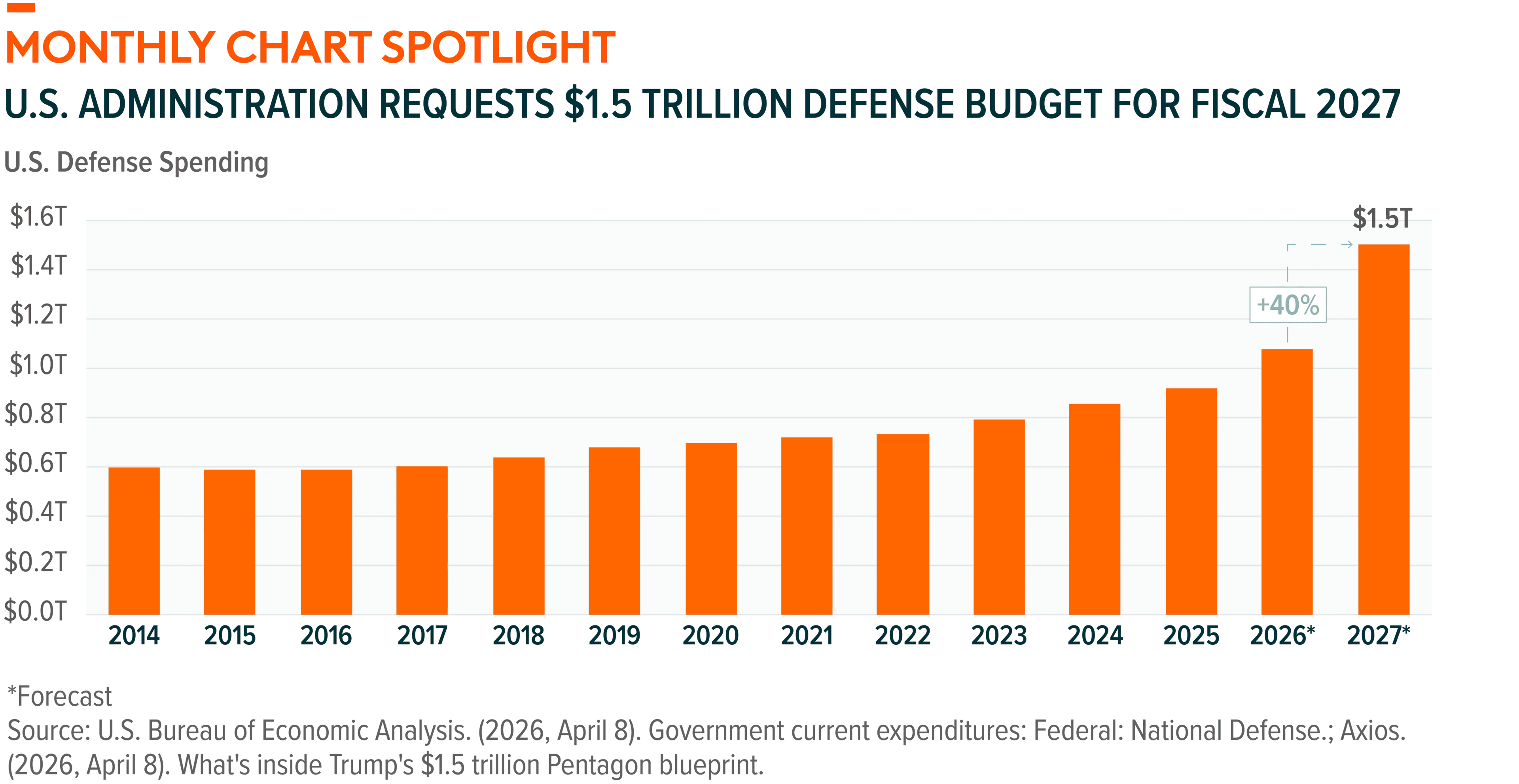
White House Proposes the Largest Defense Budget Request in Modern History
The Trump administration’s $1.5 trillion defense budget proposal for fiscal year 2027 signals accelerating momentum behind next-generation defense technologies and industrial capacity expansion. Representing a more than 40% year-over-year increase in military spending, the proposal prioritizes weapons procurement, shipbuilding, missile defense systems, and broader modernization efforts to support a shift toward sustained, high-intensity preparedness. A key focus is rebuilding munitions stockpiles, scaling production capabilities, and investing in advanced systems such as integrated missile defense and naval expansion, all while reinforcing the domestic defense industrial base through supply chain resilience.1 Collectively, these priorities point to a new phase of defense investment that underscores the strategic importance of both established contractors and a growing ecosystem of defense tech innovators.

Broadcom Seals Expanded Chip Deals with Tech Leaders, Anthropic Tops $30 Billion Run Rate
Broadcom announced expanded chip and infrastructure agreements with Google and Anthropic, further solidifying its central role in the AI ecosystem as computing needs evolve from training to inference. The company will continue developing custom Tensor Processing Units (TPUs) for Google under a long-term deal, while also supplying networking components for AI data centers. Broadcom is also deepening its relationship with Anthropic, which will gain access to roughly 3.5 gigawatts of TPU compute capacity, a scale that reflects the massive energy and hardware demands of next-generation AI models. Anthropic’s rapid growth is a key driver of those demands, with the company recently reporting a revenue run rate exceeding $30 billion, fueled by strong enterprise adoption of its Claude models.2 Together, these strategic investments and revenue achievements signal continued momentum across the AI ecosystem, supporting innovation, improving performance, and enabling more advanced applications to reach users at scale.
AI Buildout Expands Globally
Alibaba and China Telecom are launching a data center in southern China powered by Alibaba’s Zhenwu chips, advancing the nation’s homegrown AI infrastructure efforts. The facility will initially deploy around 10,000 chips, with plans to scale to as many as 100,000 to help meet the intensive compute demands of modern AI workloads. Designed for both training and inference, these chips already power Alibaba’s cloud platform and external data centers to support enterprise customers and its own AI models. The project reflects a broader push toward vertical integration that combines chips, cloud, and software, while reducing reliance on foreign suppliers. More broadly, it demonstrates how AI-driven data center expansion is accelerating globally.3 As regions invest in localized infrastructure and semiconductor capabilities, the global AI ecosystem is becoming more distributed, resilient, and better equipped to meet surging demand.
Nonresidential Construction Activity Accelerates to Start 2026
Nonresidential construction starts totaled $80.3 billion in January, a 53% year-over-year increase and one of the highest monthly totals on record. Megaprojects, defined as projects exceeding $1 billion, accounted for $26.3 billion of the total and continue to play an outsized role in shaping activity. Nonresidential building starts also more than doubled year-over-year, fueled by major investments in healthcare facilities and office projects, particularly data centers. While starts in select civil categories like airports and bridges declined, gains in power, water, and other infrastructure segments helped offset that weakness.4 Collectively, this early 2026 data highlights strong momentum in U.S. infrastructure, with large, capital-intensive projects and AI-related developments driving a new phase of construction growth.
Space Tech Theme Supercharged by Potential SpaceX Initial Public Offering and Public Sector Investment
After merging with xAI, SpaceX is reportedly targeting a valuation of up to $2 trillion for its upcoming IPO, setting up what could be a landmark moment for the commercial space industry. A public listing of that size would highlight the powerful forces reshaping the sector, including declining launch costs, rising launch frequency, and growing demand for satellite-based connectivity.5 Further strengthening the sector, the White House’s fiscal year 2027 budget proposal includes a significant funding increase for the U.S. Space Force, with the administration reportedly requesting roughly $71 billion for missile defense, launch infrastructure, and other space capabilities.6 This commitment adds a layer of durability to the Space Tech theme, as it provides the capital to scale infrastructure that underpins commercial launch, satellite deployment, and orbital data networks.
Humanoid Robots Move into the Physical and Consumer Economy
Amazon acquired humanoid robotics startup Fauna Robotics, signaling a push beyond warehouse automation into consumer-facing robots designed for everyday environments. Fauna Robotics’ “Sprout” bipedal robot, which is 3.5-feet tall and costs $50,000, is built for social interaction and light tasks in homes, schools, and offices, reflecting a broader industry shift toward more approachable, AI-powered humanoids. Disney and Hyundai’s Boston Dynamics are among its early customers.7 Google DeepMind is partnering with Agile Robotics to integrate its Gemini AI models into real-world robotic systems, aiming to create more adaptable, reasoning machines for industrial use.8 Together, these developments highlight an emerging trend among tech giants: the strategic expansion of AI into the physical world, moving the technology from software into robotics as the next major frontier.
To learn more about the disruptive themes changing our world, read the latest research from Global X, including:
To see individual ETF holdings and current performance across the Global X Thematic Suite, including information on the indexes shown, click these links:
Disruptive Technology: Artificial Intelligence & Technology ETF (AIQ), Blockchain ETF (BKCH), Robotics & Artificial Intelligence ETF (BOTZ), Cybersecurity ETF (BUG), AI Semiconductor & Quantum ETF (CHPX), Cloud Computing ETF (CLOU), Autonomous & Electric Vehicles ETF (DRIV), Data Center & Digital Infrastructure ETF (DTCR), FinTech ETF (FINX), Video Games & Esports ETF (HERO), Space Tech ETF (ORBX), Defense Tech ETF (SHLD), Internet of Things ETF (SNSR), Social Media ETF (SOCL)
Consumer Economy: Millennial Consumer ETF (MILN), E-Commerce ETF (EBIZ), Genomics & Biotechnology ETF (GNOM), Aging Population ETF (AGNG), HealthTech ETF (HEAL)
Infrastructure & Environment: U.S. Infrastructure Development ETF (PAVE), ClimateTech ETF (CTEC), Renewable Energy Producers ETF (RNRG), Clean Water ETF (AQWA), Hydrogen ETF (HYDR), AgTech & Food Innovation ETF (KROP), Infrastructure Development ex-U.S. ETF (IPAV), U.S. Electrification ETF (ZAP)
Digital Assets: Blockchain & Bitcoin Strategy ETF (BITS), Bitcoin Trend Strategy ETF (BTRN)
WSJ. (2026, April 4). Trump Seeks $1.5 Trillion for Military, the Largest Request in Modern History.
Bloomberg. (2026, April 7). Anthropic Tops $30 Billion Run Rate, Seals Broadcom Deal.
CNBC. (2026, April 8). Alibaba launches data center with 10,000 of its own chips as China ramps up AI push.
Constructconnect. (2026, February 24). January 2026 Nonresidential Construction Starts Surge to $80.3 Billion.
Reuters. (2026, April 11). SpaceX files for IPO, sources say, offering investors stake in Musk's space ambitions.
Space News. (2026, April 4). Space Force budget would more than double in Trump’s $1.5 trillion defense plan.
CNBC. (2026, March 24). Amazon acquires ‘approachable’ humanoid maker Fauna Robotics.
CNBC. (2026, March 24). Google partners with Agile Robots, growing its AI robotics footprint.
The data center industry is poised to accelerate, as AI monetization scales and the demand for AI computing infrastructure grows.
The data center industry is poised to accelerate, as AI monetization scales and the demand for AI computing infrastructure grows.
As defense budgets shift toward AI, automation, and cybersecurity, contractors across the defense supply chain could benefit. Charting Disruption.
As defense budgets shift toward AI, automation, and cybersecurity, contractors across the defense supply chain could benefit. Charting Disruption.
Multi-Theme: Dorsey Wright Thematic ETF (GXDW)