

Data Centers & Digital Infrastructure
AI Boom Drives Another Round of Massive Investments in Hyperscale Data Centers
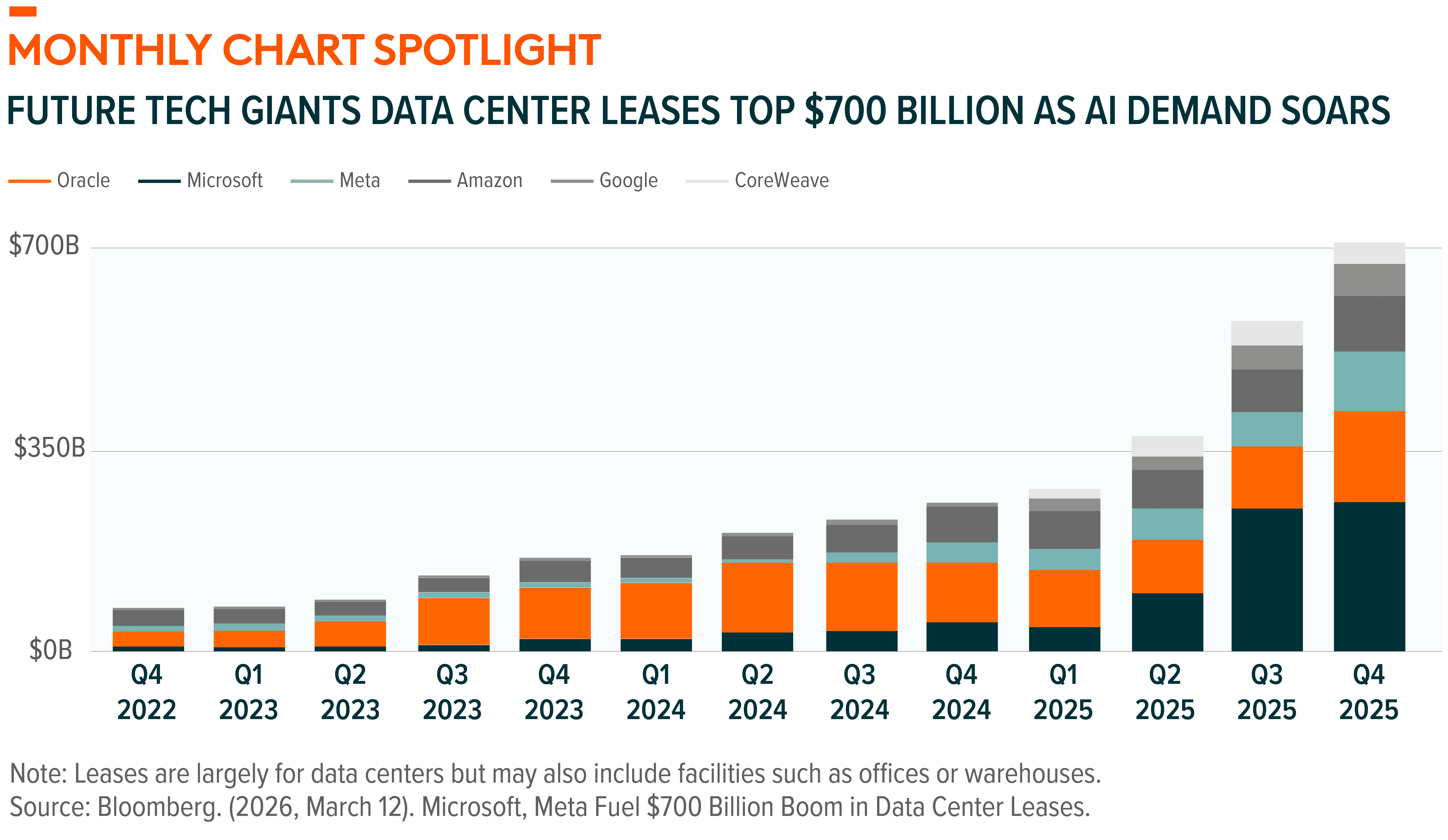
Meta announced plans to build a new 1-gigawatt data center campus in Indiana, one of its largest infrastructure projects to date. The facility is designed to support the company’s growing AI workloads and core digital platforms while creating thousands of construction jobs and hundreds of long-term operational roles.1 Nvidia announced a $2 billion investment in AI cloud company Nebius, which plans to develop large-scale AI data center capacity to support demand for training and inference workloads. Nebius aims to deploy substantial computing infrastructure over the coming years as specialized AI cloud services continue to scale.2 Investments like these highlight the vast physical infrastructure required to power AI’s future growth, driving hyperscalers and specialized cloud providers to allocate significant capital to data centers, advanced networking, and power infrastructure to support the next generation of AI computing.

Defense Tech
Pentagon Accelerates $152 Billion Defense Spending Push
The U.S. Department of Defense plans to obligate the full $152 billion in reconciliation funding in fiscal year (FY) 2026, a significant increase from the previously expected $113 billion. This move accelerates defense procurement and pushes total U.S. defense spending toward $1 trillion years ahead of prior Congressional Budget Office estimates. Rather than phasing funds over multiple years, the Pentagon will deploy the capital in FY2026 to create a near-term industrial ramp-up across munitions production, missile defense, air systems, nuclear modernization, and shipbuilding. Major allocations include roughly $25 billion for conventional munitions and supply chain expansion, $24 billion for the Golden Dome missile defense initiative, $20 billion for air superiority programs, $11 billion for nuclear modernization, and $29 billion for shipbuilding and maritime capabilities.3 Advancing the reconciliation package early provides fiscal clarity and compresses what could have been multi-year spending into a concentrated surge, improving visibility into contracts, production, and backlogs throughout the defense industrial base. Overall, the plan reinforces structural themes of modernization, advanced manufacturing capacity, and next-generation military technology development across the defense ecosystem.
HealthTech
Hims & Hers and Novo Nordisk Realignment Fuels GLP-1 Telehealth Expansion
Hims & Hers announced a strategic shift in its U.S. weight-loss business to expand access to GLP-1 therapies while strengthening its role as a scalable digital health platform. Hims & Hers plans to broaden its offering by incorporating Food and Drug Administration-approved weight-loss medications such as Wegovy and Ozempic through its telehealth ecosystem, which includes virtual consultations, personalized treatment plans, and home delivery through its pharmacy network. This shift also resolves the company’s recent dispute with Novo Nordisk over distribution, allowing Hims & Hers to move forward with a clearer partnership framework while continuing to expand its weight-loss category.4 Demand for GLP-1 therapies remains strong, and integrating them into a digital subscription model positions the company to improve patient access and long-term adherence while capturing growth in one of the fastest-growing segments of healthcare.
U.S. Electrification
AI Infrastructure Surge Is Reshaping Power Systems and Grid Planning
The Electric Power Research Institute’s (EPRI) annual report shows that rapid growth in AI and cloud infrastructure is driving a sharp increase in electricity demand from data centers. Data centers currently account for 4–5% of U.S. electricity consumption, but that share could rise to 9–17% by 2030 as AI workloads expand and new facilities come online. AI applications alone already represent 15–25% of data center power usage, and their energy intensity is rising as models grow larger and inference deployments scale globally. Total U.S. data center electricity demand could increase from 177–192 terawatt-hours (TWh) to 380–790 TWh by 2030. This growth is expected to concentrate in regions with major data center clusters, increasing pressure on local generation capacity and transmission infrastructure. Meeting this demand will likely require accelerated investment in power generation, grid modernization, and transmission expansion, along with closer coordination between utilities, policymakers, and technology companies to maintain reliability.5
AI Semiconductors
Big Tech Designs Custom Chips to Support Next Wave of AI Growth
Meta unveiled four new custom AI chips—the MTIA 300, 400, and 500 series processors—designed to power its recommendation systems and future generative AI models across its platforms. The chips are expected to be manufactured by Taiwan Semiconductor Manufacturing Company, with support from Broadcom, and deployed within Meta’s growing network of AI data centers.6 The move reflects a broader shift across the technology industry as companies aim to reduce reliance on off-the-shelf hardware while optimizing chips for specific AI workloads, such as recommendation engines, generative models, and large-scale inference. As AI models grow larger and become more computationally intensive, custom silicon can help improve efficiency, reduce latency, and lower operating costs across hyperscale infrastructure. Addressing this demand for specialized semiconductors positions those companies designing and manufacturing advanced chips and chipmaking equipment to benefit from the continued buildout of AI infrastructure.
Autonomous & Electric Vehicles
Waymo’s Capital Raise Accelerates Global Robotaxi Expansion
Autonomous mobility reached another major milestone as Alphabet’s self-driving unit Waymo raised $16 billion in new funding, valuing the company at approximately $126 billion. Backed by one of the largest capital raises in autonomous vehicle history, Waymo plans to scale its driverless ride-hailing services and expand its robotaxi fleets globally with launches in 20 more cities in 2026, headlined by London and Tokyo. The company already operates commercial autonomous ride services in multiple U.S. markets and has logged hundreds of millions of miles of autonomous driving data, positioning it as one of the leaders in the rapidly developing robotaxi industry.7 An investment of this size reflects growing confidence in the path toward large-scale commercial deployment and the potential to reshape urban transportation and mobility services.
KEEP UP WITH THE LATEST RESEARCH FROM GLOBAL X
To learn more about the disruptive themes changing our world, read the latest research from Global X, including:
- Balancing Growth with Staying Power; The HALO Trade
- Defense Tech: Inventory Burn Becomes a Catalyst
- Iranian Revelation: Strategic Tops Tactical
- Software Volatility: Separating Noise from Signal
- Inflection Points: Earning Proof Points
THEMATIC ETF LINEUP
To see individual ETF holdings and current performance across the Global X Thematic Suite, including information on the indexes shown, click these links:
- Disruptive Technology: Artificial Intelligence & Technology ETF (AIQ), Blockchain ETF (BKCH), Robotics & Artificial Intelligence ETF (BOTZ), Cybersecurity ETF (BUG), AI Semiconductor & Quantum ETF (CHPX), Cloud Computing ETF (CLOU), Autonomous & Electric Vehicles ETF (DRIV), Data Center & Digital Infrastructure ETF (DTCR), FinTech ETF (FINX), Video Games & Esports ETF (HERO), Defense Tech ETF (SHLD), Internet of Things ETF (SNSR), Social Media ETF (SOCL)
- Consumer Economy: Millennial Consumer ETF (MILN), E-Commerce ETF (EBIZ), Genomics & Biotechnology ETF (GNOM), Aging Population ETF (AGNG), HealthTech ETF (HEAL)
- Infrastructure & Environment: U.S. Infrastructure Development ETF (PAVE), CleanTech ETF (CTEC), Renewable Energy Producers ETF (RNRG), Clean Water ETF (AQWA), Hydrogen ETF (HYDR), AgTech & Food Innovation ETF (KROP), Infrastructure Development ex-U.S. ETF (IPAV), U.S. Electrification ETF (ZAP)
- Digital Assets: Blockchain & Bitcoin Strategy ETF (BITS), Bitcoin Trend Strategy ETF (BTRN)
- Multi-Theme: Dorsey Wright Thematic ETF (GXDW)