

U.S. Electrification
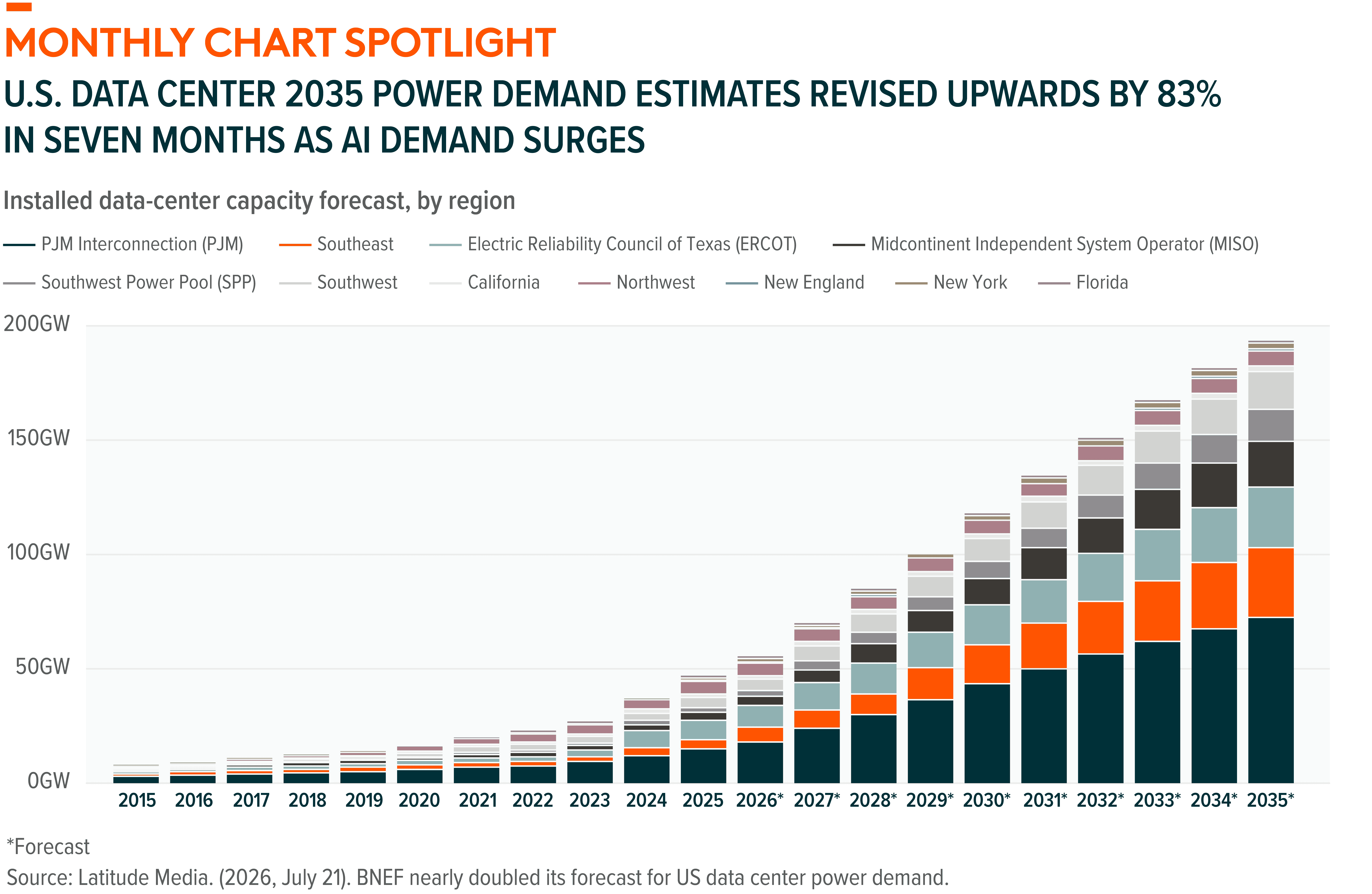
Data Center Energy Intensity Continues to Rise
Recent industry estimates suggest U.S. data center power demand is rising far faster than previously expected, with capacity projected to reach 194 gigawatts (GW) by 2035, nearly double forecasts from just seven months ago. Data centers are expected to consume 20% of U.S. electricity by 2035, up from roughly 6% today, with nearly half of that demand driven by AI training and inference workloads. Forecasts like these reaffirm that power availability is one of the biggest bottlenecks to scaling AI infrastructure, as grid interconnection delays, transformer shortages, and permitting challenges threaten to slow new data center deployments. Even under an optimistic grid expansion scenario, the U.S. could face a 19 GW power shortfall by 2035, underscoring the critical need for investment in electricity generation, transmission, grid modernization, and power equipment to support the next wave of AI-driven growth.1 If AI adoption continues apace, data centers could account for 1,935 terawatt-hours of new electricity demand globally by 2035, roughly equivalent to India’s total annual consumption.2

AI Semiconductors
Investments Pour Into Memory Production
Nvidia entered a multi-year strategic partnership with SK Group that could be worth $500 billion. The deal secures long-term supplies of next-generation high-bandwidth memory (HBM) from SK Hynix and includes the joint development of advanced AI memory technologies, expanded HBM production, and the construction of AI factories targeted to begin operations in 2027.3 Separately, Samsung Electronics and Broadcom announced an estimated $200 billion collaboration on memory and foundry technologies to support the next generation of AI infrastructure.4 These announcements underscore how HBM has become one of the most critical components in the AI semiconductor supply chain, with demand extending beyond GPUs to the memory required to feed them. As AI models grow larger and more compute-intensive, securing a reliable HBM supply is emerging as a key competitive advantage that can drive sustained investment across the AI semiconductor ecosystem.
Defense Tech
Sea Drones Enter Modern Naval Warfare as Drone Tech Adoption Intensifies
The U.S. military deployed sea drones in combat for the first time, using three Saronic Corsair one-way unmanned surface vessels to strike a submarine and ship maintenance facility near the Strait of Hormuz. This milestone operation demonstrated that commercially developed, low-cost maritime drones can execute high-value naval missions while minimizing risk to personnel. Notably, the military used the same Corsair platform in the rescue of downed U.S. pilots, highlighting how these systems can rapidly transition from support roles to frontline combat.5 Elsewhere, the military awarded AeroVironment a three-year, $500 million contract to provide counter-drone capabilities. The award expands AeroVironment’s role beyond its well-known Switchblade loitering munitions. Leveraging its broader portfolio of counter-drone technologies, including assets gained through its BlueHalo acquisition, AeroVironment will provide layered defenses against threats ranging from small commercial quadcopters to larger attack drones.6
U.S. Infrastructure
Modernization Push Spurs a New Round of Government Investment
The U.S. Department of Transportation (DOT) announced $1.73 billion in BUILD grants to fund 127 infrastructure projects across all 50 states, Washington, D.C., and U.S. territories. Roughly 77% of the funding is for roads and bridges, with additional investments targeting freight rail, maritime infrastructure, aviation, and multimodal transportation projects designed to improve safety, reduce congestion, and strengthen supply chains. This broad-based investment reflects the need to modernize America’s aging transportation network while supporting economic growth, domestic manufacturing, and long-term infrastructure resilience. The projects are expected to accelerate construction activity and increase demand for engineering services, construction equipment, aggregates, steel, cement, and other industrial materials.7 The funding stems from the Infrastructure Investment and Jobs Act (IIJA) of 2021, which set aside roughly $1.2 trillion for national infrastructure. As of May 2026, the DOT had announced roughly $510 billion in IIJA grants, with $392 billion, or 72% of total budget authority, already obligated.8
Artificial Intelligence
Alibaba’s Latest Model Highlights the Expansion of Open-Weight AI
Alibaba unveiled Qwen3.8-Max, its largest and most capable AI model to date. The 2.4 trillion-parameter model is designed for enterprise workloads, including coding, research, multimodal reasoning, and long-horizon task execution. Alibaba plans to make its model weights openly available, allowing developers to run, customize, and deploy them on their own infrastructure. The release builds on the growing success of the Qwen family, which has become one of the world’s most widely adopted open AI model ecosystems.9 More broadly, the continued advancement of open-weight models is expected to expand AI deployment across industries, lowering barriers to adoption while accelerating the development of next-generation AI applications and intelligent software.
Autonomous Driving
Amazon’s Zoox Hits the Road in Latest Boost to Robotaxi Adoption
Amazon-owned Zoox received federal approval to begin charging passengers for rides in its purpose-built robotaxis, becoming the first company in the U.S. authorized to operate fully autonomous vehicles without a steering wheel or pedals. The approval allows Zoox to deploy up to 2,500 robotaxis annually over the next two years, with paid service launching in Las Vegas before expanding to additional markets. Unlike competitors that retrofit existing vehicles, Zoox’s bidirectional electric robotaxi was designed from the ground up for autonomous operation.10 The launch is another step toward the commercialization of autonomous transportation as regulatory approvals, advancing AI capabilities, and declining hardware costs converge to accelerate adoption. As robotaxi fleets expand, demand is expected to increase across the autonomous driving value chain, including AI chips, LiDAR sensors, cameras, software, connectivity, and high-performance computing, reinforcing the long-term growth opportunities in next-generation mobility.
KEEP UP WITH THE LATEST THEMATIC RESEARCH FROM GLOBAL X
To learn more about the disruptive themes changing our world, read the latest research from Global X, including:
- The Next Big Theme: July 2026
- Energy Playbook: Navigating the Global Supercycle
- From Promise to Progress: The U.S. Reshoring Story Finds Cyclical Footing
- The Next Big Theme: June 2026
- Data Center Operators: AI’s Underappreciated Winners
THEMATIC ETF LINEUP
To see individual ETF holdings and current performance across the Global X Thematic Suite, click these links:
- Disruptive Technology: Artificial Intelligence & Technology ETF (AIQ), Blockchain ETF (BKCH), Robotics & Artificial Intelligence ETF (BOTZ), Cybersecurity ETF (BUG), AI Semiconductor & Quantum ETF (CHPX), Cloud Computing ETF (CLOU), Autonomous & Electric Vehicles ETF (DRIV), Data Center & Digital Infrastructure ETF (DTCR), FinTech ETF (FINX), Video Games & Esports ETF (HERO), Space Tech ETF (ORBX), Defense Tech ETF (SHLD), Internet of Things ETF (SNSR), Social Media ETF (SOCL)
- Consumer Economy: Millennial Consumer ETF (MILN), E-Commerce ETF (EBIZ), Genomics & Biotechnology ETF (GNOM), Aging Population ETF (AGNG), HealthTech ETF (HEAL)
- Infrastructure & Environment: U.S. Infrastructure Development ETF (PAVE), ClimateTech ETF (CTEC), Renewable Energy Producers ETF (RNRG), Clean Water ETF (AQWA), Hydrogen ETF (HYDR), AgTech & Food Innovation ETF (KROP), Infrastructure Development ex-U.S. ETF (IPAV), U.S. Electrification ETF (ZAP)
- Digital Assets: Blockchain & Bitcoin Strategy ETF (BITS), Bitcoin Trend Strategy ETF (BTRN)
- Multi-Theme: Dorsey Wright Thematic ETF (GXDW)