

Artificial Intelligence
Anthropic Nears $1 Trillion Valuation, Confidentially Files for IPO
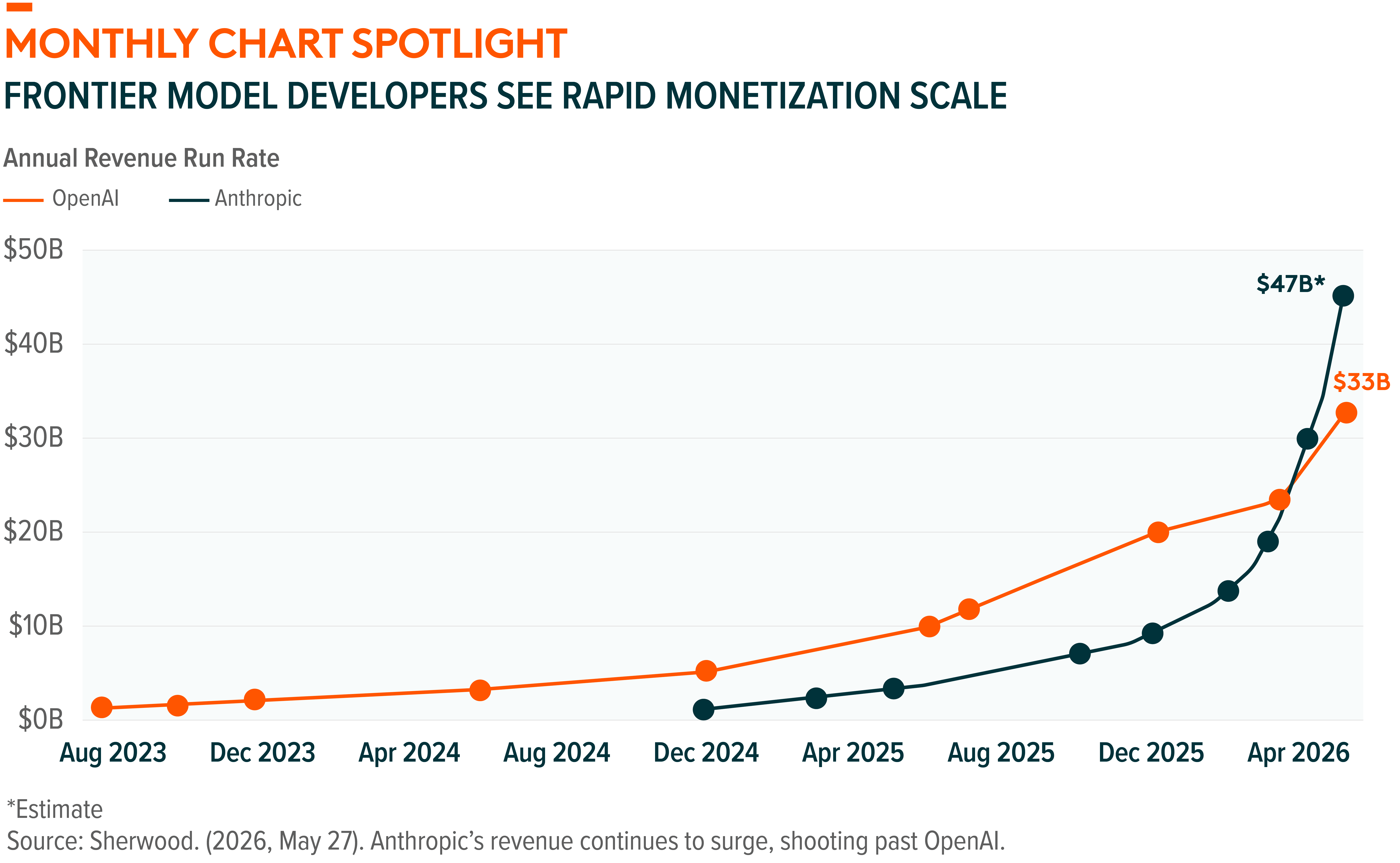
Anthropic became the world’s most valuable AI startup after raising $65 billion in a funding round that pushed its valuation to roughly $965 billion. The company reported annualized revenue of approximately $47 billion, a dramatic increase from earlier levels, driven by strong enterprise adoption of its Claude platform, coding assistants, and AI productivity tools.1 Anthropic also confidentially filed for an initial public offering (IPO), marking another milestone in its evolution from venture-backed startup into cornerstone of the AI ecosystem.2 The scale of the valuation and revenue expansion highlights how quickly leading AI firms are maturing into large-scale commercial platforms with meaningful enterprise penetration. It also signals that investors increasingly view frontier AI companies less as traditional startups and more as foundational platforms capable of reshaping large portions of the global economy.

Data Centers
Demand for AI Capacity Continues to Outpace Supply
Anthropic secured access to more than 300 megawatts of data center capacity and over 220,000 Nvidia graphics processing units (GPUs) through a major infrastructure agreement with SpaceX. The deal, which significantly expands the capacity available to support Anthropic’s rapidly growing Claude platform, highlights the enormous computing resources required to support the next generation of AI models.3 As AI developers train larger models and serve growing enterprise demand, access to compute is a key competitive advantage. More broadly, the agreement reinforces a central theme across the AI landscape: infrastructure is becoming just as important as software. The capacity buildout is expected to drive demand across the data center ecosystem, and benefit operators, power providers, cooling and networking companies, and semiconductor manufacturers.
U.S. Electrification
NextEra and Dominion Energy Unveil Merger
NextEra Energy and Dominion Energy announced a $67 billion deal that, if approved, would create the world’s largest regulated electric utility by market capitalization. The transaction comes as utilities face accelerating demand from data centers, AI infrastructure, manufacturing reshoring, and the broader electrification of transportation and industry. NextEra is known for its scale in renewable generation, grid investment, and utility execution, while Dominion offers a large, regulated utility footprint, nuclear and natural gas infrastructure, and exposure to fast-growing Mid-Atlantic electricity demand. Together, the companies would serve approximately 10 million customer accounts across some of the fastest-growing regions in the country and own roughly 110 gigawatts of generation capacity. The combined company is expected to provide greater access to capital, lower financing costs, and enhanced capabilities to deploy the infrastructure needed to support long-term load expansion.4 More broadly, the deal highlights how utilities may be positioning themselves for a future in which electricity demand grows faster than it has in decades, requiring unprecedented investment.
Defense Tech
Drones Move to the Center of Modern Warfare
The Trump administration is exploring government-backed financing for U.S. drone manufacturers as part of a broader effort to strengthen domestic defense technology capabilities. Potential support, including loans and equity investments through the Pentagon’s Office of Strategic Capital, could help emerging drone companies scale production and compete with foreign suppliers, particularly China. These efforts align with the 2026 National Defense Strategy, which highlighted drones as an area of importance for the Pentagon and emphasized the critical need to develop the domestic supply chain.5 The Pentagon’s $1.1 billion Drone Dominance initiative targets production of roughly 300,000 low-cost attack drones by 2027, with proposed spending on autonomous warfare set to expand significantly.6 Such capital commitments highlight how government funding now supports both established contractors and venture-backed startups developing next-generation autonomous capabilities.
U.S. Infrastructure
Construction Activity Stayed Strong in April
Total U.S. construction starts rose 9% month-over-month (MoM) to a seasonally adjusted annual rate of $1.33 trillion. By segment, non-residential construction led with an 18.6% increase, while nonbuilding starts rose 7%. Large-scale data center developments and energy generation projects remained key drivers, underscoring the growing investment required to support AI, cloud computing, and rising electricity demand. Notably, commercial construction surged 41.4%, fueled by a 46.1% MoM increase in office and data center projects, while several multibillion-dollar projects broke ground, including major data center campuses and advanced semiconductor facilities.7 The April data reinforces a key aspect of the U.S. infrastructure theme: meeting the demands of electrification, reindustrialization, and the digital economy will require sustained investment across power, grid, transportation, and industrial infrastructure for years to come.
Cybersecurity
AI Increases Demand for Cyber Protections
Palo Alto Networks unveiled a new AI-powered cybersecurity model called Mythos GPT, which the company says can identify software vulnerabilities at more than seven times the rate of traditional methods.8 The announcement highlights how AI is transforming the cyber landscape by enabling security teams to detect threats, analyze code, and identify vulnerabilities at unprecedented speed and scale. At the same time, it illustrates the growing complexity of the threat landscape, as malicious actors can leverage the same AI capabilities that improve defense to automate attacks and uncover weaknesses more efficiently. This paradox reinforces a key cybersecurity theme: AI is expanding the opportunity set rather than diminishing it. As organizations deploy AI applications, agents, and models across their operations, the attack surface continues to grow, creating new security challenges around data, identities, cloud environments, and AI systems themselves that can translate into increased cyber spending.
KEEP UP WITH THE LATEST THEMATIC RESEARCH FROM GLOBAL X
To learn more about the disruptive themes changing our world, read the latest research from Global X, including:
- Data Center Operators: AI’s Underappreciated Winners
- The Next Big Theme: May 2026
- AI Does Not Kill Cybersecurity, It Enhances the Opportunity
- Why a Good Theme Can Deliver the Best Defense
- Inflection Points: When Push Comes to Shove: Investing with the Return of Mercantilism
THEMATIC ETF LINEUP
To see individual ETF holdings and current performance across the Global X Thematic Suite, including information on the indexes shown, click these links:
- Disruptive Technology: Artificial Intelligence & Technology ETF (AIQ), Blockchain ETF (BKCH), Robotics & Artificial Intelligence ETF (BOTZ), Cybersecurity ETF (BUG), AI Semiconductor & Quantum ETF (CHPX), Cloud Computing ETF (CLOU), Autonomous & Electric Vehicles ETF (DRIV), Data Center & Digital Infrastructure ETF (DTCR), FinTech ETF (FINX), Video Games & Esports ETF (HERO), Space Tech ETF (ORBX), Defense Tech ETF (SHLD), Internet of Things ETF (SNSR), Social Media ETF (SOCL)
- Consumer Economy: Millennial Consumer ETF (MILN), E-Commerce ETF (EBIZ), Genomics & Biotechnology ETF (GNOM), Aging Population ETF (AGNG), HealthTech ETF (HEAL)
- Infrastructure & Environment: U.S. Infrastructure Development ETF (PAVE), ClimateTech ETF (CTEC), Renewable Energy Producers ETF (RNRG), Clean Water ETF (AQWA), Hydrogen ETF (HYDR), AgTech & Food Innovation ETF (KROP), Infrastructure Development ex-U.S. ETF (IPAV), U.S. Electrification ETF (ZAP)
- Digital Assets: Blockchain & Bitcoin Strategy ETF (BITS), Bitcoin Trend Strategy ETF (BTRN)
- Multi-Theme: Dorsey Wright Thematic ETF (GXDW)