U.S. Electrification
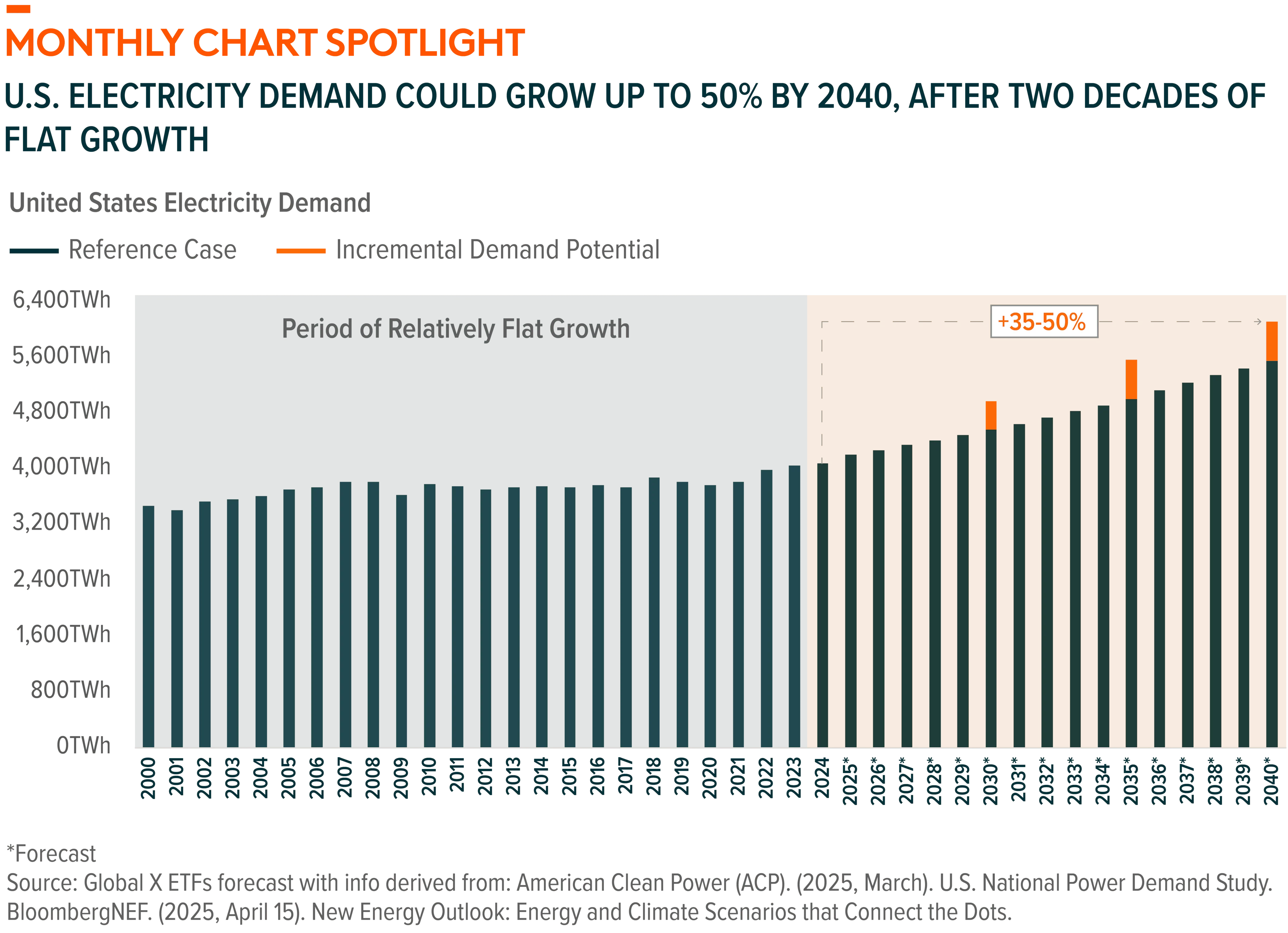
A New Electricity Age Is Underway
The International Energy Agency’s (IEA) annual report outlines how global electricity use from data centers is likely to double by 2030, with AI-centric facilities increasing their consumption by more than four times. Power is becoming the defining bottleneck for markets around the world, particularly in the United States, where the initial wave of the data center buildout is focused. The IEA also noted geopolitical tensions are driving the need for more investments into domestic power production and critical minerals, and that nuclear power is in the early stages of a potential revival. Spending on electricity supply and end-use electrification now comprises half of all global energy investment. The IEA projects capital expenditure on data centers to reach $580 billion in 2025, surpassing global oil supply investment for the first time.1 Together, these takeaways from the IEA’s report highlight the shift toward an electricity-driven economy is charging ahead.

Artificial Intelligence
AI Infrastructure Deals Keep Flowing
Anthropic, the AI startup behind the Claude model family, entered a major new alliance with Microsoft and Nvidia. The deal involves Anthropic purchasing approximately $30 billion in Azure cloud services from Microsoft, while Nvidia committed up to $10 billion and Microsoft up to $5 billion in investments. The move signals a strategic shift for Microsoft to diversify beyond its exclusive focus on OpenAI, and for Nvidia to boost demand for its AI chips beyond OpenAI-dominated usage. The deal helped push Anthropic’s valuation to roughly $350 billion.2 Nvidia also invested $2 billion in Synopsys as part of a broader multi-year partnership to combine Nvidia’s AI computing power with Synopsys’ chip-design and engineering tools. The collaboration aims to accelerate development of AI-driven design workflows, spanning semiconductor design, physical verification, simulations and digital twins, reflecting Nvidia’s intensified push into the software and design side of the AI industry.3
Defense Technology
Advances in Drone and Counter-Drone Technology Continue to Redefine Defense
In a striking demonstration of modern counter-drone capabilities, the United Kingdom’s high-power laser weapon DragonFire recently shot down drones flying over 400 mph during live trials, a first for above-horizon engagements. The success triggered a £316 million contract to deploy the system on Royal Navy destroyers as soon as 2027, five years earlier than expected. DragonFire offers a highly cost-effective alternative to missiles, with each laser shot costing roughly £10, versus hundreds of thousands of pounds per missile.4 Meanwhile, the NATO-Brave1 joint program, referred to as UNITE – Brave NATO, is launching a first-of-its-kind innovation competition aimed at rapidly scaling battlefield-tested technologies. The program committed to an initial €10 million fund for systems targeting counter-drones, secure frontline communications, and advanced air-defense.5 The combination of physical solutions like DragonFire with alliance-driven research and development via UNITE – Brave NATO signals accelerating momentum in defense tech, especially in counter-drone and broader unmanned counter capabilities.
AI Semiconductors
Alternative AI-Specific Chips Gain Steam in Evolving Semiconductor Landscape
Meta Platforms is in talks to spend billions of dollars on Google’s custom AI chips, the tensor processing units (TPUs), for deployment in Meta’s data centers starting in 2027. Negotiations also include the possibility of Meta renting Google Cloud TPUs as early as 2026. This deal would be a major strategic shift for Google, which has historically reserved TPUs for internal use. By opening them to major external customers, Google could expand its share in the rapidly growing AI infrastructure market. Google Cloud analysts suggest this move could enable Google to capture up to 10% of the revenue currently captured by other chip providers, a sign of serious commercial traction for the company’s AI-chip ambitions.6 For the broader AI ecosystem, this proposed deal underscores growing demand and momentum around alternative AI-specific chips beyond traditional offerings, highlighting how AI’s evolution continues to reshape the semiconductor landscape.
HealthTech
Pharma Giants Fast-Track Access to Weight Loss Treatments via Direct-to-Consumer Platforms
Eli Lilly and Novo Nordisk have validated the HealthTech commercial model by aggressively slashing prices for their respective weight loss drugs for self-pay patients. Through its proprietary direct-to-consumer platform, LillyDirect, Eli Lilly has reduced the cost of its 2.5 milligram (mg) Zepbound starter dose to $299 and its 5 mg dose to $399 to deliver discounted treatments directly to patients quickly. Novo Nordisk reduced its Wegovy cash-pay costs to $349 per month, with introductory offers as low as $199, via its own direct access channels.7 These moves significantly expand the total addressable market by making branded GLP-1s financially accessible to millions of uninsured Americans, effectively capturing demand that might otherwise flow to compounding pharmacies or competitors.8 Also, by utilizing a tech-enabled fulfillment channel to solve supply and constraints, it is evident that digital health platforms are no longer just support tools, but central engines for unlocking value, securing recurring revenue, and reshaping the pharmaceutical supply chain.
E-Commerce
AI Powers Record Online Black Friday and Cyber Monday Spending
U.S. consumers spent a record $11.8 billion online this Black Friday, a 9.1% jump from last year. Fueling the surge was the explosive adoption of AI-powered shopping tools, which helped buyers compare prices, generate product recommendations, and locate the best deals in real time. Traffic driven by generative-AI search tools rose more than 800% year-over-year (YoY), signaling a major shift in how consumers discover products during peak shopping events. Another trend was the continued dominance of mobile shopping. Smartphones accounted for a growing share of purchases as retailers optimized apps and checkout flows for faster, frictionless transactions. Popular categories included electronics, toys, and apparel, with significant momentum coming from early holiday promotions and deeper-than-usual online discounts. A few days later, Cyber Monday 2025 set a new record as the largest online shopping day in U.S. history, with spending climbing to $14.25 billion, a 7.1% YoY increase. These spending levels underscore how digital commerce and AI continue to reshape how Americans shop.9
KEEP UP WITH THE LATEST RESEARCH FROM GLOBAL X
To learn more about the disruptive themes changing our world, read the latest research from Global X, including:
ETF HOLDINGS AND PERFORMANCE
To see individual ETF holdings and current performance across the Global X Thematic Suite, including information on the indexes shown, click these links: